Recruiters are facing a signal-to-noise crisis as AI-powered auto-apply tools flood hiring funnels with low-quality applications. This article explains why traditional ATS screening is failing, how verification-first and conversational hiring are emerging, and what talent teams can do to identify real candidates again.


Table of Contents
- Why Application Volume Exploded Almost Overnight
- How The Signal-to-Noise Crisis is Breaking Traditional ATS Screening
- Why Verification-First Screening is Becoming Unavoidable in the Signal-to-Noise Crisis
- How Modern Recruiting Platforms Are Restoring Clarity
- Evaluating How Candidates Think, Not Just What They Say
- Hiring is Becoming More Rigorous, Not More Restrictive
- What This Means For Talent Leaders Today
The modern hiring funnel is breaking under the weight of volume. Recruiters are no longer struggling to attract applicants; they are struggling to find the right ones. The signal-to-noise crisis has emerged as one of the most pressing challenges in recruitment today, driven largely by candidate-side AI tools that can generate resumes and auto-apply to hundreds of jobs in minutes. What once looked like a healthy increase in interest has become a flood of low-quality, indistinguishable applications that obscure genuine talent.
In response, many organizations are rethinking how screening happens at the very beginning of the hiring process. Platforms such as CloudApper AI Recruiter are being used not to replace recruiters, but to restore clarity where traditional systems have failed. The focus is shifting away from static resume keywords toward conversational, verification-first approaches that help teams quickly understand who a candidate really is and whether they are worth deeper consideration.
Why Application Volume Exploded Almost Overnight
The current hiring environment did not deteriorate gradually. It changed quickly. Candidate-facing AI tools now make it trivial to tailor resumes, generate cover letters, and submit applications at scale. For job seekers, this feels like efficiency. For recruiters, it feels like noise. A single open role can attract thousands of applications, many of them generated or heavily assisted by AI, with little relevance to the actual requirements of the job.
This surge has exposed a structural weakness in most applicant tracking systems. Keyword-based filtering was designed for an era when applications were scarce and resumes reflected real experience. Today, those same filters are easily gamed. Candidates learn which terms to include, often with AI assistance, and the system surfaces resumes that look relevant on paper but fall apart under scrutiny. The result is wasted time, slower hiring cycles, and mounting frustration across recruiting teams.
How The Signal-to-Noise Crisis is Breaking Traditional ATS Screening
Most ATS platforms still rely on static signals. They scan for keywords, job titles, and years of experience, assuming these indicators correlate with capability. In the current environment, that assumption no longer holds. AI-generated resumes are fluent, well-structured, and keyword-dense, but they often lack substance. Recruiters spend hours reviewing profiles that appear qualified yet fail basic screening conversations.
This failure has consequences beyond inefficiency. Recruiter burnout is rising as teams are forced to sift through ever-growing piles of applications. Qualified candidates are delayed or missed entirely, while less suitable ones consume attention. Over time, trust erodes on both sides. Recruiters lose confidence in their tools, and candidates lose confidence in a process that feels slow and impersonal.

What makes the situation more complex is that adding more automation does not solve the problem. Faster keyword screening simply accelerates the wrong outcomes. To address the crisis, organizations must change what they measure and how they engage with candidates early on.
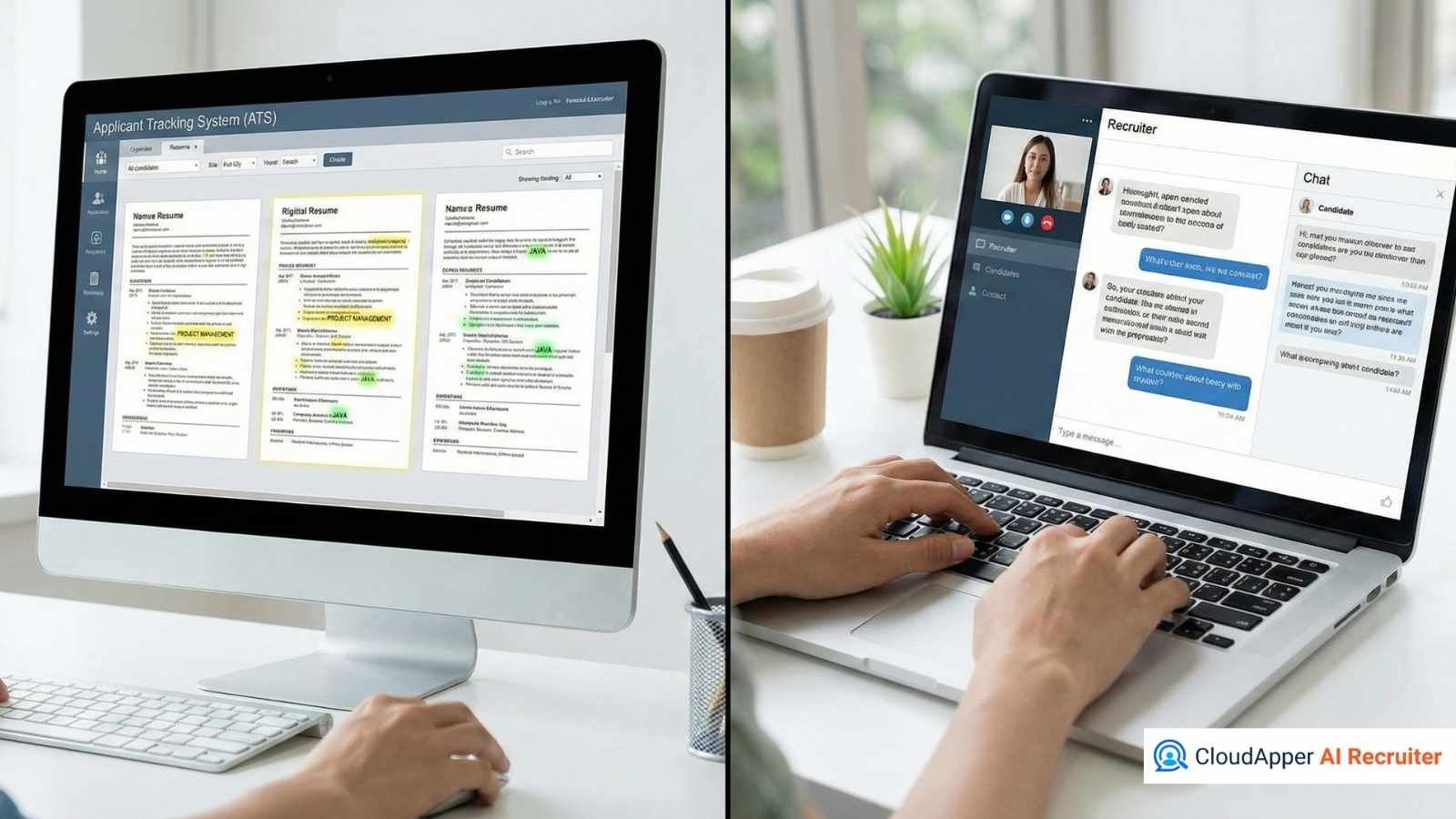
Why Verification-First Screening is Becoming Unavoidable in the Signal-to-Noise Crisis
Recruiting teams are beginning to accept that low-friction hiring funnels invite abuse. When applying is effortless, there is little incentive for candidates to be thoughtful or honest. As a result, many employers are intentionally introducing higher-friction, human-centered steps earlier in the process. This does not mean adding unnecessary bureaucracy. It means asking candidates to demonstrate real understanding, experience, and intent before they progress.
Verification-first screening focuses on proof rather than claims. Instead of asking whether a resume contains the right terms, it asks whether the candidate can explain how they have applied relevant skills in real situations. This approach filters out AI-generated noise naturally, without penalizing genuine applicants who are willing to engage.
Conversational screening plays a critical role here. By interacting with candidates in real time or near real time, recruiters gain insight into communication style, reasoning, and consistency. These signals are far harder to fabricate at scale and provide a clearer picture of fit long before interviews begin.
How Modern Recruiting Platforms Are Restoring Clarity
To be effective, verification-first hiring must still scale. High-volume environments cannot rely solely on manual effort. This is where purpose-built AI recruiting platforms differentiate themselves from legacy ATS tools. Instead of acting as passive databases, they actively engage candidates and evaluate responses in context.
One of the most immediate benefits is reduced candidate drop-off. When screening, scoring, and scheduling happen instantly, candidates are not left waiting for days or weeks. Automated reminders and follow-ups keep momentum high, while recruiters regain time to focus on meaningful conversations rather than logistics. Engagement improves not because the process is easier, but because it is clearer and more responsive.
Equally important is the ability to detect AI-assisted exaggeration during screening. Contextual analysis allows systems to move beyond surface-level claims and ask scenario-based questions tailored to a candidate’s background. When candidates are required to explain decisions, trade-offs, and outcomes, generic or fabricated answers become obvious. This approach shifts the emphasis from polished language to demonstrated understanding.
Evaluating How Candidates Think, Not Just What They Say
The rise of real-time AI assistance during interviews has added another layer of complexity. Candidates can now receive suggested answers on the fly, making traditional question-and-answer formats less reliable. In response, some hiring teams are redesigning assessments to focus on reasoning rather than recall.
Scenario-based evaluations help reveal how candidates approach problems, communicate uncertainty, and adapt when assumptions change. These assessments test consistency across responses and explore soft skills such as judgment and collaboration. Because they require active thinking, they are difficult to complete convincingly with external AI tools. Over time, this method rebuilds confidence that shortlisted candidates represent real capability, not just polished output.
This evolution reflects a broader realization within the industry. The signal-to-noise crisis cannot be solved by removing humans from hiring. It requires bringing human judgment back into the process, supported by technology that amplifies insight rather than obscuring it.

Hiring is Becoming More Rigorous, Not More Restrictive
There is a misconception that verification-first hiring creates barriers for candidates. In practice, the opposite is often true. Clear expectations and timely interaction benefit serious applicants who want their experience to be understood. When noise is reduced, qualified candidates move faster and receive more attention.
Recruiters also benefit from regained trust in their systems. When early screening surfaces fewer but higher-quality profiles, teams can invest energy where it matters. Decision-making improves, time-to-hire stabilizes, and the hiring experience becomes more consistent across roles and locations.
As organizations look ahead, many see the signal-to-noise crisis as a forcing function. It is pushing the industry to confront outdated assumptions and adopt tools designed for an AI-saturated world. The future of recruiting will likely be defined by balance: automation where it adds speed, and human-centered evaluation where it adds meaning.
What This Means For Talent Leaders Today
For HR and talent acquisition leaders, the takeaway is not to fear AI but to use it more thoughtfully. Candidate-side automation is not going away. The organizations that succeed will be those that adapt their processes to prioritize authenticity, proof, and engagement from the start.
This shift requires investment, not just in technology, but in mindset. Screening is no longer about sorting resumes. It is about understanding people. Platforms that enable conversational interaction, contextual evaluation, and real-time engagement offer a path forward that aligns with how candidates actually behave today.
In that sense, the signal-to-noise crisis is less a threat than an opportunity. It is an opportunity to rebuild hiring systems around trust, clarity, and genuine connection, supported by AI that works with recruiters rather than against them.
What is CloudApper AI Platform?
CloudApper AI is an advanced platform that enables organizations to integrate AI into their existing enterprise systems effortlessly, without the need for technical expertise, costly development, or upgrading the underlying infrastructure. By transforming legacy systems into AI-capable solutions, CloudApper allows companies to harness the power of Generative AI quickly and efficiently. This approach has been successfully implemented with leading systems like UKG, Workday, Oracle, Paradox, Amazon AWS Bedrock and can be applied across various industries, helping businesses enhance productivity, automate processes, and gain deeper insights without the usual complexities. With CloudApper AI, you can start experiencing the transformative benefits of AI today. Learn More
- Useful Links:
- Agentic AI
- No-Code/Low-Code
- Custom Software
- HCM Personalization
- iPaaS
- FedRAMP
CloudApper AI Solutions for HR

- Works with








- and more.
Similar Posts

How to Stop Losing Shortlisted Candidates During a Hiring Surge…

Recording Candidate Video Interviews in Illinois: Consent, Retention, and Deletion…