Recruiters are overwhelmed by application volume and losing top talent to slower competitors. This article explains how AI candidate ranking works, why it matters, and how automated scoring and ranking help teams prioritize the right candidates faster and more consistently.
TL;DR
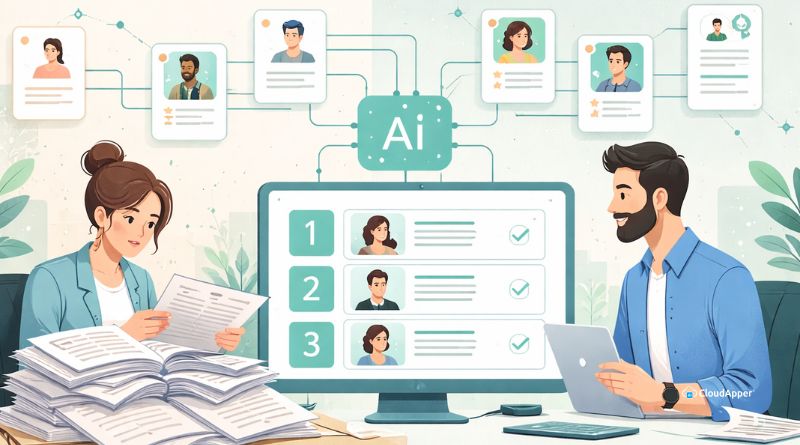
- What it is: AI candidate ranking automatically orders applicants by relevance so recruiters know exactly who to interview first.
- How it works: AI analyzes skills, experience, responses, and role-specific weights to score and rank candidates consistently.
- Why it matters: It cuts shortlisting time by up to 97% and prevents strong candidates from being buried in high-volume pipelines.
- Bias reduction: Rankings are based on defined job criteria, not gut feeling, helping minimize unconscious bias.
- Real-world impact: Tools like CloudApper AI Recruiter deliver ranked shortlists with clear reasoning in minutes, not days.
Table of Contents
- What Is Candidate Ranking in Recruitment?
- Manual vs. Automated Candidate Ranking Methods
- How AI Candidate Ranking Works: The Technology Behind It
- How Candidate Ranking Looks with CloudApper AI Recruiter
- Candidate Ranking vs. Candidate Scoring: What’s the Difference?
- Key Benefits of AI Candidate Ranking
- How to Implement Candidate Ranking in Your Recruitment Process
- Transform Your Hiring with AI Candidate Ranking
I recently spoke with a talent acquisition leader at a growing tech company. She was drowning in applications. “We posted a software engineer role and got 347 applications in three days,” she told me, exhausted. “I spent two full days just trying to figure out which candidates to interview first. By the time I reached out to my top picks, half of them had already accepted offers elsewhere.” This is the reality for most recruiters today. You’re not just competing to attract candidates. You’re racing against time to identify and contact the best ones before your competitors do. This is where AI candidate ranking changes everything.

Instead of spending days manually sorting through hundreds of resumes, AI analyzes every application, scores each candidate based on your specific requirements, and creates a prioritized list showing you exactly who to interview first. Tools like CloudApper AI Recruiter take this even further by automating the entire process from application to ranked shortlist in just minutes.
Let me show you how candidate ranking works, why it matters for your hiring process, and how you can implement it to hire faster and smarter.
What Is Candidate Ranking in Recruitment?
Candidate ranking is the process of ordering your applicants from most qualified to least qualified based on how well they match your job requirements. Think of it as creating a priority list that tells you exactly which candidates deserve your attention first. Instead of treating all 200 applications equally or defaulting to whoever applied first, you’re making strategic decisions about who gets interviewed based on actual qualifications and fit.
Here’s why this matters so much. You probably have limited interview slots. Maybe you can realistically interview 10 people for a role before you need to make a decision. Without ranking, you might interview the first 10 people who applied, potentially missing incredible candidates who submitted their applications on day three. Or you might use gut feeling to decide who seems promising, which introduces all kinds of unconscious bias and inconsistency into your process.
Manual vs. Automated Candidate Ranking Methods
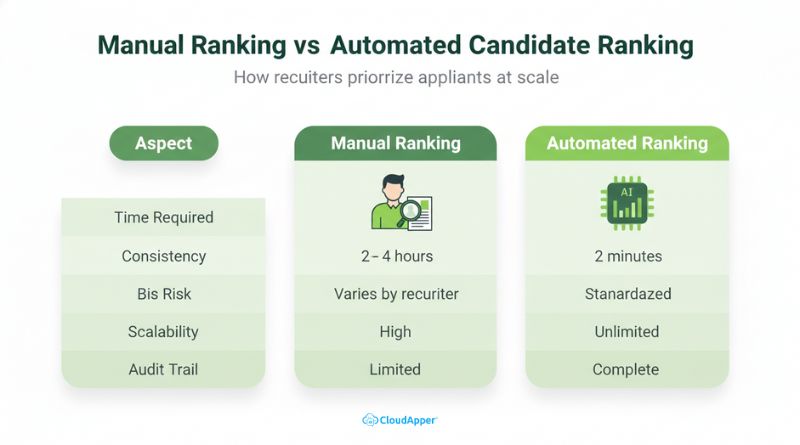
Traditional manual ranking involves reading through each resume and mentally sorting candidates into “definitely interview,” “maybe,” and “no” categories. For a pool of around 50 candidates, this process typically takes two to four hours. The drawbacks become apparent quickly. Decisions can vary from one recruiter to another, unconscious bias can influence who stands out, and fatigue often affects how later resumes are evaluated. Manual ranking also does not scale well. As application volume grows, it becomes increasingly difficult to review every candidate consistently, and there is no clear audit trail showing why certain candidates were prioritized over others.
Automated candidate ranking approaches the problem differently. Instead of reviewing resumes one by one, AI evaluates all applicants at the same time using the same criteria for everyone. A ranked shortlist can be generated in minutes, with standardized results that remain consistent regardless of volume. Bias risk is reduced by focusing on defined qualifications rather than subjective impressions, and scalability is no longer a constraint. Each ranking decision is documented, creating a transparent record that supports compliance and accountability. For many roles, especially high-volume ones, automated ranking is the only practical way to prioritize candidates efficiently without losing consistency or clarity.
How AI Candidate Ranking Works: The Technology Behind It
Multi-Factor Analysis
AI evaluates candidates across multiple dimensions simultaneously:
- Skills matching: Compares required competencies against demonstrated abilities in resumes and responses
- Experience relevance: Considers years worked and whether that experience directly relates to your needs
- Education fit: Evaluates degrees, certifications, and specialized training
- Cultural indicators: Analyzes work style and values alignment from application responses
- Job stability: Reviews tenure patterns and career trajectory
- Location and logistics: Considers commute feasibility or relocation willingness
Scoring and Weighting
Each factor receives a numerical score, typically 0 to 100. Not everything matters equally for every role, so weighting comes in. For a senior engineer position, you might weight technical skills at 40%, relevant experience at 35%, education at 15%, and other factors at 10%. The AI multiplies each factor score by its weight, then combines everything into an overall candidate score.

Comparative Ranking Algorithms
The AI looks at the entire applicant pool and identifies who stands out relative to everyone else. Maybe 10 candidates all have five years of experience, but three have experience in your specific industry, while the others don’t. Those three get ranked higher even though their raw years of experience are identical.
Multi-Agent AI Approach
The most sophisticated systems, like CloudApper AI Recruiter, use multiple specialized AI agents working together. A screening agent identifies qualifications from resumes. An assessment agent evaluates candidate responses and communication quality. An analytics agent compares candidates across your pool. Each agent focuses on what it does best, and then they collaborate to produce more accurate rankings than any single model could achieve.
How Candidate Ranking Looks with CloudApper AI Recruiter
Instant Mobile Application
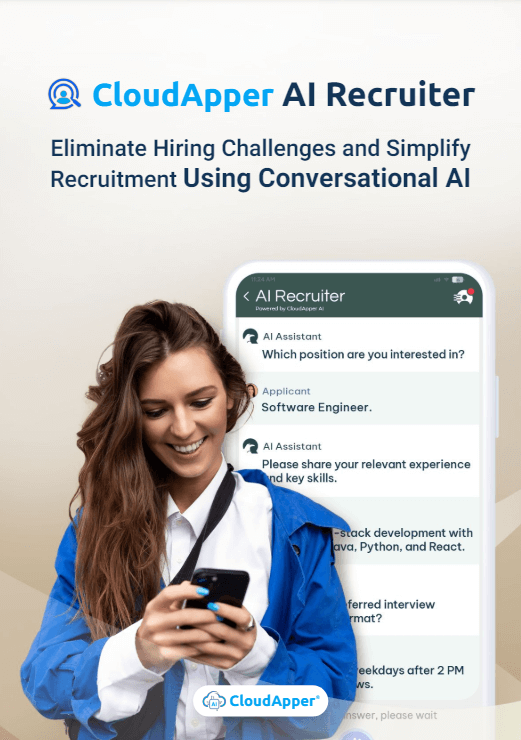
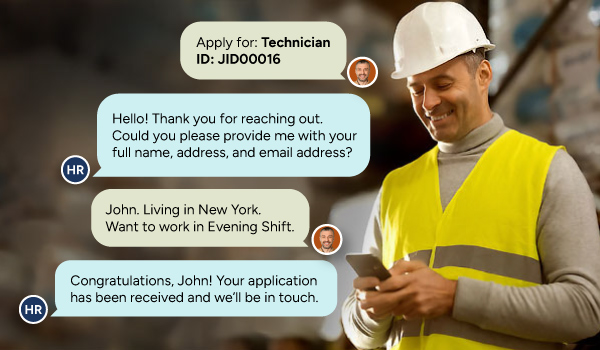
A candidate sees your job posting and scans a QR code with their phone. No app download required, no creating an account, no friction. The conversational AI chatbot welcomes them and asks them to share their resume directly in the chat.
Intelligent Pre-Screening Questions
The AI parses the resume in real time and generates personalized pre-screening questions based on what’s in this specific candidate’s resume and the role requirements. If the resume shows Python experience and your job requires it, the chatbot asks about a recent project. If customer service skills are critical, it asks about handling difficult situations. The questions adapt to each person.
Comprehensive Scoring
The screening agent combines everything: resume qualifications, quality of pre-screening responses, experience level, and educational background. Each factor gets weighted according to what you decided matters most for this role.
Automated Ranking with Reasoning
The analytics agent ranks all candidates relative to each other and provides notes explaining each person’s position. You open your recruiter dashboard and see: “Candidate ranked #1: 8 years of relevant experience, strong technical skills demonstrated in screening responses, excellent communication, holds required certification.”
These AI-generated notes help you understand why each person ranked where they did, what their strengths are, and where they might have gaps. The entire process from QR code scan to ranked shortlist takes about two minutes per candidate, reducing your time to hire by 97%.
See what candidate ranking looks like when screening, scoring, and prioritization happen automatically in minutes.
Candidate Ranking vs. Candidate Scoring: What’s the Difference?
Many people confuse these terms, but they’re different concepts that work together.
| Aspect | Candidate Scoring | Candidate Ranking |
| Type | Absolute assessment | Comparative assessment |
| Output | Numerical value (e.g., 85/100) | Position in list (e.g., #3 of 47) |
| Evaluation | Independent of other candidates | Relative to the entire pool |
| Purpose | Shows qualification level | Shows interview priority |
| Example | Candidate A scores 85/100 | Candidate A ranks #3 |
Here’s a practical example. Candidate A scores 85 with incredibly strong technical skills but less leadership experience. Candidate B scores 83 with a strong leadership background but slightly less technical depth. For an individual contributor role, Candidate A ranks higher. For a team lead position, Candidate B jumps ahead despite the lower score because leadership matters more for that role.
Both scoring and ranking matter in your process. Scores tell you the qualification level. Rankings tell you who to prioritize when you can’t interview everyone.
Key Benefits of AI Candidate Ranking
Dramatically Faster Shortlisting
You go from spending two to four hours ranking 50 candidates manually to getting results in two minutes. That’s a 97% reduction in time spent. For high-volume recruiting, this is the difference between making offers before competitors even finish reviewing applications.
Reduced Unconscious Bias
AI focuses on the skills and qualifications you defined as important. It’s blind to names, photos, ages, and all the other factors that unconsciously influence human judgment. Research-backed systems like CloudApper actively work to minimize both human and algorithmic bias.
Better Quality of Hire
Data-driven decisions consistently beat gut feelings. You’re never missing strong candidates buried in the pile. The AI identifies non-obvious fits, people who might not have the traditional background you’d expect but who actually have all the skills that predict success.
Improved Candidate Experience
When you rank and respond to applications quickly, candidates hear back from you in hours instead of days or weeks. Top talent doesn’t abandon your process out of frustration. This improves your employer brand, increases offer acceptance rates, and enhances the candidate experience.
Unlimited Scalability
Whether you get 10 applications or 1,000, the AI handles it the same way. You can maintain consistent quality during seasonal hiring surges without bringing in temporary recruiting staff.
Compliance and Defensibility
Every ranking decision has an audit trail showing exactly why each candidate landed in their position. This is critical for EEOC compliance and defending your hiring decisions if questioned.
How to Implement Candidate Ranking in Your Recruitment Process
Implementing candidate ranking successfully requires a systematic approach that aligns your technology, processes, and team. The goal is to make ranking a natural part of your workflow rather than an added burden that creates friction.
- Define your ranking criteria clearly: Identify must-have qualifications versus nice-to-haves for each role. Determine which skills matter most for success and assign importance weights to each factor. Get hiring manager input on priorities and document criteria for consistency across similar roles.
- Select the right AI candidate ranking tools: Look for systems that integrate with your existing ATS and HCM rather than requiring full platform replacement. Choose enhancement layers like CloudApper AI Recruiter that sit on top of current systems. It integrates with all major ATS and HCM platforms like UKG, Workday, Bullhorn, Greenhouse, Lever, Oracle, etc.
- Configure and test thoroughly before rolling out: Set up role-specific templates for common positions in your organization. Test the system with historical candidates to validate that rankings match what your best recruiters would have decided. Adjust weights and criteria based on test results to ensure accuracy from day one.
- Train your team on interpretation and override protocols: Show recruiters how to interpret ranking results and understand the reasoning behind each position. Explain when to override AI recommendations based on context that the system might miss. Teach how to explain rankings to hiring managers and emphasize that AI is a decision support tool that enhances judgment rather than replacing it.
- Integrate rankings with your interview workflow seamlessly: Set top-ranked candidates to receive interview invitations first and automate scheduling for highest-priority applicants. Track which ranked positions accept offers and succeed in their roles, then feed outcomes back to improve future rankings and refine your criteria over time.
Transform Your Hiring with AI Candidate Ranking
Candidate ranking solves one of recruitment’s hardest problems: figuring out who deserves your limited time when you have far more applicants than interview slots. AI makes this process faster, more consistent, and less biased than manual methods. You get better hires because you never miss strong candidates buried in the pile. You fill positions faster because you contact top talent immediately instead of days later.
Ready to see how AI candidate ranking can transform your recruitment process? CloudApper AI Recruiter uses specialized AI agents to screen, score, and rank candidates in minutes instead of hours. Our multi-agent system integrates seamlessly with your existing ATS, adding powerful ranking intelligence without disrupting your workflow. Stop losing top talent to competitors who move faster and start making better hiring decisions based on data.
Hiring faster does not mean lowering standards. It means prioritizing the right candidates sooner.

What is CloudApper AI Platform?
CloudApper AI is an advanced platform that enables organizations to integrate AI into their existing enterprise systems effortlessly, without the need for technical expertise, costly development, or upgrading the underlying infrastructure. By transforming legacy systems into AI-capable solutions, CloudApper allows companies to harness the power of Generative AI quickly and efficiently. This approach has been successfully implemented with leading systems like UKG, Workday, Oracle, Paradox, Amazon AWS Bedrock and can be applied across various industries, helping businesses enhance productivity, automate processes, and gain deeper insights without the usual complexities. With CloudApper AI, you can start experiencing the transformative benefits of AI today. Learn More
- Useful Links:
- Agentic AI
- No-Code/Low-Code
- Custom Software
- HCM Personalization
- iPaaS
- FedRAMP
CloudApper AI Solutions for HR

- Works with







- and more.
Similar Posts

Recruiter Handover: What Happens to Candidates When a Recruiter Leaves

Hiring During ATS Migration: How to Keep Your First Round…