Candidate pipeline management at high volume is a throughput problem, not a tracking problem. A comparison of three approaches, the ROI arithmetic against SHRM's $5,475 cost-per-hire benchmark, and the four metrics worth tracking instead of stage counts.

Table of Contents
- What Is Candidate Pipeline Management?
- Your ATS Tracks the Pipeline. It Does Not Move It.
- Three Ways Teams Manage a High-Volume Pipeline, Compared
- What Fixing the Pipeline Is Actually Worth
- What This Looks Like in Practice
- How CloudApper AI Recruiter Fits a Pipeline You Already Have
- Frequently Asked Questions
What Is Candidate Pipeline Management?
Candidate pipeline management is the practice of controlling how applicants move from application to offer — how they enter, how they are screened and ranked, and how quickly they progress. In high-volume hiring it is a throughput problem, not a tracking problem: the goal is keeping qualified people moving before they accept another offer.
Your ATS Tracks the Pipeline. It Does Not Move It.
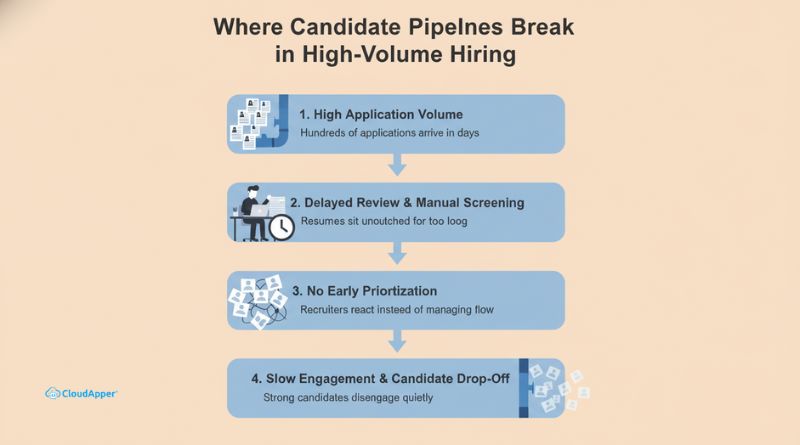
Every high-volume team already has a pipeline. The applications arrive, the stages exist, the dashboard is accurate. And still the roles stay open.

That gap is measurable. SHRM’s 2025 benchmarking survey put non-executive cost per hire at $5,475, and found that screening and interviewing each average 8–9 days on their own. For a team running 300 hires a year, the screening stage alone consumes more than two calendar weeks per requisition — while the candidate is still holding three other applications.
The same survey found only 20% of organizations measure quality of hire at all. So most pipelines are optimized for the metric that is easy to see — how many candidates sit in each stage — rather than the two that determine whether hiring works: how fast people move, and whether the right ones survive.
A pipeline that is tracked but not moved has a specific signature. See whether you recognize it:
- Applications arrive faster than anyone can read them, so review order becomes arrival order
- Screening happens in batches when a recruiter has an afternoon free, not when the candidate applies
- Prioritization is redone from scratch each week instead of updating continuously
- The strongest candidates disappear first, because they are the ones with other options
None of that is a recruiter performance problem. It is what happens when the system of record holds the pipeline and humans have to supply all the motion.
Three Ways Teams Manage a High-Volume Pipeline, Compared
| Manual / spreadsheet | ATS stages only | ATS + AI screening layer | |
|---|---|---|---|
| Review order | Arrival order | Arrival order, filtered by keyword | Ranked by fit against the requisition |
| Time to first response | Days | Days | Minutes, at any hour |
| Screening consistency | Varies by recruiter and by fatigue | Varies by recruiter | Identical questions, every applicant, timestamped |
| Prioritization | Redone manually each week | Static filters set at posting | Continuous — re-ranks as candidates respond |
| Drop-off exposure | Highest | High | Reduced; candidates finish on a phone |
| Audit trail | Email and memory | Stage history | Full transcript per candidate |
| Breaks at | ~50 applicants per req | ~200 applicants per req | Scales with volume |
| Recruiter role | Doing the sorting | Managing the tool | Judging the shortlist |
The honest read: an ATS is not the problem, and replacing it is not the fix. Rows one to five are all motion — work that happens between the stages your ATS records. That work has to live somewhere. Today it lives in your recruiters’ calendars.
What Fixing the Pipeline Is Actually Worth
There is no universal ROI number, so here is the arithmetic instead. Run it with your figures.
Take a team hiring 300 people a year at SHRM’s $5,475 benchmark — a $1.64M annual recruiting spend.
| Lever | Conservative assumption | Annual effect |
|---|---|---|
| Screening days removed per requisition | 8 days → 2 days | 6 days faster per hire |
| Agency or overtime cover avoided while roles sit open | 5% of spend | ~$82,000 |
| Recruiter hours returned from manual sorting | 6 hrs/week × 4 recruiters | ~1,250 hours |
| Reduction in drop-off before first response | 15% more applicants reach screening | ~45 additional qualified candidates |
The number that matters most is not in the table. It is the offer you did not lose. In high-volume hiring the winning retailer, carrier, or health system is usually not the one with the best offer — it is the one that responded first. Every day of screening latency is a day your competitor gets to make that call instead.
What to measure instead of stage counts
- Time to first meaningful response — application received to a real screening interaction, in hours
- Screen-to-interview ratio — is your ranking actually surfacing better candidates?
- Drop-off by stage — where applicants abandon, not just how many sit in each bucket
- Quality of hire at 90 days — the metric 80% of organizations skip
What This Looks Like in Practice
A fast-growing software company came to CloudApper with the classic high-volume signature: manual resume screening, a recruiting team underwater, and strong candidates lost to a slower process rather than a worse offer.
After moving screening into an AI layer on top of their existing system of record, time to hire fell by 50%. Screening ran on the candidate’s schedule instead of the recruiter’s, personal identifiers were stripped from early review, and the team’s own reported effect was that recruiters went back to judging shortlists rather than assembling them.
For customer security reasons, we cannot disclose the customer’s name.
How CloudApper AI Recruiter Fits a Pipeline You Already Have
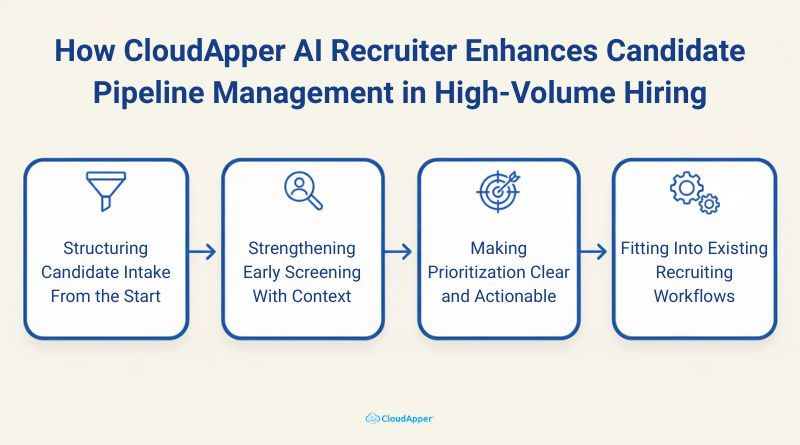
Your ATS or HCM holds the pipeline. It records that an application arrived, that a stage advanced, that an offer went out. It was never built to do the work between those events — read 400 applications the night they land, rank them against the requisition, ask every candidate the same qualifying questions, and put a shortlist in front of a recruiter by morning.
CloudApper AI Recruiter sits on top of the system you already run and does that work. Applications get a conversational screen candidates finish on a phone. Ranking updates continuously as people respond. Every applicant is asked the same structured questions, with a timestamped record. Interviews get scheduled while the candidate is still engaged. Your ATS stays the system of record — the motion moves. The same pattern applies at the top of the funnel in AI resume screening, in better pre-screening to reduce unqualified applicants, and downstream in recruitment analytics. If you are still scoping the category, start with what an AI recruiter actually does.
That is the difference between a pipeline you can see and a pipeline that moves.
See how high-volume teams run screening inside the ATS they already use.
Frequently Asked Questions
What is candidate pipeline management in high-volume hiring?
It is the practice of controlling how applicants move from application to offer at scale — how they enter, how they are screened and ranked, and how quickly they progress. At high volume it becomes a throughput problem rather than a record-keeping one, because the constraint is how fast qualified candidates move, not whether their status is stored.
Why do candidate pipelines break down at high volume?
Because the work between stages is manual. Applications arrive faster than anyone can read them, so review defaults to arrival order; screening happens in batches rather than on arrival; and prioritization is rebuilt by hand each week. SHRM’s 2025 benchmarking survey found screening and interviewing each average 8 to 9 days, which is time the strongest candidates spend considering other offers.
What metrics should I track for candidate pipeline management?
Track time to first meaningful response in hours, screen-to-interview ratio, drop-off by stage, and quality of hire at 90 days. Stage counts describe the pipeline but do not tell you whether it is moving. SHRM found only 20% of organizations measure quality of hire, which is the metric that reveals whether faster hiring is also better hiring.
Do I need to replace my ATS to fix pipeline management?
No. The problem is usually not the system of record but the manual work between its stages — screening, ranking, follow-up, and scheduling. An AI screening layer on top of an existing ATS or HCM addresses that motion while leaving the ATS as the system of record, which avoids a migration and keeps reporting intact.
How does AI improve candidate pipeline management?
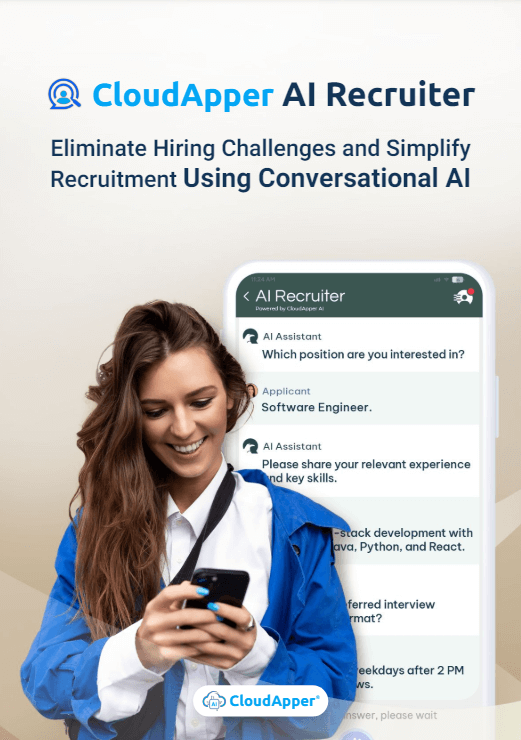
It removes the latency between an application arriving and a qualified candidate being reached. Conversational screening runs at any hour and candidates complete it on a phone, ranking updates continuously as candidates respond, every applicant is asked the same structured questions with a timestamped record, and interviews are scheduled while interest is still high.
How quickly can pipeline improvements show results?
Faster than most hiring changes, because the gains come from removing wait time rather than changing headcount. In CloudApper’s published deployment with a fast-growing software company, time to hire fell by 50%. The realistic first signal is time to first response, which typically moves within the first hiring cycle.
CloudApper is the process layer that closes the gaps enterprise software can’t — across HR, ERP, CRM, and beyond, on any platform, in weeks not quarters. Because the teams that fill roles fastest are not the ones with the biggest recruiting budgets. They are the ones that stopped waiting for their system of record to do the work.

What is CloudApper AI Platform?
CloudApper AI is an advanced platform that enables organizations to integrate AI into their existing enterprise systems effortlessly, without the need for technical expertise, costly development, or upgrading the underlying infrastructure. By transforming legacy systems into AI-capable solutions, CloudApper allows companies to harness the power of Generative AI quickly and efficiently. This approach has been successfully implemented with leading systems like UKG, Workday, Oracle, Paradox, Amazon AWS Bedrock and can be applied across various industries, helping businesses enhance productivity, automate processes, and gain deeper insights without the usual complexities. With CloudApper AI, you can start experiencing the transformative benefits of AI today. Learn More
- Useful Links:
- Agentic AI
- No-Code/Low-Code
- Custom Software
- HCM Personalization
- iPaaS
- FedRAMP
CloudApper AI Solutions for HR


- Works with








- and more.
Similar Posts

How to Reduce Interview Rounds Without Lowering Your Hiring Standards

How to Stop Losing Shortlisted Candidates During a Hiring Surge…