High-volume hourly hiring is breaking as labor shortages, screening overload, and compliance pressure expose systems that weren’t built to scale.
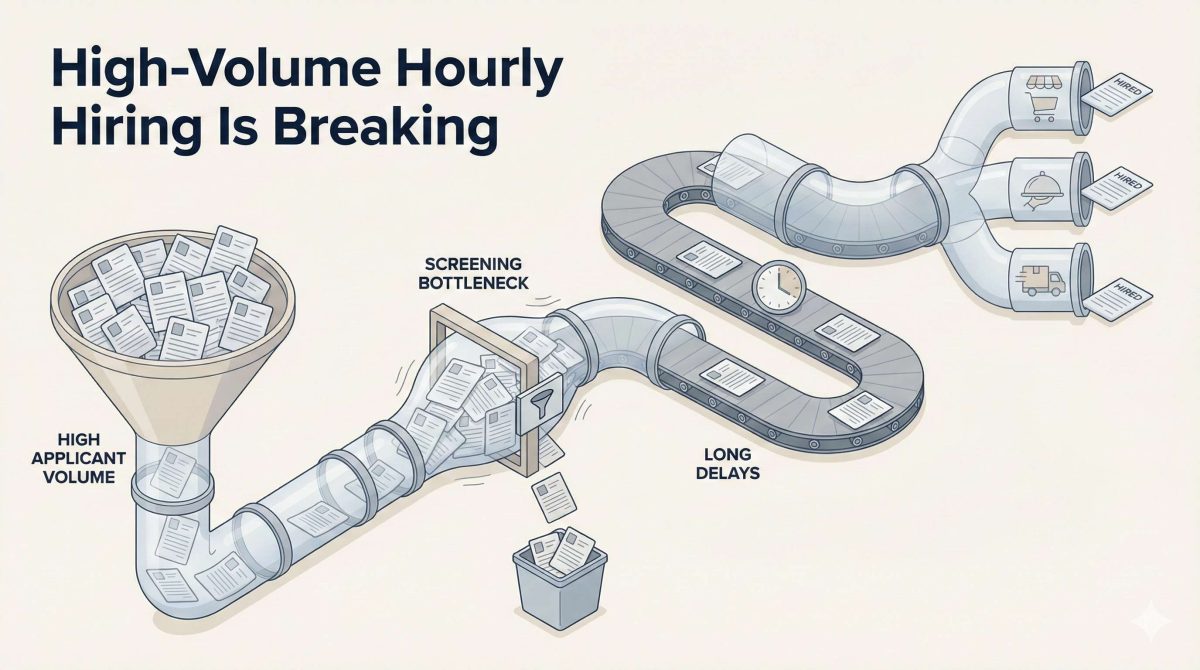
Table of Contents
- What High-Volume Hourly Hiring Really Looks Like
- Why Immigrant Labor Reductions Tighten Hourly Hiring First
- Where Screening Breaks Down at Scale
- Compliance Becomes Harder When Volume Outpaces Process
- Candidate Experience Suffers Most for Deskless Workers
- Why Traditional Hiring Models Don’t Hold Up
- How AI Can Support High-Volume Hourly Hiring Without Replacing Humans
- Who Feels the Breakdown Most
- The Real Problem Isn’t Volume — It’s Fragility
- Frequently Asked Questions
High-volume hourly hiring has always been challenging. But what teams are experiencing now isn’t just pressure—it’s structural breakdown.
Across retail, hospitality, logistics, and other deskless industries, hiring teams are struggling to keep up with demand even when roles are clearly defined and budgets are approved. Screening backlogs grow. Compliance becomes harder to maintain. Candidate experience deteriorates. And the harder teams push, the more fragile the process becomes.

This isn’t a talent acquisition effort problem. It’s a system problem.
To understand what’s breaking high-volume hourly hiring today, you have to look at how labor supply, screening models, and deskless hiring realities collide under volume.
What High-Volume Hourly Hiring Really Looks Like
High-volume hourly hiring refers to recruiting large numbers of hourly workers in short timeframes, often with high turnover and recurring demand. These roles are typically deskless, frontline, and operationally critical.
Unlike salaried hiring, success here depends on speed, consistency, and scale. Candidates expect quick responses. Hiring managers need roles filled immediately. And recruiters are expected to move hundreds—or thousands—of applicants through screening without sacrificing fairness or compliance.
The margin for error is small, and the tolerance for delay is even smaller.
Why Immigrant Labor Reductions Tighten Hourly Hiring First
One of the most under-discussed forces affecting high-volume hourly hiring is immigrant labor reductions.
Hourly and frontline roles have historically relied more heavily on immigrant labor than many white-collar positions. When that labor supply tightens, the impact shows up first in roles that already face high churn, seasonal spikes, and geographic constraints.
For hiring teams, this means fewer available candidates just as demand remains constant—or increases. Time-to-fill stretches. Recruiters feel pressure to move faster. And processes that were barely holding together under normal volume begin to crack. AI recruiting solutions can really help face serious frontline hiring challenges.
The issue isn’t just fewer applicants. It’s less room for error in how candidates are screened, engaged, and moved forward.
Where Screening Breaks Down at Scale
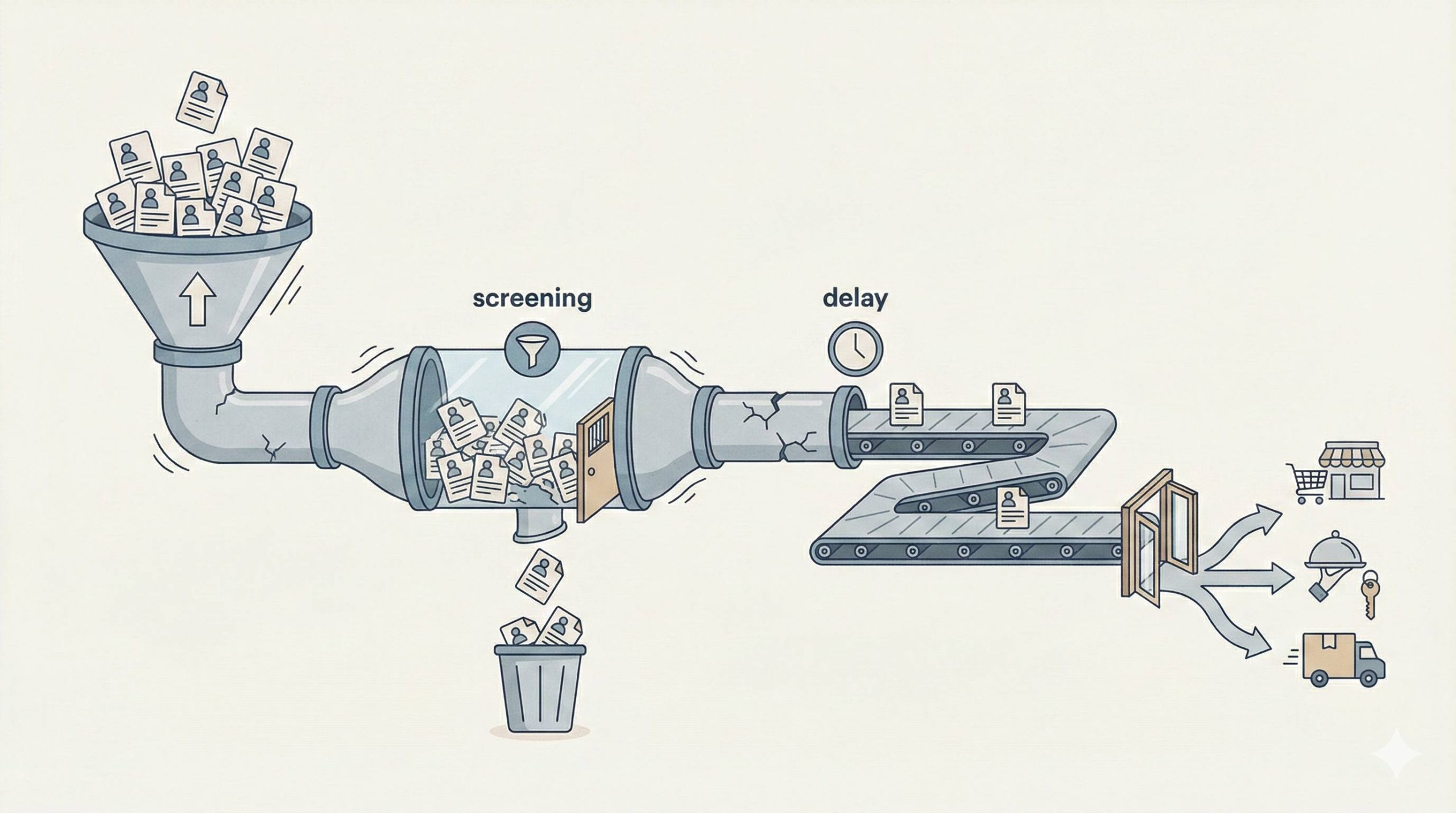
Screening is often the first major failure point in high-volume hourly hiring.
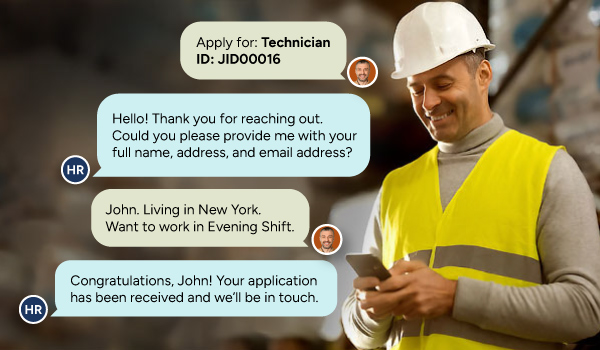
Most screening models were designed for lower volume, resume-centric workflows. But hourly candidates frequently don’t have traditional resumes, apply from mobile devices, or expect fast, conversational interactions hence recruiters have to do screening at scale.
When volume surges, recruiters are forced to choose between speed and rigor. Manual screening becomes inconsistent. Documentation falls behind. Decisions get harder to explain after the fact.
At scale, this creates three compounding problems:
- Qualified candidates are missed or delayed
- Unqualified candidates move forward due to rushed reviews
- Compliance risk increases as consistency erodes
Screening doesn’t just slow hiring down—it introduces risk when it can’t keep up.
High-volume hiring doesn’t fail because teams aren’t working hard enough
it fails because the system can’t flex under pressure
High-volume hiring doesn’t fail because teams aren’t working hard enough
it fails because the system can’t flex under pressure
Compliance Becomes Harder When Volume Outpaces Process
In high-volume hourly hiring, compliance often breaks quietly.
When teams are overwhelmed, shortcuts appear. Criteria are applied unevenly. Decision rationale isn’t documented consistently. And audit readiness becomes an afterthought rather than a built-in safeguard.
This is especially risky in deskless environments, where hiring decisions must often be explained without the paper trail common in salaried roles. The faster hiring needs to move, the more important it becomes that screening decisions are consistent, explainable, and traceable.
When volume outpaces process, compliance doesn’t fail loudly—it weakens gradually, until the risk becomes unavoidable.
Candidate Experience Suffers Most for Deskless Workers
Deskless candidates feel hiring friction more acutely than any other group.
They apply from phones, often between shifts or personal responsibilities. They can’t wait days for responses or navigate long forms. When communication stalls or processes feel complicated, they move on quickly.
In high-volume hourly hiring, poor candidate experience doesn’t just hurt employer brand—it directly reduces the available labor pool. Drop-off rates climb at the exact moment teams can least afford them.
The irony is that many of these issues aren’t about compensation or job fit. They’re about speed, clarity, and follow-through.
Why Traditional Hiring Models Don’t Hold Up
Traditional hiring workflows assume time, stability, and recruiter bandwidth. High-volume hourly hiring offers none of those.
Applicant tracking systems designed for salaried roles struggle with rapid throughput. RPO models alone can’t absorb constant volume spikes without automation support. And adding more recruiters doesn’t fix a process that wasn’t built to scale.
What breaks isn’t effort—it’s architecture.
High-volume hourly hiring requires workflows that adapt to volume, not ones that collapse under it.
How AI Can Support High-Volume Hourly Hiring Without Replacing Humans
The most effective responses to these challenges don’t remove recruiters from the process—they remove the bottlenecks around them.
AI-assisted screening, when designed responsibly, can help hiring teams handle volume by standardizing initial qualification, accelerating responses, and reducing manual workload—while keeping humans in control of decisions.
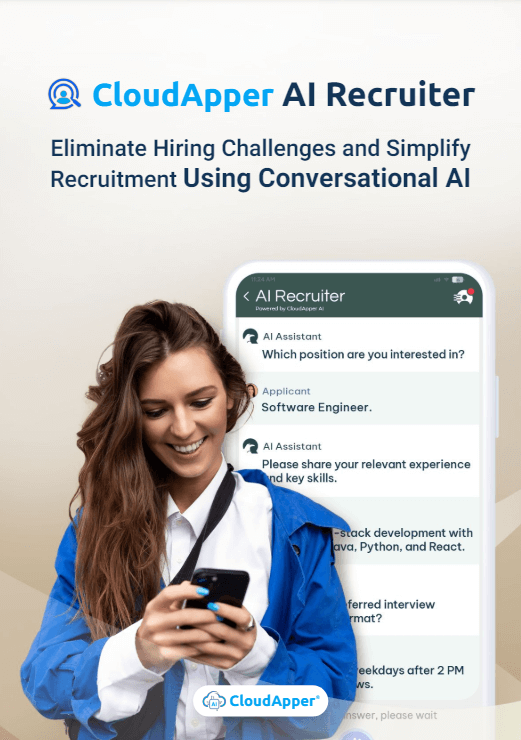
Many organizations use CloudApper AI Recruiter to support high-volume hourly hiring by automating repetitive screening and candidate engagement tasks, while ensuring decisions remain transparent and recruiter-led.
When AI is used to reduce busywork rather than automate judgment, it strengthens the hiring process instead of undermining it.
Who Feels the Breakdown Most
The cracks in high-volume hourly hiring are most visible in:
- Retail, where seasonal demand and turnover collide
- Hospitality, where speed directly affects operations
- Logistics, where volume and compliance pressures intersect
- SMBs, where limited recruiting resources amplify every inefficiency
For these teams, hiring isn’t a background function. It’s operational survival.
The Real Problem Isn’t Volume — It’s Fragility
High-volume hourly hiring doesn’t fail because teams aren’t trying hard enough. It fails because the system wasn’t designed for sustained pressure from constrained labor supply, screening overload, and deskless realities.
Immigrant labor reductions tighten the funnel. Volume exposes weak processes. And traditional models can’t flex fast enough to keep up.
Sustainable high-volume hourly hiring requires systems that are scalable, explainable, and built for how frontline workers actually apply and engage.
Until that shift happens, hiring teams will keep fighting the same fires—just faster, and with more risk.
Frequently Asked Questions
Why is high-volume hourly hiring breaking down?
High-volume hourly hiring breaks down when labor supply tightens and screening processes cannot scale consistently. Volume exposes weaknesses in speed, compliance, and candidate experience that systems built for abundant labor struggle to absorb.
Why are hourly and frontline roles affected first?
Hourly and frontline roles depend more heavily on immediate labor availability and fast hiring cycles. When supply tightens, these roles feel the impact before salaried or remote positions because there is less flexibility to delay or expand the candidate pool.
What is the biggest bottleneck in high-volume hiring?
Screening is often the first bottleneck to break because it sits at the intersection of volume, speed, and compliance. When screening cannot scale, hiring slows down and risk increases across the process.
Explore how scalable, human-led AI can support high-volume hourly hiring without compromising compliance or candidate experience.

What is CloudApper AI Platform?
CloudApper AI is an advanced platform that enables organizations to integrate AI into their existing enterprise systems effortlessly, without the need for technical expertise, costly development, or upgrading the underlying infrastructure. By transforming legacy systems into AI-capable solutions, CloudApper allows companies to harness the power of Generative AI quickly and efficiently. This approach has been successfully implemented with leading systems like UKG, Workday, Oracle, Paradox, Amazon AWS Bedrock and can be applied across various industries, helping businesses enhance productivity, automate processes, and gain deeper insights without the usual complexities. With CloudApper AI, you can start experiencing the transformative benefits of AI today. Learn More
- Useful Links:
- Agentic AI
- No-Code/Low-Code
- Custom Software
- HCM Personalization
- iPaaS
- FedRAMP
CloudApper AI Solutions for HR

- Works with








- and more.
Similar Posts

How to Stop Losing Shortlisted Candidates During a Hiring Surge…
Recording Candidate Video Interviews in Illinois: Consent, Retention, and Deletion…