Managing employee lifecycles often involves navigating silos and manual tasks. IAM integration automates user identities and access, enhancing security and efficiency. CloudApper iPaaS offers seamless integration, reducing errors and delays, and ensuring compliance and productivity.
Table of Contents
- What Is Identity and Access Management (IAM) Integration and Why Does It Matter?
- How Does CloudApper iPaaS Address Common Challenges in Employee Lifecycle Management?
- What Are the Key Features of CloudApper iPaaS for IAM Integration?
- How Can IAM Integration with CloudApper iPaaS Boost Organizational Efficiency?
- What Insights Can We Draw from Real-World Applications of CloudApper iPaaS?
- Why Should Businesses Prioritize IAM Integration in Employee Lifecycle Management?
Have you ever wondered why managing employee lifecycles feels like navigating a maze of silos and manual tasks, even in the most advanced organizations? In an era where digital transformation is reshaping industries, the disconnect between HR and IT systems remains a persistent barrier, leading to inefficiencies, security risks, and lost productivity. This industry trend toward seamless integration is not just a luxury—it’s a necessity for businesses aiming to thrive in competitive landscapes.
What Is Identity and Access Management (IAM) Integration and Why Does It Matter?
Identity and Access Management (IAM) integration refers to the process of connecting HR systems with IT security platforms to automate user identities, access rights, and lifecycle events. At its core, it’s about ensuring that when an employee joins, changes roles, or leaves an organization, their access to tools and data adjusts automatically and securely. Without robust IAM integration, companies grapple with fragmented workflows that expose them to compliance issues and operational bottlenecks. As an expert in automation technologies, I’ve seen firsthand how this integration can transform chaos into cohesion, allowing teams to focus on innovation rather than administration.

Consider the broader industry challenge: In many organizations, HR departments rely on platforms like UKG or Workday for personnel data, while IT uses systems such as Okta or Microsoft Entra ID for security. The lack of synchronization often results in manual interventions, which are not only time-consuming but also prone to errors. This is where thoughtful IAM integration steps in, acting as a unified bridge that aligns these disparate systems. By prioritizing IAM integration, businesses can address key trends like increasing regulatory demands for data protection and the shift toward remote workforces, where secure access is paramount.
How Does CloudApper iPaaS Address Common Challenges in Employee Lifecycle Management?
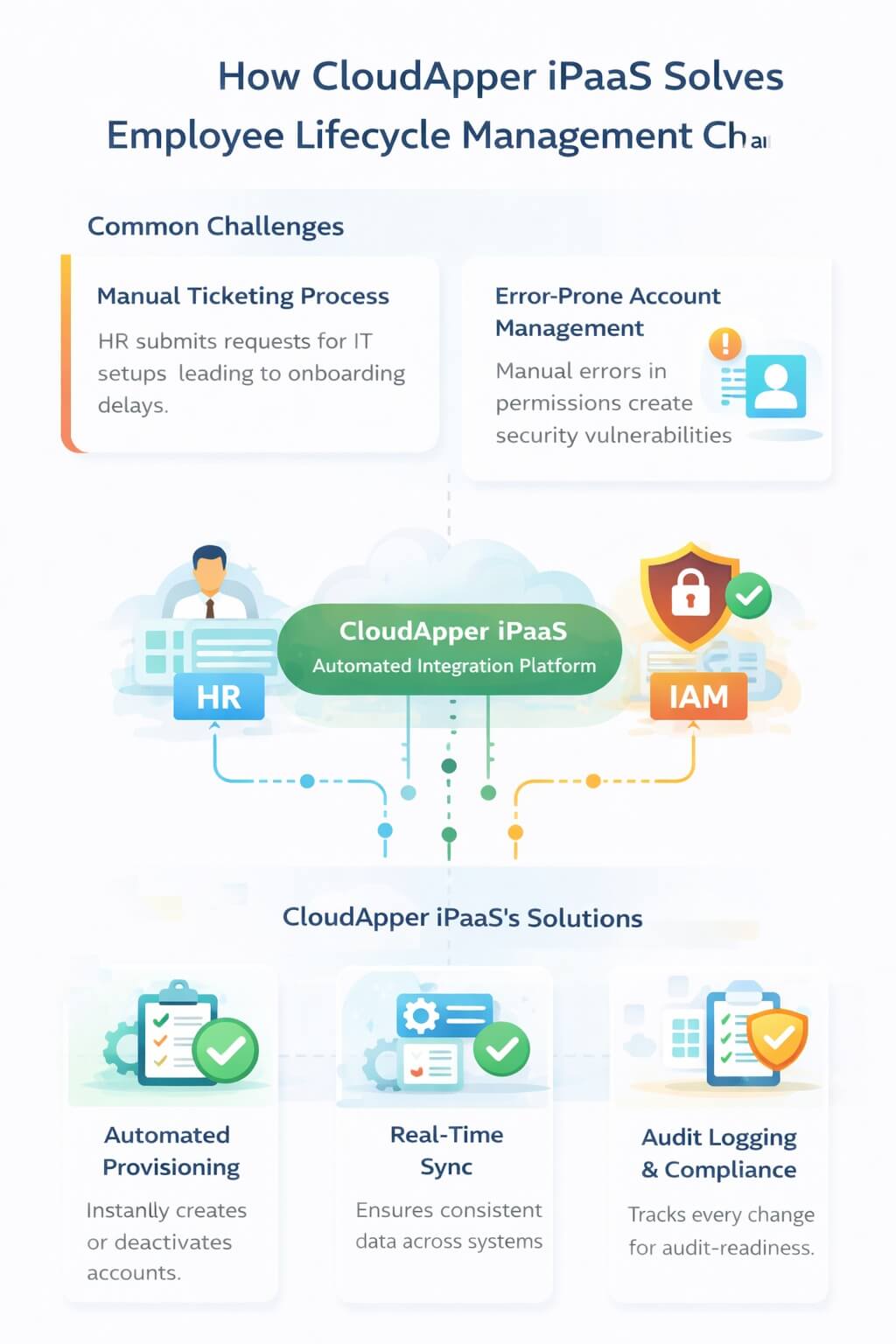
Employee lifecycle management encompasses everything from onboarding to offboarding, and without automation, it’s riddled with pain points. One major issue is the manual ticketing process: HR submits requests to IT for account setups, leading to delays that can stretch from hours to days. This not only frustrates new hires but also hampers overall productivity. Another challenge is error-prone account management—human oversights might grant excessive permissions or fail to revoke access for departed employees, creating security vulnerabilities.
CloudApper iPaaS emerges as a game-changer in this space, offering an integration platform as a service designed specifically for IAM integration. Drawing from my experience advising on digital transformations, I can attest that tools like CloudApper iPaaS solve these issues by automating the entire process. For instance, its pre-built connectors seamlessly link HR systems with IAM platforms, eliminating the need for custom coding or extensive IT involvement. This means that when a new employee is added to an HR database, CloudApper iPaaS instantly provisions accounts, assigns role-based access, and even notifies managers—all in real time.
Moreover, real-time synchronization ensures 100% data consistency, addressing the trend of inconsistent records across systems. In industries like healthcare or finance, where compliance with regulations such as GDPR or CCPA is non-negotiable, this feature is invaluable. CloudApper iPaaS includes audit logging to track every change, providing a transparent trail that supports audits and reduces compliance risks. By tackling these challenges head-on, CloudApper iPaaS not only streamlines operations but also enhances security, aligning perfectly with the growing emphasis on zero-trust models in IAM integration.
What Are the Key Features of CloudApper iPaaS for IAM Integration?
Diving deeper into its capabilities, CloudApper iPaaS boasts features that make IAM integration effortless and effective. Automated account provisioning stands out, where changes in HR status trigger immediate actions in IAM systems—think creating user profiles, assigning software licenses, or deactivating accounts upon termination. This automation eradicates the delays associated with traditional methods, ensuring new team members are productive from day one.
Role-based access control is another cornerstone, allowing organizations to customize permissions based on job functions, which mitigates risks from over-provisioning. From an industry perspective, this feature aligns with the trend toward granular security controls, especially in environments handling sensitive data. Additionally, CloudApper iPaaS’s no-code tools empower non-technical users, such as HR professionals, to configure integrations without relying on developers. This democratizes automation, making IAM integration accessible and scalable for businesses of all sizes.
In my analysis, what sets CloudApper iPaaS apart is its focus on proactive workflows. For example, it can automate manager notifications for approvals or offboarding tasks, fostering better collaboration between departments. These features collectively solve pain points like data silos and manual errors, positioning CloudApper iPaaS as an essential tool for forward-thinking leaders aiming to optimize employee lifecycle management through superior IAM integration.
How Can IAM Integration with CloudApper iPaaS Boost Organizational Efficiency?
The benefits of implementing IAM integration via CloudApper iPaaS extend far beyond basic automation. On the efficiency front, it drastically reduces provisioning times, turning what used to be multi-day processes into instantaneous actions. This improvement directly impacts employee satisfaction and retention, as seamless onboarding sets a positive tone for the employee experience.
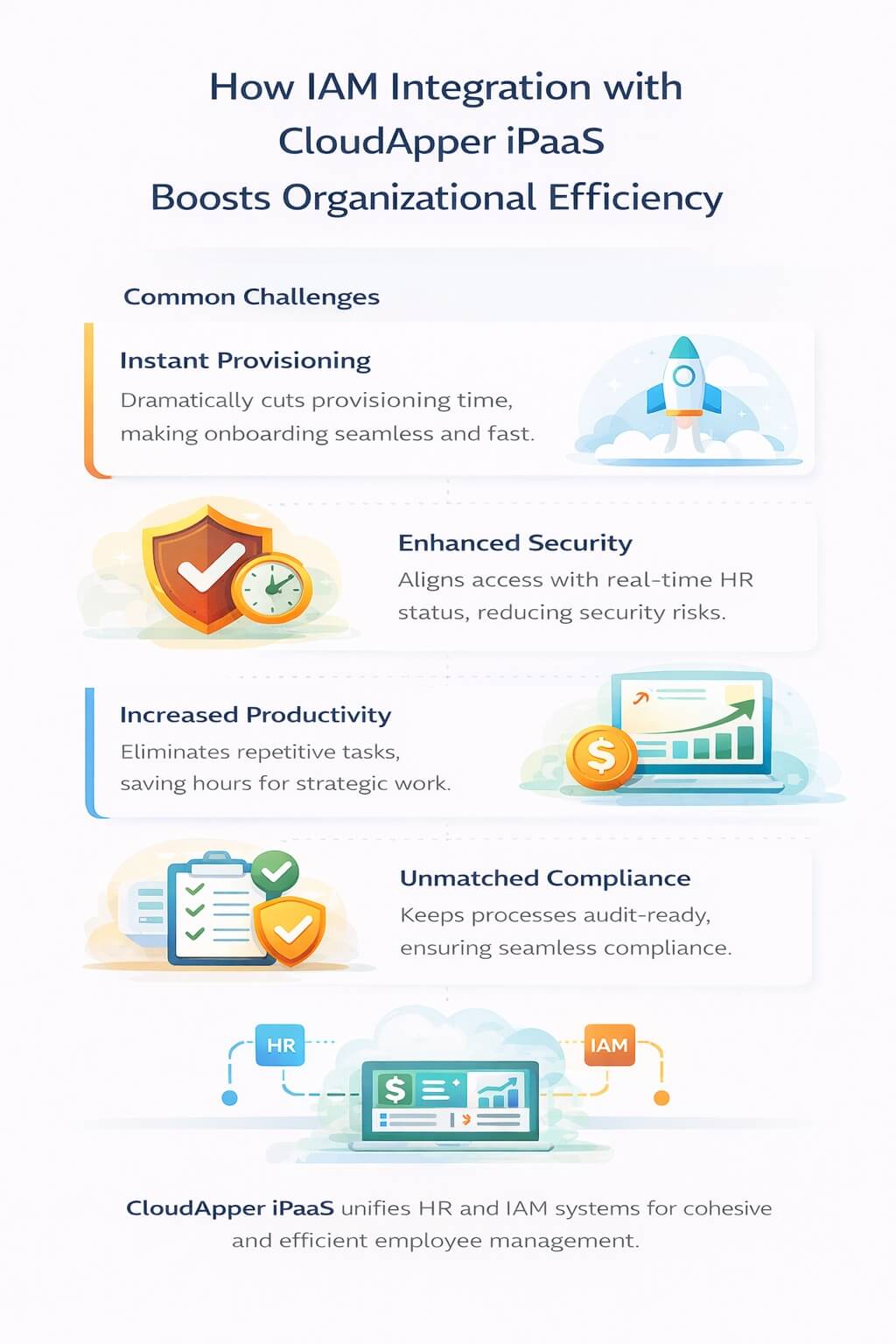
From a security standpoint, aligning access with real-time HR status minimizes risks—lingering accounts from former employees become a thing of the past, thwarting potential breaches. I’ve observed in various case studies how this leads to significant cost savings; by eliminating manual tasks, teams reclaim hours that can be redirected toward strategic goals. Furthermore, the platform’s emphasis on compliance ensures organizations stay ahead of regulatory curves, avoiding fines and reputational damage.
Let’s explore a practical example: Imagine a growing tech firm using Workday for HR and Microsoft Entra ID for IAM. Without integration, offboarding involves emails and tickets, risking data exposure. With CloudApper iPaaS, a termination entry in Workday automatically deactivates access across all connected systems, complete with audit logs for verification. This not only enhances security but also exemplifies how IAM integration can drive operational excellence. In broader industry trends, as remote and hybrid work models persist, such automation becomes crucial for maintaining secure, efficient workforces.
What Insights Can We Draw from Real-World Applications of CloudApper iPaaS?
Real-world applications provide compelling evidence of CloudApper iPaaS‘s value in IAM integration. Take a retail enterprise struggling with seasonal hiring spikes. Previously, onboarding dozens of temporary staff meant overwhelming IT with tickets, leading to errors and delays. By adopting CloudApper iPaaS, they automated integrations between UKG and Okta, enabling bulk provisioning that scaled effortlessly. The result? Faster ramp-up times and reduced administrative overhead, allowing the business to respond agilely to market demands.
Another insight comes from a financial services firm facing compliance pressures. Manual processes left gaps in data synchronization, inviting audit risks. CloudApper iPaaS’s real-time sync and logging features ensured seamless IAM integration, achieving full compliance while cutting error rates dramatically. These examples underscore a key thought leadership point: In an industry trending toward AI-driven automation, platforms like CloudApper iPaaS are not just tools—they’re strategic enablers that empower organizations to navigate complexity with confidence.
Reflecting on these cases, it’s clear that successful IAM integration requires more than technology; it demands a mindset shift toward proactive automation. Leaders who embrace this can unlock hidden efficiencies, turning potential vulnerabilities into strengths. CloudApper iPaaS facilitates this by offering customizable solutions that adapt to unique business needs, ensuring long-term relevance in evolving landscapes.
Why Should Businesses Prioritize IAM Integration in Employee Lifecycle Management?
Prioritizing IAM integration is essential for addressing the multifaceted challenges of modern employee management. As industries face increasing cyber threats and regulatory scrutiny, manual approaches simply fall short. CloudApper iPaaS provides an authoritative solution by automating these processes, delivering accuracy, speed, and security that manual methods can’t match.
In my view, the true value lies in its ability to foster a culture of efficiency. By reducing human error and streamlining workflows, it allows HR and IT to collaborate as partners rather than silos. This integration trend is reshaping how organizations operate, emphasizing agility and resilience. Businesses that invest in tools like CloudApper iPaaS position themselves as leaders, ready to capitalize on opportunities while mitigating risks.
To get started, assess your current HR-IT ecosystem for integration gaps. CloudApper iPaaS’s user-friendly interface makes it easy to implement, even for those without deep technical expertise. The payoff? A more secure, efficient, and compliant operation that drives sustainable growth.
Ready to transform your employee lifecycle management? Explore CloudApper iPaaS today and discover how seamless IAM integration can elevate your business. Visit the CloudApper website to schedule a demo and take the first step toward automated excellence—your teams and your bottom line will thank you.

What is CloudApper AI Platform?
CloudApper AI is an advanced platform that enables organizations to integrate AI into their existing enterprise systems effortlessly, without the need for technical expertise, costly development, or upgrading the underlying infrastructure. By transforming legacy systems into AI-capable solutions, CloudApper allows companies to harness the power of Generative AI quickly and efficiently. This approach has been successfully implemented with leading systems like UKG, Workday, Oracle, Paradox, Amazon AWS Bedrock and can be applied across various industries, helping businesses enhance productivity, automate processes, and gain deeper insights without the usual complexities. With CloudApper AI, you can start experiencing the transformative benefits of AI today. Learn More
- Useful Links:
- Agentic AI
- No-Code/Low-Code
- Custom Software
- HCM Personalization
- iPaaS
- FedRAMP
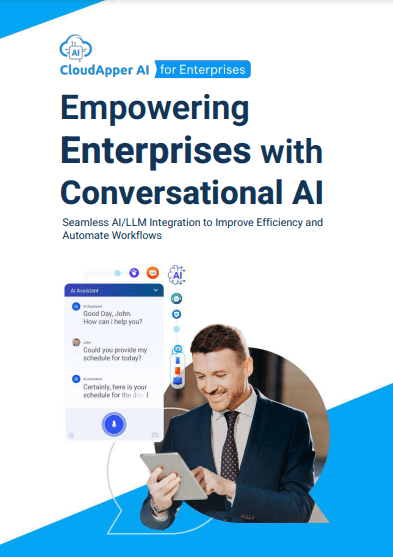
CloudApper AI Solutions
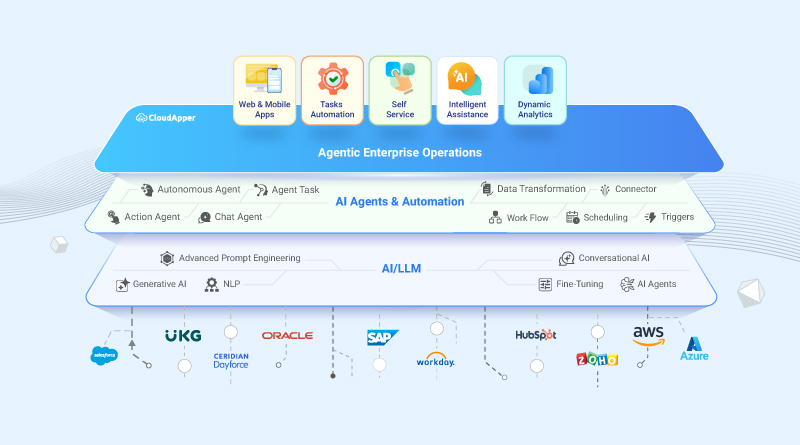
- Works with







- and more.
Similar Posts

Legacy Modernization Transition: The Compliance Gap That Opens When Both…

Outsourced Legacy Systems: Why Vendor Exit Costs More Than the…