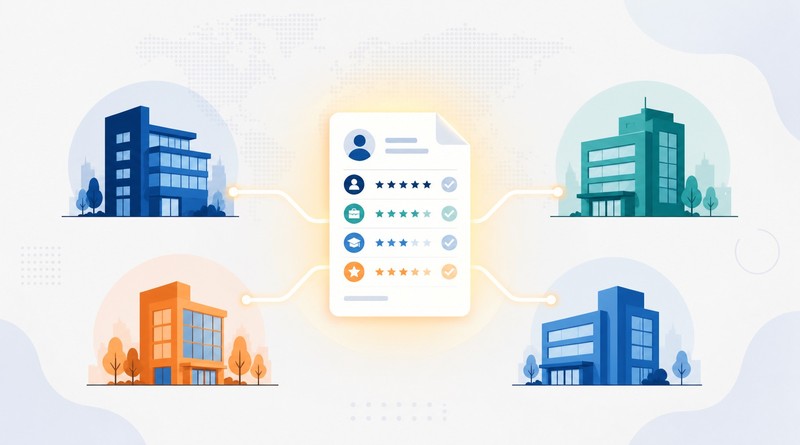
Recruiter administrative tasks consume up to 46% of coordinator time. See where the hours actually go and how AI Recruiter automation gets them back.
Table of Contents
- Why “we’re busy” is not a strategy
- The four buckets where recruiter time actually goes
- A worked example: 12-recruiter team, 800 hires per year
- Where automation actually lands (and where it doesn’t)
Every TA leader feels it. The team is busy, the calendar is full, the requisitions still slip. Headcount conversations come around and you cannot quite explain where the time goes. The honest answer: a meaningful share of every recruiter’s week disappears into recruiter administrative tasks that nobody on the leadership team actually wants them doing.
The numbers are sharper than most people expect. Talent teams report spending around 38% of their time scheduling interviews, and recruiting coordinators sink roughly 46% of their week into admin scheduling work. In-house recruiters average nearly two hours a day on administrative tasks, more than a full work day each week, gone. That is not a productivity problem. That is a budget problem hiding inside a productivity problem.
This piece breaks down where those hours actually go, gives you a calculation framework you can drop into a forecast review, and shows where AI Recruiter automation lands the recovery.
Why “we’re busy” is not a strategy
Recruiting leaders walk into Q2 budget cycles asked to justify headcount or accept a freeze. Most show up with funnel metrics: applicants, screens, offers, accepts. Those numbers describe the output. They do not describe the cost of the output. The CFO asks the obvious follow-up: “What would it take to do this with the team we already have?” If your answer is “we are doing all we can,” the conversation ends with a freeze.
The way to win that conversation is to translate recruiter administrative tasks into hours, hours into dollars, and dollars into a clean before/after that shows what AI removes from the bill. The recruiter productivity story has to be a finance story, not a feelings story.
The four buckets where recruiter time actually goes
Most recruiter time waste falls into four buckets. Naming them makes the conversation tractable.
1. Scheduling
This is the heaviest bucket and the most studied. The average time to schedule a single interview manually runs to 243 minutes when availability has to be coordinated across panel, candidate, and recruiter calendars. Two-thirds of recruiters say it takes between 30 minutes and two hours per interview. For high-volume hourly hiring, where an interview-to-hire ratio of 4 or 5 is normal, scheduling alone can consume more than half a coordinator’s week.
This is the bucket where interview scheduling automation pays back fastest. Self-scheduling drops the time-per-interview from 243 minutes to roughly 27 minutes, and AI-assisted decline handling shrinks interviewer turnaround from 68 hours to 21 hours.
2. Screening
Screening is the most visible recruiter administrative task and the easiest to mistake for “real work.” Reading 80 resumes to surface 8 worth a phone call is a job. It is also a job that an AI screening layer does in minutes, not hours, with documented criteria and an audit trail. The hours saved here are not luxuries. They are the hours that get reinvested in the candidates who actually convert.
3. Status updates
Status updates rarely show up in productivity studies because nobody tracks them. They are the ten emails an hour about “any update on the role?” and the Slack pings from hiring managers asking about the same shortlist. The honest measurement is that a recruiter handling six open requisitions can lose 60 to 90 minutes a day to status updates alone. AI Recruiter pushes a structured update to the hiring manager on a cadence and removes the manual back-and-forth. Small bucket, high friction.
4. Source-and-sift
Sourcing is the bucket where leaders push back, because sourcing feels like skilled work. It often is. But the source-and-sift bucket also includes the hours spent re-running the same Boolean search every Monday, exporting the same shortlist to a spreadsheet, and tagging candidates by hand for the next round. That part is not skilled work. That part is overhead.
A worked example: 12-recruiter team, 800 hires per year
Here is the calculation framework, with conservative inputs you can defend in a budget meeting.
Assume a 12-recruiter team running 800 hires per year, at an average of 4 interviews per hire (3,200 interviews annually). Assume a fully-loaded recruiter cost of $130,000 per year, or roughly $62.50 per hour.
| Bucket | Manual hours | At-scale cost | After automation | Savings |
|---|---|---|---|---|
| Scheduling (3,200 × 243 min) | 12,960 hours | $810,000 | 1,440 hours | $720,000 |
| Screening (assume 1.5 hr/req × 800) | 1,200 hours | $75,000 | 240 hours | $60,000 |
| Status updates (60 min/day × 12 × 220 days) | 2,640 hours | $165,000 | 880 hours | $110,000 |
| Source-and-sift (3 hrs/week × 12 × 50 weeks) | 1,800 hours | $112,500 | 720 hours | $67,500 |
| Total | 18,600 hours | $1,162,500 | 3,280 hours | $957,500 |
Two cautions before you put this in a deck. First, the savings do not cash out as a reduced headcount one-for-one. Most of the recovered hours get reinvested into candidate quality, requisition velocity, or absorbed pipeline growth. Second, the automation numbers above are a defensible average, not a ceiling. A team with strong adoption discipline can do better; a team that buys software and skips change management will do worse. The point is that the time tax is not a rounding error. It is the budget line you have not been measuring.
Where automation actually lands (and where it doesn’t)
A short, honest take. AI Recruiter genuinely removes the bulk of scheduling friction, screening triage, and status-update ping-pong. It does not remove the recruiter relationship with the hiring manager, the diagnostic conversation about a stuck role, or the hard call on a borderline candidate. Anyone who tells you it does is selling, not advising. The right framing for the budget conversation is, “Automate the work that does not need a human, so the humans can do the work that needs them.” For a deeper read on where automation begins and ends, see Why Your ATS Isn’t Enough: How AI Recruiter Automates Hiring from First Touch to Interview and the related work on multi-site interview scheduling automation in manufacturing recruitment. For the corresponding hire-quality argument, the real cost of a bad hire and how AI screening changes the math sits alongside this productivity case.
A 90-day plan to claw the hours back
Days 1-30. Run the calculation. Use your real interview volume and recruiter cost. Do not negotiate against yourself with optimistic inputs.
Days 31-60. Pick one bucket and automate it end-to-end. Scheduling is usually the right starting point because the ROI is visible inside two pay cycles and the candidate experience improves immediately. Drawing on the SHRM workforce productivity research helps frame the executive narrative.

Days 61-90. Move to the next bucket and start measuring quality-of-hire alongside time-to-hire. The conversation with leadership is no longer about doing the same work faster. It is about doing better work at the same headcount. That is the recruiter productivity story finance signs off on.
Ready to run the numbers on your team?
Book a demo of CloudApper AI Recruiter and walk through your hiring volume, your cost per recruiter hour, and the bucket where the time tax is hurting you most.
Frequently asked questions
How much of a recruiter’s day is actually administrative?
Independent studies put scheduling alone at 35-46% of recruiter and coordinator time, with another two hours a day on broader admin. For most teams, recruiter administrative tasks account for half of every working week.
Does interview scheduling automation actually deliver the time savings vendors promise?
The credible benchmarks show time-to-schedule dropping from 243 minutes to 27 minutes when self-scheduling is implemented well. The gain depends on adoption discipline and clean calendar integrations, not the software alone.
Where does AI Recruiter not help?
The hiring manager relationship, the diagnostic on a stuck role, and the judgment calls on borderline candidates remain human work. Automation removes the overhead so recruiters can spend more time on those decisions, not less.

What is CloudApper AI Platform?
CloudApper AI is an advanced platform that enables organizations to integrate AI into their existing enterprise systems effortlessly, without the need for technical expertise, costly development, or upgrading the underlying infrastructure. By transforming legacy systems into AI-capable solutions, CloudApper allows companies to harness the power of Generative AI quickly and efficiently. This approach has been successfully implemented with leading systems like UKG, Workday, Oracle, Paradox, Amazon AWS Bedrock and can be applied across various industries, helping businesses enhance productivity, automate processes, and gain deeper insights without the usual complexities. With CloudApper AI, you can start experiencing the transformative benefits of AI today. Learn More
- Useful Links:
- Agentic AI
- No-Code/Low-Code
- Custom Software
- HCM Personalization
- iPaaS
- FedRAMP
CloudApper AI Solutions for HR

- Works with








- and more.
Similar Posts

The Real Cost of Interview No-Shows, and How Automated Reminders…

Verify Required Certifications and Licenses Without Slowing Down Screening