- Why AI Coding Governance Is Different From Other IT Governance
- The Five Pillars of Enterprise AI Coding Governance
- The Architecture Decision That Changes the Governance Equation
- Handling Shadow AI Within the Framework
- Integrating AI Coding Governance With Existing Frameworks
- What Good Governance Actually Produces
- Talk to CloudApper About Building a Governance Framework That Works
Most enterprise IT teams didn’t plan for AI coding governance. They planned for cloud governance, vendor governance, data governance — frameworks built over years with clear ownership, documented policies, and audit trails.
Then developers started using AI coding tools. Productivity improved. Applications got built faster. And somewhere in the background, a governance gap opened up that nobody assigned to anyone.
This article is a practical guide for closing that gap. Not a theoretical framework — an actual working structure that IT and compliance teams can implement, regardless of which AI coding tools their developers are currently using.
Why AI Coding Governance Is Different From Other IT Governance
Before getting into the framework itself, it’s worth being specific about what makes AI coding governance distinct from the governance work enterprise IT teams already do.
The output is code, not data: Most enterprise governance frameworks address data — where it lives, who can access it, how long it’s retained. AI coding tools produce something different: software that runs in your environment, makes security decisions, creates databases, and processes your data. Governing AI-generated code requires thinking about software governance, not just data governance.

The pace is faster than traditional review cycles: Enterprise change management processes were designed for development timelines measured in weeks or months. AI coding tools compress those timelines to hours or days. A governance framework that requires two weeks of review for every new application will either be bypassed or will eliminate the speed advantage that made AI adoption appealing in the first place. The framework needs to be workable at AI development pace.
The vulnerability profile is different: AI-generated code carries known vulnerability patterns — injection risks, broken access control, inconsistent cryptographic implementations — that emerge from how AI models generate code rather than from individual developer mistakes. Governance needs to address these patterns specifically, not just apply standard code review checklists.
Shadow AI is the alternative to governance: If your governance framework is too restrictive or too slow, developers will work around it. They’ll use unsanctioned tools, build outside official channels, and your governance problem becomes worse, not better. Any framework that ignores developer experience will fail in practice regardless of how sound it is in policy.
The Five Pillars of Enterprise AI Coding Governance
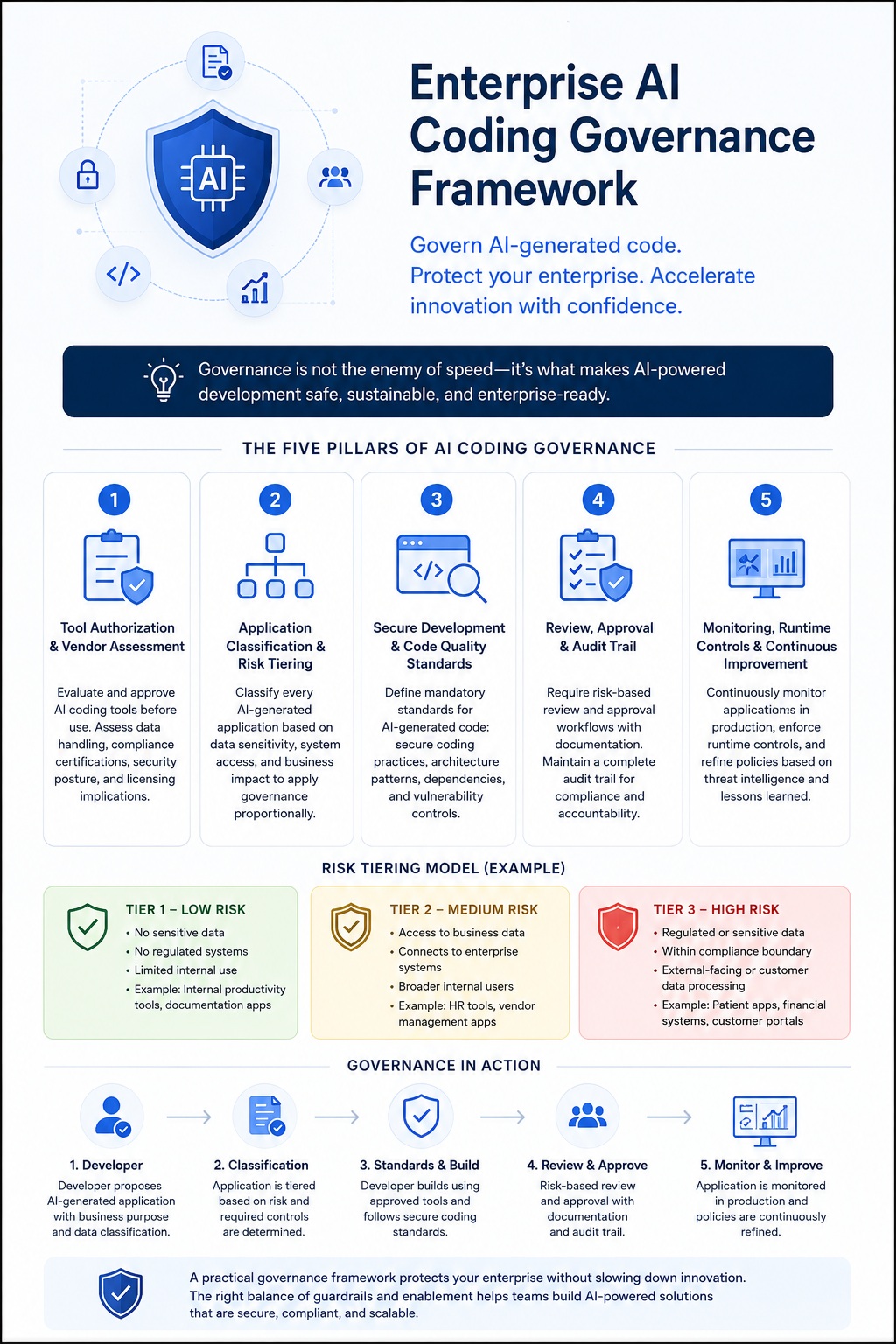
A working enterprise AI coding governance framework rests on five operational pillars. Each one addresses a different dimension of the problem.
Pillar 1: Tool Authorization and Vendor Assessment
Before any AI coding tool enters your development environment, it needs to go through a formal assessment. This isn’t bureaucratic overhead — it’s the foundation everything else rests on.
What the assessment covers:
Data handling practices: AI coding tools interact with your codebase. Some transmit code snippets to external APIs for processing. In a regulated environment, that matters: code touching HIPAA-protected systems, financial data, or confidential business logic may not be appropriate to send to an external model. Understand exactly what each tool transmits, where it goes, and under what retention policy.
Compliance certifications: For organizations with HIPAA, SOC 2, FedRAMP, or FIPS requirements, tool certifications matter. A tool running on SOC 2-audited infrastructure is not the same as a tool with no independent security assessment. Document the compliance posture of every authorized tool.
Licensing and IP implications: AI coding tools trained on public code repositories may generate output that carries licensing implications. Your legal team should weigh in on this before tools are sanctioned for production use.
Output of this pillar: A maintained approved tool list, with assessment documentation for each tool, accessible to developers and compliance teams. Tools not on the list require an exception process before use.
Pillar 2: Application Classification and Risk Tiering
Not every AI-generated application carries the same risk. An internal productivity tool that processes no sensitive data is meaningfully different from an application that handles PHI, financial records, or access to critical systems.
A tiered classification system lets you apply governance proportionally — thorough review where it matters, lighter process where the risk is lower.
A practical three-tier model:
Tier 1 — Low risk. Internal tools with no access to sensitive data, no connection to regulated systems, used by a defined internal audience. Examples: internal knowledge bases, meeting note tools, simple reporting dashboards on non-sensitive data.
Tier 2 — Medium risk. Applications with access to business data, connection to enterprise systems, or used by a broader internal audience. Examples: HR workflow tools, vendor management applications, internal operations dashboards.
Tier 3 — High risk. Applications that process regulated data (PHI, PII, financial records), connect to systems within a compliance boundary, or have external-facing components. Examples: patient-facing healthcare tools, applications within HIPAA or FedRAMP scope, customer data processing applications.
Governance requirements scale with tier. Tier 1 applications might require a standard security scan and a brief documentation checklist. Tier 3 applications require full security assessment, compliance review, architecture sign-off, and inclusion in your relevant compliance documentation (SSP updates for FedRAMP, HIPAA risk assessment updates, etc.).
This tiering prevents the governance framework from becoming a uniform bottleneck. Developers building Tier 1 tools move quickly. Tier 3 applications get the scrutiny they warrant.
Pillar 3: Security Review Standards for AI-Generated Code
This pillar defines what security review actually means for AI-generated code — specifically, not generically.
Standard code review checklists were written for human-generated code. They’re necessary but not sufficient for AI-generated output. AI coding tools produce specific vulnerability patterns that need specific review criteria.
Mandatory review elements for AI-generated code:
Input validation and injection risk. AI-generated applications frequently implement input handling in ways that look correct but are vulnerable to injection attacks — SQL, OS command, LDAP, XML. Every application tier 2 and above needs explicit injection testing, not just static analysis.
Access control alignment. Review access control implementations against your organizational RBAC policy. AI tools implement access control based on general patterns, not your specific requirements. Misalignments are common and often subtle.
Cryptographic implementation. Verify that cryptographic functions use approved libraries with FIPS-validated modules where required. AI tools may use strong algorithms implemented with non-validated modules — a distinction that matters for FedRAMP and certain HIPAA implementations.
Data access patterns. Map what data each application accesses, how it accesses it, and whether those patterns are consistent with your data governance policies. AI-generated applications often create their own data access logic outside established enterprise patterns.
Logging and monitoring integration. Verify that audit logs from AI-generated applications are in a format compatible with your SIEM and that log completeness satisfies the audit trail requirements of applicable compliance frameworks.
Documentation requirement. Every Tier 2 and Tier 3 application needs a security review record that maps findings to the above elements and documents how each was addressed. This becomes part of your compliance evidence package.
Pillar 4: Deployment and Boundary Management
This pillar governs how AI-generated applications move from development to production — and specifically, how they’re integrated into your compliance boundaries.
Change management integration. AI-generated applications should go through the same change management process as any other software. The speed of AI development doesn’t exempt applications from change control. What changes is how you structure the change record — it should explicitly note that the application was AI-generated and document which tool was used.
Compliance boundary assessment. Before deployment, every AI-generated application needs a determination of where it sits relative to your compliance boundaries. For FedRAMP organizations: is this within the authorization boundary, outside it, or does it create an interconnection that needs documentation? For HIPAA organizations: does this application create, receive, maintain, or transmit PHI? The answer determines what compliance documentation needs to be updated before deployment.
Database and data architecture review. AI-generated applications frequently create new data stores. Before deployment, review whether new databases created by the application are consistent with your enterprise data architecture, properly documented, and governed under your data retention and access policies. Applications that create data stores outside your established architecture should require architecture review before deployment.
Interconnection documentation. Any connection between an AI-generated application and an existing enterprise system — ERP, HCM, CRM, clinical systems — needs to be formally documented. For regulated environments, this is not optional.
Pillar 5: Ongoing Monitoring and Maintenance Governance
Governance doesn’t end at deployment. AI-generated applications in production need ongoing oversight, and the framework needs to address who is responsible for what.
Application ownership assignment. Every AI-generated application in production needs a named owner responsible for its ongoing security posture. This owner is accountable for security patch application, compliance documentation updates, and incident response coordination. “The team that built it” is not sufficient — there needs to be a named individual.
Vulnerability management inclusion. AI-generated applications need to be included in your standard vulnerability management program. They should be scanned regularly, findings should be tracked, and remediation timelines should follow your standard SLAs. The fact that an application was AI-generated doesn’t create a separate vulnerability management track.
Dependency monitoring. AI-generated code frequently uses third-party libraries. Those libraries need to be tracked for known vulnerabilities (CVEs) and updated when security patches are released. This is an ongoing operational responsibility that needs to be assigned.
Compliance documentation maintenance. When compliance requirements change — a new HIPAA guidance, a SOC 2 control update, a FedRAMP baseline revision — AI-generated applications within scope need to be reassessed and documentation updated. This should be triggered automatically when framework changes are identified, not discovered during an audit.
Annual inventory review. At minimum annually, conduct a full inventory of AI-generated applications in your environment. Identify any applications that were built outside the governance framework (shadow AI output), any applications with ownership gaps, and any applications whose risk tier may have changed due to expanded use or new data access.
The Architecture Decision That Changes the Governance Equation
A governance framework built around standard AI coding tools — Copilot, Cursor, and similar — requires substantial ongoing operational work. Every new application triggers the review cycle. Every deployment needs boundary assessment. Every application in production needs individual ownership and maintenance.
There’s an architectural alternative that changes this fundamentally: building AI applications on a platform where governance is structural rather than procedural.
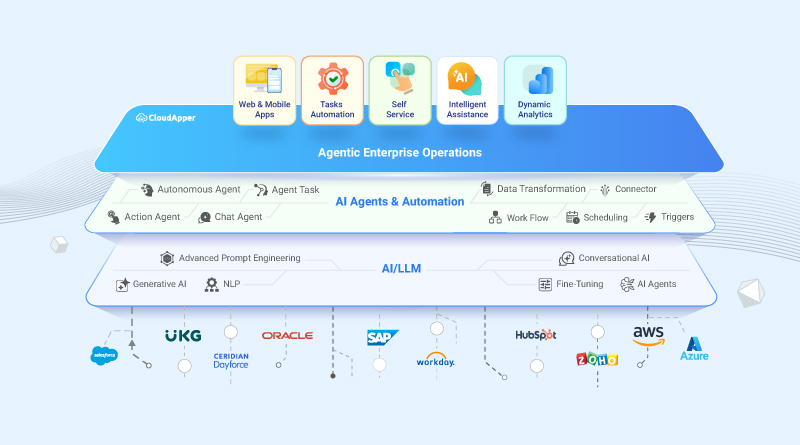
CloudApper’s AI platform takes a different approach to the problem. Instead of generating source code that your governance process then has to manage, the platform generates governed application blueprints that execute on a certified application server. Every application built on the platform automatically inherits the same security controls, the same data governance layer, the same access control model, and the same audit logging format.
For the five pillars above, this changes the workload considerably:
Tool authorization (Pillar 1): One platform assessment instead of ongoing assessments for multiple AI tools. CloudApper is SOC 2 audited, FedRAMP Ready, and carries documented compliance controls for HIPAA, FIPS, CCPA, and GDPR.
Risk tiering (Pillar 2): Applications built on the platform inherit a certified security baseline. Tier 3 applications still require compliance boundary documentation, but the security review is substantially simplified because the underlying controls are already assessed.
Security review (Pillar 3): Platform-level controls address injection risk, access control, and cryptographic implementation uniformly. Per-application security review focuses on application-specific logic and data access patterns rather than infrastructure-level vulnerabilities.
Deployment governance (Pillar 4): New applications run on the existing certified server rather than creating new infrastructure. Compliance boundary work focuses on data flow documentation, not infrastructure assessment.
Ongoing monitoring (Pillar 5): Security patches at the platform level apply to all applications. There’s no per-application dependency management or infrastructure vulnerability tracking.
This doesn’t eliminate governance work — it focuses it where it actually matters. Rethinking how enterprise software gets built is precisely what CloudApper’s architecture enables: the speed of AI development with the governance posture enterprise compliance requires.
Handling Shadow AI Within the Framework
Any governance framework for AI coding tools needs a realistic approach to shadow AI — developers using tools that aren’t in the approved list.
The wrong approach: strict prohibition with no sanctioned alternative. This drives usage underground without eliminating it. You end up with the same governance gaps plus a culture of concealment.
The right approach: provide a sanctioned option that’s genuinely better, then enforce the framework against unsanctioned use consistently.
“Genuinely better” means faster, more capable, and producing output your developers are proud of — not a compliance-compliant tool that slows everyone down. This is the bar CloudApper’s platform is designed to clear. Building AI agents and applications without coding barriers means developers get more done, not less — while the governance framework gets the structural compliance posture it needs.
When you have a sanctioned alternative that developers actually prefer, the enforcement conversation changes. It’s no longer “you can’t use the fast tool.” It’s “here’s the fast tool that we’ve approved, and unsanctioned tools create audit exposure for you and the team.”
Integrating AI Coding Governance With Existing Frameworks
AI coding governance doesn’t need to be a standalone program. It should integrate with what you already have.
SDLC integration. Add AI-specific requirements to your existing software development lifecycle documentation. Tool selection, code review requirements, deployment boundary assessment — these become additional checkpoints in the existing process rather than a parallel process.
Risk register integration. AI coding tools and the applications they produce should appear in your enterprise risk register. The risk category is software development risk; the specific risk is unreviewed or ungoverned AI-generated code in production systems. Track it the same way you track other software development risks.
Vendor management integration. AI coding tools are vendors. Add them to your vendor management program with the same assessment requirements as other technology vendors. For tools used in regulated environments, apply the same scrutiny you’d apply to any software vendor with access to or influence over regulated systems.
Incident response integration. Update your IR playbooks to address scenarios specific to AI-generated applications: injection exploits in AI-generated code, prompt injection in LLM-integrated applications, data exposure through AI-generated applications with access control misalignments. Understanding how AI integrates with enterprise systems is prerequisite to writing realistic IR scenarios for AI-related incidents.
Compliance evidence integration. AI-generated applications in scope for HIPAA, SOC 2, or FedRAMP need to appear in your compliance evidence packages. Security review records, access control documentation, and compliance boundary determinations become part of your audit evidence. Build this into the governance process from the start — retrofitting documentation before an audit is expensive and stressful. Ensuring enterprise AI is truly secure requires this kind of systematic integration, not point-in-time assessments.
What Good Governance Actually Produces
A governance framework that works produces three observable outcomes:
Audit readiness. When an auditor asks about AI coding tools in your environment, you have a complete answer: which tools are authorized, what assessments were done, how AI-generated applications are reviewed before deployment, and how they’re maintained in production. Nothing is discovered during fieldwork that wasn’t already documented.
Developer trust. When developers understand the governance framework and have sanctioned tools that work within it, they use the official path. Shadow AI decreases. The governance framework reflects actual practice, not just policy aspiration.
Security posture you can defend. When a security incident occurs — not if, when — the investigation starts with documented code, documented access controls, and documented ownership. The forensic work is still hard, but it’s not starting from zero.
Getting there requires sustained effort across all five pillars. It also requires an honest assessment of whether your current AI coding tools are architected in a way that makes governance manageable, or whether the governance burden they create will outpace your team’s capacity to manage it.
That’s a decision about the future of your enterprise software development approach — and it’s worth making deliberately rather than discovering its implications at audit time.
Talk to CloudApper About Building a Governance Framework That Works
If your organization is actively developing with AI coding tools and needs a governance structure that satisfies your compliance requirements without slowing your team down, CloudApper can walk through the framework above against your specific environment.
Schedule a conversation with the CloudApper team →
Bring your current tool inventory, your active compliance frameworks, and your biggest governance gap. The conversation will be specific to your situation.

What is CloudApper AI Platform?
CloudApper AI is an advanced platform that enables organizations to integrate AI into their existing enterprise systems effortlessly, without the need for technical expertise, costly development, or upgrading the underlying infrastructure. By transforming legacy systems into AI-capable solutions, CloudApper allows companies to harness the power of Generative AI quickly and efficiently. This approach has been successfully implemented with leading systems like UKG, Workday, Oracle, Paradox, Amazon AWS Bedrock and can be applied across various industries, helping businesses enhance productivity, automate processes, and gain deeper insights without the usual complexities. With CloudApper AI, you can start experiencing the transformative benefits of AI today. Learn More
- Useful Links:
- Agentic AI
- No-Code/Low-Code
- Custom Software
- HCM Personalization
- iPaaS
- FedRAMP