When an ISV disappears and leaves a Windows application orphaned, most IT directors focus on the technical risk. The harder problem is the business unit that refuses to let it go. This article gives IT directors a practical model for quarantine, runway calculation, and governing the surrounding processes with CloudApper.

TL;DR
When a software vendor disappears, the immediate challenge isn't technical — it's that one business unit has made the orphaned application non-negotiable, creating a de-facto organizational veto that stalls every modernization effort. IT directors need to first classify the application as truly orphaned (versus discontinued or unsupported), each of which requires a different containment strategy. The quarantine model treats the application as a managed asset with a defined economic life rather than an open-ended deferral, while CloudApper's governed platform enables IT teams to build workflow layers adjacent to the binary, reducing organizational capture. The key discipline is runway management: calculating the most likely forced event horizon — OS deprecation, hardware failure, compliance finding, key-person departure — and working backward to put the right governance architecture in place before that event arrives.
Table of Contents
You already have the number. Maybe it’s 18 months to OS end of extended support. Maybe it’s an upcoming SOC 2 audit. Maybe it’s one DBA who built the stored procedures in 2009 and is taking retirement in Q2. You are not discovering a problem — you are calculating how far you can travel before the forced event arrives.

That is where most IT directors land when an ISV disappears. The vendor closed, was acquired and sunset the product, or stopped issuing patches four years ago. The Windows application still runs. The business unit still depends on it. Nobody in the building has the source code, and there is no upgrade path because the vendor no longer exists.
What “Truly Orphaned” Actually Means
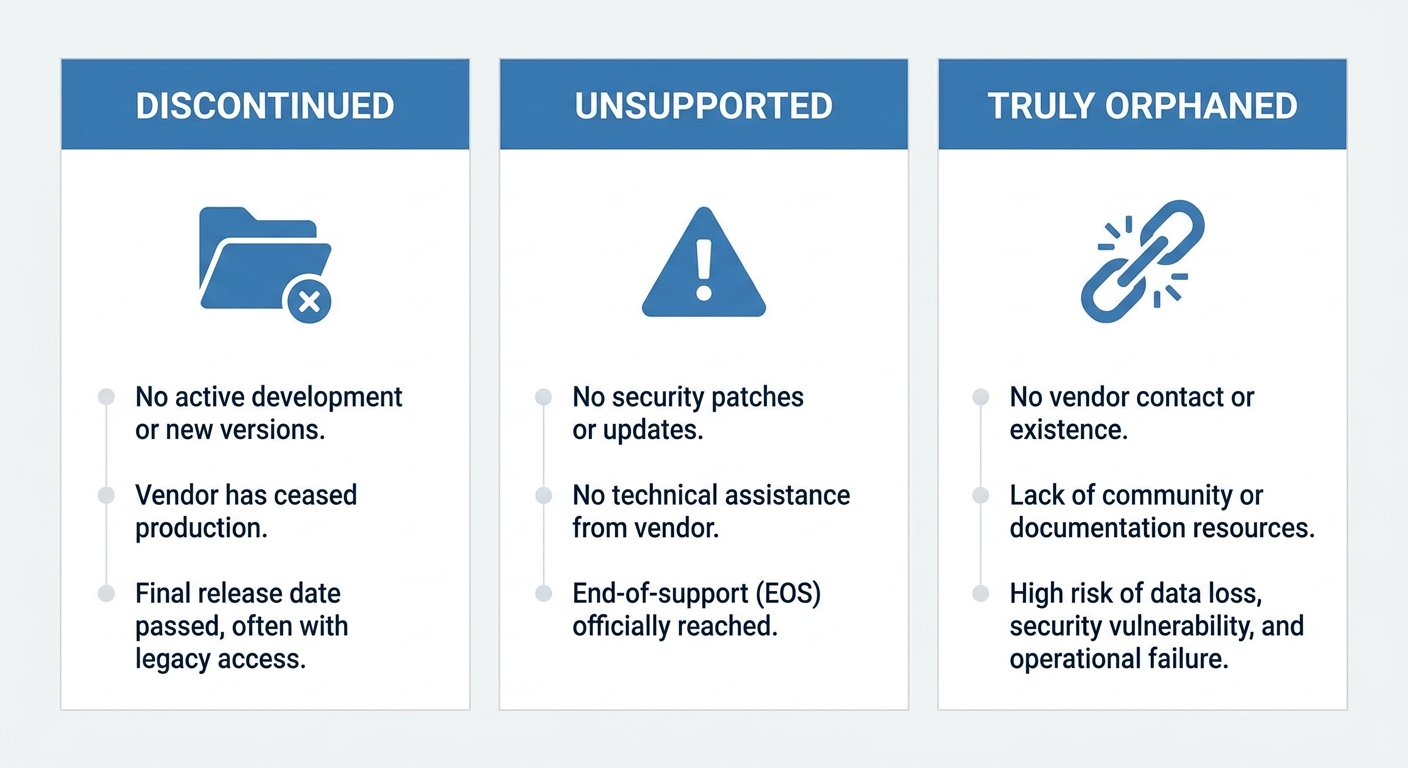
There is a meaningful difference between discontinued, unsupported, and truly orphaned — and conflating them collapses your options.
A discontinued product still has a vendor. You can negotiate extended support, hire consultants who know the platform, or retrieve documentation. An unsupported product has a vendor who stopped issuing patches, but the binary is stable and the codebase is known. A truly orphaned application has no vendor, no documentation owner, no security patch pipeline, and often no internal staff who fully understand the logic encoded inside it. Those three categories require three different containment strategies — and organizations that treat them identically underestimate how much each deferral decision costs as time passes. CloudApper’s legacy assessment framework separates them into distinct governance tracks precisely because the isolation and replacement architecture for each is different.
The Organizational Veto Nobody Maps
Here is where most legacy assessments fail. IT identifies the risk, documents it, and presents a modernization case — and the project stalls. Not because of budget. Not because of technical complexity. Because the controller, the plant manager, or the claims supervisor whose team uses the application every day has decided it is non-negotiable.
That person is not being obstructionist. They have undocumented workarounds embedded in their team’s daily operations — things that took years to develop, that are not in any requirements document, and that a replacement system will break on day one. They have no clean way to explain this to IT without sounding obstructive, so they say the system works fine. And it does — today.
Before IT can develop a credible plan, it needs to map the full dependency surface of the orphaned application, including the undocumented process workarounds that live in the heads of the process owner’s team. That is not a technical task. It is a structured stakeholder conversation with someone who built their workflow around a binary that predates their tenure.
The Quarantine Model — Containing What You Cannot Remove
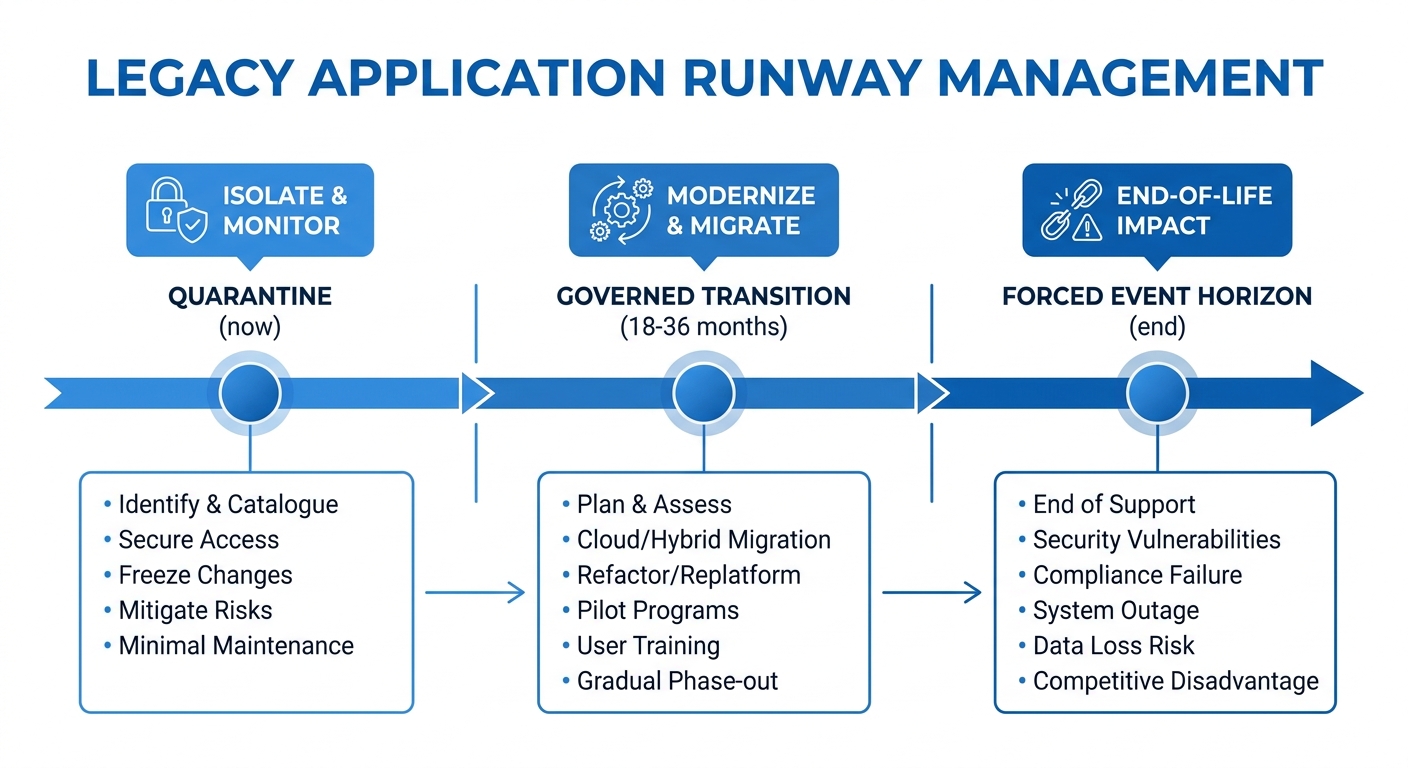
The architecture goal for a truly orphaned application is not migration — it is containment. The application gets network-isolated, access-controlled, monitored for anomalous behavior, and treated as a quarantined asset with a defined economic life. This shifts the conversation from “when do we replace it” to “what is its remaining useful runway and what can we build around it.”
The patching risk in an unvendored Windows application is not theoretical. Unpatched binaries on aging OS versions accumulate CVEs with no remediation path. SOC 2 auditors and HIPAA reviewers will document them. While the quarantined binary runs in isolation, the surrounding processes do not have to stand still.
This is where CloudApper delivers near-term value without requiring a big-bang replacement. CloudApper’s governed platform lets IT teams build workflow layers, reporting interfaces, and data exchange pipelines that sit adjacent to the orphaned application — capturing outputs, standardizing inputs, and creating the data continuity that makes eventual replacement tractable. The goal is not to remove the binary on day one. It is to reduce the organizational capture it currently holds over the business process, so the forced event becomes manageable rather than catastrophic.
Calculating the Runway Before the Forced Event
Every orphaned application has a forced event horizon: an OS deprecation, a hardware failure, a compliance finding, a key person departure. Organizations that wait for the forced event to begin planning consistently pay three to five times more than those who begin the surrounding-process work 18 to 36 months in advance.
The calculation is not complicated: identify the most likely forced event, assign a probability-weighted timeline, and work backward to determine what governed processes need to be in place before that event arrives. That is runway management — and it is the difference between an IT team that absorbs the event and one that gets buried by it.
Legacy modernization fails when it is treated as a single replacement project. Managing an orphaned Windows application requires treating its remaining useful life as a governed transition period with explicit milestones — not an open-ended deferral waiting for a crisis to force the decision.
If your team is managing a Windows application with no vendor, no upgrade path, and a compliance deadline approaching, CloudApper gives IT directors a governed way to isolate the risk, extend surrounding processes, and build the replacement architecture at a pace the business can absorb. Talk to the CloudApper team to map your runway.

What is CloudApper AI Platform?
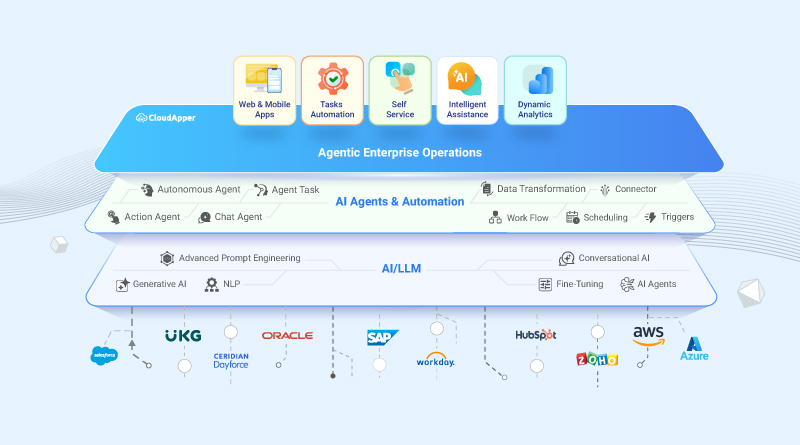
CloudApper AI is an advanced platform that enables organizations to integrate AI into their existing enterprise systems effortlessly, without the need for technical expertise, costly development, or upgrading the underlying infrastructure. By transforming legacy systems into AI-capable solutions, CloudApper allows companies to harness the power of Generative AI quickly and efficiently. This approach has been successfully implemented with leading systems like UKG, Workday, Oracle, Paradox, Amazon AWS Bedrock and can be applied across various industries, helping businesses enhance productivity, automate processes, and gain deeper insights without the usual complexities. With CloudApper AI, you can start experiencing the transformative benefits of AI today. Learn More
- Useful Links:
- Agentic AI
- No-Code/Low-Code
- Custom Software
- HCM Personalization
- iPaaS
- FedRAMP
CloudApper AI Solutions


- Works with







- and more.
Similar Posts

Microsoft Access Modernization: Why the Technical Migration Is the Easy…

Crystal Reports and SSRS: The Reporting Layer Nobody Budgeted for…