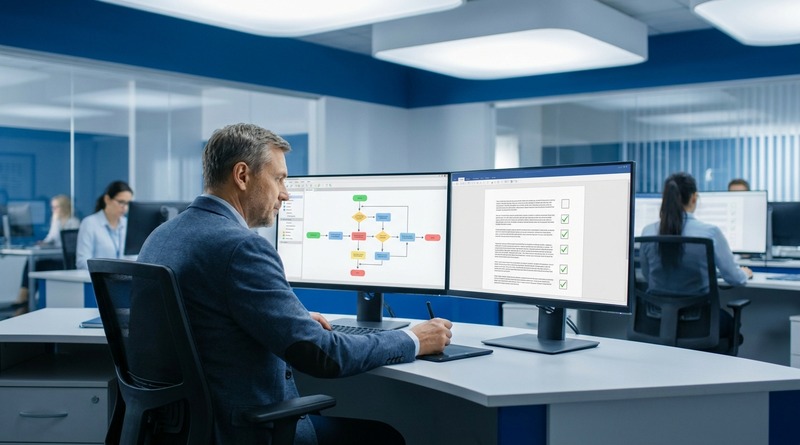
Legacy modernization projects fail at data migration not because of the technology but because governance decisions were never made. The data profiling report reveals what deferral actually costs — and why it arrives after the budget is locked.

TL;DR
Enterprise legacy modernization projects fail most often at the data migration phase, not because of technical shortcomings but because accumulated governance debt — unresolved data ownership, inconsistent records, and missing compliance classifications — surfaces only when the data must move. Eighty-three percent of enterprise data migration projects exceed budget or fail to meet stated objectives, with data quality debt as the leading cause. Compliance exposure is acute during migration, when data classification gaps become visible under deadline pressure. Organizations that avoid this outcome run data profiling before the project plan is finalized and treat governance documentation as a first-class deliverable. CloudApper AI provides a governed platform that surfaces these requirements before the project scope is locked.
Table of Contents
Legacy system data migration is where enterprise modernization projects fail, and the cause is governance risk nobody scoped rather than the technology. The first data profiling report on the system being decommissioned shows a decade of entries without a consistent standard, records owned by three departments who disagree on the canonical version, and retention flags compliance never applied.

A plan that assumed six weeks for data preparation now needs twelve, before anyone has found the people who know what the data means. CloudApper AI, a governed platform for building, extending and modernizing enterprise applications, treats migration as a governance event rather than an execution task.
What the Project Plan Gets Wrong About Migration
Legacy modernization roadmaps typically schedule data migration after requirements gathering, architecture review, and vendor selection — the second-to-last step before go-live. That sequencing treats migration as an implementation task that follows from design decisions, when it is actually a governance exercise that surfaces dependencies no other part of the project can resolve.
Who owns this record across business units? Which version is the system of record when the ERP and the subsidiary ledger disagree? Which fields carry compliance classifications that constrain where data can land and in what form? These questions require cross-functional ownership and formal documentation. They cannot be answered by the migration team alone, and they cannot be answered on a go-live deadline without shortcuts that create compliance exposure.
Eighty-three percent of enterprise data migration projects exceed their original budgets and schedules or fail to meet their stated objectives. The leading cause is not tooling failure or infrastructure mismatch. It is data quality debt — the accumulated inconsistencies, undocumented dependencies, and unresolved ownership questions that were invisible while the legacy system was running. The institutional knowledge embedded in legacy systems includes not just how the system works but what the data means — and that knowledge walks out the door before the migration team needs it.
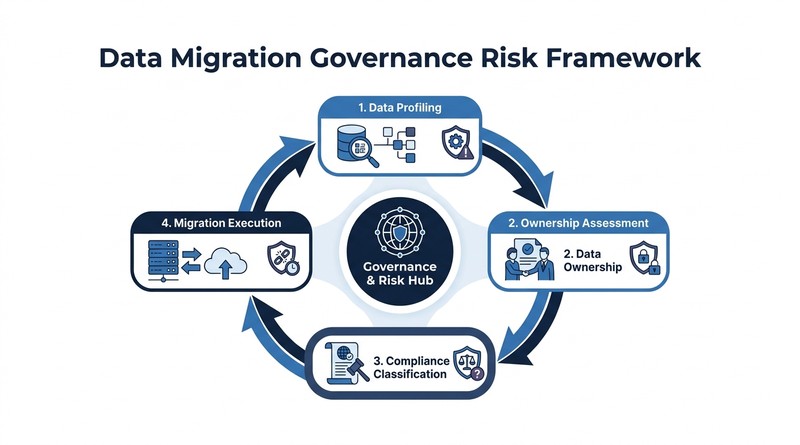
The Compliance Cost of Discovering Governance Debt at Migration
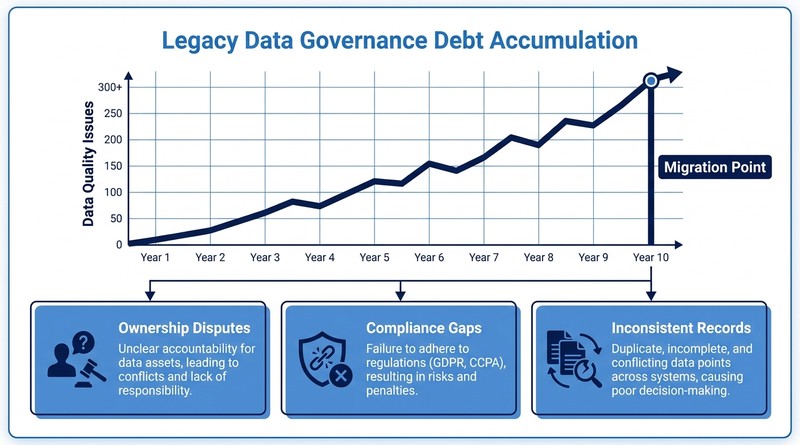
Data quality debt is not a technical artifact. It is the residue of governance decisions that were deferred. A field with inconsistent values exists because no one standardized entry across business units. A customer record that exists in three systems with three identifiers was never resolved because the teams that owned each system had no shared governance over the data. These gaps were manageable in the legacy system because the system accommodated them. A modern platform with defined data models and audit requirements cannot.
For organizations with active HIPAA, SOC 2, or FIPS compliance requirements, migration surfaces these gaps at the worst possible time. Thirty-one percent of enterprise migrations involve some degree of sensitive data exposure during transit — a figure that rises when data classification is compressed or skipped because the go-live date is already slipping. What a SOC 2 audit requires about data handling does not pause for a migration schedule.
The lift-and-shift fallacy applies to data as much as to architecture: data that was ungoverned in the legacy system does not become governed by landing on a modern platform. The same quality debt, the same ownership disputes, and the same compliance gaps are now running on newer infrastructure with higher audit exposure. Legacy modernization without data governance does not reduce technical debt — it relocates it.
What the Budget Should Have Included
The organizations that avoid migration failures do not have better migration tools. They run data profiling before the project plan is finalized, not as the first workstream of the migration phase. They identify data owners before the migration team needs to resolve conflicts between competing records. They treat the compliance documentation of the migration — data lineage, classification records, access control decisions — as a defined deliverable with its own budget line, not a byproduct of the technical work.
CloudApper’s approach to legacy modernization includes a data governance assessment before migration planning begins, so the project scope reflects the actual state of the data rather than an assumption about it. The real cost of modernization is not just infrastructure and development — it includes the governance work the data requires to move cleanly. Organizations that discover this mid-project do not face only a schedule extension. They face compliance exposure that costs more to remediate under deadline pressure than it would have cost to scope at the outset.
The profiling report is not the surprise. The surprise is that it was scheduled last.
For organizations scoping a legacy modernization program where data migration is on the critical path, CloudApper provides a governed platform that surfaces data governance requirements before the project plan is locked. To discuss your modernization architecture, visit CloudApper’s contact page.

What is CloudApper AI Platform?
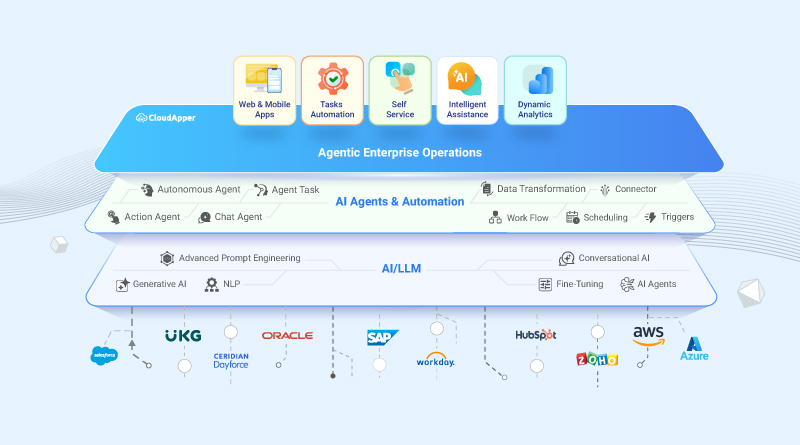
CloudApper AI is an advanced platform that enables organizations to integrate AI into their existing enterprise systems effortlessly, without the need for technical expertise, costly development, or upgrading the underlying infrastructure. By transforming legacy systems into AI-capable solutions, CloudApper allows companies to harness the power of Generative AI quickly and efficiently. This approach has been successfully implemented with leading systems like UKG, Workday, Oracle, Paradox, Amazon AWS Bedrock and can be applied across various industries, helping businesses enhance productivity, automate processes, and gain deeper insights without the usual complexities. With CloudApper AI, you can start experiencing the transformative benefits of AI today. Learn More
- Useful Links:
- Agentic AI
- No-Code/Low-Code
- Custom Software
- HCM Personalization
- iPaaS
- FedRAMP
CloudApper AI Solutions

- Works with







- and more.
Similar Posts

Vendor-Built Internal Applications: The Governance Gap Enterprise IT Inherited From…

What Your AI Development Platform Vendor’s Security Review Should Actually…