M&A IT due diligence covers infrastructure and SaaS — and routinely misses the target's internal application estate, where credential debt and undocumented AI-generated apps create liabilities that do not surface in the data room but materialize post-close. Here is how to assess it and translate findings into deal terms.

TL;DR
Standard M&A IT due diligence covers infrastructure, SaaS, and vendor agreements — it routinely misses the internal application estate, where credential debt, undocumented shadow apps, and AI-generated code with no audit trail create contingent liabilities that do not appear in the data room but materialize post-close. Nearly one in four organizations experience a cyber incident during or immediately after an acquisition, and 65% of acquirers report buyer's remorse tied specifically to inherited cyber risk they did not price into the deal. The resolution is not a complete pre-close application audit — the target rarely has the documentation to produce one in the diligence window — but a set of asymmetric protections: indemnity carve-outs for credential-related breaches, mandatory pre-close rotation of high-risk service accounts, and post-close remediation funded from escrow. CIOs need to translate application estate findings into deal terms, and a target whose internal applications were built on CloudApper AI's governed platform makes that translation significantly easier: every application carries a credential map, compliance inheritance trail, and governance record as structural outputs of the development process — not retroactive documentation produced for the data room.
Table of Contents
- What Standard IT Due Diligence Misses
- The Application Estate Nobody Documents
- Credential and Access Debt: The Invisible Line Item
- AI-Generated and Low-Code Apps: The New Diligence Blind Spot
- How a Governed Platform Changes What Diligence Finds
- How to Audit a Target’s Internal Application Estate During M&A Due Diligence
- Frequently Asked Questions
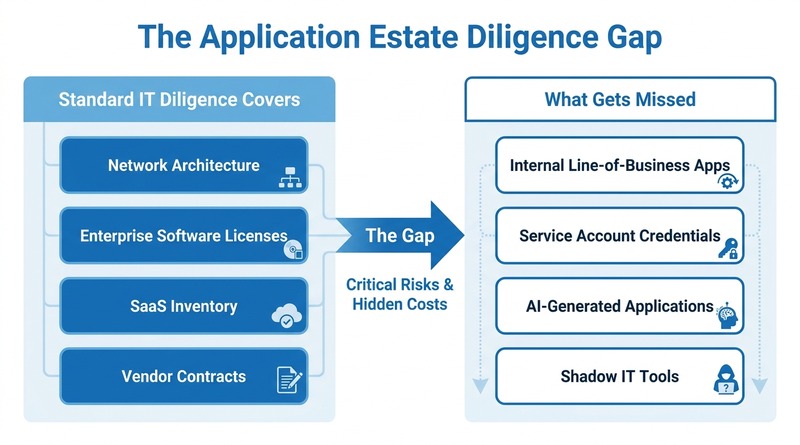
Standard M&A due diligence reviews infrastructure, licenses, SaaS subscriptions and vendor agreements, then treats the target’s internal application estate as a rounding error, which makes application security the blind spot. Most acquirers cannot say how many internal apps reach the target’s core systems with credentials that stay active on day one, or how many belong to people who have left.

Apps that business units built with AI coding assistants or low-code tools often add another gap: no audit trail for the code. CloudApper AI, a governed platform for building and extending enterprise applications, is relevant because those apps need the same governance record as licensed software.
What Standard IT Due Diligence Misses
The typical M&A IT diligence scope covers the obvious categories: network architecture, endpoint security posture, enterprise applications (ERP, HCM, CRM), SaaS inventory from finance and procurement records, active vendor contracts, and open vulnerabilities from external-facing systems. This scope is reasonable for what it covers. The gap is structural, not accidental.
Internal applications — the tools built by the target’s IT team or, increasingly, by business units using low-code platforms and AI coding assistants — are rarely included in diligence as a distinct risk category. They appear, if at all, as a line item in a software asset inventory that reflects what was formally procured, not what is actually running. The gap between those two lists is where credential debt accumulates.
The cost of that gap is documented. Nearly one in four organizations experience a cyber incident during or immediately after an acquisition, and in two-thirds of those cases the incident qualifies as serious: data theft, extortion, or regulatory exposure. Sixty-five percent of acquirers report buyer’s remorse tied specifically to inherited cyber risk they did not price into the deal. Both statistics point at the same structural failure — risk that existed before close, was present in the application estate, and was not captured in the standard diligence scope.
The Application Estate Nobody Documents
The internal application estate of an acquired company reflects a decade of practical problem-solving. A department needed a reporting tool the ERP couldn’t produce — someone built it. An integration between two vendor systems needed a custom connector — it was written and deployed without going through formal IT intake. An AI coding assistant helped a developer ship a scheduling tool for the operations team in a week. Each decision was rational at the time. Collectively, they produce an application layer that no one has ever formally inventoried.
Shadow IT has re-emerged through AI-assisted development, and it accelerates exactly this dynamic. Business units now have access to tools that let a non-developer ship a functional application in days. The code works, the application addresses a real need, and it carries no documentation of what data it accesses, what credentials it uses, or who is responsible for maintaining it.
The people who built these applications — and who knew the workarounds embedded in them — are frequently the first to leave during an acquisition, either because the deal creates uncertainty or because their earn-out incentives do not include clean documentation. What remains is a set of applications that run, connect to production systems, hold credentials with elevated access, and have no owner who can answer a diligence question about them.
This is also why a governed enterprise application inventory is the baseline most organizations cannot produce under normal conditions — let alone under the time pressure of a transaction. The target’s IT team cannot enumerate applications it never formally tracked. Diligence conducted against an incomplete inventory produces an incomplete risk picture.
Credential and Access Debt: The Invisible Line Item
The specific risk that makes undocumented internal applications dangerous in an M&A context is not the application itself — it is the credentials the application uses to function.
Internal applications that integrate with production systems require service accounts, API keys, database credentials, or integration tokens. When an application is built outside formal governance, those credentials are typically created with the access level required to make the integration work — which is often broader than the minimum required. They are then embedded in configuration files, hardcoded into scripts, or stored in ad-hoc secrets management. And they are almost never rotated when the developer who created them leaves the company.
After an acquisition closes, the buyer inherits every one of those credentials. They inherit the access those credentials grant, the privilege they carry, and the exposure they create. A credential with direct database access created by someone who left the target 18 months ago and was never rotated is active on day one of integration. The buyer has no record of it, no process for auditing it, and no reliable way to enumerate all the places it is used without risking the applications that depend on it.
This is the liability that does not appear on the balance sheet and does not surface in the data room — because the target itself cannot produce an access map for systems it never formally inventoried. The acquirer’s CISO and CFO inherit the exposure regardless. The question of whether they knew about it before close is a governance question. The question of whether it creates post-close breach liability is a legal one. Both questions land on the acquiring organization.
AI-Generated and Low-Code Apps: The New Diligence Blind Spot
The spread of AI coding assistants and low-code development platforms has accelerated the undocumented application problem faster than diligence frameworks have adapted. A business unit that deployed AI-generated applications in the last two years likely produced working software with no formal security review, no documentation of data access patterns, and no audit trail of the code’s provenance.
AI-generated code carries licensing and IP exposure that standard diligence does not typically assess — but the more immediate risk in an acquisition is access and credential exposure. An AI-generated application that was shipped by a business unit, connects to a production database through an embedded credential, and processes regulated data is a liability the acquirer will own post-close. The question of whether the code works correctly is secondary to the question of what data it touches and through what access mechanism.
The diligence implication is direct: asking the target’s IT team about its application estate will not surface applications that were built and deployed by business units outside the IT intake process. Those applications require a separate inquiry — specifically, asking business-unit leaders what tools their teams have built or deployed in the last two to three years, and then treating the answers as a starting point for a credential and access audit rather than as a complete inventory.
How a Governed Platform Changes What Diligence Finds
The diligence gap is not symmetric. A target company whose internal applications were built on CloudApper AI’s governed platform presents a fundamentally different picture to an acquirer: every application carries a provenance record, a credential map, a compliance inheritance trail, and documentation of the business process it supports. The governance record exists because the platform requires it at deployment — not because someone produced it retroactively for the data room.
For an acquiring organization, this means the diligence process for platform-governed applications can proceed against documentation rather than inference. The access map exists. The credential inventory is current. The compliance posture is documented and inherited from a certified platform — HIPAA, SOC 2, GDPR, FIPS 140-2 — rather than relying on representations the target’s IT team cannot support with evidence.
For applications built outside a governed platform, which will represent the majority of the target’s internal estate in most acquisitions, the diligence process falls back on discovery scanning, interview-based reconstruction, and inference about access patterns. Application security review is already a bottleneck under normal operating conditions; conducting an equivalent review against an undocumented external estate under deal-timeline pressure is a materially harder problem. The standard diligence window is rarely sufficient to complete it, which is why the risk transfers to the buyer regardless of the effort made during diligence.
The regulatory trend toward formal application registers — particularly under frameworks like DORA — is making this gap visible at the regulatory level as well. Organizations that cannot produce a current, governed application inventory on demand are increasingly exposed not just to acquisition risk but to regulatory findings. An acquirer inherits that exposure along with the application estate.
How to Audit a Target’s Internal Application Estate During M&A Due Diligence
Step 1: Expand the diligence scope definition before the process begins
Establish a working definition of “internal application” that covers more than what the target’s IT team formally owns. Include applications built by business units using any development tool, custom integrations between vendor systems, scheduled scripts and automations that access production data, and any application that holds or transmits regulated data. Require the target to represent this scope in the data room, not just the formal software asset inventory. The representation itself is a diligence deliverable — gaps in it become part of the reps and warranties conversation.
Step 2: Require a credential and service account inventory as a distinct deliverable
Request that the target produce a list of all service accounts, API keys, database credentials, and integration tokens in active use — with the applications that use them, the access level each carries, and the last rotation date. This deliverable is the single highest-value output of application estate diligence because it reveals the intersection of credential risk and undocumented access. Accounts with no associated application, or applications with no documented credentials, are risk indicators regardless of how they are explained. The absence of this inventory is itself a risk indicator.
Step 3: Identify AI-generated and low-code applications through direct inquiry
Ask the target’s IT and business-unit leaders explicitly about AI coding tool usage over the last two to three years. Applications built this way are unlikely to appear in formal inventories but are likely to have production credentials and active data access. For each identified application, request documentation of what data it accesses, what credentials it uses, whether it has been through security review, and what the maintenance process is. Treat the absence of this documentation as unreviewed application risk and include those applications in the post-close remediation scope from the outset.
Step 4: Map high-risk credentials to integration and remediation priority
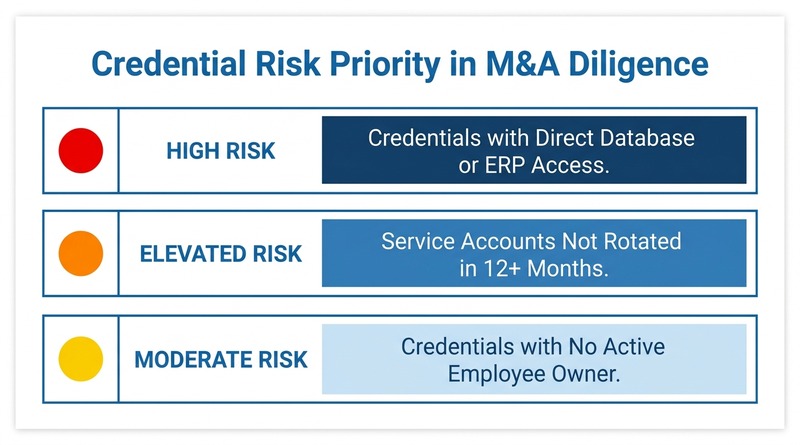
Not all credential exposure creates equal risk. Prioritize credentials that have direct database or ERP access, credentials associated with no active employee, and credentials that have not been rotated in more than 12 months. Work with the target’s IT team and M&A counsel to determine which credentials can be rotated or isolated before close as a condition to signing, and which require post-close remediation. The remediation budget for the latter should be funded from escrow rather than absorbed by the integration team’s existing operational capacity.
Step 5: Translate findings into deal terms, not just integration to-do lists
Application estate diligence findings should inform deal structure. Specific indemnity carve-outs for credential-related breaches discovered post-close, reps and warranties that represent the completeness of the application and credential inventory, and a defined escrow allocation for post-close remediation are all mechanisms that translate technical findings into financial protection. The governance evidence that matters after close — who knew what, when, and what was represented in the data room — depends on the documentation produced during diligence. The acquirer’s CIO is the person who has to defend that documentation if a breach occurs in the first 18 months post-close.
Frequently Asked Questions
What is application security debt in M&A, and why does it matter for deal value?
Application security debt in M&A refers to the accumulated security risk in a target company’s internal application estate: undocumented credentials, unpatched applications, shadow IT tools, AI-generated code with no provenance, and custom integrations with privileged access that have never been formally reviewed. It matters for deal value because it creates contingent liabilities — the cost of post-close credential remediation, the exposure to breach liability if ungoverned applications are exploited, and the integration delay caused by discovering undocumented dependencies after the deal closes. Standard IT diligence does not reliably surface this risk category, which is why it frequently surfaces instead in the 12 to 18 months following close.
How should CIOs audit a target company’s internal application estate during M&A due diligence?
Start by expanding the diligence scope definition to include applications built by business units, not just those formally managed by IT. Require the target to produce a credential and service account inventory as a distinct deliverable. Ask directly about AI coding assistant and low-code tool usage. Map credentials by access level and rotation recency. Prioritize credentials with direct database or ERP access that have not been rotated in over 12 months. Translate findings into deal terms — indemnity carve-outs, reps and warranties on the application inventory, and escrow-funded remediation — rather than leaving them as post-close items the integration team absorbs.
Why do acquired companies typically fail to document their internal application estates?
Internal applications are built to solve immediate operational problems, not to produce governance documentation. The developer or business-unit team building an integration tool focuses on making it work, not on creating an audit trail of what credentials it uses or what data it accesses. Over time, these applications become embedded in business processes, their original builders leave the company, and the institutional knowledge of how they function exists only in people who may no longer be available. The diligence window rarely provides enough time or access to reconstruct this documentation, which is why the gap persists through close and into integration.
What deal protections should acquirers require when the target cannot produce a complete application and credential inventory?
When the target cannot produce a complete inventory, acquirers should negotiate: specific indemnity language for credential-related security breaches discovered within 24 months post-close; reps and warranties representing the accuracy and completeness of the IT asset and application schedule, with cure mechanisms if undisclosed applications surface; mandatory pre-close rotation or isolation of high-risk service accounts as a condition to signing; and a defined remediation budget held in escrow rather than left to the integration team’s general operating budget. These protections do not eliminate the risk, but they price it into the deal structure and provide a financial recovery mechanism when the undocumented estate is eventually enumerated.
How does a governed development platform affect M&A application security due diligence for an acquired company?
A target company whose internal applications were built on CloudApper AI’s governed platform provides documented applications rather than undocumented ones. Every application carries a governance record — owner, data classification, credential map, compliance inheritance, and business process documentation — because the platform requires it at deployment. For an acquirer, diligence on platform-governed applications can proceed against existing documentation rather than interview-based reconstruction. The credential inventory exists. The compliance posture is certified. Applications built outside the governed platform still require conventional diligence, but the platform-governed portion of the estate represents a known, bounded, documentable risk rather than an open-ended one.
If your organization is evaluating an acquisition and needs to understand what a governed internal application estate looks like in diligence — or if you are building and deploying applications now and want the governance record that stands up to acquirer scrutiny — CloudApper AI provides the platform where documentation is a structural output of how applications are built. Reach out to learn more.

What is CloudApper AI Platform?
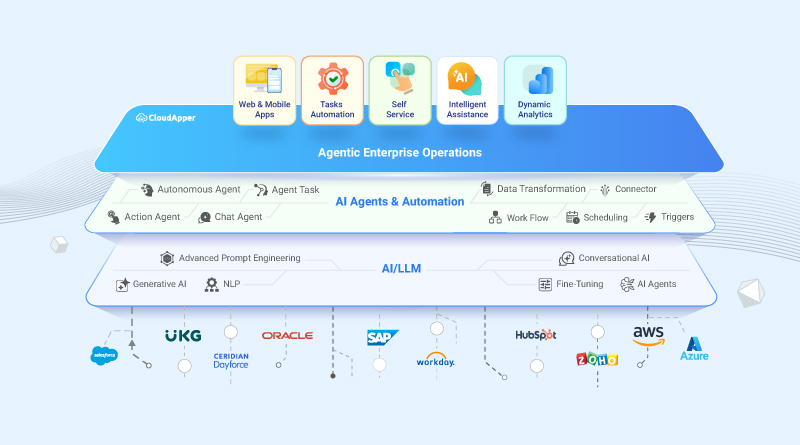
CloudApper AI is an advanced platform that enables organizations to integrate AI into their existing enterprise systems effortlessly, without the need for technical expertise, costly development, or upgrading the underlying infrastructure. By transforming legacy systems into AI-capable solutions, CloudApper allows companies to harness the power of Generative AI quickly and efficiently. This approach has been successfully implemented with leading systems like UKG, Workday, Oracle, Paradox, Amazon AWS Bedrock and can be applied across various industries, helping businesses enhance productivity, automate processes, and gain deeper insights without the usual complexities. With CloudApper AI, you can start experiencing the transformative benefits of AI today. Learn More
- Useful Links:
- Agentic AI
- No-Code/Low-Code
- Custom Software
- HCM Personalization
- iPaaS
- FedRAMP
CloudApper AI Solutions

- Works with








- and more.
Similar Posts

Vendor-Built Internal Applications: The Governance Gap Enterprise IT Inherited From…

What Your AI Development Platform Vendor’s Security Review Should Actually…