- Why this risk is harder to see than it looks
- What the failure actually looks like
- The industries where this risk is most acute
- What capturing institutional knowledge actually requires
- The modernization frame: turning a risk into an opportunity
- Questions to ask before the countdown runs out
- The Bottom Line
There is a system running in your organization right now that nobody fully understands.
It processes something important — payroll calculations, production scheduling, patient billing, compliance reporting, inventory management. It has been running for years, possibly decades. It mostly works. Nobody thinks about it much, because it mostly works.

And somewhere in your organization, there is a person — maybe two — who actually understands how it works. Not the documentation, which hasn’t been updated since the original implementation. Not the vendor, who may have been acquired twice and no longer supports this version. The person. The one who knows why that field populates the way it does, what that edge case in the calculation logic is actually doing, and what will happen to the quarterly reports if anyone touches the configuration in module seven.
That person is planning to retire. Or they’re getting calls from recruiters. Or they’re just quietly burning out and thinking about doing something else.
When they leave, the system doesn’t fail immediately. Legacy systems rarely announce their own fragility. What happens instead is slower and harder to manage: a question arises that nobody can answer. A change needs to be made that nobody knows how to make safely. An audit asks for documentation of a process that exists only in someone’s memory. A compliance requirement demands a modification that requires understanding the original business logic — logic that was never written down because the person who built it was always there to explain it.
This is the institutional knowledge time bomb. It is sitting in virtually every enterprise with systems more than ten years old. It is not a hypothetical risk. It is a countdown that most organizations have not started managing. What makes it solvable — before the clock runs out — is that AI platforms like CloudApper can now do what manual documentation never could: analyze an existing legacy system, extract its embedded business logic, map its data structures, and produce a structured modernization blueprint from the knowledge that currently exists only in people’s heads and aging codebases. That capability changes the calculus from “how do we document before they leave” to “how do we preserve and modernize before we have to.”
Why this risk is harder to see than it looks
The institutional knowledge problem doesn’t feel urgent until it is. That’s what makes it dangerous.
The person who holds the knowledge is still there. The system is still running. Nobody is raising a formal concern because nothing has formally gone wrong. The risk is invisible in the way that all deferred risks are invisible — present and accumulating, but not yet manifesting as a problem that demands attention.
There are a few specific reasons why enterprise IT organizations systematically underestimate this risk.
The system works, so the assumption is that it will continue to work: Legacy systems have a kind of operational credibility that comes from longevity. A system that has been running for fifteen years without a major failure is intuitively assumed to be stable. What that longevity actually demonstrates is that the system has been maintained by people who understood it. That maintenance is what produced the stability — not anything inherent in the system itself. When the maintainers leave, the stability leaves with them.
Documentation exists, but it’s not the same as knowledge: Most legacy systems have some documentation — installation guides, user manuals, configuration records from the original implementation. That documentation describes the system as it was designed, not as it actually works after years of accumulated modifications, workarounds, and undocumented decisions. The gap between what the documentation says and what the system actually does is the institutional knowledge gap. It lives in people, not in files.
The people who hold the knowledge don’t know how much they know: This is perhaps the most counterintuitive aspect of the problem. The people who hold critical institutional knowledge about legacy systems often don’t think of themselves as knowledge holders. They just know how to do their job. The significance of what they know — and what will be lost when they leave — is not obvious to them because they’ve never had to articulate it. It’s never come up, because they’ve always been there.
Succession planning treats people, not systems: When organizations think about knowledge transfer for departing employees, they usually focus on process knowledge — how to do the job. They’re less systematic about technical knowledge — how the systems that support the job actually work. The outgoing employee trains a replacement on the process. Nobody systematically captures the technical knowledge about the legacy system that the outgoing employee holds, because that knowledge isn’t part of the formal job description.
What the failure actually looks like
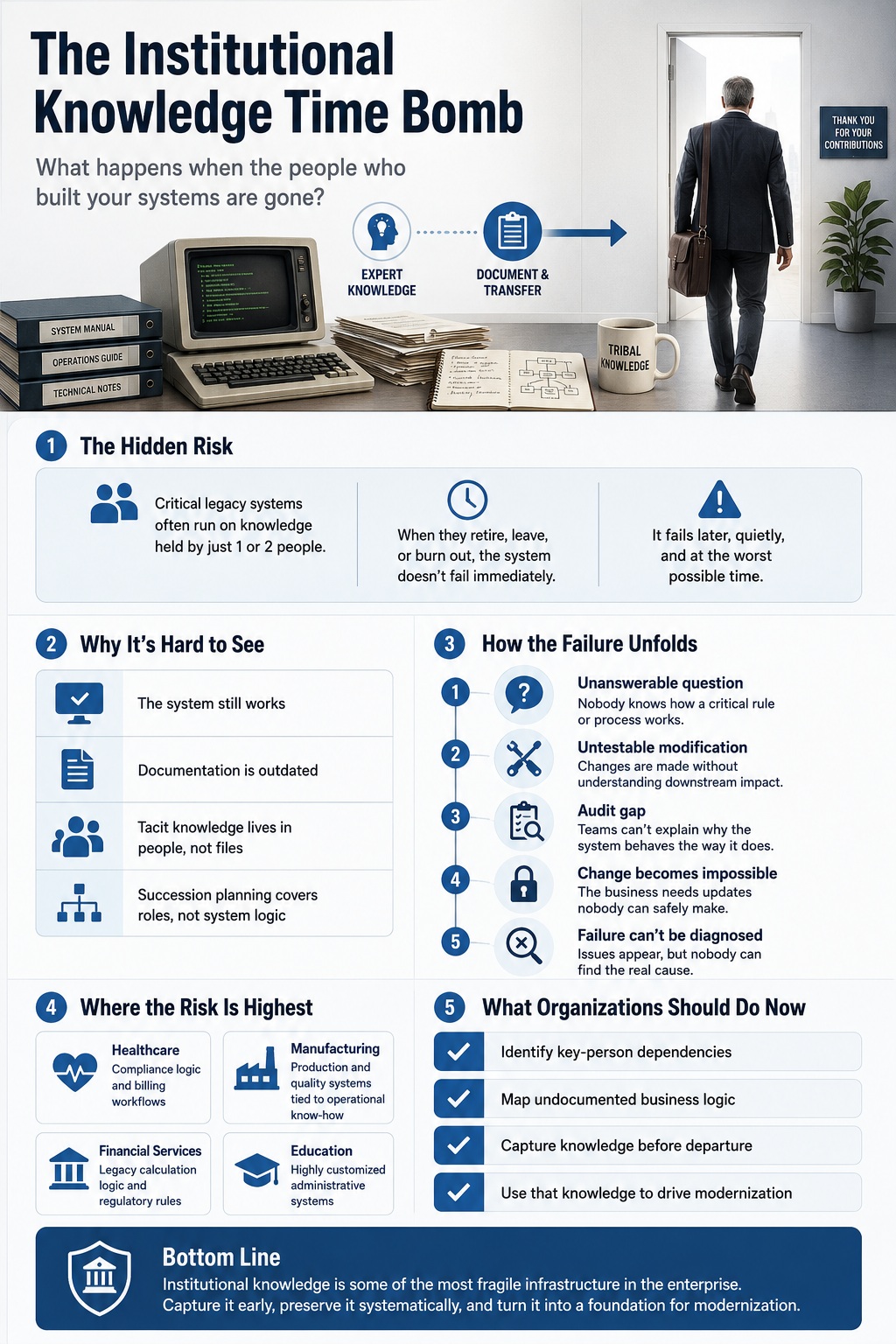
When an organization loses the last person who understands a legacy system, the consequences don’t arrive all at once. They arrive incrementally, in a sequence that is initially manageable and eventually becomes a crisis.
Phase one: The unanswerable question: Something changes in the business environment — a regulatory requirement, a reporting need, an integration with a new system — and the IT team needs to understand how a piece of the legacy system works in order to respond. The person who would have known has left. Nobody who remains can answer the question with confidence. The team makes its best guess, or defers the change, or implements something around the legacy system rather than in it.
Phase two: The untestable modification: A change needs to be made to the legacy system. Maybe it’s a required compliance modification. Maybe it’s a fix for a bug that has surfaced. The team makes the change, but without understanding the full system, cannot be confident that the change doesn’t have unintended downstream effects. Testing is incomplete because nobody knows all the things that need to be tested. The change goes in. Something breaks later, in a way nobody predicted, in a part of the system that wasn’t obviously connected to the change.
Phase three: The audit that can’t be satisfied: A compliance audit asks for documentation of a business process that the legacy system implements. The documentation doesn’t exist in the form the auditor needs. The team tries to reconstruct it from the system itself, but without understanding the original design intent, can’t explain confidently why the system works the way it does. The audit finding requires remediation. The remediation requires understanding the system. The understanding doesn’t exist. The remediation takes far longer and costs far more than it should.
Phase four: The modification that can’t be made: The business needs a change to the legacy system that would have been straightforward for the person who originally built it. For the team that inherited it without knowledge transfer, the change is effectively impossible without reverse-engineering the system — which requires time, expertise, and access to documentation that may not exist. The organization ends up building something parallel to the legacy system rather than modifying it, creating two systems where there was one and compounding the maintenance and governance problem.
Phase five: The failure that can’t be diagnosed: The system fails in a way that nobody can explain. The error messages are cryptic. The logs don’t tell the story clearly. The documentation is useless. The team that responds to the incident doesn’t have the context to understand what went wrong, which means they can’t be confident that their fix actually addresses the root cause rather than the symptom. The system gets restarted. The failure reoccurs. The cycle continues until the organization decides the only option is a full replacement — which it now must do under crisis conditions rather than planned conditions.
Each phase is significantly more expensive than the previous one. The organization that addresses the institutional knowledge problem before phase one arrives spends a fraction of what the organization that discovers it in phase four or five will spend.
The industries where this risk is most acute
While the institutional knowledge problem exists in virtually every enterprise with aging systems, certain industries face it with particular severity.
Healthcare: Hospital systems and health networks have clinical and administrative legacy systems that often encode years of regulatory interpretation — decisions made by people who understood both the system and the regulatory environment at a specific point in time. When those people leave, the regulatory context for the system’s design leaves with them. The system continues to run, but nobody can explain with confidence why it was built the way it was or whether the original compliance rationale still holds.
Manufacturing: Process manufacturers and industrial enterprises often have production management and quality systems built in close collaboration with engineers who understood both the software and the physical process it supported. The integration between the system’s logic and the operational reality on the floor is institutional knowledge that rarely gets documented because it was developed iteratively over years. When the engineers who built it retire, the operational knowledge and the system knowledge separate — and neither is fully coherent without the other.
Financial services: Banks, insurance companies, and financial services firms have calculation logic in legacy systems that encodes regulatory requirements, product terms, and actuarial assumptions from decades past. The people who built those systems understood why the calculations work the way they do — what regulatory requirement drove a particular approach, what product feature required a specific exception. That context is gone when they leave, leaving behind calculations that produce correct outputs through logic that nobody can fully explain.
Education: Universities and school systems have student information systems, financial systems, and administrative applications that have accumulated institutional customizations over decades. The registrar who knows why graduation requirements are calculated a specific way, the financial aid administrator who understands why a certain class of exceptions is handled differently — their knowledge is embedded in system configuration and business rules that will be opaque to anyone who wasn’t there when those decisions were made.
What capturing institutional knowledge actually requires
The instinct when this problem is recognized is to ask the departing employee to document everything before they leave. That approach fails predictably and for understandable reasons.
Documentation produced under departure conditions is incomplete. The departing employee doesn’t know what they don’t know they know — the tacit knowledge that feels obvious to them but is not obvious to anyone else. They document the things they think are important. They don’t document the things they take for granted, which are often the things that matter most.
Documentation produced under time pressure is shallow. Two weeks of documentation before a departure produces a surface-level overview, not the deep technical and contextual knowledge that the team will actually need when something goes wrong.
Documentation that isn’t actively maintained becomes stale immediately. A document that accurately described the system at departure becomes less accurate every month as the system continues to evolve — because nobody who understands it well enough to update the documentation is still there.
Effective institutional knowledge capture requires something more systematic: a process that extracts and preserves knowledge while the people who hold it are still present and engaged, produces documentation that is structured for future reference rather than retrospective understanding, and uses the captured knowledge as the foundation for a governed modernization process rather than as a standalone archive.
The organizations that handle this well don’t wait for departure to trigger documentation. They treat institutional knowledge capture as a parallel track to system modernization — using the knowledge extraction process to build the requirements foundation for a modernized system that encodes the institutional knowledge in documented, maintainable form rather than in the minds of individuals who will eventually leave. CloudApper‘s approach to this is direct: upload the legacy system, share whatever documentation exists — however incomplete — describe how it works, and the platform’s AI analyzes everything to automatically produce structured software requirements. Business logic that lives in a database configuration, edge cases that exist only in someone’s memory, workflows that were never formally documented — all of it becomes input for a governed modernization process rather than a gap that only surfaces after the wrong person leaves.
The modernization frame: turning a risk into an opportunity
The organizations that handle this well don’t wait for departure to trigger documentation. They treat institutional knowledge capture as a parallel track to system modernization — using the knowledge extraction process to build the requirements foundation for a modernized system that encodes the institutional knowledge in documented, maintainable form rather than in the minds of individuals who will eventually leave. CloudApper is built specifically for this transition: upload the legacy system, share whatever documentation exists — however incomplete — describe how it works, and CloudApper’s AI analyzes everything to automatically produce structured software requirements. Business logic embedded in database configurations, edge cases that exist only in someone’s memory, workflows that were never formally documented — all of it becomes structured input for a governed modernization process rather than institutional debt that surfaces only after the wrong person walks out the door.
The departing employee who holds critical system knowledge is also the best possible source of requirements for the system that should replace the one they’re leaving behind. They know what the current system was supposed to do. They know where it falls short. They know the business rules that drive its behavior and the edge cases that required special handling. They know the workarounds that accumulated over years of operational reality.
That knowledge, captured systematically before departure, is the input for a modernization process that produces a replacement system with documented logic, maintainable architecture, and the institutional knowledge encoded in the system rather than in the people who run it.
This reframe changes the urgency dynamic. Instead of scrambling to document a legacy system before a key departure, the organization is capturing the knowledge it needs to build something better — and the time pressure of an impending departure becomes the deadline that drives a modernization project that should have happened anyway.
The AI-assisted modernization tools available today make this significantly more practical than it would have been five years ago. Feeding institutional knowledge — described in natural language, in existing documentation however incomplete, in process descriptions from the people who hold it — into a structured requirements generation process produces a modernization foundation in weeks rather than months. The knowledge that would have walked out the door becomes the architecture of the system that replaces the one it supported.
Questions to ask before the countdown runs out
If your organization has legacy systems with concentrated institutional knowledge, a few questions will surface how far along the countdown is:
- Who in your organization has knowledge about critical legacy systems that is not documented anywhere and that no one else currently holds?
- Of those people, how many are within five years of retirement, actively being recruited, or showing signs of disengagement?
- For your most critical legacy systems, could you produce a complete description of the business logic they implement — not the documentation from the original implementation, but an accurate description of how the system actually works today?
- If the person who best understands your most critical legacy system gave notice tomorrow, what would you do, and how long would it take before the absence of their knowledge became operationally significant?
The answers to those questions define the urgency of the problem. Most organizations that work through them honestly find that the countdown is closer to zero than they assumed.
The Bottom Line
Every enterprise with legacy systems older than ten years has institutional knowledge concentrated in a small number of people. Those people will eventually leave — through retirement, recruitment, burnout, or circumstances outside anyone’s control.
The system doesn’t fail when they leave. It fails later, incrementally, in ways that are difficult to diagnose and expensive to fix because the knowledge required to understand and maintain the system left before anyone thought to capture it.
The organizations that address this risk before the countdown reaches zero spend a fraction of what the organizations that discover it in crisis will spend. The institutional knowledge that feels permanent because it has always been available is the most fragile infrastructure in the enterprise — and the most invisible, right up until the moment it isn’t.
CloudApper uses AI to capture and preserve institutional knowledge from legacy systems — generating structured software requirements from existing documentation, system analysis, and the knowledge of the people who built and maintained them. The result is a modernized system where institutional knowledge is encoded in documented, maintainable architecture rather than in individuals who will eventually leave. Contact us to see how organizations in your situation are approaching this before the knowledge walks out the door.

What is CloudApper AI Platform?
CloudApper AI is an advanced platform that enables organizations to integrate AI into their existing enterprise systems effortlessly, without the need for technical expertise, costly development, or upgrading the underlying infrastructure. By transforming legacy systems into AI-capable solutions, CloudApper allows companies to harness the power of Generative AI quickly and efficiently. This approach has been successfully implemented with leading systems like UKG, Workday, Oracle, Paradox, Amazon AWS Bedrock and can be applied across various industries, helping businesses enhance productivity, automate processes, and gain deeper insights without the usual complexities. With CloudApper AI, you can start experiencing the transformative benefits of AI today. Learn More
- Useful Links:
- Agentic AI
- No-Code/Low-Code
- Custom Software
- HCM Personalization
- iPaaS
- FedRAMP