- What FedRAMP Actually Authorizes
- The Three Mistakes That Come Up Most Often
- Why Documentation Is the Real Bottleneck
- The Inherited Compliance Alternative
- What This Means for Organizations Pursuing Initial Authorization
- FIPS, FedRAMP, and the Multi-Framework Reality
- The Government Contractor Scenario
- Practical Steps Before Your Next FedRAMP Assessment
- The Architecture Decision That Makes This Manageable
- Talk to CloudApper About Your FedRAMP Environment
FedRAMP authorization is one of the more demanding compliance exercises a technology organization can go through. The process is long, expensive, and unforgiving about documentation gaps. Organizations that have been through it once rarely want to go through it again — which is part of why the idea of inheriting compliance from an already-authorized platform is so appealing.
It’s also why the recent wave of AI coding tools creates a specific problem that most teams aren’t thinking through carefully enough until they’re already in the middle of it.

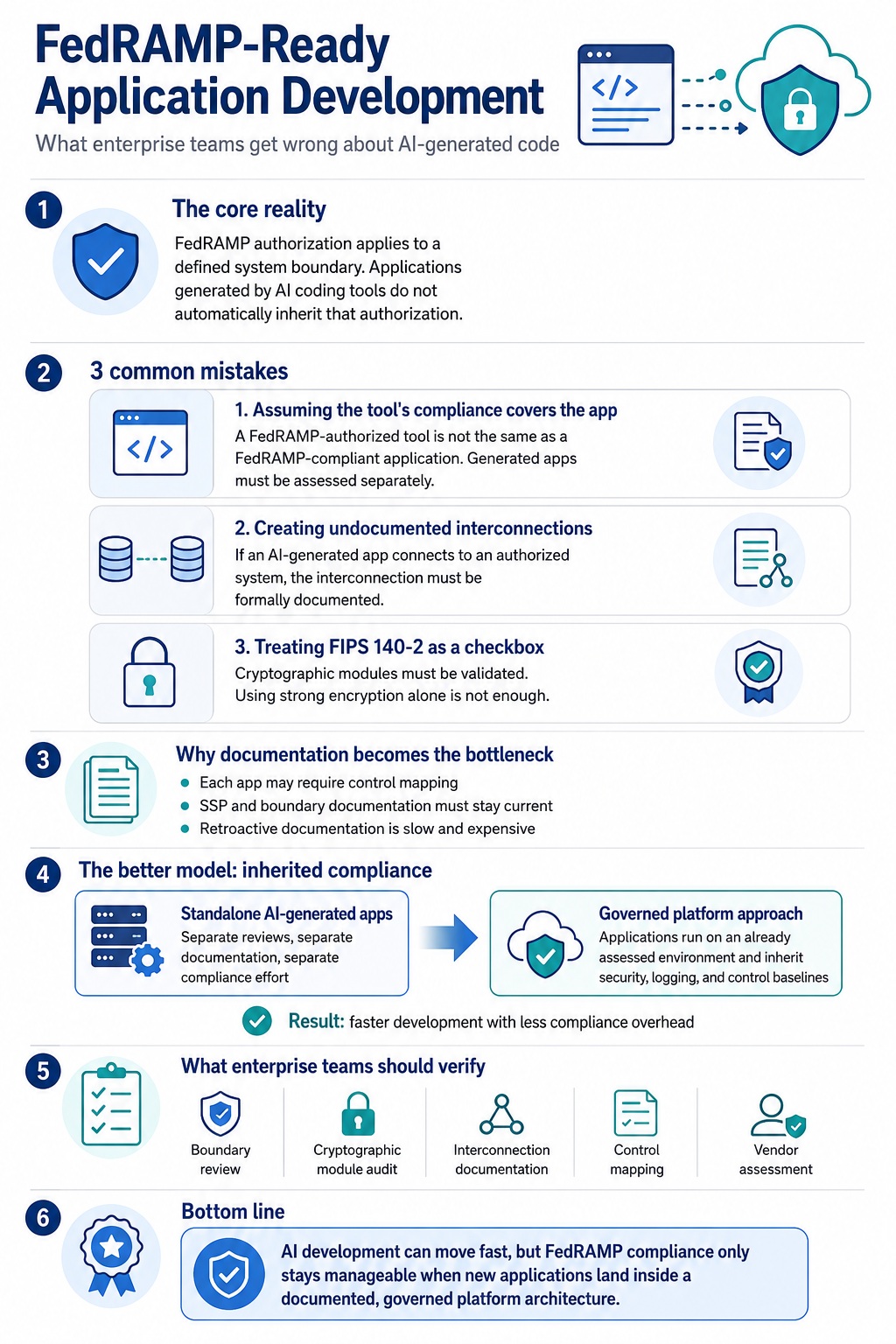
The short version: FedRAMP-authorized or FedRAMP Ready status applies to a defined system boundary. Anything you build on top of that boundary — including applications generated by AI coding tools — does not automatically inherit that authorization. It needs to be assessed separately, documented thoroughly, and integrated into your existing authorization package in a way that satisfies NIST SP 800-53 controls.
Most teams using AI coding tools in federal or federal-adjacent environments haven’t worked through what that means in practice.
What FedRAMP Actually Authorizes
FedRAMP authorization isn’t a blanket certification that covers everything your organization does. It covers a specific system — defined by a boundary that includes infrastructure, software, data flows, and the controls applied to each.
When your team builds a new application using an AI coding tool, that application sits somewhere in relation to your authorization boundary. If it processes, stores, or transmits federal data, it either needs to be within your existing authorization boundary (with your SSP updated accordingly) or it needs its own assessment. If it’s outside the boundary but touches authorized systems, that connection needs to be documented as an interconnection.
None of this is new. Federal system owners have been managing application sprawl within authorization boundaries for years. What’s new is the pace at which AI coding tools can generate applications — and the fact that each one of those applications may have its own database, its own data access rules, its own authentication implementation, and its own security characteristics that need to be assessed and documented.
A team that builds one application every six months, using traditional development methods, can manage this. A team that’s generating multiple internal applications per month using AI tools is creating documentation and assessment obligations faster than most federal compliance programs are designed to handle.
The Three Mistakes That Come Up Most Often
Mistake 1: Assuming the AI tool’s compliance covers the application
Some AI coding tools run on compliant infrastructure. That doesn’t mean the code they generate is compliant.
FedRAMP authorization covers the tool itself as a system — its infrastructure, its data handling, its access controls. It says nothing about whether the applications generated by that tool meet the security requirements of your specific authorization boundary. The generated application has its own attack surface, its own data access patterns, its own vulnerabilities. Those need to be assessed against your control baseline independently.
This is the most common misunderstanding. “We use a FedRAMP-authorized tool” is not the same as “the applications our tool produces are FedRAMP-compliant.” They’re different systems, assessed separately.
Mistake 2: Creating unauthorized system interconnections
When an AI-generated application needs to access data from an authorized system — your federal database, your authorized ERP — that connection is a system interconnection. NIST SP 800-53 CA-3 requires that interconnections between systems be formally documented with an Interconnection Security Agreement (ISA) or a Memorandum of Understanding (MOU).
AI coding tools generate data connections quickly and without ceremony. An application needs customer data, so it connects to the customer database. An application needs to pull from the ERP, so it connects to the ERP API. Each one of those connections, if it touches an authorized system boundary, needs formal documentation.
In a rapid AI development environment, it’s easy to end up with a dozen undocumented interconnections that only become visible during an assessment — at which point they’re findings, not just paperwork gaps.
Mistake 3: Treating FIPS 140-2 as a checkbox
FIPS 140-2 (and its successor, FIPS 140-3) requires that cryptographic modules used in federal systems be validated. That validation applies to specific implementations — not to “we use AES-256 in general.”
AI-generated code frequently implements cryptographic functions using whatever library seemed appropriate at generation time. Those libraries may or may not use FIPS-validated cryptographic modules. The distinction matters: using an unvalidated cryptographic library in a system that handles federal data is a FIPS non-compliance finding, regardless of whether the underlying algorithm is theoretically strong.
Auditors checking FIPS compliance during a FedRAMP assessment will ask for documentation of which cryptographic modules are in use and confirmation that they’re validated. “The AI wrote it” is not an acceptable answer.
Why Documentation Is the Real Bottleneck
Federal compliance is a documentation exercise as much as it is a technical one. The NIST controls framework requires not just that you implement controls, but that you can demonstrate and document how each control is satisfied.
AI-generated code creates a documentation problem that’s genuinely hard to solve retroactively. When a developer writes code themselves, they understand what it does and can document how it satisfies specific controls. When an AI generates code, that understanding isn’t automatic — it has to be developed through review, and the review has to be thorough enough to produce documentation an assessor will accept.
For a single application, this is manageable. For an environment where multiple teams have been generating applications at AI speed for 12–18 months, the documentation backlog can be significant. Some organizations have discovered this during authorization renewal — they have working applications in production, the applications are doing useful things, but the compliance documentation doesn’t exist or isn’t sufficient for the controls they need to satisfy.
Fixing that retroactively is slow, expensive, and sometimes requires taking applications out of service while assessments are completed.
The Inherited Compliance Alternative
The cleaner answer to this problem is to not generate it in the first place.
If applications run on a platform that is already within an authorization boundary — or already FedRAMP Ready with a documented control baseline — those applications don’t create new authorization obligations in the same way. They operate within an already-assessed environment. New applications inherit the control baseline from the platform. The documentation burden is at the platform level, not the per-application level.
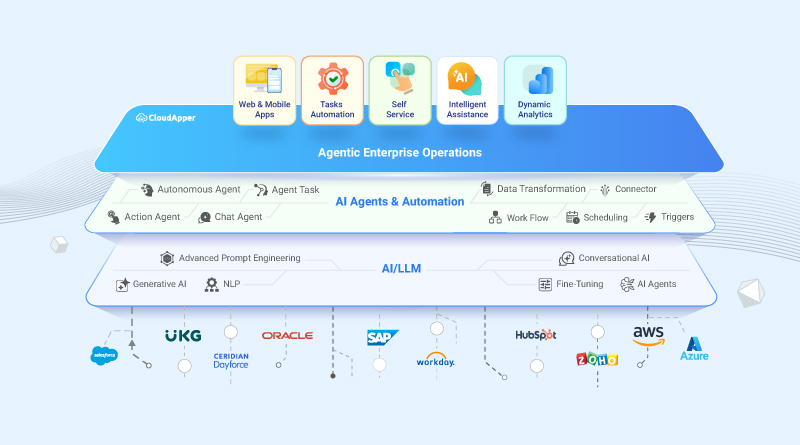
This is what CloudApper’s FedRAMP Ready platform does. Instead of generating source code that your team deploys independently, CloudApper generates application blueprints that run on a certified application server. Every application built on the platform runs within the same defined boundary. Security controls, FIPS-validated cryptography, access controls, and audit logging are platform-level characteristics, not per-application implementations.
For federal contractors and organizations building toward FedRAMP authorization, this changes the architecture of the compliance problem considerably. Instead of assessing each AI-generated application individually, you’re operating within a platform whose controls are already documented and assessed. New applications extend the platform; they don’t create new boundaries.
This also means the FIPS 140-2 question has a clean answer: CloudApper’s platform uses validated cryptographic modules. Applications built on it inherit that characteristic. There’s no per-application cryptographic library audit to conduct.
What This Means for Organizations Pursuing Initial Authorization
For organizations in the process of pursuing their first FedRAMP authorization — not renewing an existing one, but going through the initial process — AI coding tools add a specific risk that’s worth understanding before it shows up as a finding.
The authorization boundary definition is one of the first and most consequential decisions in the process. Boundaries that are too broad are expensive to assess and maintain. Boundaries that are too narrow can be challenged if assessors find systems handling federal data outside them.
AI-generated applications that have been built rapidly, without clear consideration of where they sit relative to the boundary definition, can create scope problems. Either they’re inside the boundary (and need to be assessed as part of it) or they’re outside it (and shouldn’t be touching federal data). Getting that determination right for applications that were built quickly and without formal documentation requires significant remediation work.
Starting with a platform architecture that was designed for FedRAMP compliance from the beginning avoids this problem. The boundary definition is cleaner, the control documentation exists, and new applications don’t create scope ambiguity.
FIPS, FedRAMP, and the Multi-Framework Reality
Most enterprise organizations navigating FedRAMP aren’t doing so in isolation. Healthcare organizations serving government clients face HIPAA and FedRAMP simultaneously. Defense contractors face FedRAMP and CMMC. Commercial organizations processing certain categories of government data face FedRAMP and FISMA.
Each framework has its own control baseline, its own assessment requirements, and its own documentation obligations. Managing those independently — with separate security reviews for each AI-generated application across multiple frameworks — is genuinely unsustainable at the pace modern development teams work.
The organizations that handle multi-framework compliance well have usually made one key architectural decision: they’ve chosen infrastructure and development platforms where compliance is structural rather than per-application. One set of controls, one documentation baseline, one set of audits that satisfies multiple frameworks.
CloudApper’s platform is built for this. It’s FedRAMP Ready, SOC 2 audited, and carries controls for HIPAA, FIPS, CCPA, FERPA, and GDPR from a single infrastructure baseline. Organizations dealing with overlapping compliance frameworks aren’t running parallel compliance programs — they’re running one, from a platform designed to satisfy all of them.
The enterprise AI security architecture behind this matters: regional data residency keeps federal data within authorized AWS regions, AES-256 encryption with FIPS-validated modules covers cryptographic requirements, and independent SOC 2 audits provide the third-party validation that FedRAMP and other frameworks require.
The Government Contractor Scenario
There’s a specific version of this problem that affects commercial enterprises more than pure-play government IT shops: the government contractor that is rapidly building internal tooling to support contract delivery.
A logistics company that wins a federal transportation contract suddenly needs internal applications to manage compliance reporting, track shipments against federal requirements, handle personnel clearance documentation, and manage subcontractor compliance. Their development team, using AI coding tools, can build these applications in weeks instead of months.
Each of those applications, if it touches data subject to federal requirements, creates a compliance obligation. The fact that the company built them internally for internal use doesn’t change that. If federal data flows through an AI-generated application that lives outside any authorization boundary, that’s a potential finding — and in some contracting contexts, a contract risk.
CloudApper’s platform for enterprise application development addresses this directly: the applications run on a certified, FedRAMP Ready server, federal data stays within regional boundaries, and the control baseline is documented and auditable. Government contractors can build the internal tooling they need at the pace AI development enables, without creating compliance exposure in the process.
Practical Steps Before Your Next FedRAMP Assessment
If your organization has been using AI coding tools to build applications in a federal or federal-adjacent environment, a few things are worth working through before your next assessment or authorization renewal.
Boundary review: Map every AI-generated application currently in operation. Determine where each one sits relative to your authorization boundary. Any application touching federal data that isn’t clearly inside or outside the boundary is an ambiguity your assessor will surface.
Cryptographic module audit: For each AI-generated application that handles federal data, identify the cryptographic libraries in use and verify they implement FIPS-validated modules. Applications using standard open-source libraries should be checked carefully — FIPS validation status varies significantly.
Interconnection documentation: Review AI-generated applications for connections to authorized systems. Any undocumented interconnection to a system within your authorization boundary needs an ISA or MOU before your next assessment.
Control mapping: For applications inside your boundary, document how each one satisfies the NIST 800-53 controls applicable to its function. If documentation doesn’t exist or is insufficient, that’s your remediation backlog.
Vendor assessment: If the AI coding tools your team uses aren’t in your authorized vendor list with completed security assessments, add them. For tools that process or have access to federal data as part of their operation, a FedRAMP authorization or equivalent assessment is required.
Working through this list before an assessment is significantly less expensive than working through it as a findings remediation exercise.
The Architecture Decision That Makes This Manageable
FedRAMP compliance with AI coding tools isn’t impossible. Organizations are doing it. But the ones doing it well have generally made one architectural decision that keeps the compliance overhead manageable: they’ve chosen a development platform where the authorization work has already been done at the infrastructure level.
That decision doesn’t constrain development. Building custom enterprise software on a FedRAMP Ready platform with AI-driven development tools still means applications built in days instead of months. It still means your team can create the internal tooling they need without waiting for a traditional development cycle. What changes is that those applications land in an environment with documented controls, assessed boundaries, and FIPS-compliant cryptography — rather than creating new compliance obligations every time someone builds something useful.
That’s a meaningful operational difference. And it’s one that shows up very clearly at assessment time.
Talk to CloudApper About Your FedRAMP Environment
If your organization is operating under a FedRAMP authorization, pursuing initial authorization, or building applications for federal clients, CloudApper can walk through specifically how the platform’s architecture maps to your authorization requirements.
Schedule a conversation with the CloudApper team →
Bring your current SSP scope, your active AI tooling inventory, and your compliance framework requirements. The conversation will focus on your specific boundary questions, not a general platform overview.

What is CloudApper AI Platform?
CloudApper AI is an advanced platform that enables organizations to integrate AI into their existing enterprise systems effortlessly, without the need for technical expertise, costly development, or upgrading the underlying infrastructure. By transforming legacy systems into AI-capable solutions, CloudApper allows companies to harness the power of Generative AI quickly and efficiently. This approach has been successfully implemented with leading systems like UKG, Workday, Oracle, Paradox, Amazon AWS Bedrock and can be applied across various industries, helping businesses enhance productivity, automate processes, and gain deeper insights without the usual complexities. With CloudApper AI, you can start experiencing the transformative benefits of AI today. Learn More
- Useful Links:
- Agentic AI
- No-Code/Low-Code
- Custom Software
- HCM Personalization
- iPaaS
- FedRAMP