Workday wasn't built to hand its HR data to AI agents built outside IT. This article examines the governance gap opening as enterprise teams use AI coding tools to extend Workday with custom agents, and what a governed extension model looks like before the next agent ships to production.

TL;DR
Workday's own governance model works well inside Workday, but AI agents and AI-generated extensions built on top of it don't automatically inherit that same access control, audit logging, or compliance posture. As enterprise IT and HR technology teams use AI coding tools to extend Workday faster, each ungoverned agent creates its own data handling risk, and most organizations can't currently account for every AI integration touching their Workday instance. A governed extension model routes every agent through a single access control and audit layer instead. For senior decision-makers, the takeaway is that Workday extension work needs a consistent governance framework in place before, not after, AI agents proliferate across the HR data estate.
Table of Contents
- Why This Is Suddenly Urgent
- The Governance Gap Workday Itself Can’t Close
- What an Ungoverned Workday Agent Actually Looks Like
- The Distinction Enterprise IT Keeps Missing
- Where This Becomes an Audit Problem, Not Just a Security Problem
- What a Governed Approach to Workday Extension Looks Like
- Evaluating Vendors for This Specific Problem
- What Enterprise IT Should Do Before the Next Agent Ships
Workday holds some of the most sensitive data in the enterprise: compensation history, performance reviews, immigration status, disability accommodations, disciplinary records. For years, that data stayed inside Workday’s own walls, governed by Workday’s own access model. That containment is breaking down, not because Workday changed, but because AI agents are now the fastest way to extend what an HCM platform does, and most of them were never designed with Workday’s governance model in mind.

An AI agent that reads employee records to answer a manager’s question, flags a compliance gap, or automates a workflow step has to touch the same data Workday was built to protect. The question enterprise IT teams are only now confronting is what happens to that data once it leaves Workday’s boundary and enters an agent’s context window, its logs, or a downstream integration nobody in security signed off on.
Why This Is Suddenly Urgent
Workday has spent the past two years building its own AI agent capabilities, and enterprise vendors, plus internal development teams, have followed with AI coding tools that generate custom agents and extensions on top of the platform. GitHub Copilot, Cursor, and similar tools make it fast to prompt an agent into existence that reads from Workday’s API, summarizes data, or triggers actions. Fast is the problem.
An AI-assisted developer can generate a working Workday integration in an afternoon. What that code does with the data it pulls, where it stores it, whether it logs sensitive fields in plaintext, whether it respects the same role-based access controls Workday enforces natively, depends entirely on whether anyone reviewed it before it went live. AI-generated code carries a documented vulnerability rate in the 40 to 45 percent range, and none of that code inherits Workday’s own security posture just because it talks to Workday’s API.
This is where CloudApper eliminates the security, compliance, and maintenance risks of AI-generated code before it ever touches a system like Workday. The platform doesn’t generate raw source code that a Workday extension then has to maintain forever. It generates governed application definitions that run inside a certified runtime, which means the same access controls and audit trail apply whether the app is reading Workday data for a compensation report or triggering an onboarding workflow.
The Governance Gap Workday Itself Can’t Close
Workday is exceptional at governing data inside Workday. Role-based security, business process framework, audit logs, all of that works as designed within the platform’s own boundary. The gap opens the moment an organization needs Workday to do something it wasn’t built to do: surface data to a chatbot, feed a workflow tool, power an AI agent that spans Workday and three other systems.
At that point, the enterprise is either waiting on Workday’s product roadmap for a feature that may or may not ship, or building a custom extension. Why your HCM system will never do everything you need is a problem enterprise IT is already working through, and that gap is exactly where AI-generated extensions are proliferating fastest, often with the least oversight. Whether that extension belongs inside the tenant in Workday Extend or outside it is a separate decision with its own tradeoffs; this article is about governing whatever you build, wherever it runs.
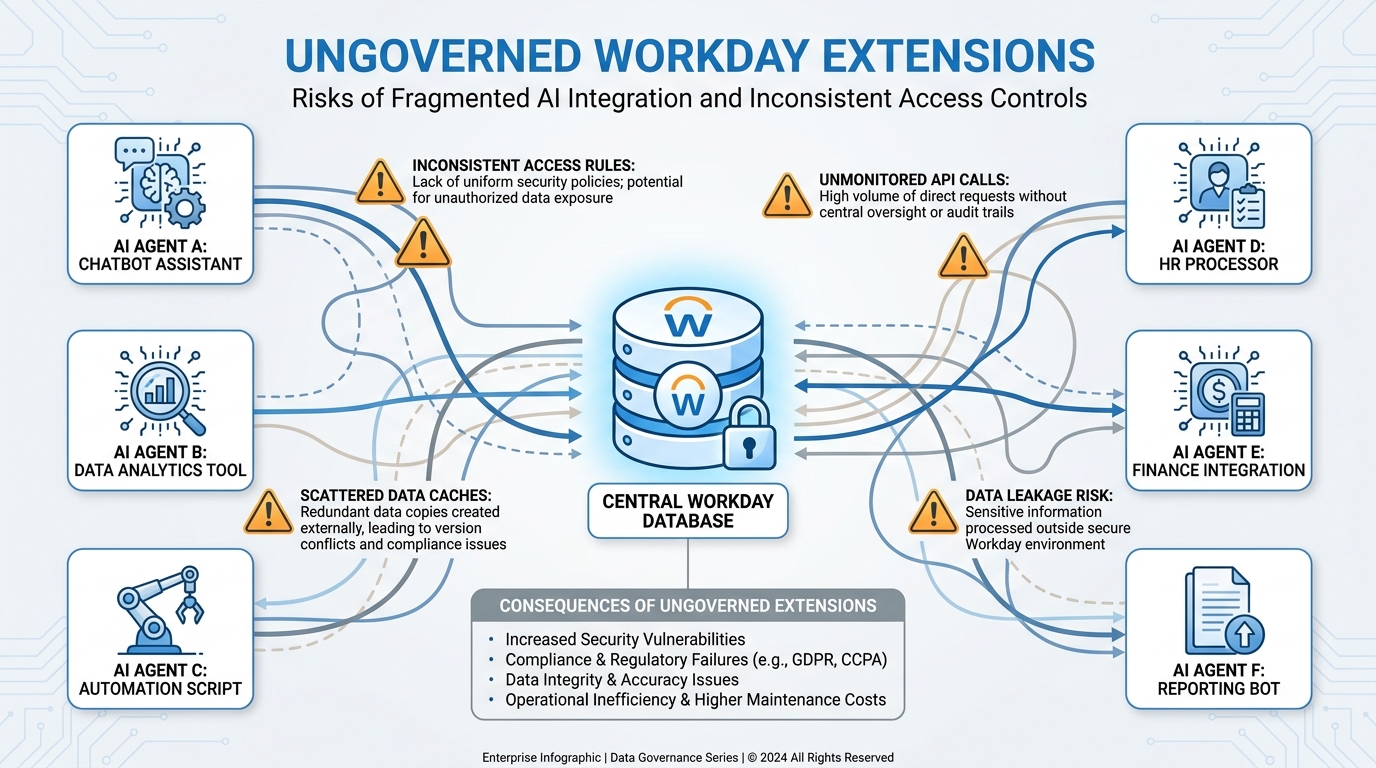
The trouble is that most teams solve this gap the same way they’d solve any other integration problem: prompt an AI coding assistant, generate the connector, ship it. Each one of those extensions creates its own logic, its own data handling pattern, and its own vulnerability surface. None of them inherit Workday’s governance model, and none of them get audited with the rigor that Workday’s own configuration receives. Multiply that across a few dozen internally built agents and integrations, and IT has lost visibility into where employee data actually lives.
What an Ungoverned Workday Agent Actually Looks Like
Picture a manager-facing agent built to answer questions like “who on my team is eligible for promotion” or “flag anyone whose leave balance is running low.” A developer prompts an AI coding tool, it pulls the relevant Workday fields through an API call, caches results locally for performance, and ships to production in a sprint.
None of that is hypothetical. It is the default pattern for how these agents get built today. The caching layer that made the agent fast now holds compensation and leave data outside Workday’s access controls. The API credentials are often broader than the agent needs, because scoping permissions precisely takes more time than the sprint allowed. And when a compliance team eventually asks who has access to this data and how it’s logged, the answer is scattered across a Slack thread, a GitHub repo, and whatever the original developer remembers.
Every generated app creates its own logic, its own data access patterns, and its own vulnerabilities, and must be individually audited, which is manageable for one agent and unworkable for the dozens an enterprise Workday deployment tends to accumulate over a few years.
The Distinction Enterprise IT Keeps Missing
There’s an important difference between an AI agent that answers questions and one that takes action inside Workday: approving a change, initiating a workflow, modifying a record. Why enterprise AI agents are not the same as chatbots is a distinction that matters for IT governance, and it matters even more when the agent in question has write access to HR data that feeds payroll, benefits eligibility, and compliance reporting.
A chatbot that answers “what’s our PTO policy” carries low risk if it hallucinates. An agent that reads an employee’s leave balance and automatically approves a request based on that read carries a very different risk profile, one where a bad prompt, a stale cache, or an unscoped permission can produce a real HR action with real downstream consequences. Enterprise IT teams evaluating Workday agents need to classify each one by what it’s authorized to do, not just what data it touches, and govern accordingly.
Where This Becomes an Audit Problem, Not Just a Security Problem
Workday customers in regulated industries, healthcare, financial services, manufacturing with union workforces, already answer to auditors about how HR data is accessed and by whom. An AI agent built outside Workday’s governance model introduces a question most compliance teams haven’t had to answer yet: can you show us the access log for every AI-generated integration touching employee records, and can you demonstrate that each one enforces the same role-based restrictions Workday applies natively?
The hidden security risks of letting developers use AI coding assistants without a governance framework compound specifically around HCM data, because the blast radius of a leak isn’t a broken feature, it’s exposed compensation records, protected health information tied to accommodations, or immigration status data subject to its own regulatory handling requirements. An auditor asking about Workday extensions in six months deserves a better answer than “we’re not entirely sure how many of those exist.”
What a Governed Approach to Workday Extension Looks Like
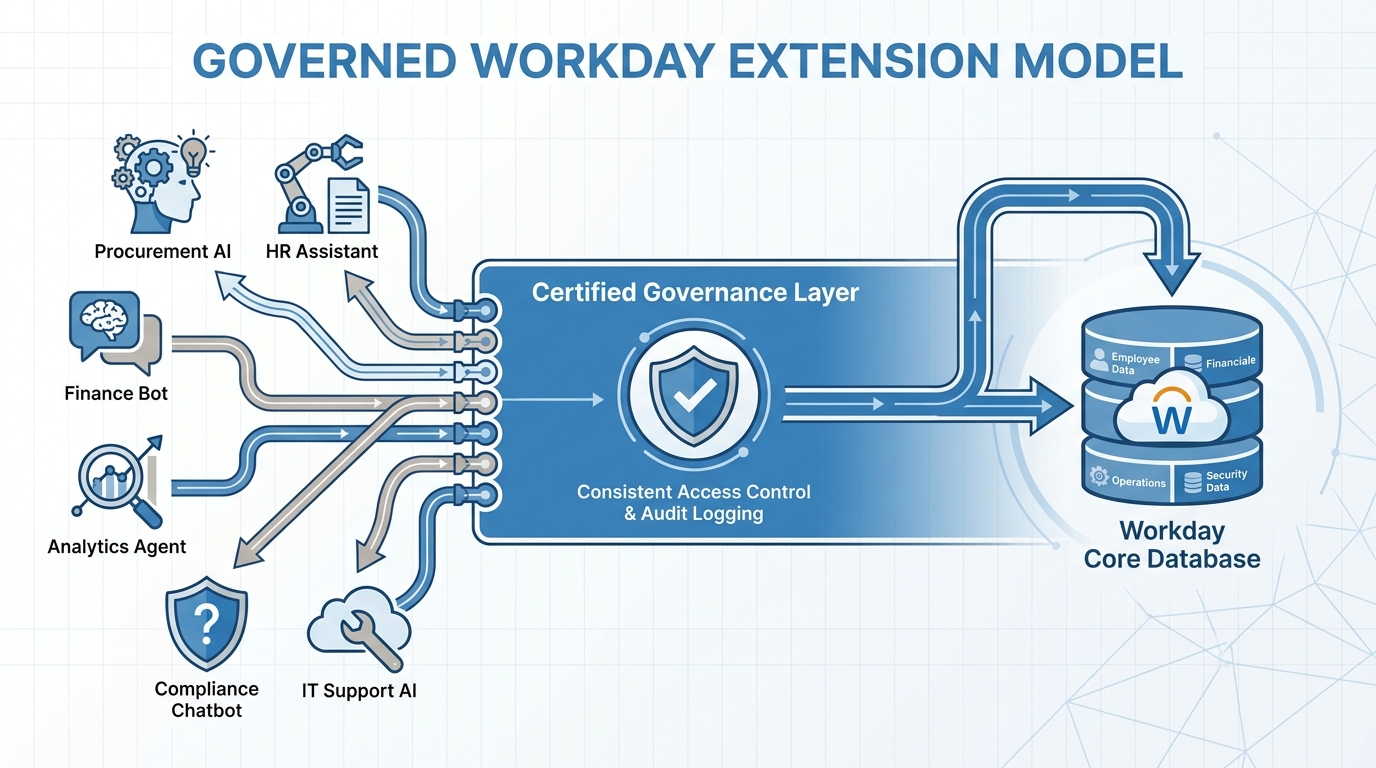
The alternative isn’t to stop building on top of Workday. The gap between what Workday does natively and what the business needs is real, and it isn’t closing on its own. The alternative is making sure every extension, agent, and integration inherits a single governance layer instead of inventing its own.
That means every agent connecting to Workday goes through the same access control model, the same audit logging, and the same review process, regardless of which team built it or how quickly it needed to ship. It means the organization can answer, in one query, every AI agent with access to Workday data, what each one is authorized to do, and when it last touched a given employee’s record. And it means new agents don’t require a fresh security review from scratch, because they’re running on infrastructure that’s already been certified rather than a one-off script someone in HRIS built over a weekend.
This is the model CloudApper applies to Workday extension work specifically. Rather than generating custom code that a Workday integration then depends on indefinitely, the platform produces governed application definitions that execute inside a certified runtime shared across every app the organization builds. An agent that reads leave balances and one that flags compensation anomalies both inherit the same access controls, the same logging, and the same compliance posture, because neither one is running as an independent, unaudited piece of code sitting on top of Workday’s API.
Evaluating Vendors for This Specific Problem
Not every AI development platform positions itself for HCM extension work, and not every vendor claiming Workday compatibility has actually built for the governance model Workday customers need. Secure enterprise app development platforms need to be evaluated with compliance as a non-negotiable criterion, which means asking specific questions before any agent touches production HR data: does the platform generate raw source code your team then owns and maintains, or does it produce something governed and auditable? Does every agent inherit a consistent access model, or does each integration define its own? Can your compliance team produce an access log for any given employee’s data across every AI agent touching Workday, on demand, without assembling it from five different sources?
Those questions separate platforms built for prototyping from platforms built for the compliance reality of running AI agents against a system as sensitive as Workday. CloudApper was built around that second answer specifically, treating every Workday extension as an application that has to pass the same governance bar as anything running in a regulated production environment, because for the data Workday holds, that’s the only bar that matters.
What Enterprise IT Should Do Before the Next Agent Ships
The practical starting point isn’t a platform migration. It’s an inventory. Most enterprise IT teams running Workday cannot currently list every AI agent or AI-generated integration with access to their instance, who built it, what data it touches, and whether it was reviewed by security before going live. That inventory is the prerequisite for any governance conversation, because you can’t govern what you can’t see.
From there, the organizations moving fastest are the ones establishing a single governed path for Workday extension work before the next agent gets prompted into existence, not after the fifth one creates an incident. The AI coding tools accelerating this work aren’t going away, and neither is the pressure to make Workday do more than it was built to do natively. The choice enterprise IT actually has is whether that expansion happens through a governed, auditable layer or through a scattered collection of one-off scripts that nobody can fully account for six months from now.
CloudApper works with enterprise IT and HR technology teams to extend Workday and other HCM platforms through governed, compliant AI development, without the security debt that comes from raw, unmanaged AI-generated code. If your organization is building AI agents on top of Workday and needs a governance model that holds up under audit, reach out to CloudApper to talk through what that looks like for your environment.

What is CloudApper AI Platform?
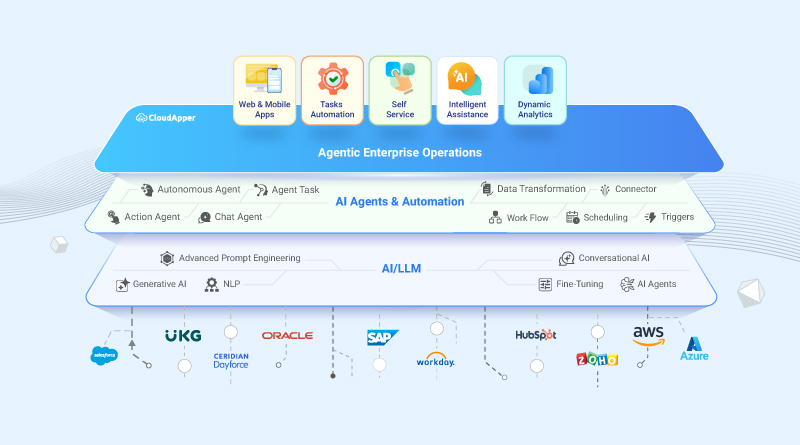
CloudApper AI is an advanced platform that enables organizations to integrate AI into their existing enterprise systems effortlessly, without the need for technical expertise, costly development, or upgrading the underlying infrastructure. By transforming legacy systems into AI-capable solutions, CloudApper allows companies to harness the power of Generative AI quickly and efficiently. This approach has been successfully implemented with leading systems like UKG, Workday, Oracle, Paradox, Amazon AWS Bedrock and can be applied across various industries, helping businesses enhance productivity, automate processes, and gain deeper insights without the usual complexities. With CloudApper AI, you can start experiencing the transformative benefits of AI today. Learn More
- Useful Links:
- Agentic AI
- No-Code/Low-Code
- Custom Software
- HCM Personalization
- iPaaS
- FedRAMP
CloudApper AI Solutions
- Works with







- and more.
Similar Posts

Legacy Modernization Transition: The Compliance Gap That Opens When Both…

Outsourced Legacy Systems: Why Vendor Exit Costs More Than the…