- Why the gap is structural, not fixable
- Where the gaps show up most consistently
- What enterprise IT has been doing about it — and why those approaches have limits
- What a platform extension approach actually looks like
- The governance dimension that point solutions miss
- The question worth asking before the next point solution
- The Bottom Line
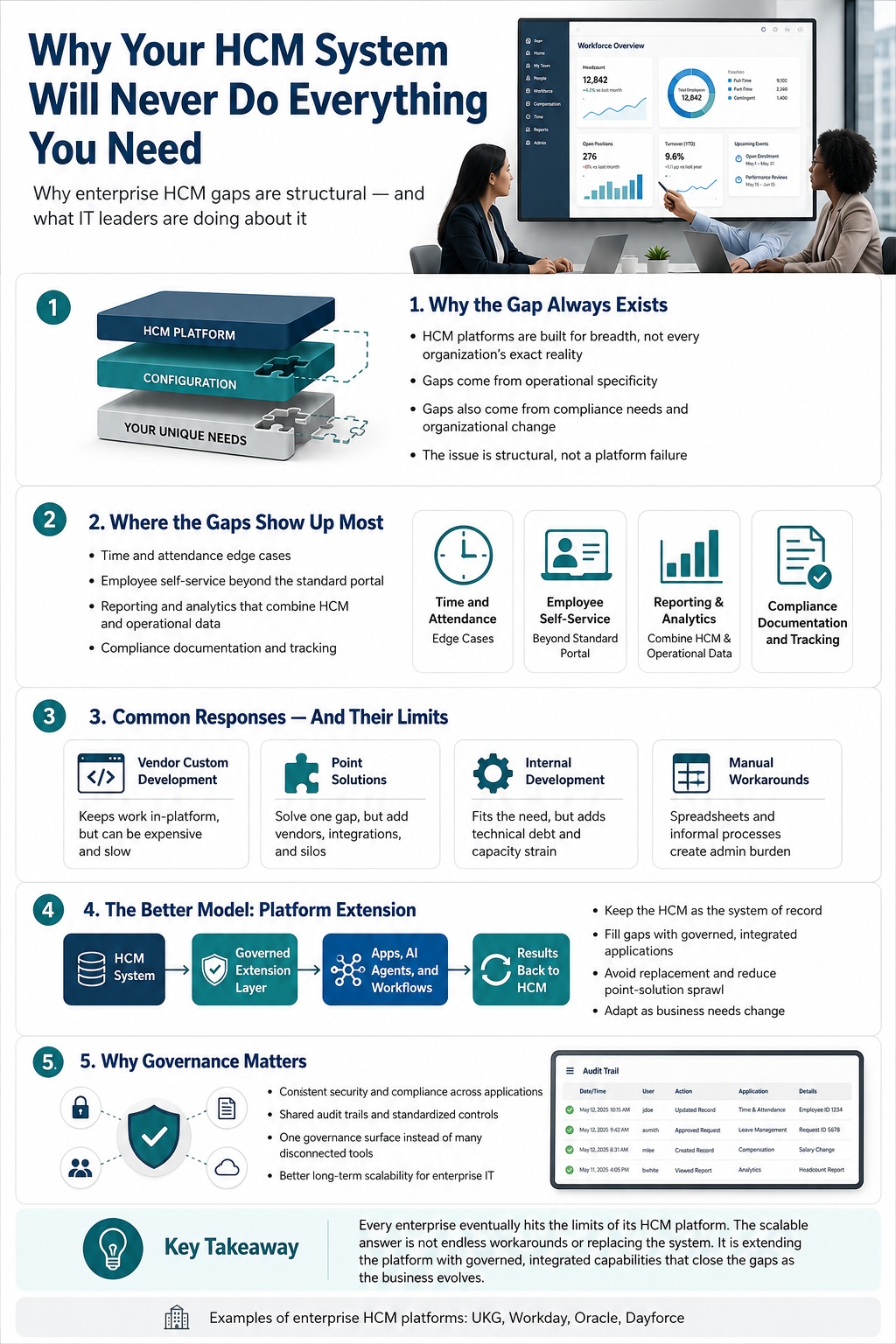
Every HCM system leaves a gap between what it can configure and how a specific organization operates, and that gap is structural rather than a sign of a weak platform. The useful question for enterprise IT is how large the gap is, where it shows up, and what to do about it.
Most enterprise organizations have managed this gap with manual workarounds, spreadsheets and informal processes built by HR and operations teams. That approach hits a ceiling as compliance requirements and workforce complexity grow, until the workaround layer costs as much to maintain as the HCM itself. Platforms like CloudApper extend the HCM with governed, integrated applications that sit on top of the existing platform rather than replacing it.
Why the gap is structural, not fixable
Understanding why HCM platforms always leave gaps requires understanding what they’re built to do — and what they’re not.
Enterprise HCM platforms are built for breadth. They need to work for a manufacturing company with 5,000 employees doing shift work, a financial services firm with 800 knowledge workers, a hospital system with complex clinical staffing requirements, and a retail organization with distributed locations and high turnover — all with the same platform. That breadth requires abstraction. The platform is configurable enough to handle most of what most organizations need, most of the time. It is not designed to handle everything any specific organization needs all of the time.

The gap appears at the intersection of three dynamics that are specific to every organization and impossible to fully anticipate in a platform designed for the broad market.
Operational specificity: Every organization has workforce processes that reflect its specific operational context — the way a production facility manages overtime eligibility, the way a healthcare organization handles on-call scheduling across credentialed staff, the way a logistics company tracks driver hours against DOT requirements. These processes have nuances that the HCM platform’s standard configuration doesn’t capture cleanly, and configuring the platform to handle them exactly often requires compromises that introduce complexity elsewhere.
Compliance specificity: Regulatory requirements vary by industry, jurisdiction, and workforce composition in ways that a global HCM platform can only address at a generalized level. The specific compliance requirements of a pharmaceutical manufacturer operating under FDA regulations in multiple states, a hospital system managing HIPAA obligations across employed and contracted staff, or a financial services firm navigating FINRA requirements alongside state-specific employment law are more granular than any platform’s standard compliance module fully accommodates.
Organizational evolution: HCM platforms are implemented at a point in time, configured for the organization as it exists at implementation, and then maintained through a change management process that is slower than the pace at which the business evolves. New business units get added. Acquisition integrates a workforce with different processes. A new compliance requirement creates a reporting need the platform wasn’t configured to produce. Each of these changes widens the gap between what the platform does and what the business needs.
None of these dynamics are failures of the HCM platform. They’re the inherent limitations of building a general-purpose system for a market of organizations that are each specifically themselves. The gap is not a bug. It’s a feature of how enterprise platforms work — and understanding that reframes the question from “how do we fix the HCM” to “how do we intelligently extend it.”
Where the gaps show up most consistently
The specific places where HCM platform gaps surface vary by organization, but a few categories appear consistently across industries and platform vendors.
Time and attendance at operational complexity: Standard HCM time and attendance modules work well for straightforward salaried and hourly workforce configurations. They struggle with the edge cases that define operational reality in manufacturing, healthcare, logistics, and retail: complex shift differentials, certification-based scheduling requirements, multi-site pay rule variations, biometric clock integrations that don’t match the platform’s supported hardware list, and real-time labor tracking requirements that the platform’s batch processing architecture wasn’t designed to handle.
The result is a time and attendance configuration that handles 80% of scenarios cleanly and requires manual intervention or workaround processes for the remaining 20% — which, in a large workforce, represents a significant ongoing administrative burden.
Employee self-service beyond the standard portal: HCM platforms include employee self-service portals, but those portals are designed for the standard interaction model: view pay stub, request time off, update personal information, complete a benefits election. The specific self-service needs of a distributed workforce — a manufacturing employee who needs to submit a production incident report, a healthcare worker who needs to access a credentialing checklist, a retail associate who needs to request a shift swap through a process that integrates with scheduling — often fall outside what the standard portal handles.
The gap gets filled by a combination of paper forms, email processes, and supplementary applications that each represent their own maintenance burden and their own disconnection from the HCM data model.
Reporting and analytics beyond standard outputs: HCM platforms produce standard workforce reports — headcount, turnover, compensation summaries, benefits enrollment. They don’t produce the operationally specific analytics that business leaders need to make decisions: labor cost as a percentage of production output by facility, overtime distribution correlated with safety incident rates, credentialed staff coverage gaps against patient census projections, or turnover analysis segmented by manager rather than by department.
These reports require combining HCM data with operational data from other systems — ERP, production management, clinical systems, scheduling tools — in ways the HCM’s native reporting tools don’t support. The result is manual report production by HR analysts who spend significant time extracting, combining, and formatting data that should be available on demand.
Compliance-specific documentation and tracking: Many industries require workforce-specific compliance documentation that goes beyond what the HCM’s standard compliance modules produce: clinical credential tracking with expiration alerts and regulatory reporting, DOT compliance documentation for commercial drivers, OSHA recordable incident tracking tied to workforce records, FINRA licensing maintenance and continuing education tracking. The HCM has some version of these capabilities, but “some version” often means “not quite right for our specific regulatory requirements” — and the gap gets filled by supplementary tracking systems that duplicate HCM data and create reconciliation overhead.
What enterprise IT has been doing about it — and why those approaches have limits
Enterprise IT organizations have developed a set of standard responses to HCM platform gaps. Each addresses the immediate problem and creates a different set of downstream complications.
Custom development through the HCM vendor: Most enterprise HCM vendors offer custom development services or extensibility frameworks that allow organizations to build functionality beyond the standard platform. This approach keeps everything within the platform’s data model and integration architecture — which is genuinely valuable — but at a cost that typically reflects the vendor’s market position: expensive, slow, and locked into the vendor’s development roadmap and release cycle. Customizations built through the vendor also create upgrade risk: when the platform releases a new version, custom functionality may need to be rebuilt or reviewed for compatibility.
Point solutions for specific gaps: The market for HR technology point solutions is extensive. There is a dedicated product for almost every HCM gap: standalone time and attendance systems, specialty scheduling tools, compliance tracking applications, employee engagement platforms. The problem with point solutions is that each one represents a separate vendor relationship, a separate integration to maintain, and a separate data silo that needs to be reconciled with the HCM’s master data. Over time, the point solution portfolio becomes its own governance problem — a landscape of partially integrated tools that each capture some HR data and none of which has the complete picture.
Internal development: IT teams build the functionality the HCM doesn’t provide using internal development resources and whatever tools are at hand. This produces applications that are closely tailored to the organization’s specific needs — which is a genuine advantage — but creates dependency on internal development capacity that has competing priorities and generates technical debt that accumulates without a clear ownership or maintenance model.
Accepting the workaround layer: The default outcome when none of the above approaches fully solves the problem is a persistent layer of manual processes, spreadsheets, and informal tools that bridges the gaps between what the HCM does and what the organization needs. This approach requires ongoing administrative effort, produces data that isn’t in the HCM’s system of record, and creates compliance exposure in any regulated environment where the manual process is the mechanism for meeting a documentation requirement.
Each of these approaches works, imperfectly, for some organizations and some gaps. None of them addresses the fundamental problem: the gap between what a general-purpose HCM platform does and what a specific organization needs will continue to exist and will continue to change as the business evolves. A sustainable response to that gap needs to be as adaptable as the gap itself.
What a platform extension approach actually looks like
The organizations that have moved past the workaround layer — and past the point solution proliferation — have converged on a different model: extending the HCM platform with a governed, integrated application layer that fills specific gaps without replacing the platform’s core functionality or creating additional data silos.
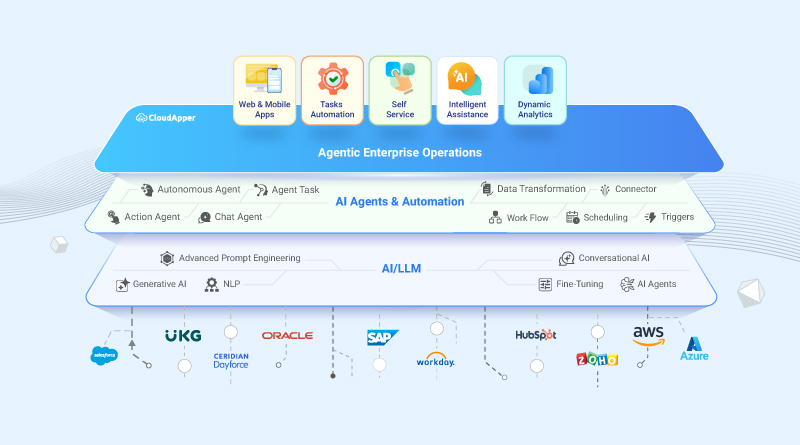
This is the model CloudApper is built for. Rather than replacing UKG, Workday, Oracle, Dayforce, or whichever enterprise HCM the organization runs, CloudApper sits alongside it — building the applications, AI agents, and workflow tools that the HCM doesn’t provide natively, while connecting back to the HCM’s data model through CloudApper’s iPaaS integration layer.
The practical effect: a manufacturing organization running UKG gets biometric time clock hardware support that UKG’s standard configuration doesn’t cover, with data flowing directly into UKG’s timekeeping module without manual transfer. A healthcare system gets a credentialing compliance tracker that alerts on expiration dates, generates regulatory reports, and writes completion records back to the HCM employee record. A logistics company gets a DOT hours-of-service tracking application that integrates with the HCM’s workforce data and produces the documentation format the regulatory audit requires.
None of these applications replace the HCM. They fill specific gaps the HCM can’t close, using the HCM’s data as the foundation, and writing results back to the HCM where the data belongs. The HCM remains the system of record. The CloudApper layer becomes the system of capability — the place where the organization’s specific operational and compliance needs get met when the platform’s standard configuration falls short.
The governance dimension that point solutions miss
What separates a governed platform extension approach from a point solution portfolio isn’t just integration. It’s governance.
Every application built on CloudApper’s platform inherits the same compliance posture: FedRAMP Ready, HIPAA-compliant, SOC 2 audited, GDPR-aligned. A healthcare organization extending its HCM with CloudApper doesn’t need to run a separate HIPAA compliance assessment for each new application. The compliance is inherited from the platform. A financial services firm adding a FINRA compliance tracker doesn’t need to configure audit logging from scratch. The audit trail is generated automatically by the CloudApper runtime.
This is the governance dimension that a portfolio of point solutions fundamentally cannot provide. Each point solution has its own security posture, its own audit trail format, its own compliance certifications — or lack thereof. Managing the compliance exposure across ten different point solutions, each with different security controls and different data handling policies, is a governance problem that grows with every solution added.
A platform extension approach collapses that governance surface. The compliance review happens at the platform level. Every application on the platform benefits from it. The audit trail is consistent. The security controls are uniform. The CIO who needs to answer an auditor’s question about what data is handled by the organization’s HR technology ecosystem has a coherent answer — not ten separate conversations with ten separate vendors.
The question worth asking before the next point solution
For enterprise IT leaders evaluating how to address the next HCM gap — whether it’s a time and attendance edge case, a compliance tracking requirement, a self-service need the portal doesn’t meet, or an analytics requirement the reporting module can’t produce — the question worth asking before procuring a point solution is whether the gap is a one-time problem or a recurring pattern.
If the gap is a one-time problem specific to a single process, a point solution may be the right answer. If it’s a pattern — if the organization consistently finds that the HCM meets 80% of what it needs and the remaining 20% requires workarounds, supplementary tools, or custom development — then the right answer is probably a platform that’s designed to fill that recurring gap systematically, rather than a collection of point solutions that each address one instance of it.
CloudApper’s no-code and low-code platform is built for that pattern. The library of pre-built applications — time clock integrations, compliance trackers, employee self-service kiosks, scheduling tools, workforce analytics — addresses the most common HCM gaps directly. The no-code platform lets organizations build the gaps that are specific to their operational context without requiring custom development capacity or vendor engagement. And the iPaaS integration layer ensures that everything built on CloudApper connects to the HCM cleanly, keeping the platform as the system of record while CloudApper fills the capability gaps.
The Bottom Line
The gap between what an enterprise HCM platform does and what your organization needs is not a failure of the platform. It is a structural feature of how enterprise software works — and it will persist as long as your organization continues to evolve, which is to say, permanently.
The organizations that manage this gap most effectively are the ones that stop trying to close it through workarounds and point solutions, and start managing it through a governed platform extension approach. That means keeping the HCM as the system of record, filling specific gaps with governed, integrated applications that connect back to the HCM data model, and maintaining a consistent compliance posture across the extended HR technology landscape — rather than a fragmented portfolio of tools, each with its own governance surface.
CloudApper is built for exactly this role: extending what enterprise HCM systems do without replacing them, filling the gaps that every enterprise organization eventually hits, and doing so on a governed platform that inherits compliance certifications, generates audit trails automatically, and scales as the gaps change with the business.
CloudApper extends enterprise HCM platforms — UKG, Workday, Oracle, Dayforce, and others — with governed applications, AI agents, and workflow tools that fill the gaps standard configurations can’t close. No replacement required. No point solution sprawl. Contact us to see how organizations in your industry are extending their HCM investment without replacing it.

What is CloudApper AI Platform?
CloudApper AI is an advanced platform that enables organizations to integrate AI into their existing enterprise systems effortlessly, without the need for technical expertise, costly development, or upgrading the underlying infrastructure. By transforming legacy systems into AI-capable solutions, CloudApper allows companies to harness the power of Generative AI quickly and efficiently. This approach has been successfully implemented with leading systems like UKG, Workday, Oracle, Paradox, Amazon AWS Bedrock and can be applied across various industries, helping businesses enhance productivity, automate processes, and gain deeper insights without the usual complexities. With CloudApper AI, you can start experiencing the transformative benefits of AI today. Learn More
- Useful Links:
- Agentic AI
- No-Code/Low-Code
- Custom Software
- HCM Personalization
- iPaaS
- FedRAMP