- Side A: What it actually costs to stay
- Side B: What modernization actually costs now
- The comparison that changes the decision
- Building the business case internally
The modernization business case is harder to make than it should be.
Not because the numbers don’t work — they almost always do, once you include everything. But because the numbers on the “stay” side of the comparison are visible and the numbers on the “go” side of the comparison are not. The maintenance budget is a line item. The security debt, the compliance exposure, the talent drag, and the operational inefficiency are distributed across a dozen different budget categories and don’t show up in the conversation about whether to modernize.

This article is an attempt to put everything in the same conversation — to build the honest comparison that most organizations aren’t making when they decide to keep running a system their vendor no longer supports.
It isn’t a case for modernizing at any cost or on any timeline. It’s a case for making the decision with accurate numbers rather than a comparison between a visible cost and several invisible ones. And it’s a case informed by what platforms like CloudApper have made possible — AI-driven modernization that compresses the timeline, preserves institutional knowledge, and eliminates the ongoing cost categories that have historically made staying feel like the safer financial choice.
Side A: What it actually costs to stay
The cost of maintaining an unsupported legacy system has two layers. The first is what shows up on the IT budget. The second is everything else.
What shows up on the budget
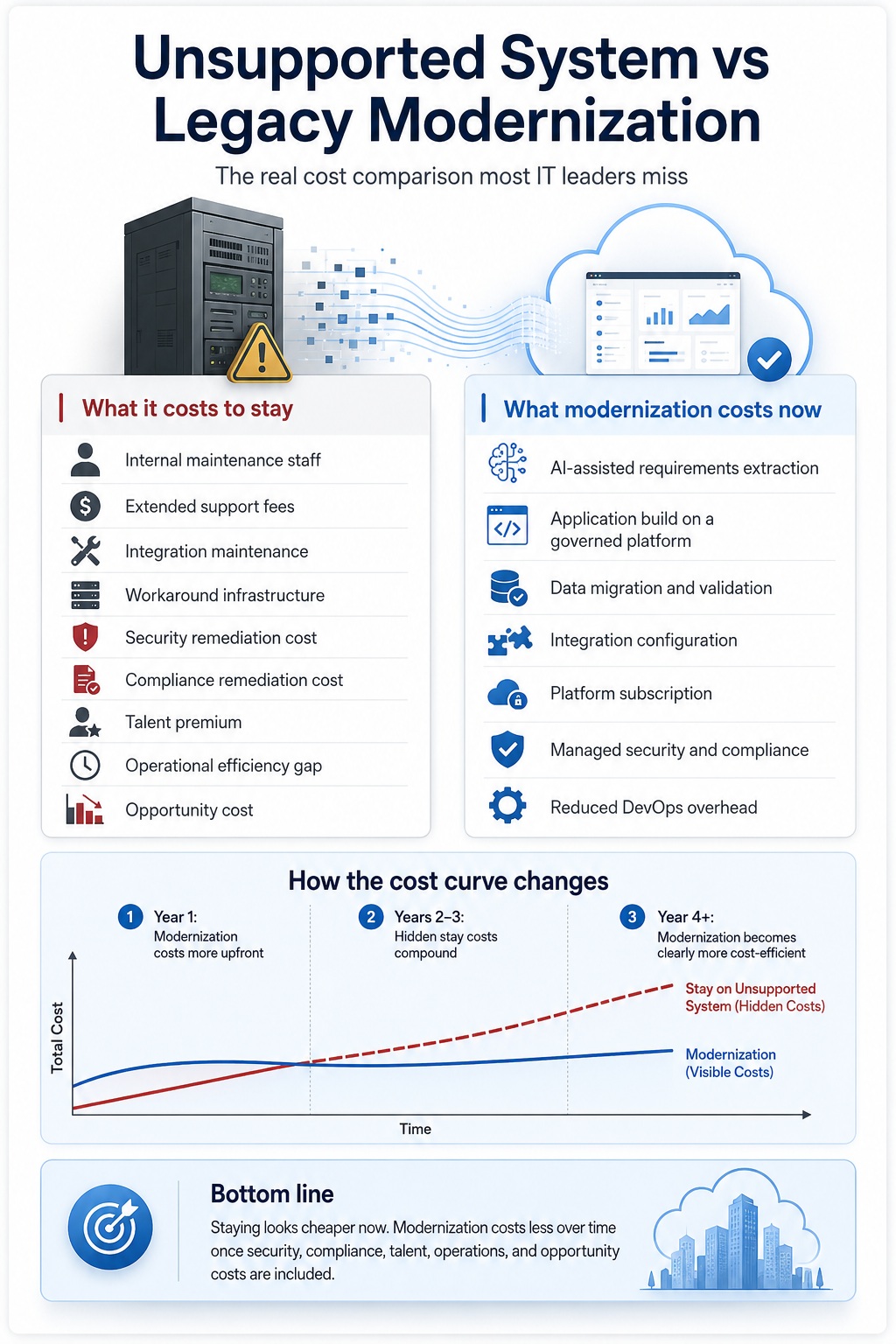
Internal maintenance staff: Someone has to keep the system running. As the system ages past its support lifecycle, the skills required to maintain it become increasingly specialized and increasingly scarce. The internal staff who hold those skills command compensation that reflects that scarcity — and if the organization hasn’t kept up with that market reality, those staff are being actively recruited by organizations that will.
Extended support fees: Many enterprise vendors offer paid extended support after the standard end-of-life date. These fees are substantial — typically 20 to 30 percent of the original license value per year — and they buy time, not a solution. The system is still unsupported in the sense that no new features are developed, no architectural improvements are made, and the underlying technology continues to age. Extended support is a deferral, not a resolution.
Integration maintenance: Every year the legacy system remains in place, the rest of the technology environment continues to evolve. APIs change. Cloud platforms release new versions. Adjacent systems get upgraded. Each of those changes creates potential integration breaks with the legacy system, and someone has to maintain the connections — often through custom code, middleware, and point-to-point integrations that require ongoing attention and break unpredictably.
Workaround infrastructure: Legacy systems that can’t do what modern systems can do natively get extended through workarounds — manual processes, supplementary tools, custom scripts, and shadow applications built by IT or business teams to bridge gaps the legacy system can’t close. That workaround infrastructure has its own maintenance cost, and it grows over time as the gap between the legacy system’s capabilities and the organization’s operational needs widens.
What doesn’t show up on the budget
This is where most cost comparisons go wrong. The costs below are real, material, and directly caused by the decision to run an unsupported system. They just don’t appear on the IT maintenance budget line.
Security remediation cost: When vendor support ends, security patches stop. Vulnerabilities discovered after the end-of-support date remain in the codebase permanently, known to the security community, exploitable by anyone who looks. The organization’s response is compensating controls — additional network segmentation, enhanced monitoring, tighter access controls — which cost money to implement, staff to maintain, and audit hours to demonstrate. They’re also never as effective as patching.
When a security incident does occur — and organizations running past-end-of-life systems are actively targeted because their vulnerability profile is known and fixed — the cost is orders of magnitude higher than the cost of compensating controls. A single ransomware incident, a single data breach involving the unsupported system, resets the cost comparison entirely.
Compliance remediation cost: Compliance frameworks update. When they do, supported software vendors ship updates. Organizations running unsupported software don’t get those updates. Each compliance framework revision that the vendor would have addressed in a supported release becomes the organization’s problem to solve independently — in a codebase nobody fully understands, under audit pressure, on a timeline set by the regulator rather than by the IT team.
The cost of a compliance finding involving an unsupported system is not just the remediation cost. It includes the audit response, the potential regulatory penalty, the reputational exposure, and the accelerated modernization that gets forced by the finding — often on a worse timeline and at a higher cost than a planned modernization would have required.
Talent premium and replacement cost: The market for legacy system expertise is a seller’s market. Developers who know COBOL, older Java frameworks, deprecated database technologies, and proprietary scripting languages from platforms that no longer exist are rare, aging, and aware of their leverage. Retaining them costs more than the compensation budgets of most enterprise IT organizations expect. Replacing them when they leave costs significantly more — through contract specialist rates that reflect the scarcity directly, or through extended periods of degraded system management while a replacement is found, hired, and brought up to speed on a system that has no documentation adequate for the purpose.
Operational efficiency gap: Legacy systems impose process constraints that organizations stop measuring because they’ve lived with them long enough that they feel like facts rather than costs. The reconciliation that takes three hours because the system can’t automate it. The report that requires manual data transformation before it’s usable. The workflow that involves five manual steps because the system wasn’t designed for the process the organization actually runs today. These costs show up in operational budgets as staff time. They don’t show up in the IT conversation about whether to modernize.
Opportunity cost: This is the largest hidden cost and the hardest to quantify, which is why it’s so rarely included in the comparison. An organization running on an unsupported legacy system cannot access the capabilities that modern infrastructure enables: real-time analytics, AI-assisted decision support, mobile-first workflows, seamless cloud integration, automated compliance monitoring. Every year those capabilities are unavailable is a year of competitive disadvantage relative to organizations that have them. That disadvantage compounds. Organizations that have modernized onto a governed platform like CloudApper — where AI agents, no-code application building, and iPaaS integration are platform-level capabilities rather than separate investments — aren’t just reducing maintenance cost. They’re accessing a capability tier that unsupported legacy infrastructure makes structurally unavailable.
Side B: What modernization actually costs now
The resistance to modernization investment is grounded in history as much as current reality. Large-scale enterprise system replacement projects have failed expensively and visibly enough that CIO skepticism about modernization timelines and budgets is well-earned.
What has changed is what modernization actually requires — and how AI-driven platforms like CloudApper have compressed the cost and timeline in ways that weren’t available five years ago.
The traditional modernization cost model
Traditional legacy modernization projects are expensive for specific, addressable reasons. Requirements gathering — understanding what the legacy system actually does well enough to specify a replacement — requires months of analyst time, stakeholder interviews, and system documentation that often doesn’t exist. Business logic embedded in the legacy codebase has to be reverse-engineered by people who understand both the technical system and the business processes it supports. Data migration requires custom transformation logic built for each migration. Integration with surrounding systems requires custom development for each connection.
These costs are real and they scale with the complexity and age of the legacy system. An enterprise system that has been in production for twenty years, modified incrementally by dozens of developers, and integrated with dozens of surrounding systems is genuinely complex to replace — if the replacement is built the traditional way.
The AI-assisted modernization model
CloudApper takes a different approach to the requirements problem that is the most expensive and most failure-prone part of traditional modernization.
Rather than relying on human analysts to reverse-engineer the legacy system’s business logic from documentation and stakeholder interviews, CloudApper’s AI platform analyzes the legacy system directly — its data structures, its processing logic, its integration patterns, its exception handling — and generates structured software requirements automatically. The institutional knowledge encoded in the system over decades of operational use gets captured as a modernization blueprint, not lost in the transition.
The result is a compressed requirements phase that delivers more complete requirements than traditional approaches — because the AI analysis captures what the system actually does, not just what stakeholders remember about what it was designed to do. That distinction matters enormously for systems that have been modified extensively over long operational lifetimes, where what the system does and what anyone thinks it does have diverged significantly.
CloudApper then builds the modernized application on its governed platform infrastructure, which addresses several of the cost categories that make the “stay” side of the comparison look cheaper than it is. Security patching is handled by the platform, not by the organization’s internal team. Compliance updates are applied at the platform level, inherited by every application deployed on it. Certifications across FedRAMP, HIPAA, SOC 2, GDPR, and other frameworks are platform-level features rather than per-application investments.
The DevOps overhead that traditional modernization creates — the infrastructure management, the deployment pipeline maintenance, the monitoring and alerting configuration — is absorbed by CloudApper’s managed runtime. The internal team that was spending development capacity keeping the legacy system alive gets that capacity back for work that actually advances the business.
The modernization cost components
The modernization investment with an AI-assisted platform like CloudApper includes: the platform subscription, the implementation engagement for requirements extraction and application build, the data migration and validation process, and the integration configuration for surrounding systems.
What it does not include — because the platform handles them — is ongoing security patching, compliance update implementation, infrastructure management, or the annual cost of legacy system expertise. Those cost categories disappear from the IT budget and stay gone.
The comparison that changes the decision
When the comparison is built with all the costs on both sides — not just the visible ones — it typically looks like this:
Year one: Modernization investment is higher than the annual maintenance cost of staying. This is true and is usually the number that drives the initial resistance. The modernization investment is front-loaded. The maintenance cost appears incremental.
Years two through three: The cumulative cost of staying starts to approach and then exceed the modernization investment, as the security remediation costs, compliance gap management, talent premium, and operational drag compound. The integration maintenance costs typically spike in this period as the technology environment continues to evolve away from the legacy system.
Year four and beyond: The cost curves have clearly crossed. The organization running on the modernized platform is paying platform subscription and integration maintenance. The organization that stayed is paying maintenance staff, compliance remediation, security compensating controls, and operational efficiency gaps that have continued to widen. The gap between those two cost structures grows every year.
The exact numbers vary by organization, system complexity, and industry regulatory environment. The directional finding is consistent: staying is cheaper in year one and increasingly expensive in every subsequent year. Modernization is more expensive in year one and increasingly cost-efficient in every subsequent year.
The decision to stay is a decision to pay less now and significantly more later. That may be the right decision in specific circumstances — if the system is close enough to end-of-life to be decommissioned rather than replaced, if a broader platform consolidation is planned that makes point modernization inefficient, or if genuine constraints on implementation capacity make the timeline unworkable. Those are legitimate reasons to defer.
What is not a legitimate reason to defer is the assumption that staying is simply cheaper — because that assumption is wrong once all the costs are in the comparison.
Building the business case internally
For IT leaders who need to make this argument to a CFO, a board, or a CEO whose mental model of the comparison is maintenance budget versus modernization investment, the most effective approach is not to present a detailed cost model. It is to make the invisible costs visible through specific, concrete examples from the organization’s own experience.
The security incident that almost happened — or that did happen and was attributed to a different cause — and its actual cost if it had been a full breach. The compliance finding from the last audit that required manual remediation because the unsupported system couldn’t be patched. The analyst who left because they were tired of working on legacy infrastructure and took their system knowledge with them. The report that every department waits three days for because the legacy system’s data model requires manual transformation.
These are not hypothetical risks. They are things that have happened or are happening in most organizations running unsupported systems. Making them concrete and attaching cost estimates to them shifts the conversation from abstract risk tolerance to specific financial exposure — and that shift is usually what moves a CFO from “let’s wait” to “what does the modernization timeline look like.”
CloudApper’s structured approach to modernization business case development — with cost modeling that includes the hidden cost categories and implementation timelines scoped to the specific system being replaced — gives IT leaders the tools to have that conversation with the specificity that internal decision-makers need.
The timing question
One question that often delays the modernization decision even after the economics are understood is timing: when is the right time to start?
The honest answer is that the best time to modernize is before the hidden costs have accumulated to their highest level — before the security incident, before the compliance finding, before the talent departure. That time is usually earlier than feels comfortable, because the system is still running and the crisis hasn’t materialized. CloudApper‘s modernization approach is designed precisely for this window — when the organization still has time to do the knowledge extraction properly, migrate data without crisis pressure, and configure the governed platform environment before the legacy system’s fragility becomes operationally visible. Organizations that engage CloudApper in this window get a significantly better modernization outcome than those who engage under incident or audit pressure, where the timeline is compressed and the options are narrower.
The second-best time is now, regardless of where in the accumulation curve the organization currently sits. The hidden costs of staying don’t reverse when the modernization decision is made — they continue to accumulate until the modernization is complete. Starting later means paying those costs for longer.
What AI-assisted platforms like CloudApper have changed about this timing question is the lead time required. Traditional modernization projects required eighteen to thirty-six months from decision to go-live. The requirements compression and governed platform deployment that CloudApper provides has reduced that timeline significantly — which means the window between “decision to modernize” and “no longer paying the costs of the legacy system” is shorter than the historical experience of enterprise modernization projects would suggest.
That shorter timeline changes the urgency calculation. An organization that deferred modernization because a three-year project seemed too disruptive might reach a different conclusion about a project with a significantly shorter path from decision to operational.
The Bottom Line
The decision to maintain an unsupported legacy system versus invest in modernization is almost never actually a choice between a higher cost and a lower cost. It is a choice between a visible cost now and a larger, less visible cost distributed across security, compliance, talent, operations, and opportunity — paid incrementally, across a longer period, and at moments the organization doesn’t control.
The comparison that produces the right decision is the one that puts all of those costs in the same calculation. When that calculation is done honestly, modernization — particularly with an AI-assisted platform like CloudApper that compresses the timeline and eliminates the ongoing cost categories that make staying expensive — is the financially defensible choice in almost every case.
The question is not whether modernization is worth it. It is whether the organization does the honest calculation before the hidden costs make the question urgent.
CloudApper helps enterprise organizations build the modernization business case with full cost modeling, AI-driven requirements extraction from legacy systems, and governed platform deployment that eliminates the ongoing security, compliance, and infrastructure costs of unsupported legacy infrastructure. Contact us to see how organizations in your situation are approaching the modernization decision.

What is CloudApper AI Platform?
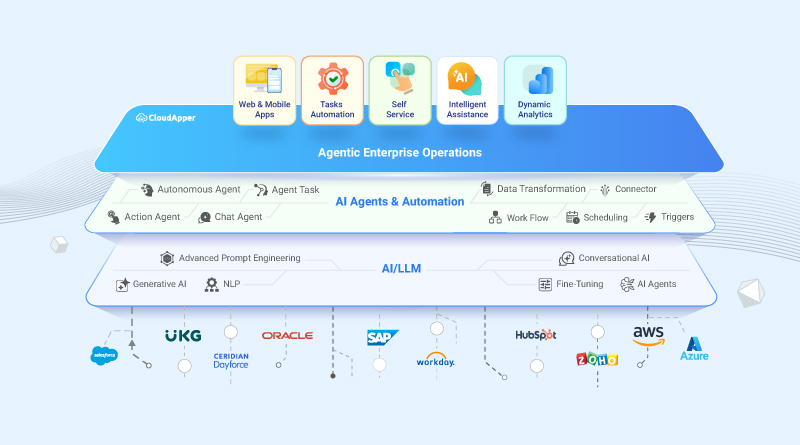
CloudApper AI is an advanced platform that enables organizations to integrate AI into their existing enterprise systems effortlessly, without the need for technical expertise, costly development, or upgrading the underlying infrastructure. By transforming legacy systems into AI-capable solutions, CloudApper allows companies to harness the power of Generative AI quickly and efficiently. This approach has been successfully implemented with leading systems like UKG, Workday, Oracle, Paradox, Amazon AWS Bedrock and can be applied across various industries, helping businesses enhance productivity, automate processes, and gain deeper insights without the usual complexities. With CloudApper AI, you can start experiencing the transformative benefits of AI today. Learn More
- Useful Links:
- Agentic AI
- No-Code/Low-Code
- Custom Software
- HCM Personalization
- iPaaS
- FedRAMP