- The visible cost versus the real cost
- The security cost that compounds every month
- The compliance cost that arrives without warning
- The talent cost nobody calculates
- The operational drag that becomes invisible
- The opportunity cost that shapes everything else
- What the modernization alternative actually looks like now
- What to do with this calculation
- The Bottom Line
The notice arrives. The vendor is ending support for the version your organization runs. Extended support is available — for a price, and only for another two years. After that, you’re on your own.
Most enterprise IT leaders have been in this meeting. The options on the table are familiar: upgrade to the new version, migrate to a different platform, or stay on the current system and accept that vendor support is ending. The upgrade and migration paths are expensive, disruptive, and require project capacity the team doesn’t have right now. Staying on the current system requires accepting some risk, but the system works, and the immediate budget pressure of running it is manageable.

So the organization stays. The vendor support ends. The system keeps running.
This decision gets made thousands of times every year across enterprise IT organizations. It is rarely made recklessly. The people making it understand the risk. What they frequently underestimate is the full cost — not the visible cost of running an aging system, but the hidden costs that accumulate quietly and surface at the worst possible moments.
This article is about those hidden costs: what they are, how they accumulate, and what the total picture looks like when an organization calculates honestly what maintaining an unsupported system is actually costing them. It is also about why the modernization alternative looks fundamentally different today than it did five years ago — because platforms like CloudApper have changed what legacy modernization actually requires, making the stay-versus-modernize calculation less one-sided than most IT leaders currently assume.
The visible cost versus the real cost
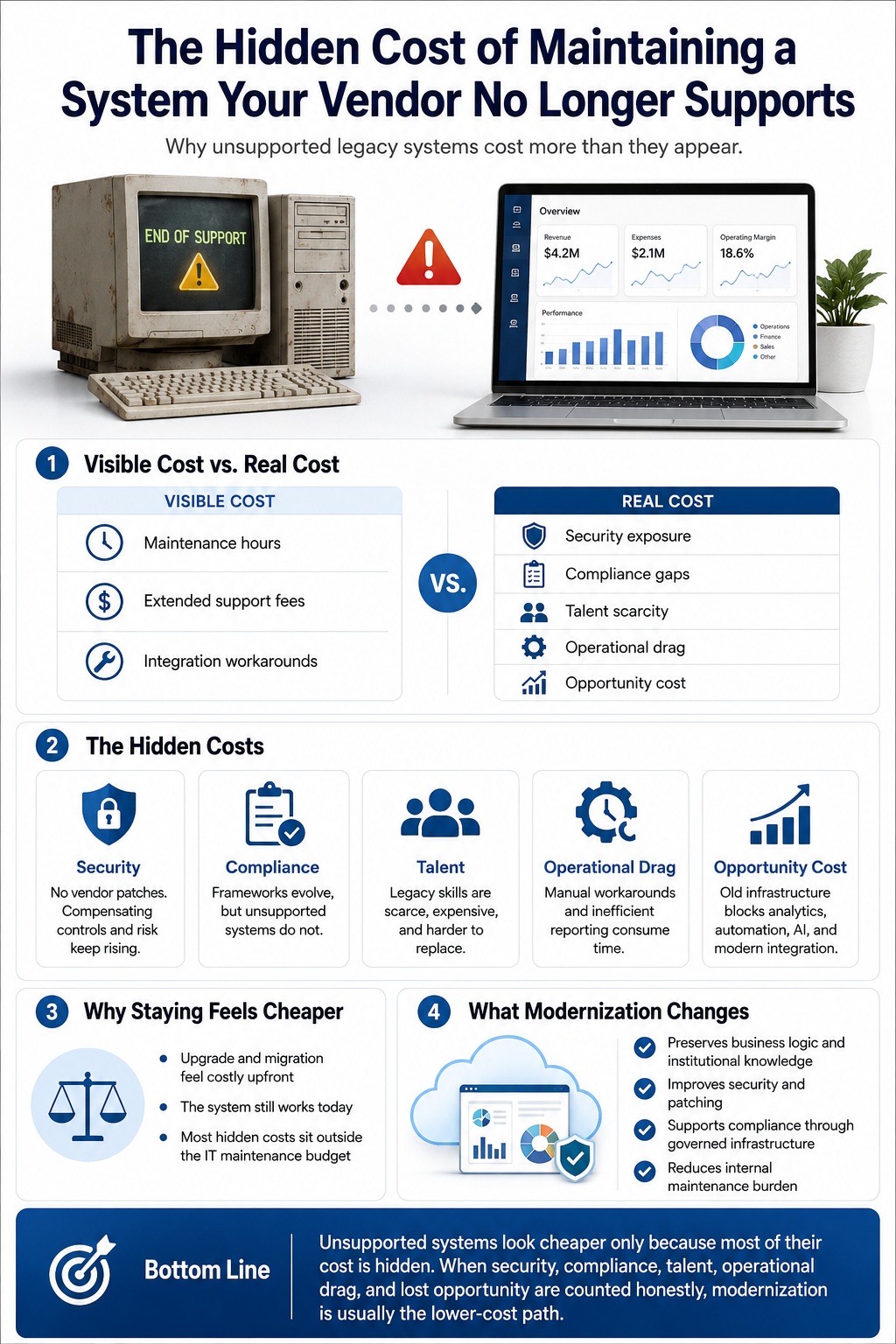
When enterprise IT leaders assess the cost of staying on an unsupported system, they typically calculate the visible costs: the internal staff hours required to maintain it, any extended support fees the vendor charges before full end-of-life, and the workarounds required to keep the system integrated with the rest of the environment as surrounding technology evolves.
Those costs are real. They’re also usually the smaller part of the picture.
The real cost of an unsupported legacy system has several components that don’t appear on a maintenance budget line but show up everywhere else — in the security budget, the compliance remediation budget, the talent budget, the operational efficiency gap, and the opportunity cost of development capacity consumed by keeping aging infrastructure alive instead of building the capabilities the business actually needs.
When you add those components together, the cost of the unsupported system is almost always significantly higher than the organization calculated when it decided to stay — and significantly higher than the modernization investment it was trying to avoid.
The security cost that compounds every month
Vendor support for enterprise software includes security patching. When support ends, patches stop. Vulnerabilities discovered after the end-of-support date don’t get fixed by the vendor. They stay in the codebase, known to the security community, exploitable by anyone willing to look.
This is not a theoretical risk. Enterprise systems running past their support lifecycle are actively targeted precisely because their vulnerability profile is known and their patch status is frozen. Security researchers publish CVEs. Exploit toolkits get updated. The organization running the unsupported system is running known vulnerabilities in its production environment with no remediation path from the vendor.
The internal response to this is usually compensating controls — additional network segmentation, enhanced monitoring, tighter access controls around the affected system. Those compensating controls cost money to implement and maintain. They require staff time to monitor. And they’re never as effective as patching would have been, because they address the exposure rather than the vulnerability.
The security cost of an unsupported system, properly calculated, includes: the staff time to implement and maintain compensating controls, the cost of any security incidents that occur because of unpatched vulnerabilities, the increased cyber insurance premiums that follow when underwriters discover the organization’s vulnerability profile, and the audit findings that result when a penetration test or security assessment identifies the unsupported system as a material risk.
None of those costs appear on the maintenance budget. All of them are caused by the decision to stay on the unsupported system.
The compliance cost that arrives without warning
Compliance frameworks are not static. HIPAA guidance gets updated. PCI-DSS standards release new versions. SOC 2 criteria evolve. ISO standards undergo revision cycles. Each of these updates may impose new technical requirements on the systems that organizations use to process regulated data.
When those requirements change, supported software vendors update their products to meet them. Organizations running supported software get compliance updates as part of their normal maintenance cycle. Organizations running unsupported software don’t. They face a choice between modifying the system themselves — which requires deep technical knowledge of an aging codebase that may not exist internally — or accepting a compliance gap that will surface in the next audit cycle.
The compliance cost of an unsupported system compounds over time. Each compliance framework update that the vendor would have addressed in a supported release is now the organization’s problem to solve independently. Over a multi-year period of running an unsupported system, the accumulated compliance gap can be substantial — and the cost of remediating it during an audit, when the timeline and the consequences are both compressed, is significantly higher than the cost of addressing it proactively.
Healthcare organizations running unsupported systems against HIPAA requirements, financial services firms running unsupported systems against PCI-DSS or FINRA requirements, and manufacturers running unsupported systems against quality and environmental compliance frameworks are all accumulating this cost — often without a clear view of how large it has become.
The talent cost nobody calculates
Enterprise systems running past their vendor support lifecycle require people who know how to maintain them. Those people are increasingly rare and increasingly expensive.
The skills required to maintain a legacy enterprise system — COBOL, older versions of Java frameworks, deprecated database technologies, proprietary scripting languages from platforms that no longer exist — are skills that younger developers don’t have and don’t seek to acquire. The people who have them are aging out of the workforce at approximately the same rate as the systems themselves. The supply of qualified maintainers is shrinking as the demand from organizations that haven’t modernized holds steady.
This supply-demand dynamic produces two distinct talent costs. The first is the cost of retaining the internal staff who currently maintain the system — staff whose market value is influenced by their specialization in skills that are genuinely scarce, and who have options beyond the current employer that will be exercised if the compensation and working conditions don’t reflect that scarcity. The second is the cost of replacing them when they do leave — either through the market for contract specialists in legacy technologies, where rates reflect the scarcity directly, or through extended periods of degraded system management while a replacement is found and trained.
There is also a less visible talent cost: the opportunity cost of the capable technologists who stay in the organization but spend their time maintaining legacy systems rather than building the capabilities that would actually advance the business. Every developer-hour spent keeping an unsupported system alive is a developer-hour not spent on the internal tools, automation, and modernization that the organization needs to remain competitive. This cost doesn’t appear anywhere in the budget, but it is real and it compounds year over year. It is also one of the first costs that disappears when an organization moves to a governed modernization platform like CloudApper — where the platform handles runtime maintenance, security patching, and compliance updates automatically, freeing internal technical teams from the perpetual task of keeping aging infrastructure alive.
The operational drag that becomes invisible
Legacy systems impose operational constraints that organizations stop noticing after they’ve lived with them long enough. The constraints become the assumed baseline — the way things work — rather than costs to be measured and managed.
But they are costs. The business process that requires three manual steps because the legacy system can’t automate them costs the staff time for those steps, every time they’re performed, indefinitely. The report that takes two hours to produce because the legacy system’s data model requires manual transformation before the analysis can run costs those two hours, every reporting cycle. The integration that doesn’t exist because the legacy system predates API-based connectivity costs the time spent manually moving data between systems that should communicate directly.
These operational drag costs are almost never calculated as part of the cost of maintaining the legacy system, because they’re categorized as operational costs rather than IT costs. They show up in department budgets as staff time. They show up in operational reports as process inefficiency. They rarely show up in the conversation about whether to modernize, because the people having that conversation are looking at the IT budget, not at the aggregate operational cost across every department that works around the limitations of the legacy system every day.
When those costs are included in the calculation — as they should be — the economics of modernization look very different from the economics of staying.
The opportunity cost that shapes everything else
The most significant hidden cost of an unsupported legacy system is the opportunity cost: the things the organization cannot do because of the constraints the system imposes.
Modern enterprise capabilities — real-time analytics, AI-assisted decision support, mobile access for distributed workforces, seamless integration with cloud platforms, automated compliance monitoring — require modern infrastructure. An organization running on unsupported legacy systems is excluded from those capabilities, not because the capabilities aren’t available, but because the infrastructure can’t support them.
That exclusion is a competitive cost. In every industry, the organizations that can act on better information faster, support their workforces more effectively, and respond to compliance requirements without manual intervention have operational advantages over those that can’t. The legacy system doesn’t just cost money to maintain. It costs the organization the capabilities that would let it compete more effectively — and that cost grows larger every year as the capability gap between legacy-constrained and modern organizations widens.
This is the cost calculation that changes the modernization conversation when it’s done honestly. The question isn’t “what does it cost to modernize versus what does it cost to stay?” The question is “what does it cost to stay, including the security exposure, the compliance gap, the talent premium, the operational drag, and the opportunity cost of capabilities we can’t access?” When all of those components are in the calculation, staying is almost never the cheaper option. It’s only the option that defers the cost — at interest.
What the modernization alternative actually looks like now
The reason the stay-versus-modernize calculation has histsrically favored staying — despite the hidden costs — is that modernization was genuinely expensive, disruptive, and risky. Large-scale enterprise system replacement projects have a well-documented history of running over budget, missing timelines, and producing systems that don’t fully replicate the business logic of what they replaced. CloudApper was built specifically to change that equation — not by reducing the scope of modernization, but by automating the parts that were previously the most expensive and failure-prone: requirements extraction from the legacy system, institutional knowledge capture, data migration with zero loss, and deployment on a governed platform that inherits compliance certifications rather than requiring per-system security investment.
That history is real. It has made CIOs appropriately cautious about modernization commitments. What has changed is what modernization actually requires.
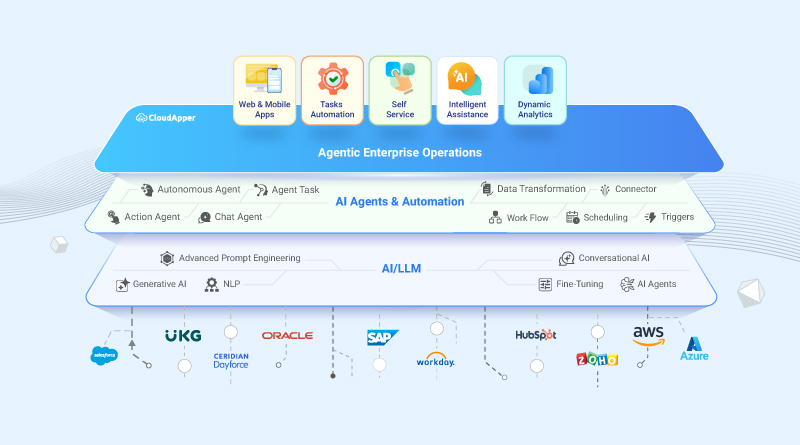
AI-assisted modernization platforms like CloudApper have compressed the timeline and cost of legacy system replacement significantly — not by doing less, but by automating the parts of modernization that were previously the most time-consuming and expensive. CloudApper’s platform analyzes the legacy system directly, extracting business requirements, mapping data structures, and generating the modernization blueprint automatically, without the months of consultant-driven requirements gathering that traditional modernization projects required. The institutional knowledge encoded in the system — the business rules, edge cases, and process logic that represent years of organizational learning — gets captured and preserved in the modernized application rather than lost in the transition.
The modernized application runs on CloudApper’s governed platform infrastructure, which means zero DevOps overhead, zero per-app compliance audits, and inherited certifications across FedRAMP, HIPAA, SOC 2, GDPR, and other frameworks. The security patching that stops when a vendor ends support is handled by the platform, not by the organization’s internal team. The compliance updates that become the organization’s problem on an unsupported system become CloudApper’s responsibility on a governed platform.
The result is a modernized system that addresses the security cost, the compliance cost, the talent cost, and the operational drag simultaneously — rather than the incremental, indefinite accumulation of those costs that comes with staying on an unsupported system.
What to do with this calculation
If your organization is running one or more systems past their vendor support lifecycle, the exercise worth doing is the full cost calculation — not the maintenance budget, but the total cost including security, compliance, talent, operational drag, and opportunity cost.
For most organizations that do this calculation honestly, the result is a number that is significantly larger than the modernization investment they’ve been deferring. That doesn’t mean the modernization decision is simple — disruption, timeline, and capacity constraints are real factors. But it does mean the decision is being made with accurate information rather than a comparison between a visible modernization cost and an invisible total cost of staying.
The hidden costs of an unsupported system are not hidden because they don’t exist. They’re hidden because the way organizations categorize costs makes them invisible in the analysis that drives the modernization decision. Making them visible is the first step toward making the right decision — before the security incident, the compliance finding, or the talent departure that makes the decision urgent rather than strategic.
The Bottom Line
The visible cost of running an unsupported legacy system is manageable. The real cost — security exposure accumulating through unpatched vulnerabilities, compliance gaps widening with each framework update, talent premiums rising as legacy skills become scarcer, operational drag compounding across every department that works around the system’s limitations, and opportunity cost growing as the capability gap widens — is not.
Organizations that calculate the full cost honestly almost always find that modernization is cheaper than staying. The question is whether they do that calculation before the hidden costs surface on their own terms or after.
CloudApper helps enterprise organizations replace unsupported legacy systems with modern, governed applications built on a secure, maintained platform — preserving institutional knowledge, migrating data with zero loss, and delivering applications that inherit compliance certifications rather than requiring per-system security investment. Contact us to see how organizations running past end-of-life systems are approaching the modernization decision.

What is CloudApper AI Platform?
CloudApper AI is an advanced platform that enables organizations to integrate AI into their existing enterprise systems effortlessly, without the need for technical expertise, costly development, or upgrading the underlying infrastructure. By transforming legacy systems into AI-capable solutions, CloudApper allows companies to harness the power of Generative AI quickly and efficiently. This approach has been successfully implemented with leading systems like UKG, Workday, Oracle, Paradox, Amazon AWS Bedrock and can be applied across various industries, helping businesses enhance productivity, automate processes, and gain deeper insights without the usual complexities. With CloudApper AI, you can start experiencing the transformative benefits of AI today. Learn More
- Useful Links:
- Agentic AI
- No-Code/Low-Code
- Custom Software
- HCM Personalization
- iPaaS
- FedRAMP