- Why modernization programs are particularly governance-vulnerable
- The specific risks that emerge when modernization skips governance
- What the “move fast without creating new risk” framework actually looks like
- The conversation IT leaders need to have with their program sponsors
The business case for legacy modernization is usually compelling and urgent at the same time. Aging systems are expensive to maintain, difficult to integrate, and increasingly unable to support the operational agility that the business requires. The people who know how they work are retiring. The vendors who support the underlying technology are sunsetting products. The cost of standing still is visibly increasing.
So the organization approves the modernization program. The mandate is clear: move fast, reduce technical debt, get off the legacy systems before they become a crisis.

What often doesn’t get the same clarity is the governance mandate. The expectation that speed is the priority — implicit in the urgency of the business case, sometimes explicit in the program’s success metrics — creates pressure to treat governance as overhead. Review processes get compressed. Documentation requirements get deferred. Security assessments get scheduled for “after the initial build” and then quietly dropped as timelines tighten.
The result is a modernization program that successfully replaces legacy technical debt with something equally problematic: a portfolio of newly built applications that are faster, more maintainable, and just as poorly governed as the systems they replaced. The organization has moved fast. It has not moved forward.
This is the trap that enterprise IT leaders running modernization programs need to actively design around. And with AI-assisted development tools accelerating the pace of modernization significantly, the trap is easier to fall into than it has ever been. CloudApper’s modernization platform is built around this exact problem — ensuring that the speed AI enables and the governance compliance requires aren’t in competition, but move together, by embedding compliance controls, change management, and audit trail generation into the modernization process from day one rather than retrofitting them after go-live.
Why modernization programs are particularly governance-vulnerable
Legacy modernization programs have a specific set of characteristics that make governance shortcuts more likely and more consequential than in standard development projects.
The urgency narrative overrides process discipline: Modernization programs are typically approved in response to a crisis or a near-crisis: a system that is failing, a vendor sunset that is approaching, a compliance requirement that the current system cannot meet. That origin story creates a culture of urgency that persists throughout the program. Governance steps that would be routine in a greenfield development project get framed as obstacles to a mission-critical initiative. The pressure to skip them is structural, not incidental.
The scope is broader and the stakes are higher: Legacy modernization isn’t building something new — it’s replacing something that the organization depends on. The applications being modernized typically handle core business processes, critical data, and operational workflows that the organization cannot afford to have disrupted. When a modernization effort has governance gaps, the exposure isn’t limited to the new application. It extends to the business processes and data that the application now supports, which are frequently more sensitive and more regulated than anything a new internal application would handle.
AI-assisted development compresses the timeline in ways governance hasn’t caught up with: AI coding tools have genuinely changed what’s possible in modernization timelines. Applications that would have taken six months to rebuild can now be rebuilt in six weeks. That compression is valuable — and it creates a governance gap that is proportionally larger. The review processes, documentation requirements, and security assessments that were designed for a six-month build don’t automatically scale down to fit a six-week one. They either get compressed to the point of being ineffective, or they get dropped entirely.
The “it’s already running in production” logic: One of the most insidious pressures in legacy modernization is the argument that the legacy system is the baseline and the modernized version is an improvement, so governance requirements that would apply to new development don’t need to apply in the same way. This logic is wrong — a newly built application requires the same governance as any other newly built application, regardless of whether it is replacing something that already existed — but it’s persuasive under time pressure and difficult to push back on without a clear governance framework that makes the requirement explicit.
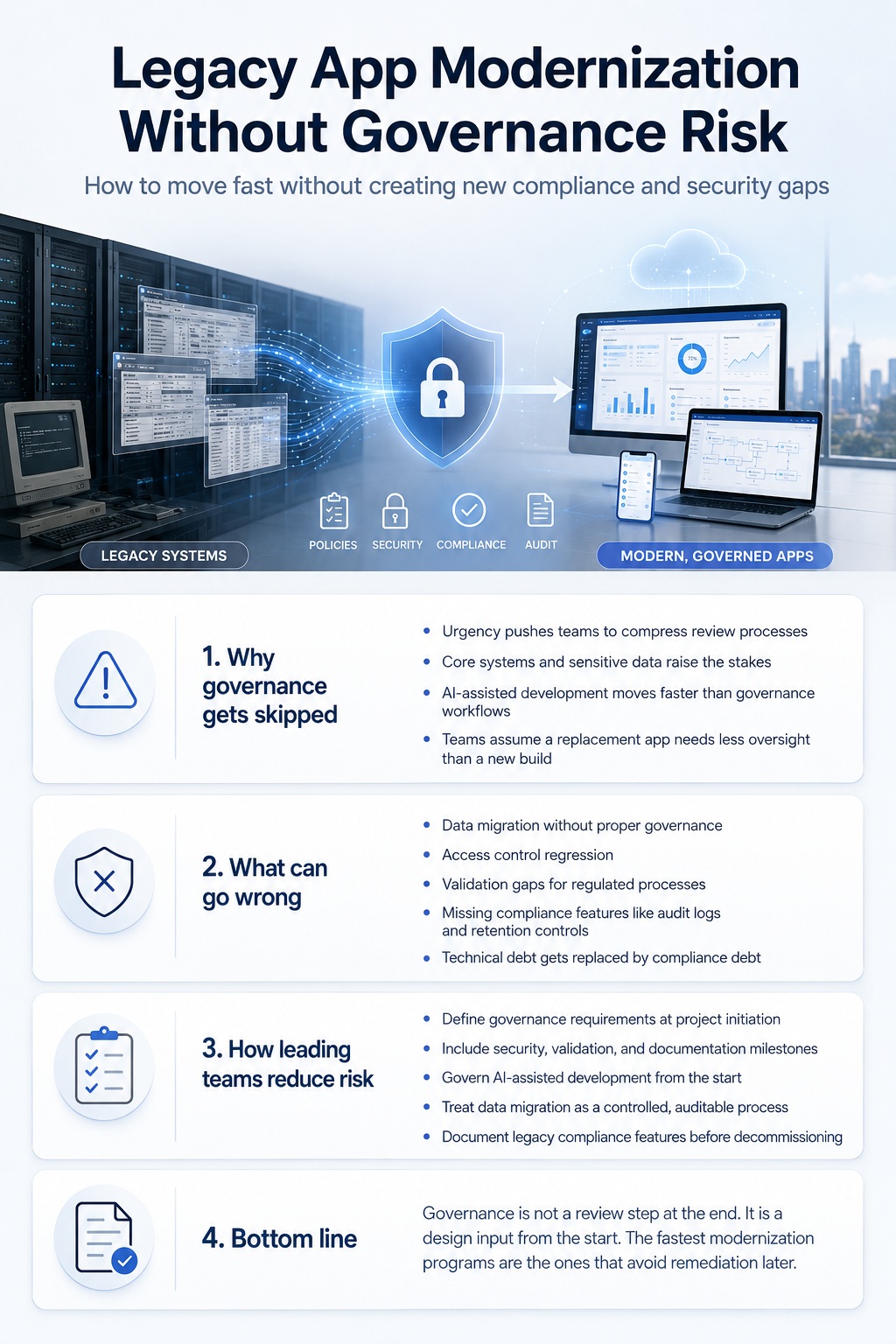
The specific risks that emerge when modernization skips governance
The governance gaps that emerge in fast-moving modernization programs tend to cluster around a predictable set of risk areas.
Data migration without data governance: Legacy modernization almost always involves migrating data from the old system to the new one. That migration is a high-risk moment from a compliance and security standpoint — data is moving, transformations are being applied, and the opportunity for data quality problems, unauthorized exposure, and compliance violations is significant. Modernization programs that are moving fast frequently treat data migration as a technical exercise rather than a governance exercise. The data lands in the new system without a documented data governance assessment, without a formal review of how access controls in the new system compare to those in the legacy system, and without an audit trail of what transformations were applied and why.
Access control regression: Legacy systems often have access control models that are poorly documented but functionally effective — the right people have access to the right things, even if nobody can fully explain why the configuration ended up that way. When those systems are modernized quickly, the access control model is rebuilt from scratch, often based on the development team’s best understanding of who needs access to what. That understanding is frequently incomplete. The result is a modernized application that is functionally better than the legacy system and has a worse access control model — more permissive, less documented, and less aligned with the principle of least privilege.
Validation gaps for regulated processes: In industries where software supporting regulated processes requires formal validation — pharmaceutical, medical device, food manufacturing, financial services — the modernized application needs to go through the same validation process as any other application in that category. The fact that it is replacing a legacy system that was previously validated does not mean the new application inherits that validation. It needs its own. Modernization programs that don’t build validation requirements into the project plan from the beginning frequently discover this gap late — after the application is in production and the validation exercise needs to be retrofitted, which is significantly more expensive and disruptive than building it in from the start.
Compliance feature gaps: Legacy systems sometimes have compliance-relevant features that are poorly documented and not obviously visible — audit logging, data retention enforcement, access reporting, change tracking. When those systems are modernized, the development team builds the functional features the business has asked for. If the compliance features weren’t explicitly documented as requirements, they don’t get built. The new application goes live, looks like it works, and then fails a compliance audit because it’s missing controls that the legacy system had — controls that nobody thought to document as requirements because they were assumed to be table stakes.
Technical debt substitution: The most ironic outcome of ungoverned modernization is that it replaces one form of technical debt with another. The old system had unsupported technology, limited integration capabilities, and institutional knowledge concentrated in a handful of people who understood its quirks. The new system, built quickly without governance, has undocumented architecture, inconsistent security controls, and code that nobody has formally reviewed. The technical debt has changed in character — it’s now compliance debt and security debt rather than infrastructure debt — but it hasn’t been reduced. It’s been deferred and transformed. This is precisely what CloudApper‘s governed modernization approach prevents: because every application built on the CloudApper platform inherits the same access control model, audit logging, and compliance certifications — FedRAMP Ready, HIPAA, SOC 2, GDPR — the modernized system starts with a compliance posture that the legacy system never had, rather than accumulating new debt in the process of shedding old debt.
What the “move fast without creating new risk” framework actually looks like
The organizations that navigate this well operate from a principle that sounds simple and requires real organizational discipline to execute: governance is a design input, not a review step.
That principle has specific implications for how modernization programs are structured.
Governance requirements are defined at the project initiation stage, not after the build is complete: Before the modernization development work begins, the program team answers a defined set of questions: What compliance frameworks apply to this application? What data does it handle and what are the governance requirements for that data? What validation requirements apply? What are the access control requirements and how will they be documented? What audit logging does the application need? What is the change management process for modifications after go-live?
The answers to those questions become requirements, not afterthoughts. The development work is designed to meet them from the beginning. This is not slower than defining requirements without governance — it’s the same requirements exercise, extended to include governance scope. The alternative — building without those requirements and adding them later — is reliably more expensive and more disruptive.
The modernization timeline includes governance milestones, not just functional milestones: A modernization program that measures progress only against functional delivery — “feature X is complete, system Y is migrated” — will deprioritize governance work whenever timeline pressure increases. Building governance milestones into the program plan — security review complete, access control documentation approved, validation protocol executed — makes governance work visible and accountable in the same way functional work is.
AI-assisted development is governed from the start, not retrofitted: If the modernization program is using AI coding tools to accelerate development — and increasingly, they are — the governance framework for AI-assisted development needs to be in place before development begins. That means approved AI tools, defined review requirements for AI-generated code, documented change management process, and automated audit trail generation. The speed that AI tools provide is sustainable only if the governance infrastructure scales with it. CloudApper addresses this directly: rather than generating raw source code that requires per-deployment security review, the platform produces governed application blueprints that run on a certified, zero-DevOps runtime — so the AI-accelerated modernization timeline and the compliance requirement for reviewed, auditable code are satisfied simultaneously, not sequentially.
Data migration is treated as a governed process, not a technical task: The data migration plan includes a governance assessment: what data is being migrated, what transformations are being applied, who has authorized those transformations, how the migrated data will be validated against the source, and what the audit trail for the migration looks like. The migration is executed in a controlled environment with documented access controls. The results are formally validated before the new system goes live.
The legacy system’s compliance features are formally documented before decommissioning: Before the legacy system is turned off, the program team produces a formal inventory of its compliance-relevant features: what audit logging it performs, what access controls it enforces, what data retention policies it implements, what reporting it produces for regulatory purposes. That inventory becomes a checklist for the new system — not a comprehensive requirements document, but a minimum floor that the new application must meet or exceed.
The conversation IT leaders need to have with their program sponsors
Modernization programs are typically sponsored at a senior level — a CIO, a COO, or a board-level digital transformation initiative. The program sponsor controls the mandate and the timeline pressure that drives the urgency culture. Having a clear, direct conversation with the program sponsor about governance is one of the highest-leverage activities an IT leader running a modernization program can engage in.
That conversation is not about slowing the program down. It’s about framing governance as risk management for the program sponsor’s initiative. The sponsor approved the modernization to reduce risk — operational risk, technical risk, competitive risk. A modernization that creates compliance debt and security vulnerabilities doesn’t reduce risk. It transforms it.
The specific risks worth naming in that conversation: a compliance finding that requires the modernized system to be taken offline for remediation is more disruptive and more expensive than building compliance in from the start. A security incident involving data that was migrated without adequate controls is a program-level failure that reflects on the sponsor. A validation gap discovered post-go-live in a regulated environment creates regulatory exposure that can delay or derail the program’s business outcomes.
Program sponsors who understand those risks respond differently to governance requirements than program sponsors who see governance as process overhead imposed by a risk-averse IT organization. The conversation is worth having explicitly, early, and at the right level.
The legacy modernization programs that work
The modernization programs that successfully move fast without creating new risk share a consistent profile. They have a governance framework defined before development begins. They have AI-assisted development governed from the start. They have data migration treated as a controlled, documented process. They have compliance requirements defined as first-class requirements alongside functional requirements. And they have program leadership that understands governance as risk management for the program, not as an obstacle to it.
Those programs deliver modernized applications that are faster, more maintainable, better integrated, and better governed than the legacy systems they replace. They don’t trade technical debt for compliance debt. They reduce both.
The programs that don’t work — the ones that move fast, skip governance, and then spend the next eighteen months remediating findings, rebuilding documentation, and explaining to auditors how a major modernization effort produced applications with material control gaps — those programs look fast at the midpoint and slow at the end. The governance shortcuts that seemed to save weeks in development cost months in remediation.
Modernization speed is real and valuable. It’s available to the organizations that build the governance infrastructure to use it responsibly — not as an alternative to governance, but as a reason to build governance that scales with the pace that AI tools make possible.
The Bottom Line
Legacy modernization programs face structural pressure to skip governance. The urgency narrative, the timeline pressure, and the implicit logic that replacing a bad system with anything better is progress all create conditions where governance gets treated as optional.
It isn’t. The compliance debt and security exposure created by ungoverned modernization is as real as the technical debt it was designed to replace — and it surfaces under worse conditions, during audits and incidents rather than during planned maintenance windows.
The organizations that get this right treat governance as a design input from the beginning of the modernization program — not a review step at the end, and not a remediation exercise after go-live. That approach is not slower than ungoverned modernization. It is faster in the only timeframe that includes the remediation work that ungoverned modernization always eventually requires.
CloudApper helps enterprise organizations govern legacy modernization programs — with AI-assisted development governance, automated documentation, and compliance-first architecture that makes fast modernization sustainable rather than a source of new risk. Contact us to see how organizations managing active modernization programs are approaching governance.

What is CloudApper AI Platform?
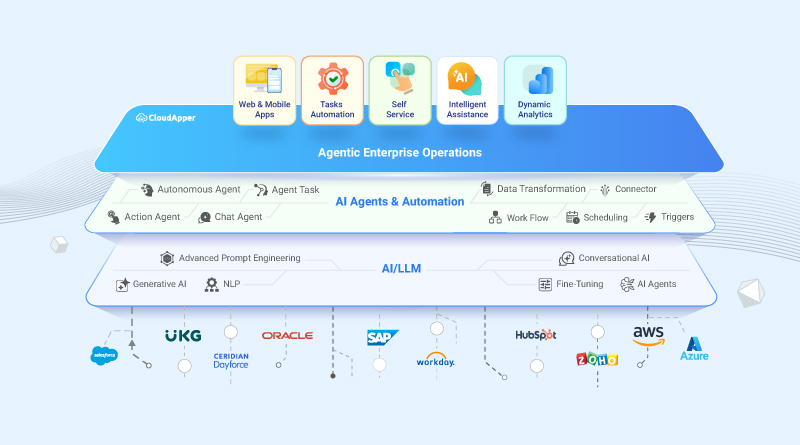
CloudApper AI is an advanced platform that enables organizations to integrate AI into their existing enterprise systems effortlessly, without the need for technical expertise, costly development, or upgrading the underlying infrastructure. By transforming legacy systems into AI-capable solutions, CloudApper allows companies to harness the power of Generative AI quickly and efficiently. This approach has been successfully implemented with leading systems like UKG, Workday, Oracle, Paradox, Amazon AWS Bedrock and can be applied across various industries, helping businesses enhance productivity, automate processes, and gain deeper insights without the usual complexities. With CloudApper AI, you can start experiencing the transformative benefits of AI today. Learn More
- Useful Links:
- Agentic AI
- No-Code/Low-Code
- Custom Software
- HCM Personalization
- iPaaS
- FedRAMP