AI coding tools make developers faster — not more plentiful. Enterprise IT leaders are learning that the developer shortage isn't a productivity problem. It's a leverage problem, and the solution looks different than most budget cycles assume.

TL;DR
AI coding tools make individual developers faster, but they don't solve the capacity problem that most enterprise IT teams actually face — too few developers, too many applications, and governance overhead that scales with every new deployment. The real constraint isn't developer speed; it's the maintenance burden, compliance overhead, and institutional knowledge concentration that accumulate when small teams build custom applications at scale. CloudApper changes the denominator by providing a governed platform where compliance is inherited, infrastructure is managed automatically, and a team of three can sustainably maintain a portfolio that would otherwise require fifteen — shifting the developer shortage from a headcount problem to an architecture problem with a tractable solution.
Table of Contents
- What AI Coding Tools Actually Deliver — and What They Don’t
- The Governance Problem That Accelerated Development Creates
- What the Capacity Problem Actually Requires
- The Shift Enterprises Are Making
Three developers. Forty-seven open requests. A backlog that grows faster than it clears.
That’s not an unusual situation for an enterprise IT team. It’s common enough that most IT leaders reading this will recognize the ratio without needing an explanation. The demand for internal applications — workflow tools, compliance dashboards, integration layers, operational apps — has grown significantly faster than the headcount allocated to build them. The business keeps identifying problems that software could solve. The IT team keeps explaining why the queue is eighteen months long.

When AI coding tools arrived, the immediate response from many organizations was to treat them as the answer to this problem. Give the developers GitHub Copilot, or Cursor, or Amazon Q, and they’ll move faster. The backlog will shrink. The staffing gap will close. Three developers will do the work of six.
The math doesn’t hold. Not for the backlog problem, and not for the compliance problem that tends to emerge when the backlog does start moving faster.
What AI Coding Tools Actually Deliver — and What They Don’t
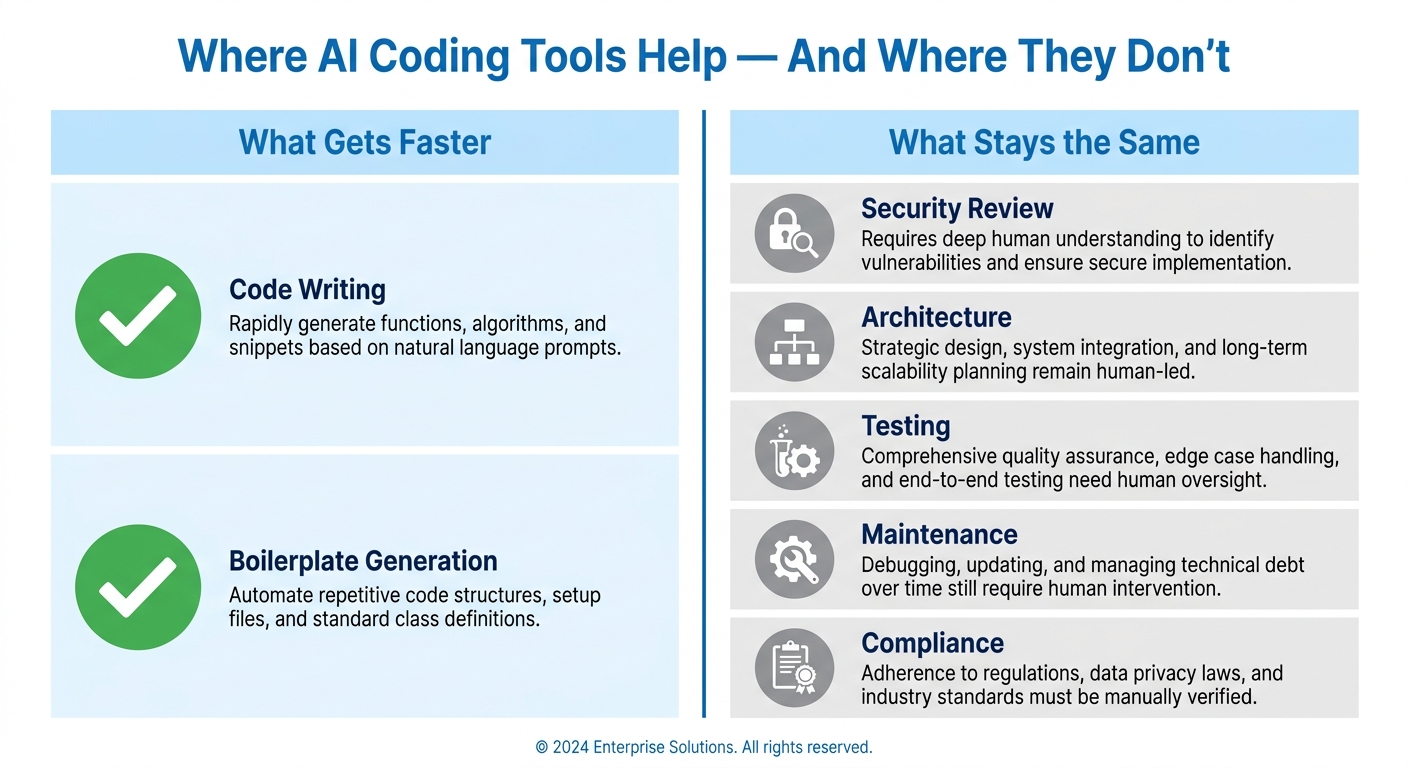
AI coding assistants are genuinely useful productivity tools for experienced developers. They accelerate boilerplate generation, reduce the friction of switching between languages, and help developers navigate unfamiliar codebases more quickly. A developer who writes 200 lines of production-ready code per day might write 280 with the right AI assistant. That’s real.
What it isn’t is a solution to a capacity problem at the scale most enterprise IT teams face. The bottleneck in a three-person team isn’t line-of-code output. It’s requirements gathering, architecture decisions, stakeholder alignment, testing, deployment, security review, and ongoing maintenance. AI coding tools accelerate one part of one stage of the development process. They don’t accelerate the system around it, and they don’t reduce the number of developers required to operate that system sustainably.
The organizations that have deployed AI coding tools across internal development teams report a consistent experience: individual developer velocity increases, but team throughput — the number of applications shipped and maintained to a production standard — doesn’t scale proportionally. The reason is structural. A three-person team with AI coding tools is still a three-person team. The governance requirements, the maintenance burden, and the compliance overhead scale with the number of applications in production, not with the productivity of the developers who built them.
AI-generated code is fast to build and expensive to trust — and the trust-building work falls on the same team that is already at capacity. Every application that gets shipped faster with an AI coding tool still needs to be reviewed, tested for security vulnerabilities, documented, and maintained. The acceleration at build time doesn’t reduce the overhead at every subsequent stage.
The Governance Problem That Accelerated Development Creates
There’s a second-order effect that doesn’t appear in the productivity conversation around AI coding tools, and it matters significantly for enterprise IT teams operating in regulated environments. When a small development team uses AI coding assistants to ship applications faster, the applications accumulate faster than the governance infrastructure can keep up with them.
The security risks of letting developers use AI coding tools without a governance framework are well-documented at this point. AI-generated code carries a 40–45% vulnerability rate compared to purpose-built enterprise frameworks. But the governance gap isn’t only a security problem — it’s an operational one. Applications built quickly without a standardized architecture create maintenance debt. Each one has its own data model, its own access control logic, its own deployment configuration. The team that built them is the only team that understands them.
The institutional knowledge problem in enterprise software is acute for small teams because the concentration of context is higher. A ten-person team losing one developer loses ten percent of its headcount. A three-person team losing one developer loses a third of its headcount — and potentially the entire working knowledge of several production systems.
Accelerated development without governance infrastructure doesn’t actually close the capacity gap. It moves debt from the build queue to the maintenance queue, where it compounds with interest. Shadow AI development — applications built quickly by business units or individual developers outside any formal process — creates the same dynamic at larger scale. The organization appears to be solving its internal app problem. The IT team is actually accumulating a different problem that will surface in the next audit cycle, the next compliance review, or the next time a developer leaves and the institutional knowledge goes with them.
CloudApper addresses this from a different angle entirely. Rather than trying to help small teams move faster through a development process that doesn’t scale, CloudApper changes the process itself — replacing custom code generation with governed platform-based application building that produces compliant, maintainable applications by default, without requiring each application to be individually architected and secured.
What the Capacity Problem Actually Requires
The internal developer shortage isn’t fundamentally a productivity problem. It’s a leverage problem. Productivity tools increase output per unit of input — and they’re valuable for that. Leverage tools change the ratio between input and outcome entirely. A development team using a governed platform doesn’t write less code per day. It ships fewer lines of custom code in total, because the platform handles the architecture, the security, the compliance, the deployment, and the ongoing maintenance that would otherwise require developer time.
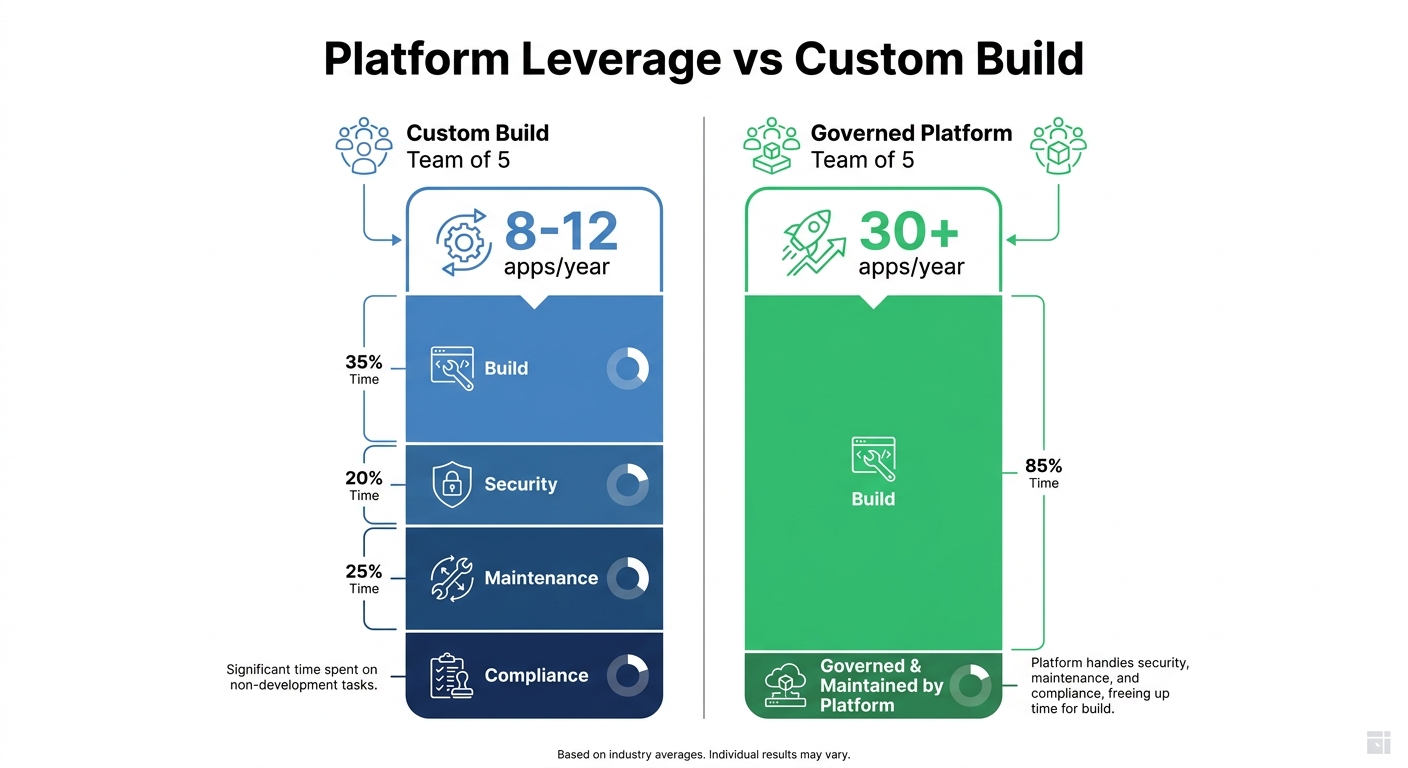
The difference in practical terms is significant. A three-person team building custom applications with AI coding tools might ship eight to twelve production applications per year while managing an existing portfolio of twenty. The same three-person team operating on a governed AI platform can build and deploy significantly more applications because each one doesn’t require bespoke architecture decisions, doesn’t create unique maintenance obligations, and doesn’t need individual security review before deployment.
Zero DevOps overhead is one dimension of this leverage. When the platform handles runtime management, patching, updates, and infrastructure, the development team’s capacity isn’t split between building new applications and keeping existing ones running. That’s not a marginal improvement — for small teams, infrastructure management is often the single largest consumer of developer time that isn’t application development.
The other dimension is compliance inheritance. Every application a small team builds on standard cloud infrastructure needs to be individually evaluated for SOC 2, HIPAA, or whatever compliance frameworks apply to the organization. On a governed platform like CloudApper, those frameworks are inherited at the platform level. The application gets the compliance posture of the platform without requiring a per-application certification cycle. For a three-person team managing a portfolio of thirty applications, the difference between individual and inherited compliance is measured in weeks of developer time per year.
The Shift Enterprises Are Making
Forward-thinking enterprise IT leaders are reframing the developer shortage problem. The question isn’t “how do we make our developers faster?” It’s “how do we change what each developer is responsible for?” The answer, increasingly, is platforms that handle the undifferentiated work — security, compliance, infrastructure, maintenance — so that developer capacity is concentrated on the business logic that actually requires human judgment.
This reframing has operational consequences that go beyond the IT team. When every business department effectively becomes a software vendor, the IT team’s role shifts from building every application to governing the environment in which applications get built. That’s a different model — one where a small IT team can support a much larger volume of application development than a traditional custom build approach allows, because the governance is centralized at the platform level rather than embedded in each project.
CloudApper supports this model directly. Business teams can build and extend applications within a governed environment, and the IT team maintains oversight through the platform rather than through direct involvement in every project. The three developers who were bottlenecking forty-seven requests are no longer the single point of failure for every application the organization needs. They’re operating the platform that the organization builds on.
The build versus platform decision for internal enterprise applications looks different when the constraint is developer capacity rather than technical complexity. Building custom applications requires developer time at every stage — design, development, testing, security review, deployment, maintenance. A governed platform front-loads the architecture and compliance work, then reduces the per-application overhead for everything that follows. For organizations where developer capacity is the binding constraint, that reallocation of overhead is what changes the throughput math.
What “Solving” the Developer Shortage Actually Looks Like
Enterprises that have genuinely reduced the gap between internal application demand and delivery capacity tend to share a common characteristic: they stopped treating the problem as a headcount problem and started treating it as an architecture problem. The organizations that hired more developers to close the gap typically found that the demand expanded to fill the available capacity — and the maintenance burden of the expanded portfolio consumed the new headcount within two years. The organizations that invested in platform-based development found that their existing teams could support significantly more applications without a proportional increase in operational overhead.
That’s not to say headcount doesn’t matter. Enterprise IT teams are understaffed relative to the internal application demand that now exists in most large organizations. But adding developers to a process that doesn’t scale is a temporary solution. The backlog grows back. The governance debt accumulates. The maintenance burden expands.
CloudApper changes the denominator in the capacity calculation. The question isn’t how many developers are available — it’s how much each developer can sustainably own and maintain given the platform they’re working on. On a governed enterprise platform, that number is significantly higher than it is for custom-built applications, because the platform absorbs the overhead that would otherwise require developer time. A team of five developers operating on CloudApper can maintain a portfolio that would require fifteen developers to support in a custom development environment — not because the developers are more productive, but because the platform eliminates the category of work that consumes most of their time.
For enterprise IT leaders working through the developer shortage in the next budget cycle, the question worth asking isn’t “how many developers do we need to hire?” It’s “how much of what our developers do today could be handled by the right platform?” The answer, for most organizations operating in custom development environments, is more than they expect.
CloudApper works with enterprise IT teams to assess current development capacity and scope platform-based alternatives that extend team leverage without adding headcount. If your organization is managing a growing internal application backlog with a team that hasn’t grown to match, reach out to discuss what a governed platform approach could change.

What is CloudApper AI Platform?
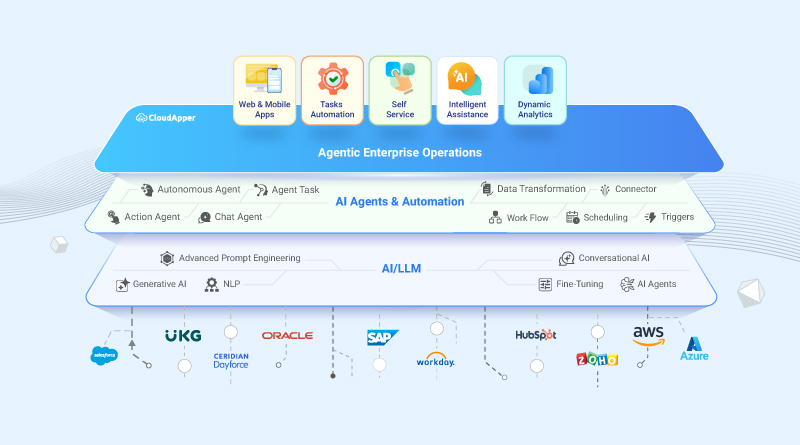
CloudApper AI is an advanced platform that enables organizations to integrate AI into their existing enterprise systems effortlessly, without the need for technical expertise, costly development, or upgrading the underlying infrastructure. By transforming legacy systems into AI-capable solutions, CloudApper allows companies to harness the power of Generative AI quickly and efficiently. This approach has been successfully implemented with leading systems like UKG, Workday, Oracle, Paradox, Amazon AWS Bedrock and can be applied across various industries, helping businesses enhance productivity, automate processes, and gain deeper insights without the usual complexities. With CloudApper AI, you can start experiencing the transformative benefits of AI today. Learn More
- Useful Links:
- Agentic AI
- No-Code/Low-Code
- Custom Software
- HCM Personalization
- iPaaS
- FedRAMP
CloudApper AI Solutions


- Works with







- and more.
Similar Posts

Microsoft Access Modernization: Why the Technical Migration Is the Easy…

When the ISV Disappears: Managing an Orphaned Windows Application With…