AI coding tools accelerate enterprise development, but unmanaged output creates security, governance, maintenance, and data fragmentation risks. CloudApper helps teams preserve speed while enforcing consistent controls, certified runtime governance, and scalable data architecture across every application built, deployed, and maintained.
Table of Contents
- The Speed Problem Is Real. So Is the Trust Problem.
- Four Ways This Gets Expensive
- Why “Move Fast and Govern Later” Doesn’t Work Here
- What Structural Governance Actually Looks Like
- The Data Governance Piece Most Teams Miss
- The Developer Experience Question
- The Hybrid Scenario: When Your Developers Want to Write Code
- Where This Leaves CIOs and CTOs
- Talk to CloudApper About Your Current AI Development Environment
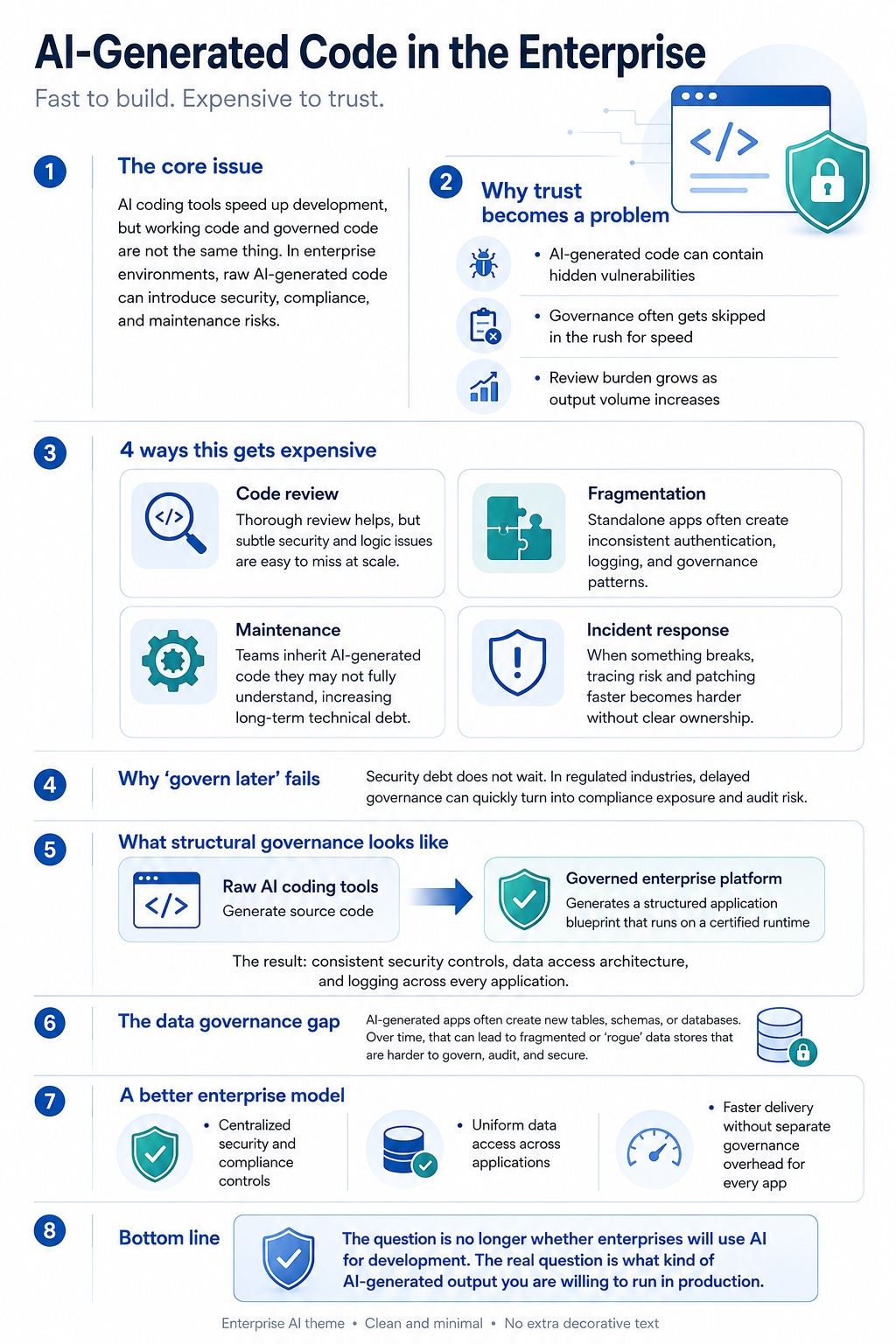
AI-generated code in the enterprise is fast to build and expensive to trust, because working code and governed code are not the same thing. Teams that adopt Copilot, Cursor or something newer see tickets close faster and the backlog shrink, and leadership expands the rollout.
The cost shows up later, usually when someone has to explain what is actually running in the environment and who reviewed it. The team did nothing wrong, and the tools worked. CloudApper is one way to keep that speed while closing the review gap, by building apps on a platform with governance controls already in place.
The Speed Problem Is Real. So Is the Trust Problem.
AI coding tools are genuinely fast. An application that would have taken a team of developers three months to design, build, and test can be generated in a fraction of that time. That’s not hype — it’s a documented shift in how software gets built, and most enterprise IT teams are already living it.
The problem isn’t the speed. The problem is what gets skipped in the interest of speed.

When a senior developer writes code by hand, they’re making explicit decisions at every step: how authentication works, how data gets accessed, how errors get logged, what happens when something fails. Those decisions are visible and reviewable. When an AI generates the same code, those decisions still get made — by a statistical model optimizing for output that looks plausible, not for your specific security requirements.
The result is code that works until it doesn’t, and fails in ways that are hard to predict because nobody fully understood it in the first place.
Research into AI-generated code quality has consistently found vulnerability rates in the 40–45% range for common weakness categories. That’s not catastrophic — most vulnerabilities aren’t exploited. But it does mean that raw AI-generated code, deployed without a structured review and governance process, is carrying a risk profile that most enterprise security teams would not accept if they saw it described plainly.
Four Ways This Gets Expensive
1. The code review problem
The obvious answer to AI-generated vulnerabilities is thorough code review. And thorough code review does catch things — obvious injection risks, insecure defaults, authentication gaps that a competent reviewer would spot.
What it doesn’t catch reliably: subtle data access issues that only surface under specific conditions, inconsistent access control implementations across a codebase that grew faster than anyone could track, logging gaps that look fine on their own but create blind spots in your monitoring, and logic that’s technically correct but violates your data handling requirements in ways that require deep domain knowledge to recognize.
Code review is also a process that scales poorly against AI-generated output volume. If your team is generating applications in hours instead of weeks, the review burden compounds quickly. At some point, the review becomes perfunctory — not because the team is careless, but because there’s simply too much to review carefully.
2. The fragmentation problem
Standard AI coding tools generate standalone applications. Each application gets its own database schema, its own access control configuration, its own logging behavior, its own authentication implementation. Build ten internal apps over a year and you have ten separate governance configurations to maintain, audit, and secure.
This is a structural problem that doesn’t go away with better code review. Reviewed or not, that application still diverges from your established data architecture. Each one is another surface for inconsistency. Each one needs to be evaluated individually when something changes — a new compliance requirement, a security patch, a personnel change on the team that built it.
Enterprise systems don’t work well with fragmentation. The whole point of enterprise architecture discipline is to have consistent, predictable systems that can be governed and audited at scale. Raw AI-generated applications work directly against that.
3. The maintenance problem
Code that AI generated is code your team has to maintain indefinitely. When a dependency updates and introduces a vulnerability, someone has to trace through AI-generated logic to understand the exposure. When a compliance requirement changes, someone has to modify code they may not have written and may not fully understand. When the original developer leaves — and they will leave — their successor inherits a system with thin documentation and logic that was produced by a model, not explained by a person.
This compounds over time. One AI-generated application with incomplete documentation is a manageable problem. A dozen of them, accumulated over two years, with three different developers who’ve since moved on, is a serious maintenance liability.
The technical debt question is worth taking seriously here. Traditional technical debt is code written quickly that needs to be cleaned up later. AI-generated technical debt is subtler — the code may look clean, it may even pass review, but nobody really owns it in the way that matters when something goes wrong. Recent research on AI-generated codebases has started calling this “intent debt” — the gap between what the code does and what anyone can confidently say it was meant to do.
4. The incident response problem
When something goes wrong in a system built with AI-generated code, the incident response process starts from an unusual position: the team responding may have limited understanding of the system they’re responding in.
Tracing a security incident through AI-generated logic is harder than tracing it through code a developer wrote themselves. Identifying the scope of a data exposure in a fragmented application with its own non-standard database schema is harder than doing the same in an application built on your established data architecture. Patching a vulnerability in code that nobody fully owns is slower and riskier than patching code that has clear ownership and documentation.
None of this is hypothetical. These are the conditions that turn a containable security incident into a material breach.
Why “Move Fast and Govern Later” Doesn’t Work Here
There’s a version of this conversation where the answer is: accept the risk now, implement governance later once the tooling matures.
That approach works fine for some categories of technical risk. It doesn’t work well for security debt in production systems that handle sensitive data.
Security debt accumulates interest differently than other technical debt. A poorly architected codebase is annoying to maintain. A poorly governed security posture creates exposure that doesn’t wait for your remediation schedule. And in regulated industries — healthcare, manufacturing, government contracting — the “govern later” approach has a way of meeting a compliance deadline that makes it a crisis instead of a backlog item.
The organizations that handle AI coding adoption well aren’t the ones that move fastest. They’re the ones that made a better architectural decision upfront about what kind of AI-generated output would end up running in their environment.
What Structural Governance Actually Looks Like
The fundamental difference between a raw AI coding tool and a platform designed for enterprise use is what the AI produces.
Raw AI coding tools generate source code. That code carries all the risks described above — unknown logic, fragmented architecture, inconsistent governance, ongoing maintenance burden. Your team gets the application fast, and then owns every problem it contains, forever.
A platform designed for enterprise governance generates something different: a structured application definition that executes on a certified runtime. The application logic is expressed as configuration, not as raw source code. The runtime — which has been independently audited and certified — handles execution. Every application built on the platform runs in the same controlled environment, with the same security controls, the same data access architecture, and the same logging behavior.
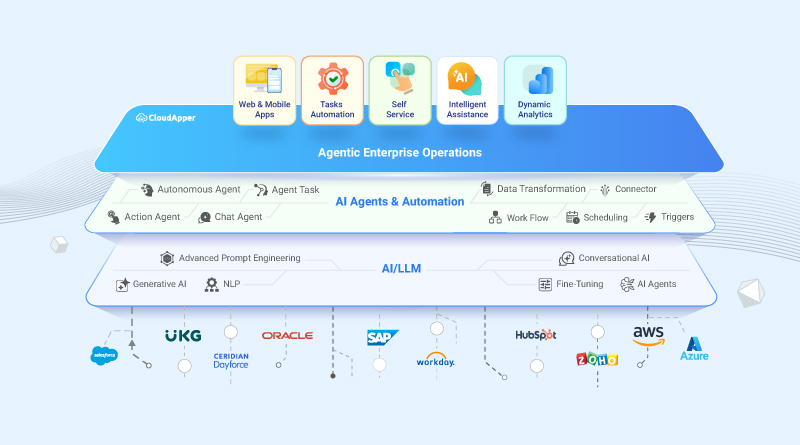
This is what CloudApper’s platform does. AI generates a lightweight application blueprint instead of unmanaged source code. That blueprint runs on CloudApper’s certified application server. Every new application automatically inherits the server’s approved security and compliance controls — without a separate review cycle for each application.
The practical result: ten applications built on the platform are not ten separate governance problems. They’re ten instances of the same governed architecture. When a security control needs to update, it updates everywhere. When an auditor asks about your data access architecture, the answer is consistent across every application.
The Data Governance Piece Most Teams Miss
One specific failure mode deserves more attention than it usually gets: what happens to your data architecture when AI coding tools are in widespread use.
Every application an AI tool generates tends to create its own data storage. New tables, new schemas, sometimes entirely new databases. Individually, each one looks like a reasonable engineering decision. In aggregate, you end up with what the CloudApper architecture deck calls “rogue databases” — fragmented, inconsistently governed data stores that have proliferated across your environment faster than your data governance function can track them.
In a regulated environment, this is not a minor housekeeping issue. HIPAA, SOC 2, GDPR, and CCPA all have requirements around knowing where your data lives and being able to demonstrate consistent controls over it. An environment with a dozen AI-generated applications each maintaining their own data stores is an environment where that demonstration gets difficult.
CloudApper addresses this by enforcing a uniform data access layer across all applications. Every application connects to data through approved enterprise data policies. Nothing creates its own database outside that structure. The result is consistent data governance regardless of how many applications get built — which matters a lot when an auditor asks you to map your data flows.
You can read more on how CloudApper handles enterprise AI integration and data governance and what a genuinely secure enterprise AI architecture looks like in practice.
The Developer Experience Question
A governance argument that ignores developer experience tends not to survive contact with actual developers. If the secure option is also the slow option, teams find workarounds. They use the fast tool and deal with the compliance question later. Shadow AI is the natural consequence of governance frameworks that aren’t workable in practice.
This is worth acknowledging directly: CloudApper’s platform doesn’t ask developers to give up speed for compliance. The AI generates applications from natural language descriptions. Development timelines that would normally take months compress to days. The output of ten engineers for the cost of one is a real operational claim, not a marketing figure — it’s what happens when you remove the DevOps overhead and compliance review cycle from every individual application.
The governance is structural, which means it doesn’t create friction at the application level. Developers build fast. The platform ensures what they build meets enterprise security standards. Those two things don’t have to be in tension if the architecture is designed correctly from the start.
And because CloudApper handles DevOps after deployment — updates, security patches, system upgrades, hosting — development teams aren’t carrying the ongoing maintenance burden either. The DevOps overhead that normally follows every AI-generated application doesn’t accumulate.
The Hybrid Scenario: When Your Developers Want to Write Code
Not everything can or should be built through configuration. Some applications have genuinely specialized requirements — complex integrations, performance-sensitive logic, custom business rules that don’t map cleanly to a platform’s model.
CloudApper’s hybrid architecture handles this: developers can write native code modules that bolt onto the platform’s existing security and data layers. The custom code runs on top of the established infrastructure rather than creating a parallel governance track. It inherits access controls and audit logging from the platform. It doesn’t create a new database to audit.
This matters for enterprise teams that still want the flexibility of custom development without accepting the full risk profile of a standalone AI-generated codebase. The platform sets the floor for security and governance. Custom code can go above that floor without pulling the floor away.
Where This Leaves CIOs and CTOs
The decision most enterprise technology leaders are actually facing right now isn’t “should we use AI for development?” That decision was effectively made when GitHub Copilot hit 1.5 million users.
The real decision is what kind of AI development output you’re willing to have running in your production environment — and whether your governance architecture was designed for the pace at which AI tools can generate applications.
Unmanaged AI-generated code in enterprise systems is genuinely fast to build. The trust problem is real and it compounds. The organizations that are ahead of this aren’t avoiding AI development — they’re channeling it through infrastructure that was designed for enterprise accountability from the start.
That’s not a complex architectural concept. It’s a procurement decision. And it’s one that’s considerably easier to make before the audit than after it.
Talk to CloudApper About Your Current AI Development Environment
If your team is actively building with AI coding tools and you want to understand the specific governance gaps in your current setup, CloudApper can walk through your environment and map exactly what the platform addresses.
Schedule a conversation with the CloudApper team →
Bring the list of tools your team is currently using and the compliance frameworks you’re operating under. The conversation will be specific to your situation, not a general product walkthrough.

What is CloudApper AI Platform?
CloudApper AI is an advanced platform that enables organizations to integrate AI into their existing enterprise systems effortlessly, without the need for technical expertise, costly development, or upgrading the underlying infrastructure. By transforming legacy systems into AI-capable solutions, CloudApper allows companies to harness the power of Generative AI quickly and efficiently. This approach has been successfully implemented with leading systems like UKG, Workday, Oracle, Paradox, Amazon AWS Bedrock and can be applied across various industries, helping businesses enhance productivity, automate processes, and gain deeper insights without the usual complexities. With CloudApper AI, you can start experiencing the transformative benefits of AI today. Learn More
- Useful Links:
- Agentic AI
- No-Code/Low-Code
- Custom Software
- HCM Personalization
- iPaaS
- FedRAMP
CloudApper AI Solutions

- Works with







- and more.
Similar Posts

CMMC Level 2 and Internally Built Applications: The Evidence Gap…

Vendor-Built Internal Applications: The Governance Gap Enterprise IT Inherited From…