Enterprises that try to build custom applications around SAP face unexpected complexity, ungoverned development sprawl, and AI coding risks. Here is what IT leaders need to know before the next extension project.

TL;DR
Enterprises that implement SAP quickly discover it was not designed to serve as a flexible application development platform — business requirements consistently outgrow what SAP configuration and even SAP BTP can deliver. The typical response, distributing custom development across business units without governance, produces an ungoverned layer of SAP-adjacent applications that carry serious compliance and security exposure. AI coding tools have accelerated this pattern, generating SAP integrations faster than governance processes can catch up. CloudApper AI addresses this by providing a governed platform layer where custom SAP extension happens inside established compliance frameworks — HIPAA, SOC 2, GDPR, FIPS 140-2 — with a managed integration layer that doesn't break when SAP upgrades. The enterprises that manage SAP extensibility well are the ones that make the compliant development path the fastest one available.
Table of Contents
- The Three Paths SAP Offers — And Why Each One Has a Ceiling
- What “We’ll Just Build It Ourselves” Actually Produces
- The AI Coding Problem Is Making This Worse
- What a Governed SAP Extension Approach Looks Like
- The Integration Layer Is Where Projects Either Hold Together or Fall Apart
- The Business-Led Development Problem Is Structural, Not Disciplinary
- What IT Leaders Should Assess Before the Next Extension Project
The hardest part of an SAP program often begins after go-live, when the business asks for things SAP does not do out of the box. SAP custom application development in the enterprise gets complicated because SAP is excellent at standardizing core processes but was never designed as a flexible application development platform.

The requests are core workflows: an approval routing engine for one procurement scenario, a mobile app that lets floor supervisors read and write shift data, a vendor portal that exposes a subset of SAP data to outside users. Each extensibility path SAP offers carries tradeoffs that only show once you are committed. Enterprise IT teams use CloudApper AI to build governed, compliant applications that integrate with SAP without inheriting those constraints.
The Three Paths SAP Offers — And Why Each One Has a Ceiling
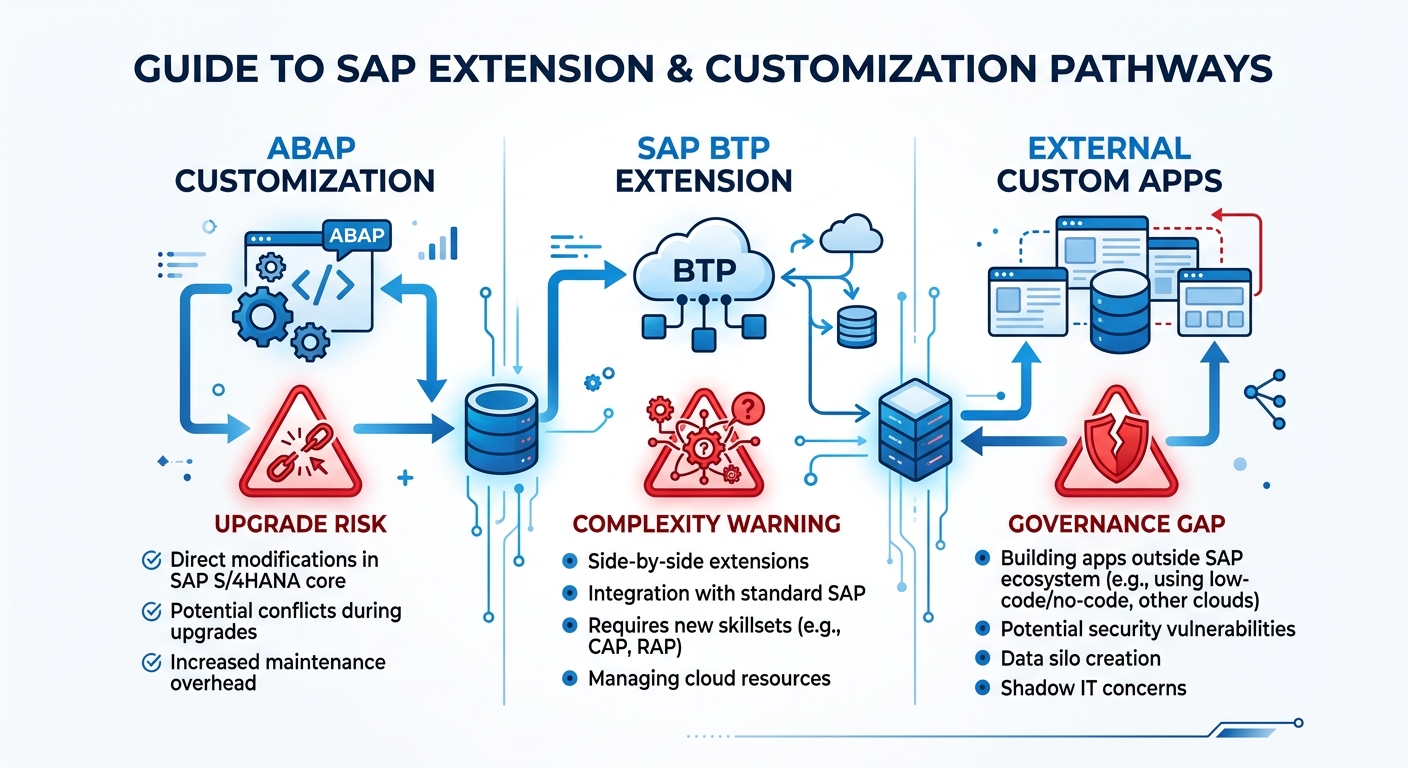
When a business requirement falls outside standard SAP functionality, IT teams have roughly three paths available. The first is ABAP customization directly inside the SAP system. The second is SAP BTP (Business Technology Platform), SAP’s cloud-based extension framework. The third is building an external application that connects to SAP via APIs or middleware.
ABAP customization has the longest history and the deepest integration, but it comes with well-understood costs. Every modification to the SAP core creates an upgrade liability. When SAP releases a new version or a support package, customizations have to be tested, adjusted, and re-certified. Over time, heavily customized SAP environments become difficult to move — they accumulate technical debt that mirrors exactly what enterprises were trying to escape when they moved off their previous legacy systems. The vendor lock-in trap that shows up in legacy modernization discussions applies just as much to SAP customization as it does to any other platform.
SAP BTP solves some of those upgrade liability problems by moving extensions into a separate layer. But BTP has its own complexity ceiling. It requires specialized SAP skills — developers who understand CAP (Cloud Application Programming Model), SAP’s authentication frameworks, and the specific integration patterns BTP supports. Those skills are scarce and expensive. For enterprises that don’t already have BTP expertise on staff, building and maintaining BTP extensions means either a significant investment in training or ongoing dependence on SAP partners. Neither option is quick.
External applications that connect to SAP via API are the most flexible approach and the one most IT teams eventually default to — but they introduce their own problems. The moment you’re building applications outside SAP, you’re building applications. That means development governance, security review, change management, and compliance coverage have to be applied to whatever you build. Most enterprises have not set up the infrastructure to govern that kind of external development at scale, and the gap tends to widen as more teams request more custom applications.
What “We’ll Just Build It Ourselves” Actually Produces
In practice, many enterprises respond to SAP’s extensibility ceiling by distributing the problem. Business units sponsor development projects. IT teams allocate developer time. Sometimes external consultants are brought in. Each project produces a custom application that works for its immediate purpose but wasn’t built with a shared architecture, shared governance standards, or a shared integration approach.
The result, several years after SAP go-live, is a sprawling collection of SAP-adjacent applications: point solutions, scripts, Excel macros with API connections, small web apps, internal tools built by developers who are no longer with the company. Each of them touches SAP data. Few of them have been through a formal security review. Many were built quickly under business pressure and never revisited. The institutional knowledge problem that comes with undocumented custom systems is particularly acute here: the developers who understood why a particular integration was built the way it was have moved on, and no one left knows whether it’s safe to change it.
This is not a niche scenario. It’s what SAP environments typically look like after a few years of business growth. The original SAP implementation was clean; the layer of custom applications around it is not.
The AI Coding Problem Is Making This Worse
The adoption of AI coding tools — GitHub Copilot, Cursor, and similar assistants — has accelerated this pattern. Developers who previously would have escalated a custom requirement to IT leadership can now prototype an SAP-adjacent application in a few days. The velocity is real. So is the risk.
AI-generated code carries well-documented vulnerability rates. Research across enterprise deployments consistently shows that 40 to 45 percent of AI-generated code contains security flaws that require remediation. In a regulated environment — and most enterprises running SAP are operating in regulated industries, whether healthcare, financial services, manufacturing, or pharmaceuticals — that rate of vulnerability in applications touching ERP data creates material compliance exposure.
Shadow IT has returned in AI form, and SAP environments are a particularly attractive target for it. Developers know what data SAP holds. Business users know what they want. AI coding tools close the gap between demand and delivery faster than governance processes can catch up. By the time IT leadership becomes aware that a business unit has built a custom SAP integration using an AI coding assistant, it’s already in production.
The governance question is not whether enterprises should allow custom development around SAP — the business need is real and is not going away. The question is what structure that development happens inside.
What a Governed SAP Extension Approach Looks Like
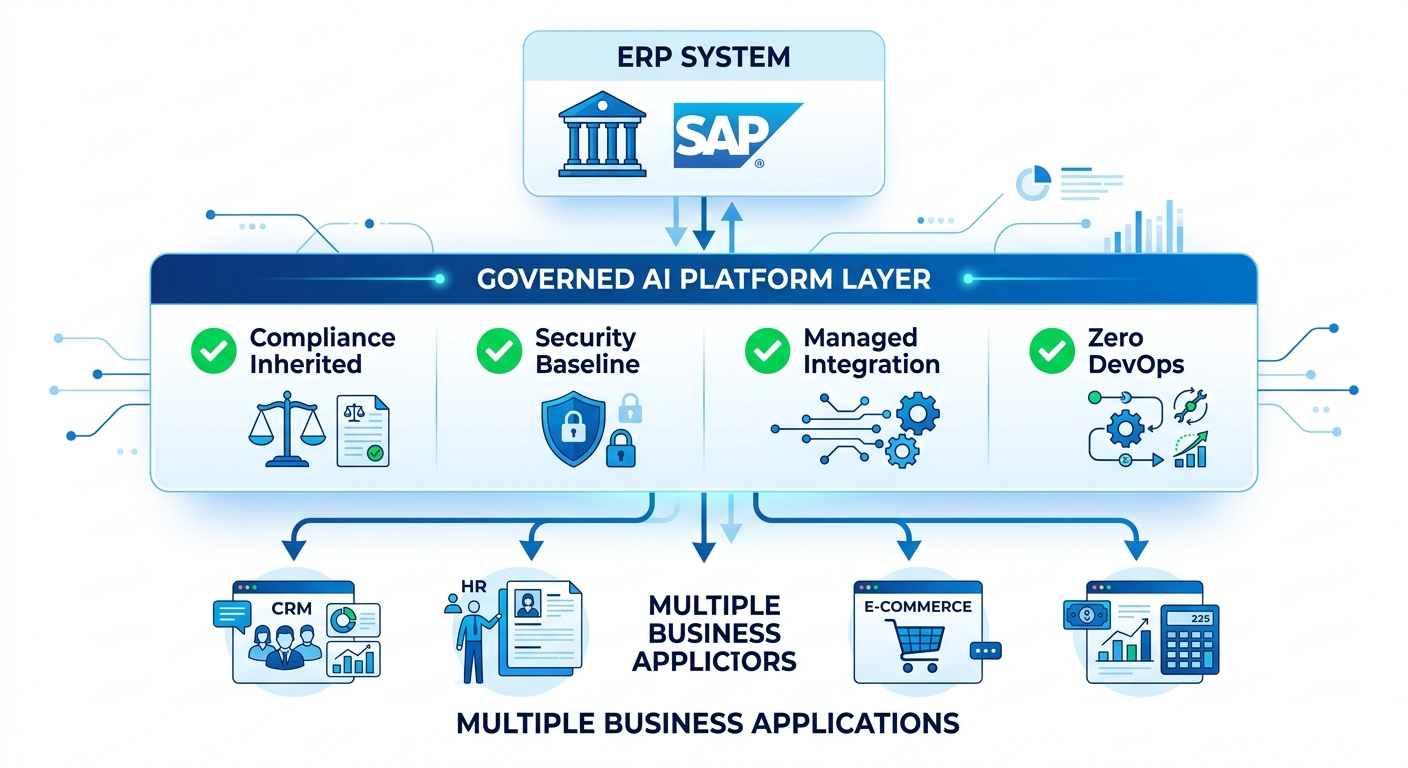
Enterprises that manage this problem well share a common pattern: they separate the platform question from the application question. SAP handles what SAP is good at — financial transactions, procurement, supply chain processes, HR data of record. Custom applications that need to read from or write to SAP are built on a governed platform that provides security, compliance, and integration infrastructure as a baseline, not as an afterthought.
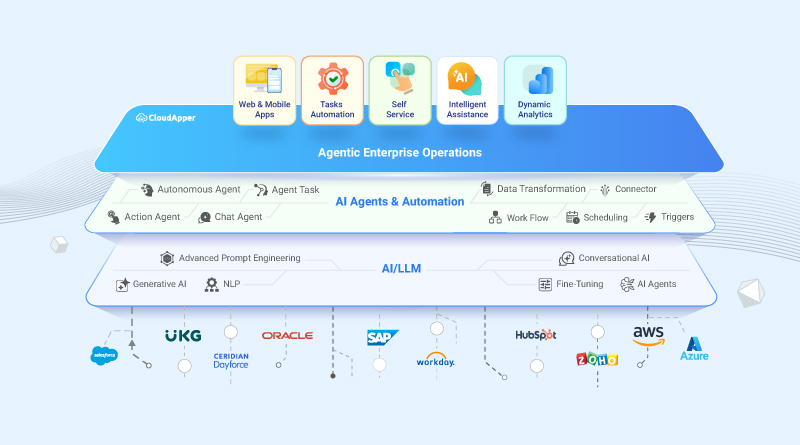
CloudApper AI operates in exactly this layer. It functions as a governed application development and deployment platform — one that integrates with SAP through established iPaaS connections and provides compliance inheritance across HIPAA, SOC 2, GDPR, FIPS 140-2, and related frameworks. Developers and technical builders use CloudApper to construct custom workflows, mobile applications, and AI agents that pull from and write back to SAP without having to rebuild security infrastructure for each project. The governance layer is the platform, not an external process applied inconsistently after the fact.
This matters for SAP customers because the compliance question doesn’t go away when you move development outside the SAP core. If anything, it intensifies. Applications that access SAP HR data carry HIPAA implications. Applications that access financial data carry SOC 2 and potentially PCI implications. Applications built for regulated pharmaceutical or manufacturing environments carry FDA or ISO implications. Evaluating a development platform against compliance requirements is not a procurement formality — it’s the core technical decision.
The Zero DevOps characteristic of CloudApper’s platform is also relevant for SAP extension projects. Custom applications built on CloudApper don’t require a separate infrastructure team to maintain — patching, updates, runtime management, and compliance monitoring are handled by the platform. This is meaningful for enterprises that are already resource-constrained in their IT departments. Every developer hour spent managing infrastructure for a custom SAP-adjacent application is a developer hour not spent building the next one.
The Integration Layer Is Where Projects Either Hold Together or Fall Apart
One of the most common failure modes in SAP extension projects is the integration layer. Custom applications that connect to SAP via APIs work well at first, then break when SAP undergoes an upgrade, when an API endpoint changes, or when the underlying data structure shifts. Debugging these failures is time-consuming, often falls to developers who weren’t involved in the original build, and creates exactly the kind of operational disruption that the custom application was supposed to prevent.
A platform-based approach to SAP extension addresses this through a managed integration layer — one that abstracts the connection to SAP so that changes to the SAP environment don’t cascade into broken applications. CloudApper’s iPaaS layer handles this for enterprises that want to extend SAP without taking on the maintenance burden of point-to-point integrations. REST API integration for legacy systems covers the technical mechanics, but the operational benefit is straightforward: the integration is maintained as part of the platform contract, not left to whoever built the original connector.
This also removes a common bottleneck in SAP extension projects — the requirement to have SAP-specific integration expertise on every development team. When the integration layer is platform-managed, developers can focus on the application logic their business users actually need rather than spending weeks on SAP authentication, RFC connections, and data mapping.
The Business-Led Development Problem Is Structural, Not Disciplinary
It’s worth being direct about something: the pressure to build custom applications around SAP is not going to stop. Business units have operational needs that standard SAP configuration doesn’t meet, and those needs grow as the business grows. Treating this as a discipline problem — telling developers not to build things without approval, telling business units to live within SAP’s standard capabilities — doesn’t work in practice.
When every department becomes a software vendor, the IT organization’s job shifts from preventing custom development to governing it well. That means providing a platform where custom SAP extension can happen quickly, safely, and inside the compliance boundaries the enterprise needs to maintain. The alternative — waiting for developers to route requests through a slow approval process while business users find their own workarounds — reliably produces the distributed, ungoverned application sprawl that makes SAP environments expensive and risky to maintain.
The enterprises that handle SAP extensibility well are not the ones that have the strictest development policies. They’re the ones that have made governed development easier than ungoverned development. When the compliant path is also the fast path, developers use it.
What IT Leaders Should Assess Before the Next Extension Project
Before approving the next custom application request that touches SAP data, IT leaders should work through a short set of questions. Does the team building this application have a clear governance framework for what they’re producing? Has the integration approach been reviewed for upgrade resilience? Does the application inherit compliance coverage from the platform it’s built on, or does each project have to establish its own security baseline? And — critically — is there a single place where all SAP-adjacent applications are documented, so that the institutional knowledge about what was built and why doesn’t leave when the developer does?
No enterprise system will ever do everything the business needs — SAP included. The question is whether the custom development that fills those gaps is happening inside a structure that keeps the enterprise’s compliance posture intact and its operational systems stable. Most enterprises running SAP have not answered that question fully. The ones that do will spend less time managing the consequences of ungoverned custom development and more time building applications their businesses actually need.
CloudApper AI gives enterprise IT teams a governed platform for building, extending, and integrating custom applications alongside SAP and other ERP systems — without the compliance exposure that comes with unstructured AI-assisted development. If your team is managing custom application growth around SAP and needs a structured approach, reach out to discuss what a governed extension platform looks like in practice.

What is CloudApper AI Platform?
CloudApper AI is an advanced platform that enables organizations to integrate AI into their existing enterprise systems effortlessly, without the need for technical expertise, costly development, or upgrading the underlying infrastructure. By transforming legacy systems into AI-capable solutions, CloudApper allows companies to harness the power of Generative AI quickly and efficiently. This approach has been successfully implemented with leading systems like UKG, Workday, Oracle, Paradox, Amazon AWS Bedrock and can be applied across various industries, helping businesses enhance productivity, automate processes, and gain deeper insights without the usual complexities. With CloudApper AI, you can start experiencing the transformative benefits of AI today. Learn More
- Useful Links:
- Agentic AI
- No-Code/Low-Code
- Custom Software
- HCM Personalization
- iPaaS
- FedRAMP
CloudApper AI Solutions

- Works with








- and more.
Similar Posts

Your SAST Tool Scanned It. Your DAST Tool Tested It.…

CMMC Level 2 and Internally Built Applications: The Evidence Gap…