- Why business-led development isn’t a problem to be eliminated
- What the unmanaged version of this looks like at scale
- The governance model that works: visibility, guardrails, and a fast path
- What this means for the role of central IT
Every department in a modern enterprise is becoming, in some functional sense, a software vendor.
The finance team built a reconciliation tool because the ERP report didn’t quite do what they needed. The operations team built a scheduling application because the workflow tool the company licensed didn’t match how their floor actually operates. The compliance team built a tracking dashboard because the audit prep process was too manual. None of these teams set out to become software developers. They had a problem, found a tool that let them solve it without waiting for IT, and built something that now functions as production software within their part of the business.

This pattern has existed for years in a limited form, through low-code and no-code platforms. AI-assisted development has expanded it dramatically. The barrier to building something functional has dropped to the point where almost any motivated business user with a clear problem can produce a working application, automation, or workflow tool — often without writing anything that looks like traditional code, and often without IT ever being part of the conversation.
The result is an enterprise software portfolio that is larger, more distributed, and less visible than the IT organization’s official inventory suggests. Most CIOs know this is happening in general terms. Far fewer have a clear picture of how extensive it has become in their own organization, and fewer still have built a governance model that addresses it without simply trying to shut it down.
Shutting it down doesn’t work, for reasons worth taking seriously before designing a response.
Why business-led development isn’t a problem to be eliminated
The instinct among IT leaders encountering this pattern for the first time is often to treat it as a containment problem — identify unauthorized development, bring it under IT control, and establish a centralized gatekeeping process that prevents it from happening again.
That instinct is understandable and largely counterproductive, for three reasons that are worth understanding clearly.
Business teams build these tools because IT genuinely can’t keep up with the demand: Enterprise IT organizations, even well-resourced ones, have finite development capacity. The demand for internal tools, automations, and workflow applications across a large organization vastly exceeds what any centralized development team can deliver in a reasonable timeframe. Business-led development isn’t a sign of organizational dysfunction. It’s a rational response to a capacity gap that existed before AI tools made it easy to close informally.
The tools being built often solve real problems well: A significant portion of business-led applications are not poorly conceived or unnecessary. They’re built by people who understand the operational problem intimately, because they live with it every day. The reconciliation tool the finance team built may genuinely be better suited to their workflow than anything a centralized development team would have produced without that same depth of domain knowledge. Eliminating business-led development eliminates that domain expertise from the build process, not just the risk associated with informal governance.
Centralizing everything back through IT recreates the bottleneck that caused the problem: If the IT organization responds to business-led development by requiring all future development — including simple departmental tools — to go through the same centralized intake and prioritization process used for enterprise systems, the demand-capacity gap doesn’t close. It just becomes invisible again, until business teams find a way around the new restriction. The cycle repeats with a longer feedback loop and less visibility than before.
The governance challenge, then, is not how to stop business-led development. It’s how to make business-led development visible, secure, and appropriately governed without removing the speed and domain expertise that make it valuable in the first place.
What the unmanaged version of this looks like at scale
Organizations that haven’t built a governance response to business-led development tend to discover the scope of the problem in one of a few predictable ways, usually at an inconvenient moment.
A security assessment or penetration test identifies an application connected to production systems that the security team has never reviewed. A compliance audit asks about an internal tool that handles regulated data, and nobody in IT can produce documentation for it because IT didn’t build it and doesn’t formally know it exists. A key employee who built and maintained a departmental tool leaves the organization, and the tool — which has quietly become essential to that department’s operations — has no documentation, no IT ownership, and no one who fully understands how it works.
Or the discovery happens through a less dramatic but more telling pattern: an IT leader runs an informal survey across department heads asking what tools and automations their teams have built in the last year, and the answer reveals a software portfolio several times larger than what IT’s official systems inventory shows.
None of these discoveries are caused by malicious intent. They’re caused by the absence of a structure that makes business-led development visible as it happens, rather than discoverable only through incident or audit.
The governance model that works: visibility, guardrails, and a fast path
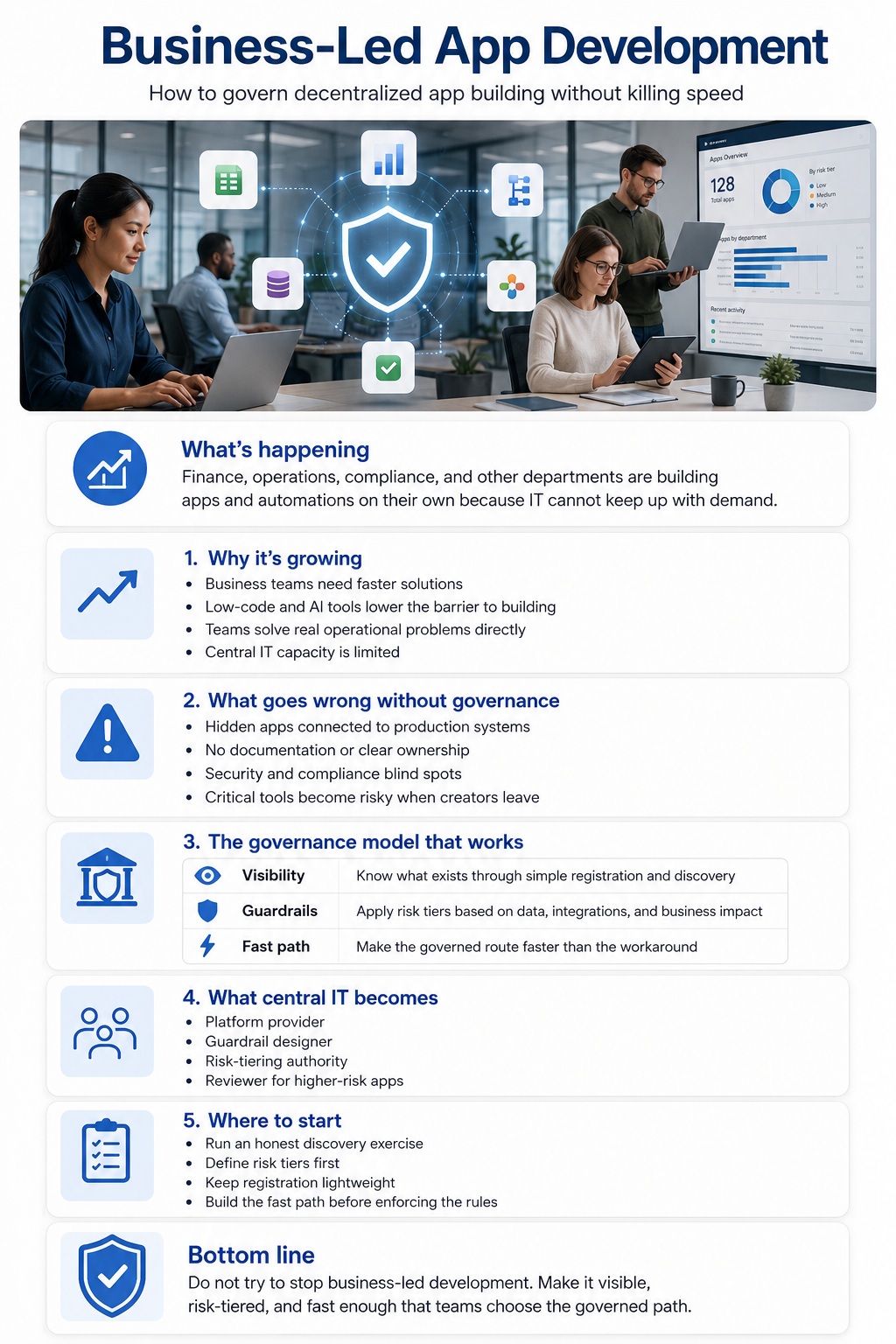
Enterprise IT organizations that have successfully governed business-led development without suppressing it have converged on a model with three consistent components. Each addresses a specific failure mode of the alternatives — pure restriction on one end, pure laissez-faire on the other.
Visibility: knowing what exists
The foundation of this model is a registration and discovery mechanism that surfaces business-led applications as they’re built, rather than relying on periodic audits or incident-driven discovery. This doesn’t mean requiring IT approval before a business team can start building something. It means establishing a lightweight, low-friction process for registering what’s been built — what it does, what data it touches, who owns it, and what systems it connects to.
The organizations that do this well make registration easy enough that it doesn’t create resistance. A short form, a defined point of contact, and a clear explanation of why it matters go a long way. The alternative — a registration process that feels like a compliance burden — gets ignored by exactly the people whose applications most need to be on the inventory.
Visibility also comes from technical discovery where possible. Network monitoring, SaaS usage analytics, and access reviews can surface applications and integrations that haven’t been formally registered, providing a check against the self-reporting mechanism and helping the organization understand where its informal inventory diverges from its formal one.
Guardrails: defining what requires more scrutiny
Not every business-led application carries the same level of risk. A workflow automation that moves data between two already-approved SaaS tools is a fundamentally different risk profile than an application that connects to a production database containing customer financial information. Treating both the same way — either with the same light touch or the same heavy review — misallocates governance attention.
The organizations that get this right define clear risk tiers based on factors like the sensitivity of the data involved, whether the application connects to production or core business systems, how many people depend on it, and whether it falls within scope for a compliance framework the organization operates under. Applications in lower risk tiers can be built and deployed with minimal friction — registration is sufficient. Applications in higher risk tiers trigger additional requirements: a security review, a data governance assessment, a formal access control review, or IT co-ownership of the application going forward.
This tiered approach means the governance effort is proportional to the risk, rather than uniform. Business teams building low-risk tools experience almost no friction. Business teams building something that touches regulated data or critical systems encounter a defined, navigable process rather than either an unstated expectation they didn’t know about or a blanket prohibition that pushes the work underground.
A fast path: making the governed route faster than the workaround
The component that determines whether the governance model actually works in practice is whether the path through it is genuinely fast. If registering an application or going through a security review for a higher-risk tool takes weeks, business teams will find ways around the process, and the organization is back to ungoverned development with an added layer of resentment toward IT.
The organizations that succeed here invest in making the governed path fast by design — not by cutting corners on the review itself, but by removing the unnecessary friction around it. This often means building self-service tooling that lets business teams register applications and request reviews without navigating a ticketing system designed for enterprise IT projects. It means having a defined, time-bound process for security and compliance reviews rather than an open-ended queue. And it means having pre-approved patterns and templates for common use cases, so that a business team building a familiar type of application doesn’t need a full bespoke review every time.
When the governed path is faster than building something quietly and hoping nobody asks about it, business teams use the governed path. That’s the design outcome that makes the entire model functional.
What this means for the role of central IT
This governance model changes what the IT organization’s role actually is, in a way that some IT leaders find uncomfortable and others find liberating.
Central IT is no longer the sole builder of internal software. It becomes the platform provider, the guardrail designer, and the risk-tiering authority for a development ecosystem that includes business teams as legitimate builders, not just legitimate requesters. This requires IT to give up some control over what gets built and by whom — and it requires IT to take on responsibility for the infrastructure, tooling, and governance framework that makes distributed building safe.
For many IT organizations, this is a more sustainable allocation of effort than trying to be the sole development resource for an enterprise where demand for internal software will only continue to grow as AI tools make building easier. The IT team’s capacity gets reinvested in the things only a centralized team can do well: setting security and compliance standards, building the governed platform that business teams build on, reviewing higher-risk applications, and maintaining the systems-of-record that the broader application ecosystem connects to.
This is also, often, a better political position for IT within the organization. An IT organization that enables business-led development within a governed framework is solving the business’s problem — speed — rather than being perceived as the obstacle to it. That shift in perception has real organizational value beyond the governance benefit itself.
Where to start
Enterprise IT leaders assessing where their organization stands relative to this pattern have a few concrete starting points.
Run an honest discovery exercise: Before building a governance model, understand the current scope of business-led development in the organization. A direct conversation with department heads, combined with whatever technical discovery tools are available, will produce a more accurate picture than assuming the official systems inventory is complete.
Define risk tiers before building process: The tiering framework — what counts as low, medium, and high risk, based on data sensitivity, system connectivity, and compliance scope — should exist before the registration and review processes are designed. Process built without a clear risk framework tends to apply uniform friction regardless of actual risk, which undermines the model’s effectiveness.
Design the registration process for adoption, not for completeness: A registration process that captures perfect information from no one is less valuable than one that captures good information from almost everyone. Optimize for low friction and high participation rather than comprehensive data capture on the first pass.
Build the fast path before announcing the governance requirement: If business teams are told they now need to register and potentially review their applications before the fast, low-friction process for doing so actually exists, the announcement creates resentment without producing compliance. Build the path first, then communicate the expectation.
The Bottom Line
Business-led application development is not a temporary phase that will resolve itself once IT catches up on its backlog. It’s a structural feature of how enterprises will build software going forward, accelerated significantly by AI tools that have made building accessible to people who aren’t traditional developers.
The IT organizations that govern this well don’t try to eliminate it. They build the visibility, the risk-tiered guardrails, and the fast governed path that let business teams keep solving their own problems quickly — within a framework that gives the organization the security, compliance, and operational continuity it needs.
The alternative — discovering the scope of ungoverned business-led development during an audit, an incident, or a departed employee’s unexplained legacy tool — is a worse way to learn the same lesson, on a worse timeline, with fewer options.
CloudApper helps enterprise organizations build governed development environments where business teams and IT can build together — with the visibility, guardrails, and speed that make distributed development safe at enterprise scale. Contact us to see how organizations in your industry are governing business-led development without slowing it down.

What is CloudApper AI Platform?
CloudApper AI is an advanced platform that enables organizations to integrate AI into their existing enterprise systems effortlessly, without the need for technical expertise, costly development, or upgrading the underlying infrastructure. By transforming legacy systems into AI-capable solutions, CloudApper allows companies to harness the power of Generative AI quickly and efficiently. This approach has been successfully implemented with leading systems like UKG, Workday, Oracle, Paradox, Amazon AWS Bedrock and can be applied across various industries, helping businesses enhance productivity, automate processes, and gain deeper insights without the usual complexities. With CloudApper AI, you can start experiencing the transformative benefits of AI today. Learn More
- Useful Links:
- Agentic AI
- No-Code/Low-Code
- Custom Software
- HCM Personalization
- iPaaS
- FedRAMP