- What AI Coding Assistants Actually Do to Your Codebase
- The Five Security Risks That Don’t Get Enough Attention
- Why “We Have a Code Review Process” Isn’t the Answer
- What a Governance Framework Needs to Address
- The Conversation Security Teams Should Be Having
- The Productivity Argument Doesn’t Override the Security Argument
- The Bottom Line
There’s a conversation happening in a lot of enterprise IT organizations right now that goes roughly like this:
A CIO or IT director asks the security team whether the developers using AI coding assistants represent a risk. The security team says they’ve reviewed the vendor’s privacy policy and the data doesn’t leave the environment. Everyone agrees the tools are probably fine. The conversation ends.

That conversation is answering the wrong question.
The vendor data handling question matters, but it’s not where most of the security risk actually lives. The risk isn’t primarily about what the AI tool does with your code. It’s about what the code the AI tool generates does inside your environment — and whether anyone is checking it carefully enough before it gets there.
Most enterprise organizations that have rolled out AI coding assistants have focused on the procurement and access questions: Which tool are we approving? Who gets access? What’s the data handling policy? Those are reasonable questions. They’re just not the ones that surface the security problems that show up six months later.
What AI Coding Assistants Actually Do to Your Codebase
AI coding assistants are trained on enormous repositories of public code. That’s what makes them useful — they’ve seen enough code to recognize patterns, complete functions, and generate working implementations fast. It’s also what creates the security problem.
Public code repositories contain a lot of insecure code. Deprecated libraries. SQL injection vulnerabilities. Hardcoded credentials left in examples. Improper input validation. Insecure deserialization. These patterns exist in training data because they exist in the real world, and no training process perfectly filters them out.
When a developer asks an AI assistant to generate a function that handles user authentication, database queries, or file uploads, the assistant draws on those patterns. Most of the time, what it produces is functional. It may not be secure. And most developers accept suggestions from AI assistants with less scrutiny than they’d apply to code they wrote themselves — partly because the code looks polished, and partly because the whole point of using the tool is to move faster.
The result: code gets into production that would have been caught by a thorough review, and it gets there faster than the review process was designed to handle.
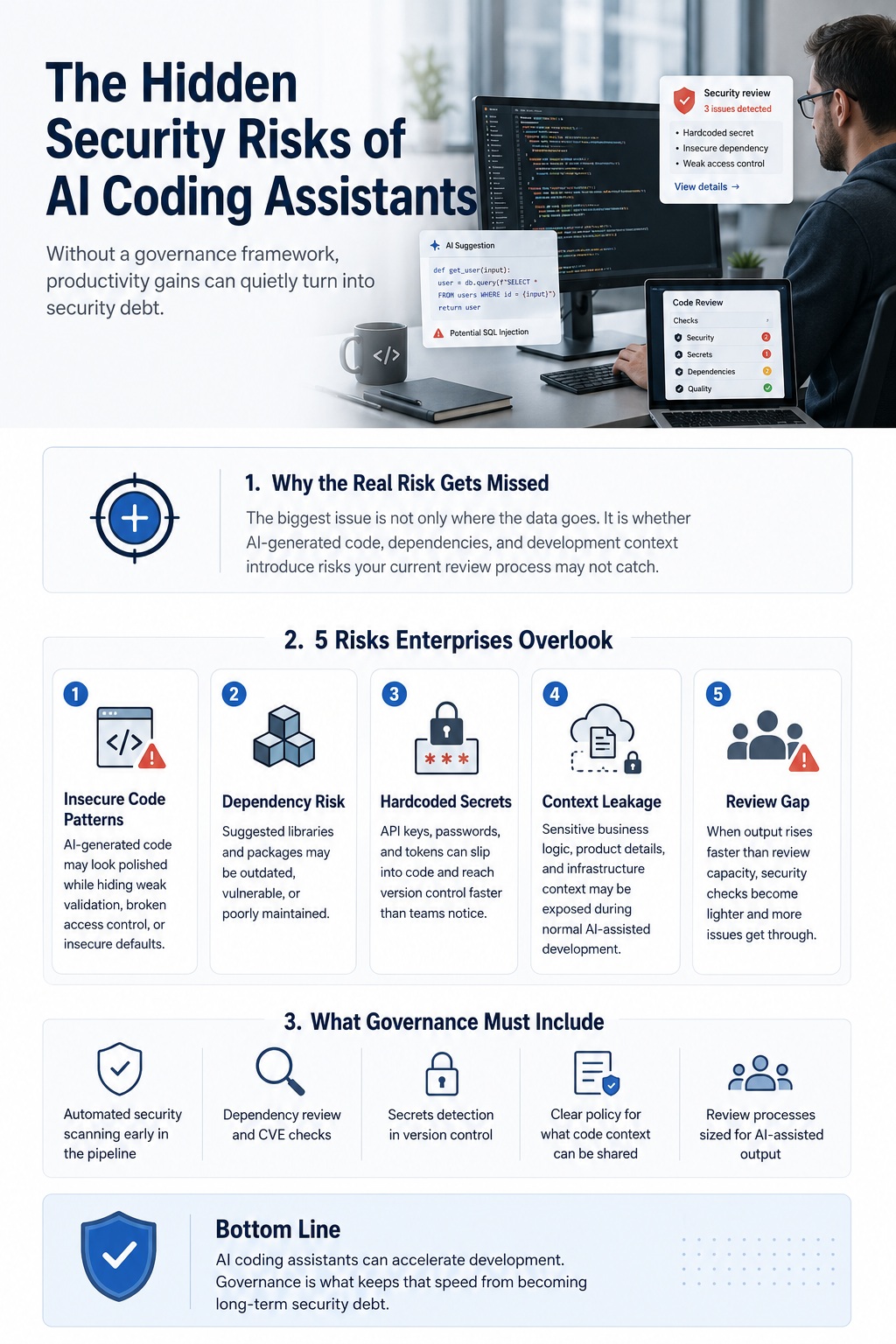
The Five Security Risks That Don’t Get Enough Attention
1. Insecure Code Patterns Generated at Speed
The faster developers can write code, the more code there is to review. AI coding assistants can generate hundreds of lines in minutes. Most enterprise code review processes weren’t built for that throughput. Something has to give — and what gives is usually the depth of review, especially for code that looks clean on the surface.
AI-generated code tends to look syntactically clean. There are no obvious formatting errors, no typos, no structural inconsistencies. That appearance of cleanliness creates a false sense that the code is also logically secure. It may not be. Subtle vulnerabilities — improper access control checks, missing input sanitization, insecure default configurations — don’t show up in a quick read. They show up in a penetration test or an incident investigation.
2. Dependency and Library Suggestions
AI coding assistants don’t just write logic — they suggest libraries, dependencies, and packages. This creates a supply chain risk that organizations often haven’t thought through.
The AI assistant might suggest a library that was widely used three years ago and has since been found to have known vulnerabilities. It might suggest a package that is no longer actively maintained. It might suggest a dependency that introduces a transitive dependency your organization hasn’t evaluated. Most developers trust these suggestions without running them through the same evaluation process they’d apply to a library they discovered independently.
The result is applications that import dependencies with known CVEs, or that pull in packages from sources your security team has never reviewed.
3. Hardcoded Secrets and Credentials
One of the most persistent security problems in software development is hardcoded credentials — API keys, database passwords, and access tokens written directly into code rather than managed through a secrets management system.
AI coding assistants, when generating example code or completing functions, sometimes include placeholder credentials in formats that look like real values. Developers in a hurry accept the suggestion and move on, sometimes without replacing the placeholder or sometimes inadvertently accepting a real credential that was in the context the AI was working from.
This is one of the most common ways credentials end up in version control. It’s not a new problem, but AI-assisted development makes it happen faster and with less awareness than when a developer is writing the code line by line.
4. Context Leakage
AI coding assistants that operate with access to a developer’s local code context — the files open in their editor, the repository they’re working in, the recent code they’ve been writing — process that context to generate useful suggestions. Most of the time this is exactly what you want. But it creates a surface for accidental exposure.
A developer working on a codebase that contains proprietary business logic, undisclosed product features, or internal infrastructure details is providing that context to the AI tool as part of normal use. Most enterprise organizations haven’t defined a clear policy about what code context is and isn’t appropriate to expose to AI tools, even approved ones operating within vendor-compliant data handling policies.
5. The Review Gap Under Velocity Pressure
This is the one that connects all the others. When AI coding assistants increase developer throughput significantly — and they do — the organizational pressure is to keep shipping at that pace. The review process becomes a bottleneck. The response, usually informal and gradual, is to lighten the review.
Lighter reviews miss more. That’s not a criticism of the reviewers — it’s arithmetic. More code, same reviewers, same hours, means less time per line. Security vulnerabilities that a thorough review would catch start getting through. The organization doesn’t notice immediately because the vulnerabilities are latent. They notice later, under circumstances that are harder to manage.
Why “We Have a Code Review Process” Isn’t the Answer
Every enterprise IT organization with a functioning development program will say it has a code review process. That’s true. The question is whether that process was designed for the output volume and velocity that AI coding assistants create — and whether it specifically addresses the security patterns that AI tools tend to generate.
Most code review processes were built around a few assumptions: that developers are reviewing code they largely wrote themselves or that came from a known colleague, that the volume of changes in a given sprint is predictable, and that the review is primarily about correctness and style rather than adversarial security analysis.
AI-assisted development breaks all three assumptions. The code volume is higher and less predictable. The reviewer didn’t write the code and may have limited context for what it was supposed to do. And the security question isn’t just “did the developer make a mistake” — it’s “did the AI introduce a pattern that looks correct but has a known vulnerability class.”
That’s a different kind of review, and it requires different tooling and process than what most organizations have in place.
What a Governance Framework Needs to Address
The security risks from AI-assisted development are real but manageable. The organizations that handle this well aren’t the ones that restrict AI tool access — they’re the ones that built governance infrastructure that makes secure AI-assisted development the default path.
That infrastructure needs to cover a few specific areas:
Automated security scanning integrated into the development pipeline. Not just at the point of deployment, but earlier — catching insecure patterns before they get through code review. Developers using AI assistants need immediate feedback when a suggestion introduces a known vulnerability class, not a finding that surfaces weeks later in a penetration test.
Dependency review as part of the approval process. Every library or package introduced into a codebase should go through an evaluation for known vulnerabilities, maintenance status, and license compliance. This should be automated where possible and should apply equally to dependencies suggested by AI tools and those introduced by developers directly.
Secrets detection in version control. This should already exist in mature development environments, but AI-assisted development makes it more important. Automated detection of credential patterns in committed code, before those credentials reach a repository that has any external access, is a baseline control for any organization using AI coding assistants.
Defined context policies for AI tool use. What code contexts are appropriate to expose to AI tools? What repositories or files should be excluded? These questions need written policy, not implicit norms. The policy needs to be communicated to developers and, where possible, enforced at the tooling level.
Review processes calibrated to AI-assisted output. If AI coding assistants have doubled developer throughput, the review process needs to be able to handle that throughput without reducing quality. That might mean different tooling, different review structures, or different staffing — but the answer can’t be accepting higher risk because the reviews are taking longer.
The Conversation Security Teams Should Be Having
Most enterprise security teams have reviewed the vendor privacy policies for their approved AI coding tools. Fewer have asked the harder question: what does our development pipeline look like when developers are generating code 3x faster than before, and does our review and security testing infrastructure scale with that?
The vendor compliance question is a procurement checkbox. The pipeline question is an operational security question, and it doesn’t have an easy answer. It requires looking at the entire path from code generation to production deployment and asking where the security controls are, whether they were designed for this volume, and what happens when they don’t catch something.
A few specific questions worth asking:
- What percentage of code review findings in the last six months were on AI-generated code, and how does that compare to the percentage of total code that came from AI assistance?
- Has your penetration testing scope been updated to specifically probe for vulnerability classes that AI coding tools tend to generate?
- Do you have a policy defining what constitutes appropriate use of AI coding tools for code that handles regulated data, and has that policy been communicated to your development team?
- When was your secrets detection tooling last updated, and does it cover the credential formats that AI tools tend to generate in example code?
If any of those questions produce a gap, that’s where the governance work starts.
The Productivity Argument Doesn’t Override the Security Argument
The productivity case for AI coding assistants is real and well documented. Development teams ship faster. Backlogs shrink. Experienced developers can focus on architecture and review rather than boilerplate. That value is genuine and worth preserving.
The way to preserve it is to build the governance infrastructure that lets the productivity gains continue without accumulating security debt. Organizations that govern AI-assisted development well can keep shipping fast because they’ve built the tooling and process that catches problems early, when they’re cheap to fix. Organizations that skip the governance step keep shipping fast until they don’t — until a security incident, a penetration test finding, or a compliance audit forces a reckoning that’s much more expensive than the governance investment would have been.
The security risks of ungoverned AI-assisted development are not catastrophic by default. They’re gradual. They accumulate quietly in production systems, in dependency trees, in codebases that nobody has audited end to end. The organizations that find them early are the ones that built the infrastructure to look. The ones that find them late are the ones that assumed the productivity gains came without tradeoffs.
They don’t. The tradeoffs just aren’t visible until they are.
The Bottom Line
AI coding assistants don’t automatically write insecure code. They write code that is statistically likely to be functional — and that may carry security vulnerabilities that your review process wasn’t designed to catch at the volume and velocity AI tools create.
The governance question isn’t whether to use these tools. It’s whether your security infrastructure scales with the output they generate, and whether your review and testing processes are calibrated for the specific vulnerability classes they tend to introduce.
The organizations that answer those questions proactively are the ones whose security posture improves as AI-assisted development scales. The ones that don’t answer them are building technical and security debt that will surface at a moment of their auditor’s or attacker’s choosing, not their own.
CloudApper helps enterprise organizations build governed AI development environments where security controls, review processes, and audit trails scale with the pace of AI-assisted development — not against it. Contact us to see how organizations in your industry are approaching this.

What is CloudApper AI Platform?
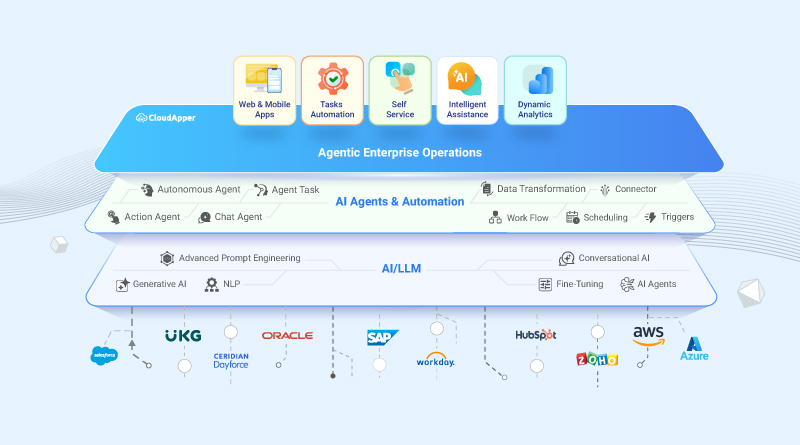
CloudApper AI is an advanced platform that enables organizations to integrate AI into their existing enterprise systems effortlessly, without the need for technical expertise, costly development, or upgrading the underlying infrastructure. By transforming legacy systems into AI-capable solutions, CloudApper allows companies to harness the power of Generative AI quickly and efficiently. This approach has been successfully implemented with leading systems like UKG, Workday, Oracle, Paradox, Amazon AWS Bedrock and can be applied across various industries, helping businesses enhance productivity, automate processes, and gain deeper insights without the usual complexities. With CloudApper AI, you can start experiencing the transformative benefits of AI today. Learn More
- Useful Links:
- Agentic AI
- No-Code/Low-Code
- Custom Software
- HCM Personalization
- iPaaS
- FedRAMP