GLBA's Safeguards Rule has never been tested against code a developer generates by describing what they want in plain English. This article looks at where AI-generated internal applications create regulated-data exposure for financial services IT, and what a governed approach to internal app development looks like before the next exam.

TL;DR
GLBA's Safeguards Rule and FINRA's recordkeeping requirements expect documented access controls, encryption, and monitoring on anything touching customer financial data. AI-generated internal tools skip that constantly, not from carelessness, but because whoever's prompting the tool is solving today's problem, not thinking about regulatory scope. Every ungoverned tool becomes its own separate answer to an examiner, and most firms can't currently produce that answer for even a handful of their internally built apps. A governed development model produces the access logging and audit trail GLBA and FINRA actually want as a normal byproduct of building the thing, not a step someone has to remember. For IT and compliance leaders, this has to get built in before the exam. Reconstructing it afterward is a much worse conversation.
Table of Contents
- Why Compliance Doesn’t Care How Fast You Moved
- Where the Exposure Actually Sits
- What This Looks Like Once It’s Actually in Production
- Read-Only Is Not the Same Risk as Write Access
- This Is an Exam Question, Not Just a Security Question
- What Actually Fixes This
- What to Actually Ask a Vendor
- Before the Next Tool Ships
GLBA’s Safeguards Rule turns twenty-five this year. It has never once been tested against a piece of software that a developer generated by describing what they wanted in plain English and got working code back in under a minute. That’s not a gap regulators have caught up to yet, and it’s not one AI coding tools are waiting around for.

Financial services IT departments have spent the last two years adopting exactly the tools that make this collision inevitable. Every internal reconciliation app, every customer lookup tool, every reporting dashboard someone builds this quarter is a test case for whether GLBA and FINRA’s decades-old assumptions about software still hold. Mostly, they don’t.
Why Compliance Doesn’t Care How Fast You Moved
The Safeguards Rule wants a documented security program: access controls, encryption, monitoring, tied specifically to systems touching nonpublic personal information. FINRA’s recordkeeping rules want firms to know who built a system and how it’s maintained, on demand, not reconstructed after the fact.
An AI-assisted developer can spin up a reconciliation tool or a customer lookup app in a sprint. Whether it logs access the way the Safeguards Rule expects is a separate question nobody asked, because the prompt was about solving today’s problem, not modeling a federal compliance framework. I’ve seen this same gap with HIPAA and with FDA’s Part 11. Different regulator, same story: fast to build, expensive to find out later that nobody checked.
That’s basically the whole argument in AI-generated code in the enterprise is fast to build and expensive to trust. In financial services, expensive has a specific shape: a FINRA finding, a GLBA enforcement action, or a remediation project that costs more than building the safeguards in from the start would have.
Where the Exposure Actually Sits
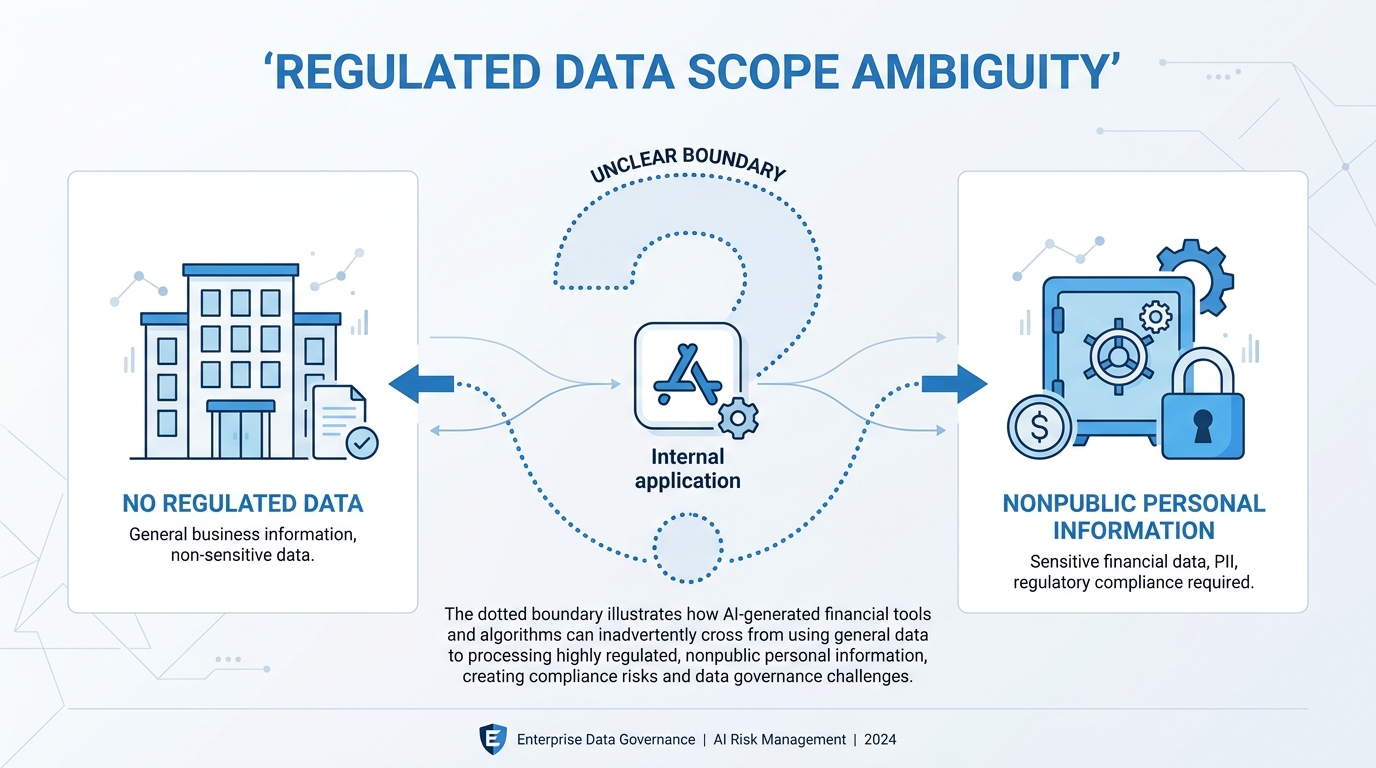
Not every internal tool is a problem. A facilities-request app touches nothing GLBA cares about. A tool pulling account balances or transaction history is a different animal, and the line between the two isn’t obvious to whoever’s just trying to close today’s exceptions faster.
That’s the whole reason shadow IT never really went away, it just switched tools. A developer isn’t thinking about Safeguards Rule scope while building a reconciliation app. They’re thinking about the backlog. Whether the thing ends up touching regulated data gets discovered later, usually by whoever’s least happy to find out.
What This Looks Like Once It’s Actually in Production
Take the reconciliation tool. It pulls transaction and account data from a core system, caches results locally so the interface feels snappy, gets used every day by ops. Nobody formally reviewed it against the Safeguards Rule’s access control and monitoring requirements, because nobody flagged it as touching regulated customer data in the first place. Why would they? It was built to solve a Tuesday problem.
A year later, during a FINRA exam or an internal GLBA review, someone asks for the access log: who viewed which customer records through that tool, and proof the data was encrypted at rest and in transit. That documentation doesn’t exist in the form the exam wants, because the tool was built the way these tools usually get built, fast, informally, with nobody mapping it against the specific things a regulator will ask about.
Multiply this by however many of these a firm has quietly accumulated over a year or two, each built by a different team, each with its own improvised approach to data handling, and you get a portfolio nobody can fully account for. That’s not a hypothetical failure mode. That’s just what happens by default.
Read-Only Is Not the Same Risk as Write Access
There’s a real difference between a tool that displays customer data for reference and one that can modify records, kick off transactions, or feed reporting regulators actually rely on. A lookup tool carries meaningfully less risk than something with write access to account information, and financial services IT teams need to classify their internal apps by what they’re authorized to do, not just what they can see.
The hidden security risks of AI coding assistants without a governance framework apply to any enterprise, but in a GLBA and FINRA context they intersect directly with a firm’s regulatory standing, not just its internal security posture. A vulnerability in a customer-facing product is a security incident. The same vulnerability in an internal tool touching nonpublic personal information is a security incident and a potential Safeguards Rule violation, at the same time.
This Is an Exam Question, Not Just a Security Question
Firms already answer to FINRA, the SEC, and state regulators about how customer data gets accessed and by whom. An AI-generated tool built outside the firm’s governance model raises a question most compliance teams haven’t had to answer systematically: can you produce, on the spot, an access log for every AI-generated app touching customer financial data, and show each one meets the Safeguards Rule’s encryption and monitoring bar?
“We believe most of them are fine” is not an answer an examiner is going to accept. SOC 2 auditors are already asking questions internal teams can’t answer about AI-assisted development, and FINRA examiners, who have statutory authority behind them rather than a voluntary attestation, are going to ask harder versions of the same questions with real consequences attached.
What Actually Fixes This
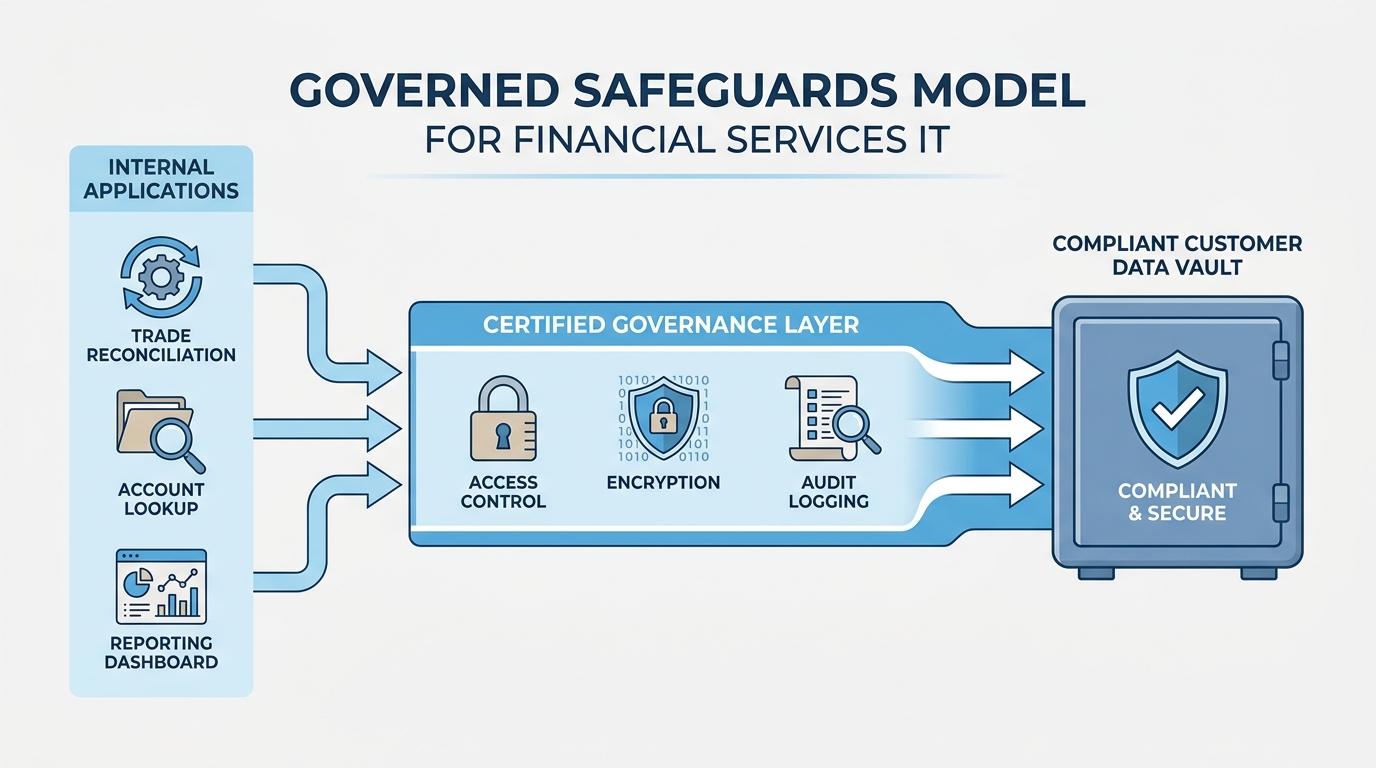
The fix isn’t slowing development back down. Financial firms are under just as much pressure to move fast as anyone else, and asking IT to manually map every internal tool against GLBA and FINRA before it ships isn’t realistic at the speed AI coding tools now enable. What actually works is building the compliance posture into the platform generating the applications, so access logging, encryption, and monitoring come along for free instead of depending on a developer remembering to add them.
CloudApper eliminates the security, compliance, and maintenance risks of AI-generated code by generating governed application definitions instead of raw source code, executing them inside a certified runtime that keeps access controls, audit logging, and data handling policy consistent across everything built on it. A reconciliation tool and a customer-facing lookup tool end up with the same access logging and encryption posture, because neither one exists as its own independent, informally built codebase sitting outside the governance layer.
That consistency is what the Safeguards Rule and FINRA’s recordkeeping expectations are actually asking for: one documented security program applied uniformly, not a fresh best-effort reconstruction for every tool after the fact. When every app the firm builds runs through the same governed foundation, answering an examiner’s question about access controls turns into a lookup instead of a scramble.
What to Actually Ask a Vendor
Not every AI development platform is built with regulated financial services in mind. Secure enterprise app development platforms need to be evaluated with compliance as a non-negotiable, and for FINRA and GLBA that means asking pointed questions: does the platform hand you raw code your own team has to independently secure and audit, or governed applications with inherited controls? Is access logging consistent across the entire portfolio, or just the tools someone remembered to review? Can it produce, on demand, the documentation an examiner would actually ask for?
A practical AI coding governance framework has to account for the fact that financial services operates under statutory examination authority most industries don’t face. Vendor evaluation should reflect that, not treat FINRA and GLBA as a checkbox bolted onto a generic governance pitch.
Before the Next Tool Ships
Start with the inventory question every governance conversation eventually reaches: which internally built applications, generated with AI coding tools over the past year or two, touch nonpublic personal information or feed regulatory reporting, and can the firm currently produce an access log and safeguards assessment for each one? Most financial services IT departments can’t answer that completely today. That gap is exactly what a FINRA exam or GLBA review is designed to find.
From there, the priority is a single governed path for internal development before the next tool gets built, one where regulated-data exposure gets assessed as part of building it, not discovered during an exam. AI coding tools aren’t leaving financial services IT, they’re delivering exactly the speed the business asked for. The real choice is whether that speed runs through a governed platform that produces the documentation FINRA and GLBA require as a matter of course, or through a pile of fast, informally built tools that each carry their own undocumented exposure into the next exam cycle.
CloudApper helps financial services IT teams build internal applications that inherit consistent access controls, audit logging, and data safeguards from day one, without slowing down the development speed AI coding tools made possible. If your organization needs a governance model for internal app development that holds up under a FINRA exam or GLBA compliance review, reach out to CloudApper to talk through what that looks like for your environment.

What is CloudApper AI Platform?
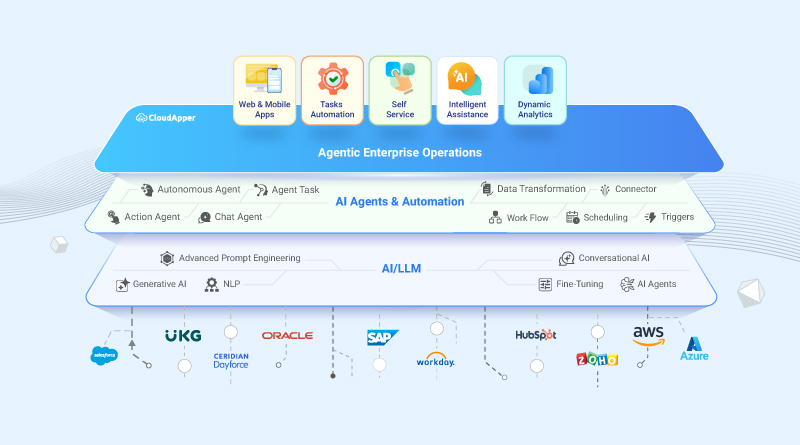
CloudApper AI is an advanced platform that enables organizations to integrate AI into their existing enterprise systems effortlessly, without the need for technical expertise, costly development, or upgrading the underlying infrastructure. By transforming legacy systems into AI-capable solutions, CloudApper allows companies to harness the power of Generative AI quickly and efficiently. This approach has been successfully implemented with leading systems like UKG, Workday, Oracle, Paradox, Amazon AWS Bedrock and can be applied across various industries, helping businesses enhance productivity, automate processes, and gain deeper insights without the usual complexities. With CloudApper AI, you can start experiencing the transformative benefits of AI today. Learn More
- Useful Links:
- Agentic AI
- No-Code/Low-Code
- Custom Software
- HCM Personalization
- iPaaS
- FedRAMP
CloudApper AI Solutions

- Works with







- and more.
Similar Posts

Legacy Database Migration Blocked by Stored Procedures: What Enterprise IT…

Windows Server 2016 End of Support: What to Do When…