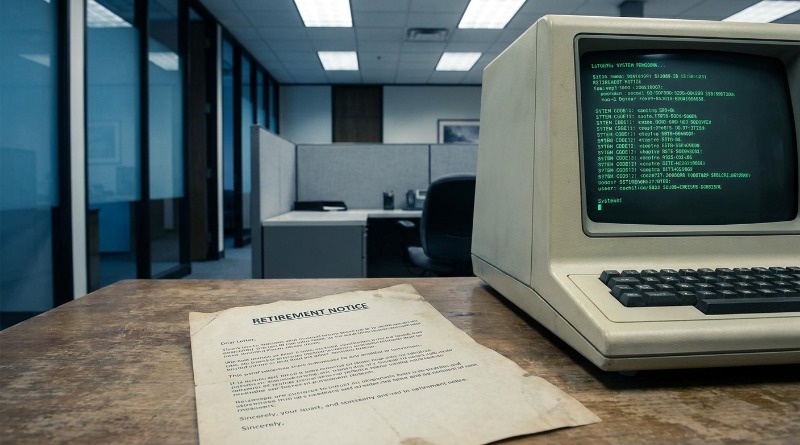
Legacy database migrations frequently stall in the SQL layer — not because of schema complexity, but because undocumented stored procedures carry business logic no current team member can attest to. Here is what enterprise IT teams find and what actually resolves it.
TL;DR
Legacy database migration projects rarely fail at the schema or data movement layer. They fail in the SQL layer, where undocumented stored procedures contain years of accumulated business logic that no current team member wrote or can attest to. The real blocker is not missing documentation — it is that nobody will sign off on whether the rewritten logic is correct, because correctness requires a business-owner attestation that the migration team cannot produce. Standard workarounds — manual reverse engineering, AI-generated rewrites, or scope freezes that leave legacy procedures on the old server — each defer the ownership problem rather than resolving it. The only path to a defensible sign-off is a governed extraction process that produces a business-readable specification before any rewrite begins, reviewed and confirmed by a named business-process owner. CloudApper AI Platform addresses this through governed requirements extraction — turning the SQL layer from a migration blocker into a structured handoff that IT directors can actually put in front of a compliance reviewer.
Table of Contents
The migration job ran overnight. At 2:47 a.m., it stopped partway through the schema conversion script. The error trace pointed to a stored procedure — 4,100 lines, last modified in 2009, no comments, no documentation, multiple cross-database calls referencing two systems your organization decommissioned three years ago. Nobody in the room wrote this. Nobody knows who did. This is where legacy database migration actually fails — not at the data movement layer, where tooling has become reliable, but in the SQL layer where undocumented stored procedures carry business logic that was never meant to leave SQL Server.
The Schema Moved. The Business Logic Did Not.
Most legacy database migration projects hit a predictable early success: tables transfer, indexes rebuild, basic queries validate. The illusion of progress holds until migration testing reaches functional validation — the point where the new system has to produce the same outputs from the same inputs as the old one. That is when the stored procedures surface. CloudApper works with enterprise IT teams in exactly this position, and the pattern is consistent: the schema was always the tractable part. The procedures are where the project timeline collapses.

SQL Server environments carrying ten or more years of production history typically contain stored procedures that encode pricing rules, compliance calculations, exception-handling workflows, and approval chains — none of which appear in any requirements document because they were added iteratively by developers who no longer work at the company. The governance debt that surfaces during legacy data migration is rarely about the data itself. It is about the procedural logic that transforms and controls it.
The Real Blocker Is Not Documentation. It Is Ownership.
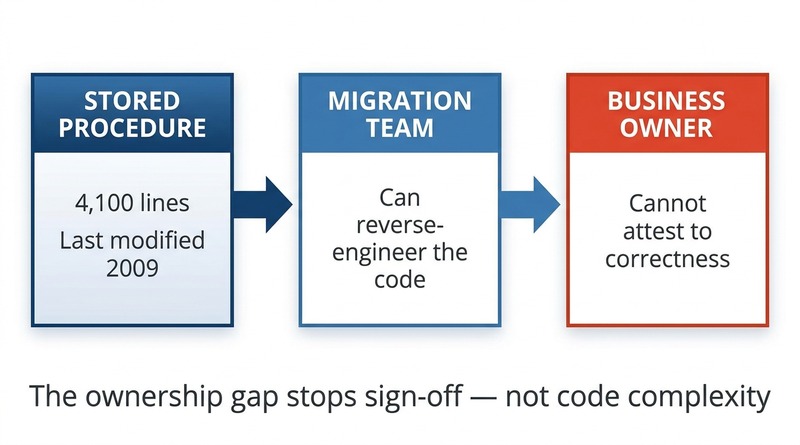
The instinct is to frame this as a documentation problem. It is not. The deeper issue is that undocumented stored procedures encode tribal risk ownership — and once those procedures are extracted and rewritten, nobody will sign off on whether the rewritten logic is correct. Migration teams can reverse-engineer what a procedure does. What they cannot produce is an attestation from a business owner that the new code enforces the same rules as the old code.
This is the same liability gap that makes COBOL developer retirement a risk-register event rather than a staffing problem — when the person who understood the logic is gone, correctness cannot be verified by anyone who remains. Migration stalls not from technical opacity but from the absence of a person willing to accept accountability for the migrated output. Reading 4,100 lines of undocumented SQL and signing off on its behavioral correctness are two different activities. No DBA will do both for code they did not write.
Why the Standard Workarounds Create More Liability Than They Resolve
Manual reverse engineering takes months and produces documentation of what the code does — not a business-owner attestation of what it should do. AI-generated rewrites produce plausible-looking code that may be silently wrong in edge cases the original procedure handled through undocumented conditional paths. Scope freeze — leaving procedures on the old server and calling them remotely from the new system — preserves the dependency without resolving it, extending the deferral cost of the original legacy system directly into the architecture of the replacement. Organizations that take this path tend to discover, during their next modernization cycle, that the remote-called legacy procedure became the new system’s undocumented dependency. The same dynamic that makes vendor exit in outsourced legacy environments so expensive applies here: architectural knowledge that has no named owner does not transfer cleanly under any migration method.
The Governance Step That Makes Sign-Off Possible
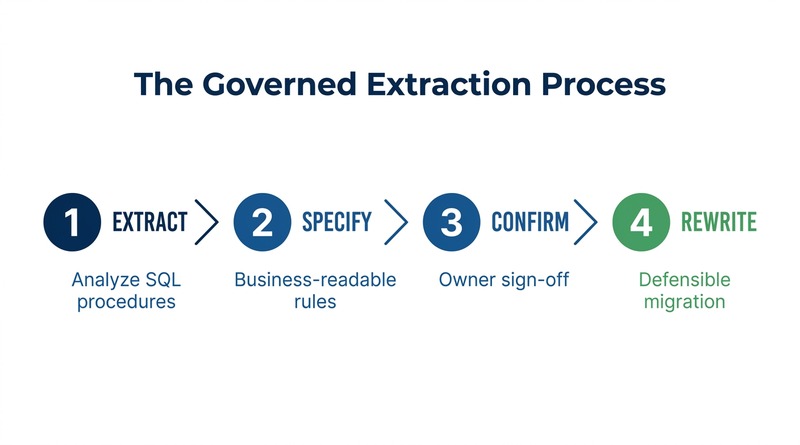
What closes the ownership gap is not better tooling. It is a structured extraction process that produces a business-readable specification of what each procedure does — mapped to the business function it serves — before any rewrite begins. CloudApper AI Platform approaches legacy database migration through governed requirements extraction: the platform analyzes procedural SQL to surface business rules embedded in conditional logic, joins, and exception paths as human-readable specifications that a business process owner can review and confirm. The output is not a rewrite. It is a governed specification that makes rewriting defensible, because a named business owner has attested that the specification matches the intended behavior.
The ERP customization debt pattern maps to this problem precisely: the decisions that were too difficult to make in the moment became the migration bill. In SQL-heavy legacy environments, the stored procedure layer is where those deferred decisions are stored, untouched, until a migration project makes them unavoidable.
That confirmation — a named owner, a reviewed specification, a defensible record — is the document that every stalled legacy database migration project is missing.
If your legacy database migration has stalled at the stored procedure layer, CloudApper can help you structure the extraction and sign-off process before project scope expands further.

What is CloudApper AI Platform?
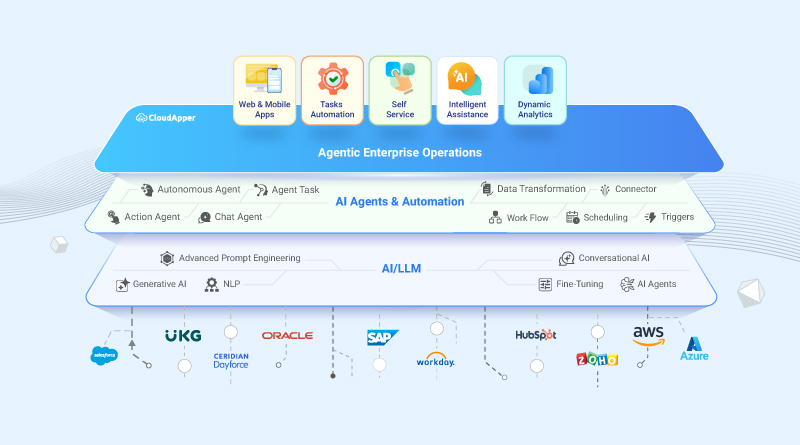
CloudApper AI is an advanced platform that enables organizations to integrate AI into their existing enterprise systems effortlessly, without the need for technical expertise, costly development, or upgrading the underlying infrastructure. By transforming legacy systems into AI-capable solutions, CloudApper allows companies to harness the power of Generative AI quickly and efficiently. This approach has been successfully implemented with leading systems like UKG, Workday, Oracle, Paradox, Amazon AWS Bedrock and can be applied across various industries, helping businesses enhance productivity, automate processes, and gain deeper insights without the usual complexities. With CloudApper AI, you can start experiencing the transformative benefits of AI today. Learn More
- Useful Links:
- Agentic AI
- No-Code/Low-Code
- Custom Software
- HCM Personalization
- iPaaS
- FedRAMP
CloudApper AI Solutions

- Works with








- and more.
Similar Posts

Windows Server 2016 End of Support: What to Do When…

Your Legacy System Is “Working Fine.” Your Compliance Exception Log…