When AI agents instruct other AI agents, accountability becomes unclear and compliance exposure grows. Learn why multi-agent orchestration demands platform-level governance — and what enterprise IT teams need in place before autonomous agentic workflows touch regulated systems.

Table of Contents
- What Multi-Agent Orchestration Actually Means in an Enterprise Context
- The Governance Gap That Agentic AI Opens
- Why Agent-to-Agent Communication Is the Hardest Piece to Audit
- What Governed Multi-Agent Orchestration Looks Like in Practice
- The Compliance Implications for Regulated Industries
- Getting Ahead of the Governance Problem Before It Becomes a Breach Problem
Accountability is the open governance question in multi-agent orchestration: when one AI agent instructs another to act inside your systems, most enterprises cannot say who approved that action. Agents that coordinate, delegate to and supervise other agents are already running in production, often ahead of the governance needed to manage them.
The enterprises getting this right treat agent orchestration like any system that touches regulated data, with a defined ownership model, an audit trail and a platform that enforces boundaries. CloudApper AI Platform gives enterprise IT governed infrastructure to deploy agentic systems without dismantling the compliance posture they spent years building. The first step is understanding what makes multi-agent orchestration different from what came before, and why its governance problem is harder than it looks.
What Multi-Agent Orchestration Actually Means in an Enterprise Context
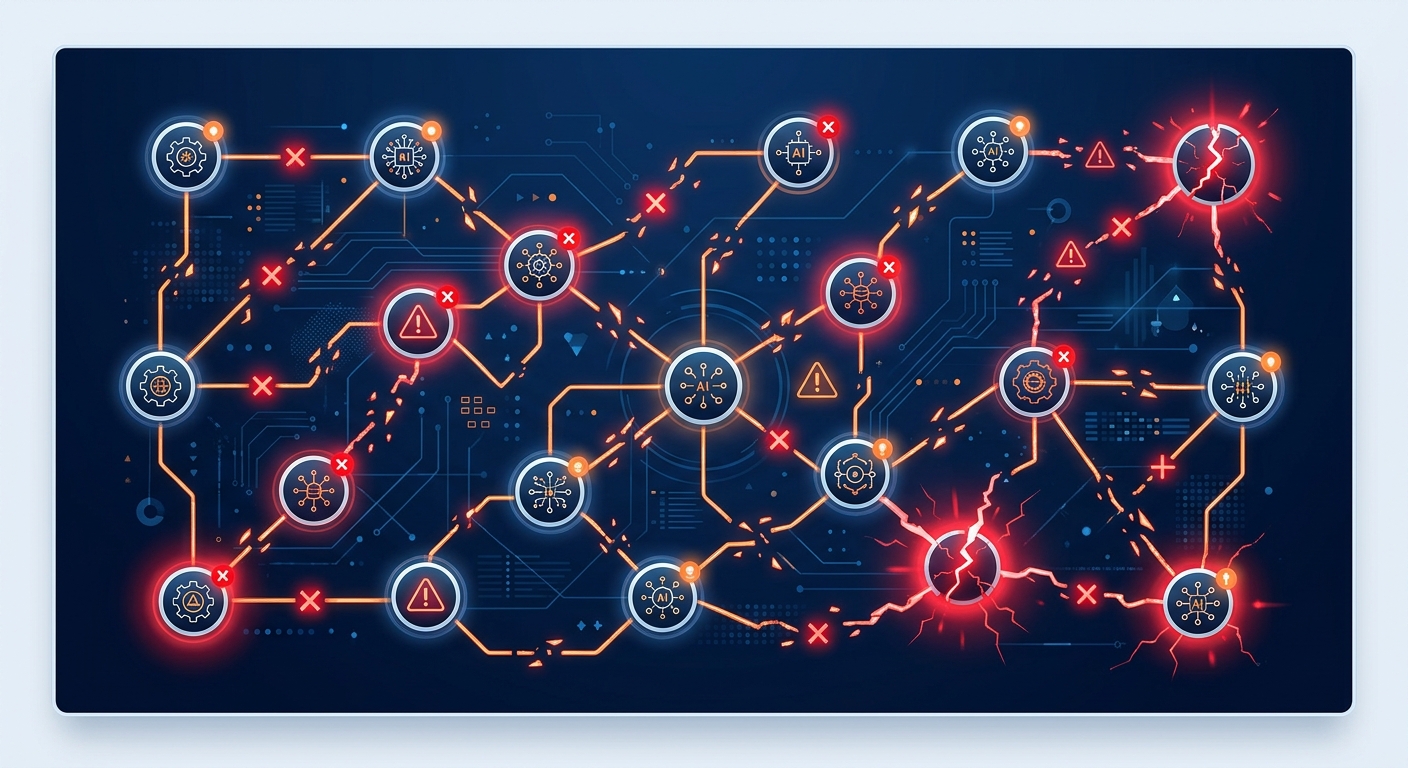
Most conversations about AI agents in the enterprise still center on single-agent systems: an AI that answers employee HR questions, one that routes support tickets, one that pulls data from an ERP for a weekly report. These are valuable. They’re also relatively easy to govern, because the agent does one thing, interacts with one or two systems, and a human reviews the output before anything consequential happens.
Multi-agent orchestration is categorically different. In an orchestrated system, a coordinating agent — often called an orchestrator or supervisor agent — receives a high-level objective and breaks it into subtasks. It then dispatches those subtasks to specialized sub-agents, each of which may interact with different enterprise systems, APIs, databases, or even other agents. The sub-agents report back, the orchestrator synthesizes the results, makes decisions, and may initiate additional actions — all without a human in the loop for any individual step.

Consider a practical example: an enterprise deploys an agentic workflow to handle employee onboarding. The orchestrator receives a trigger from the HCM system. It dispatches a sub-agent to provision access credentials in Active Directory, another to enroll the employee in benefits through a third-party portal, another to schedule compliance training in the LMS, and a fourth to notify the employee’s manager via email. Each sub-agent completes its task, reports status, and the orchestrator logs completion. From an operational standpoint, this is efficient. From a governance standpoint, it raises a cascade of questions: which agent touched which system? What data was accessed or written? If the benefits enrollment failed silently, who detected it and when? If the wrong access level was provisioned, what’s the rollback path and the audit record?
These aren’t hypothetical edge cases. They are the operational realities of multi-agent systems running at enterprise scale, and most organizations are not structurally ready for them.
The Governance Gap That Agentic AI Opens
Enterprise IT governance is built on a foundational assumption: that consequential actions are taken by identifiable actors — humans or systems — whose behavior can be logged, reviewed, and attributed. Every major compliance framework, from SOC 2 to HIPAA to ISO 27001, depends on this. Access logs, change management records, approval workflows — all of it traces back to the assumption that you know who did what and when.
Multi-agent systems challenge this assumption at its core. When an orchestrator instructs a sub-agent to query a database, who initiated that query? The sub-agent? The orchestrator? The human who configured the workflow three months ago? When a sub-agent writes a record to your ERP based on a decision the orchestrator made autonomously, whose authorization covers that write operation? These are not philosophical questions — they are exactly what your next SOC 2 auditor or HIPAA compliance review will ask.
As we noted in our analysis of enterprise AI coding governance frameworks, the gap between how fast AI moves and how slowly governance structures catch up is where most enterprise risk accumulates. With multi-agent orchestration, that gap is wider because the systems are more autonomous and the chains of causation are longer. A human approves an objective at the top of the workflow. Twenty steps later, a sub-agent takes an action that no human explicitly sanctioned.
This is not a problem you can solve by reviewing outputs after the fact. By the time you detect an issue in a multi-agent chain, the downstream effects may have already propagated across multiple systems. The governance has to be structural — embedded in the platform that runs the agents, not bolted on as a logging layer afterward.
Why Agent-to-Agent Communication Is the Hardest Piece to Audit
In a traditional integration between enterprise systems, the data exchange happens through defined APIs with known schemas and authentication mechanisms. Your integration layer logs the transaction. Your SIEM can monitor it. Your identity and access management tooling can enforce who’s allowed to call what.
Agent-to-agent communication doesn’t naturally fit this model. Agents communicate through prompts, structured context, and tool calls. The “instruction” one agent gives another may be a natural language directive or a structured JSON payload. The receiving agent interprets it, makes decisions, and acts. None of this is deterministic in the way a REST API call is deterministic.
This creates three specific audit problems. First, prompt integrity: how do you verify that the instruction an orchestrator sent to a sub-agent wasn’t modified or injected with malicious content before the sub-agent received it? Prompt injection in multi-agent systems — where a bad actor embeds adversarial instructions in data that an agent processes — is a real and documented attack vector. Second, decision traceability: when a sub-agent makes a choice that leads to a bad outcome, can you reconstruct the exact state of the context it was operating in when it made that choice? Third, scope creep: agents configured with broad permissions to complete complex tasks will, over time, tend to use more of those permissions than intended. Without explicit scope enforcement at the platform level, agents expand their operational footprint in ways that are hard to detect and harder to roll back.
The enterprises navigating this successfully are not trying to solve these problems at the agent level. They’re solving them at the platform level — which is why the choice of where you run your agentic workloads matters as much as what you configure those agents to do. This is consistent with the broader pattern we’ve observed in how enterprises lose control of internal AI development: the problem is rarely the intent, it’s the infrastructure.
What Governed Multi-Agent Orchestration Looks Like in Practice
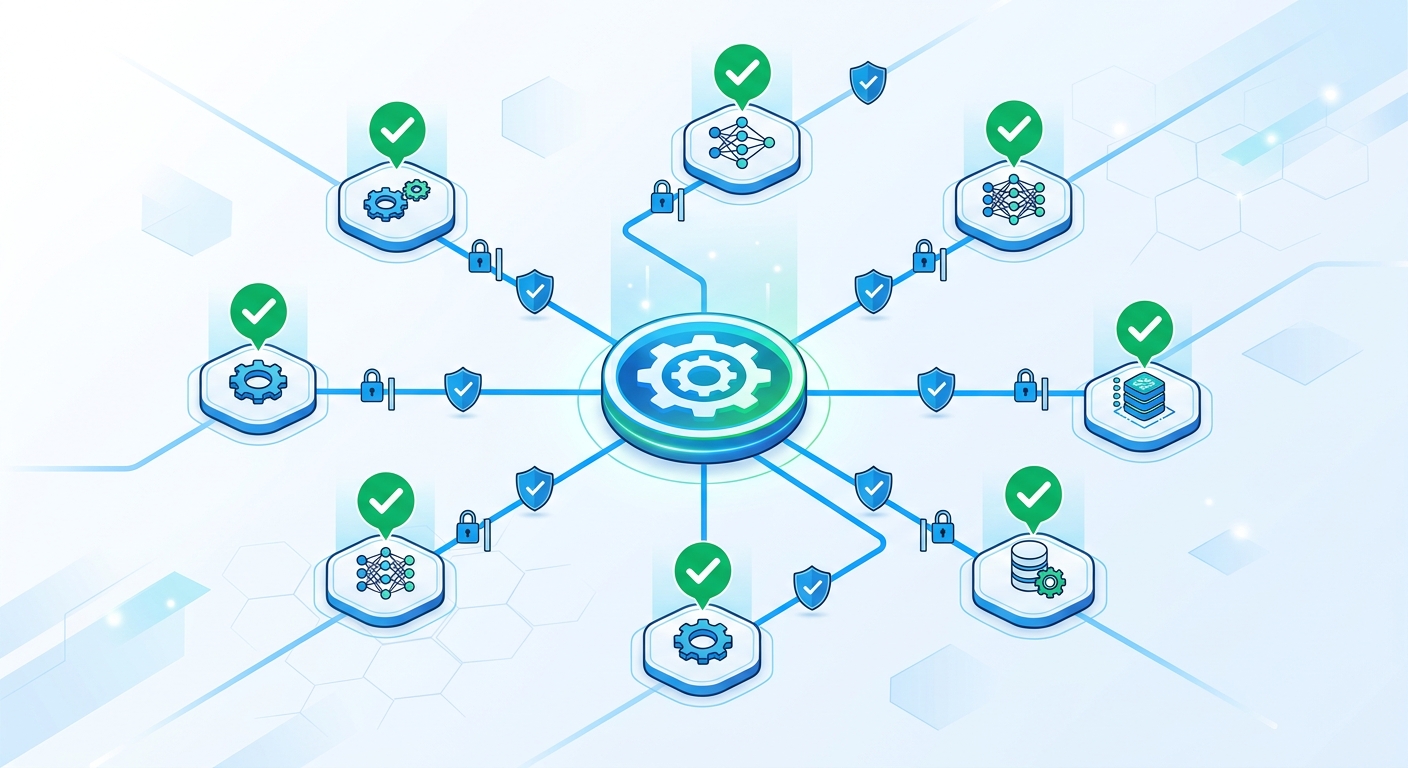
A governed multi-agent environment has four structural characteristics that distinguish it from an ungoverned one.
The first is identity and scope enforcement at the agent level. Every agent in the system — orchestrators and sub-agents alike — operates under a defined identity with explicit permissions scoped to what that agent is allowed to access. An agent provisioning access credentials should not have read permission on compensation data. An agent generating compliance reports should not have write access to any system of record. These are not configuration suggestions; they are enforced boundaries at the platform level that the agent cannot override regardless of what an orchestrator instructs it to do.
The second is immutable audit logging for every agent action. Every tool call, every API interaction, every data read or write, every agent-to-agent communication needs to produce an immutable log entry that can be reconstructed later for audit or incident response purposes. This is distinct from application logging — it needs to capture the full decision context, not just the action.
The third is human-in-the-loop checkpoints for defined risk thresholds. Not every step in an agentic workflow needs human review, but some do — and the system needs to know which ones. Governed platforms allow you to configure approval gates: if an agent is about to take an action that meets defined criteria (writing more than X records, modifying a privileged account, initiating an external communication), the workflow pauses and requires explicit human authorization before proceeding.
The fourth is rollback and remediation infrastructure. When something goes wrong in a multi-agent chain — and it will — you need the ability to identify exactly where the failure occurred, what state each agent was in, and what actions need to be reversed. This requires transaction-aware architecture, not just logs.
CloudApper AI Platform addresses all four of these requirements natively. Rather than asking enterprise teams to build governance controls on top of raw agentic infrastructure, CloudApper provides governed blueprints where these controls are structural — inherited by any agent workflow deployed on the platform. This is the same principle that makes its compliance certifications (HIPAA, SOC 2, FIPS 140-2, GDPR) meaningful: they’re not claims about what the platform can be configured to do, they’re built into how the platform works.
The Compliance Implications for Regulated Industries
For enterprises operating in healthcare, financial services, energy, or any other regulated industry, multi-agent orchestration isn’t just a governance problem — it’s a compliance exposure. When an agentic workflow touches protected health information, the fact that a human didn’t directly initiate each data access doesn’t exempt it from HIPAA. When an orchestrated system modifies financial records, SOX controls still apply. Regulators don’t make exceptions for automation.
What this means practically is that any enterprise planning to deploy multi-agent workflows in a regulated context needs to be able to answer the same questions their auditors will ask. Which agents accessed which data? Under whose authorization? What were the scope limitations on each agent? Is there an audit trail that satisfies the record-keeping requirements of the applicable framework? Can you demonstrate that no agent exceeded its defined permissions?
Most raw agentic frameworks — the ones teams build directly on top of foundation model APIs — cannot answer these questions out of the box. The audit infrastructure has to be built, the identity enforcement has to be configured, the approval workflows have to be implemented. That’s substantial engineering work, and it’s work that has to be maintained as the underlying models and agents evolve. This is why the question of how to evaluate AI development platforms when compliance is non-negotiable is increasingly relevant to teams deploying agentic systems, not just traditional app development teams.
The alternative — and the one more enterprises are arriving at — is to deploy agentic workloads on a platform where compliance is inherited, not engineered. CloudApper’s architecture means that when an enterprise builds a multi-agent workflow on the platform, the SOC 2 controls, the HIPAA safeguards, the audit logging infrastructure, and the access governance are all in place before the first agent runs. The enterprise team focuses on what the agents should do, not on whether the infrastructure they’re running on is auditable.
Getting Ahead of the Governance Problem Before It Becomes a Breach Problem
The pattern in enterprise AI adoption has been consistent: organizations move fast on deployment and slow on governance, and the gap between them is where incidents happen. We’ve seen this with AI coding tools — as documented in our coverage of the security risks of ungoverned AI coding assistants — and the same dynamic is now playing out with agentic systems.
The difference with multi-agent orchestration is that the blast radius of a governance failure is larger. A single AI coding tool that produces a vulnerable piece of code creates a discrete risk. An ungoverned multi-agent system that operates autonomously across your HCM, ERP, identity management, and communication infrastructure creates systemic risk — the kind that doesn’t surface until a breach, a compliance finding, or an audit failure forces the issue.
The enterprises that are positioned well on this are the ones treating agentic AI governance the same way they treated cloud security a decade ago: as a foundational requirement, not a retrofit. They’re asking the platform questions before the deployment questions. They’re establishing identity and scope frameworks before configuring agent workflows. They’re defining what “human in the loop” means for their specific compliance context before autonomous workflows go anywhere near production data.
That discipline is what separates organizations that capture the operational value of multi-agent AI from the ones that end up managing the consequences of deploying it without adequate controls. It’s also what distinguishes enterprises that understand what AI agents actually are from those treating them as a faster version of the automation tools they’ve used before.
Multi-agent orchestration is not the future of enterprise AI. It’s the present. The governance frameworks need to be present too.
CloudApper AI Platform gives enterprise IT and compliance teams the governed infrastructure to deploy agentic workflows at scale — with built-in audit logging, scope enforcement, compliance inheritance, and human-in-the-loop controls that meet the requirements of regulated environments. If your organization is evaluating multi-agent deployment and needs a platform built for enterprise governance requirements, contact CloudApper to discuss your specific environment.

What is CloudApper AI Platform?
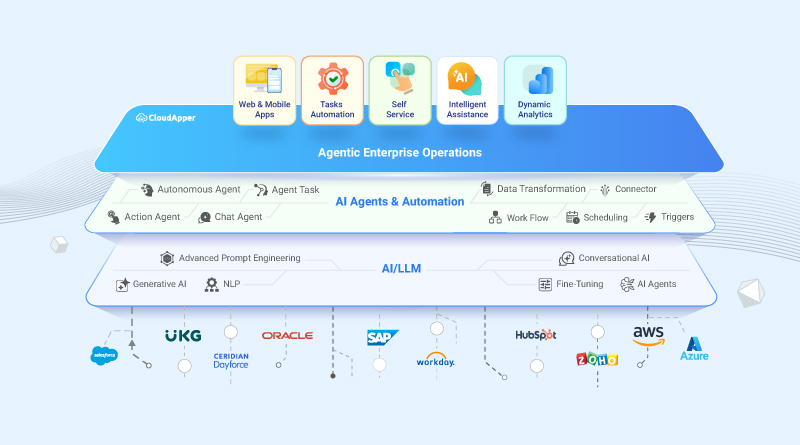
CloudApper AI is an advanced platform that enables organizations to integrate AI into their existing enterprise systems effortlessly, without the need for technical expertise, costly development, or upgrading the underlying infrastructure. By transforming legacy systems into AI-capable solutions, CloudApper allows companies to harness the power of Generative AI quickly and efficiently. This approach has been successfully implemented with leading systems like UKG, Workday, Oracle, Paradox, Amazon AWS Bedrock and can be applied across various industries, helping businesses enhance productivity, automate processes, and gain deeper insights without the usual complexities. With CloudApper AI, you can start experiencing the transformative benefits of AI today. Learn More
- Useful Links:
- Agentic AI
- No-Code/Low-Code
- Custom Software
- HCM Personalization
- iPaaS
- FedRAMP
CloudApper AI Solutions
- Works with







- and more.
Similar Posts

CMMC Level 2 and Internally Built Applications: The Evidence Gap…

Vendor-Built Internal Applications: The Governance Gap Enterprise IT Inherited From…