Most enterprise AI platform vendors pass security reviews by producing SOC 2 reports and architecture diagrams. But certification scope ends at the vendor's environment. Here's what your CISO's security review must demand — and the question that separates governed platforms from compliant-looking ones.

TL;DR
A vendor SOC 2 Type II report certifies architecture-level controls — not the runtime behavior of applications the platform generates. Enterprise IT teams evaluating AI development platforms need three specific evidence requests that most vendor decks never volunteer: code generation governance documentation, runtime privilege mapping via live demonstration, and compliance inheritance documentation. The question that sorts a shortlist: can the vendor demonstrate a generated application running in staging with its database privilege scope visible? Vendors who answer this directly are worth shortlisting. Vendors who redirect to their SOC 2 summary are telling you something too.
Table of Contents
A vendor SOC 2 Type II report certifies that security controls were designed and operating as described at the time of assessment. It does not certify what the platform’s generated applications do at runtime. For organizations conducting an enterprise AI platform security review as part of vendor due diligence, this distinction is precisely where most evaluations fail — and where audit findings surface six months after deployment. The certifications are real. The gap is real too.

This matters because every serious AI development platform vendor now carries the same certification stack: SOC 2, HIPAA attestation, encryption in transit and at rest, role-based access controls, SSO documentation. Any vendor on a legitimate shortlist can produce this paperwork. The question that separates a governed platform from a compliant-looking one is what happens after a user describes a requirement and the platform’s AI generates the application code.
What Auditors Check — and What They Don’t
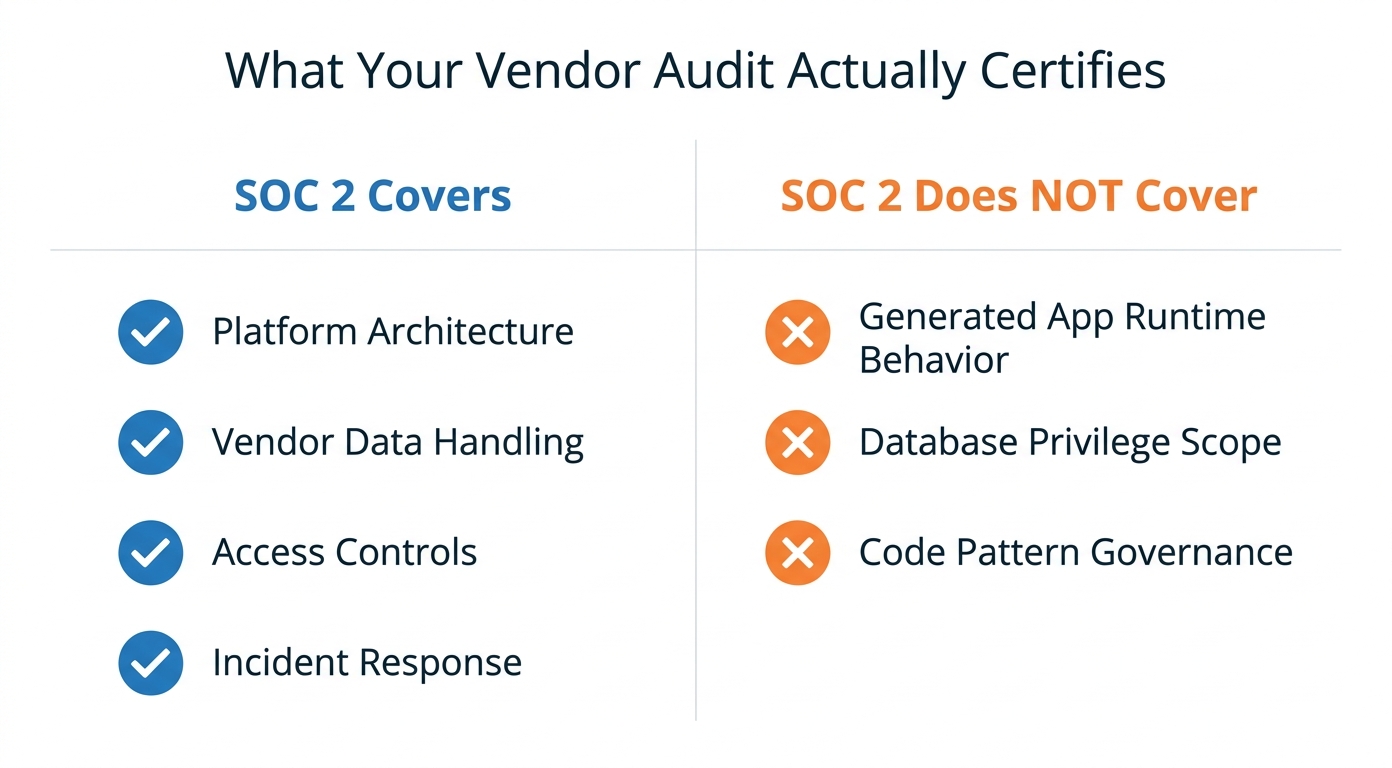
SOC 2 auditors validate the platform vendor’s own environment: data handling, access controls, incident response, change management, and subprocessor policies. These are architecture-level controls. They do not extend to the behavior of applications the platform generates and deploys on your infrastructure.
This is not a flaw in the certification. It is a scoping limitation every enterprise IT team needs to understand before signing. When AI-generated code introduces injection vulnerabilities or runs with excessive database privileges, those conditions exist in your environment — not the vendor’s. Your auditor will ask about your application. Not theirs.
The problem accelerates when platforms operate without a governance layer at the generation stage. The hidden risks of AI generation without a governance framework don’t stay hidden — they appear in your next application security walkthrough, and by then they belong to you.
Three Evidence Requests That Sort the Shortlist
When conducting a vendor security review, ask for evidence that vendor sales decks rarely volunteer.
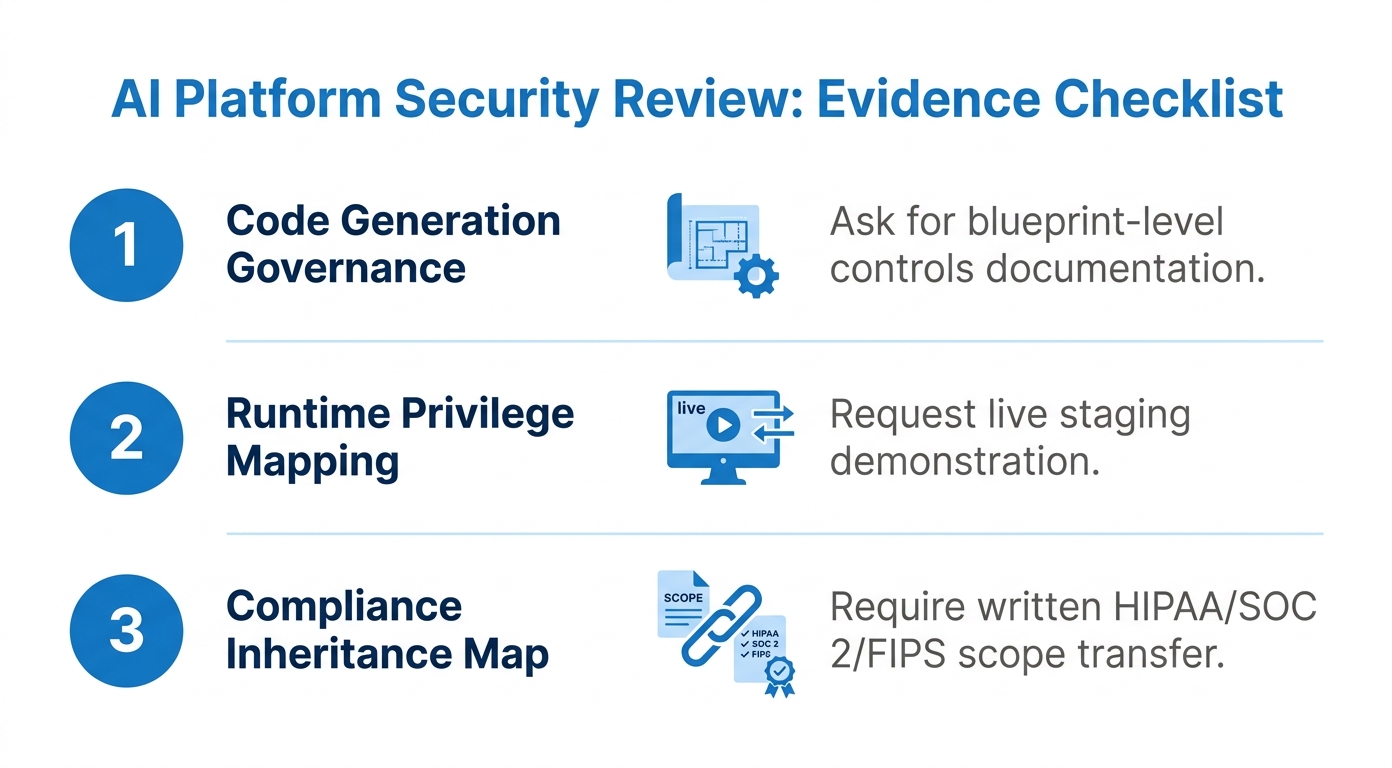
Code generation governance documentation. Ask how the platform controls which code patterns are permissible at generation time. Specifically: does it enforce security blueprints before generation, or generate first and scan afterward? Post-generation scanning creates a remediation backlog. A governed architecture enforces controls at the blueprint layer. A director of IT at a regional health system used CloudApper AI to describe her clinical workflow requirements — the AI built the application on a governed architecture where prohibited code patterns were never available to generate. The platform operates under HIPAA, SOC 2, and FIPS 140-2, and those obligations transfer structurally, not through attestation alone.
Runtime privilege mapping. Request a live demonstration, not a document, of how generated applications are scoped to database access. Blanket read-write permissions are a failure mode at the design stage. Ask the vendor to show the default privilege posture of a generated application in a staging environment.
Compliance inheritance documentation. If your organization carries HIPAA, SOC 2, or FIPS obligations, ask the vendor precisely which compliance controls transfer to applications built on their platform and which responsibilities remain yours. This is what your SOC 2 auditor will ask about internal application development — and most vendor documentation stops well short of answering it.
The Question That Closes the Evaluation
After reviewing standard security documentation, ask this question: “Can you demonstrate a generated application running in staging, show its database privilege scope, and explain what your platform would do if a user attempted to introduce a code pattern your governance layer prohibits?”
A platform with genuine security architecture can answer this in a live session. A platform that relies on certification documents and architecture diagrams will not answer it cleanly.
The application security review process is already a deployment bottleneck for most enterprise IT teams. Adding this question at the vendor evaluation stage costs an hour. Discovering the answer post-deployment during an audit costs considerably more.
For enterprises evaluating AI development platform vendors when compliance is non-negotiable, the gap between architecture-level certification and runtime-level governance is where risk concentrates. Vendors who can answer the runtime question directly are telling you something useful. Vendors who redirect to their SOC 2 summary are telling you something useful too.
CloudApper AI is built on a governed architecture where security controls are applied at the blueprint layer — before code generation, not after. If your security team is evaluating AI development platforms for a regulated environment, contact the CloudApper team to walk through how HIPAA, SOC 2, and FIPS 140-2 requirements are handled in a live demonstration.

What is CloudApper AI Platform?
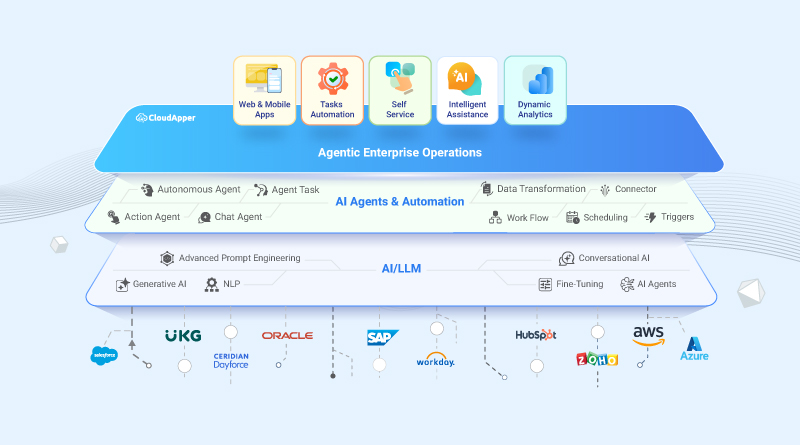
CloudApper AI is an advanced platform that enables organizations to integrate AI into their existing enterprise systems effortlessly, without the need for technical expertise, costly development, or upgrading the underlying infrastructure. By transforming legacy systems into AI-capable solutions, CloudApper allows companies to harness the power of Generative AI quickly and efficiently. This approach has been successfully implemented with leading systems like UKG, Workday, Oracle, Paradox, Amazon AWS Bedrock and can be applied across various industries, helping businesses enhance productivity, automate processes, and gain deeper insights without the usual complexities. With CloudApper AI, you can start experiencing the transformative benefits of AI today. Learn More
- Useful Links:
- Agentic AI
- No-Code/Low-Code
- Custom Software
- HCM Personalization
- iPaaS
- FedRAMP
CloudApper AI Solutions
- Works with







- and more.
Similar Posts
SR 11-7 Wasn’t Written for This: AI-Assisted Internal App Development…
Legacy Application Decommissioning and the Compliance Evidence Trap