- What a chatbot actually is and what governance it requires
- What an AI agent actually is and why the difference matters
- The governance questions that chatbot frameworks don’t ask
- What enterprise AI agent governance actually requires
The briefing comes across as familiar. A vendor wants to show you their AI solution. The demo is impressive. Something answers questions, responds to inputs, and appears to understand context in a way that earlier systems didn’t. The business case involves productivity improvement and cost reduction. The security team wants to review the data handling policy. The procurement team checks the compliance certifications.
If that sequence feels like the chatbot evaluation process from three years ago, it should. Most enterprises are applying the chatbot governance framework to AI agents — and that framework is wrong for the problem.

Chatbots and AI agents are not the same technology doing the same thing at different capability levels. They are architecturally different, operationally different, and governed differently. Treating them as points on a single capability spectrum — chatbot at one end, advanced AI at the other — produces governance frameworks that address the wrong risks, miss the right ones, and leave organizations with AI deployments they cannot audit, control, or explain to a regulator.
This distinction matters more now than it did twelve months ago, because AI agents are no longer a future consideration for enterprise IT. They are arriving on the desk of every CIO in the form of vendor offerings, internal proposals, and pilot program requests. Platforms like CloudApper — built specifically to deploy enterprise AI agents on a governed, FedRAMP-ready infrastructure — are designed around this distinction from the ground up, treating action authorization, audit trails, and compliance inheritance as platform features rather than implementation afterthoughts. The organizations that understand the governance difference before the deployment decisions are made will manage this transition significantly better than those that discover it after.
What a chatbot actually is and what governance it requires
A chatbot, in the enterprise context, is a system that receives a text input and produces a text output. The sophisticated versions use large language models to make those outputs contextually relevant and conversationally coherent. The governance requirements for chatbots are relatively well understood and map to familiar IT risk categories.
Data handling: what information does the chatbot receive, where does it go, who has access to it, and what are the data retention policies? This is the question that drove most chatbot governance conversations — often framed as “does our data go to train the vendor’s model?” — and the answer determines the compliance exposure.
Access control: who can use the chatbot, what topics or information can it address, and what are the guardrails on its responses? This is the content governance question — making sure the chatbot doesn’t say things the organization doesn’t want said or doesn’t provide information it shouldn’t provide.
Integration scope: what systems does the chatbot connect to in order to retrieve information for its responses? This determines the access surface and the data exposure from the integration.
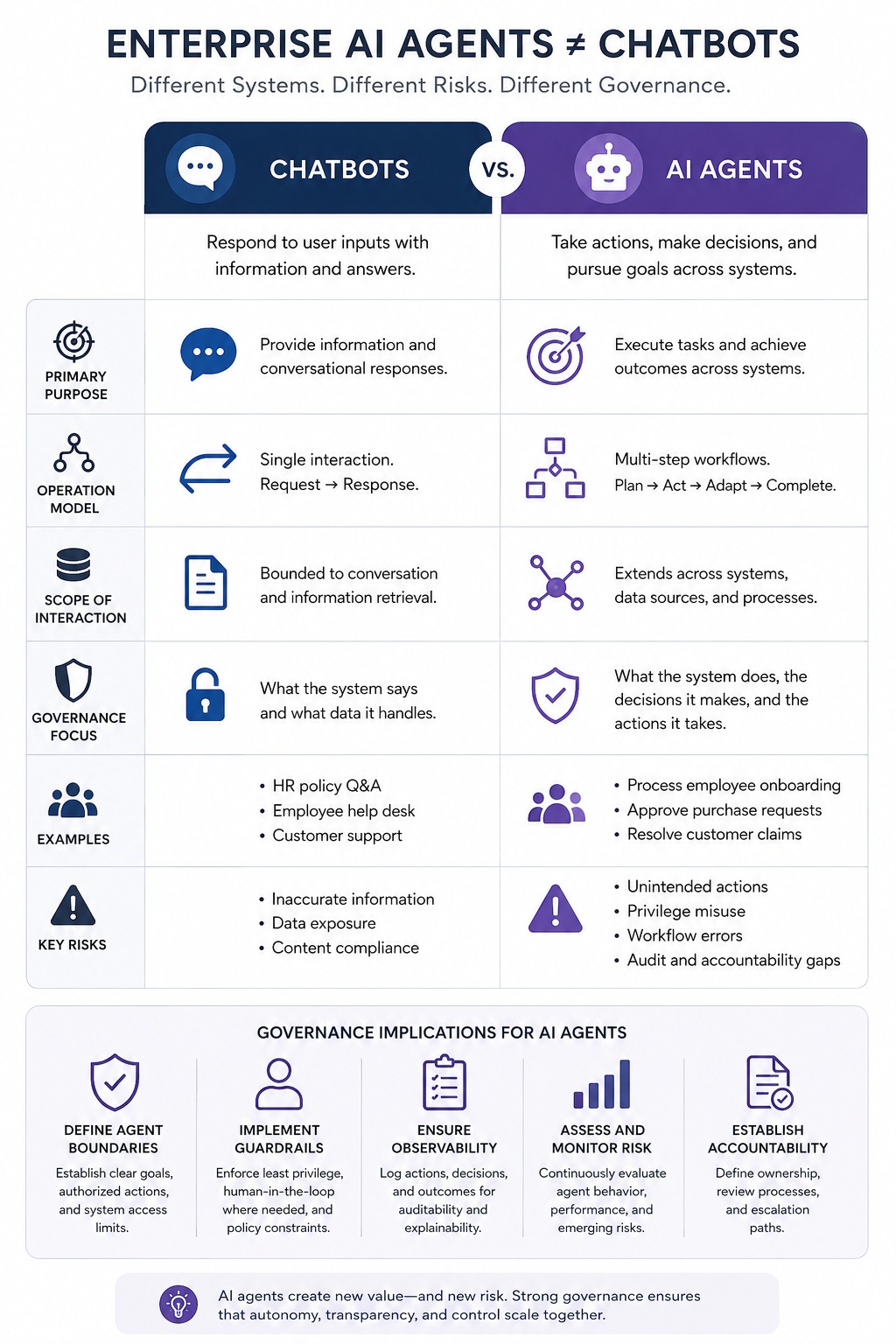
These are meaningful governance questions. They are also relatively bounded. A chatbot that answers HR policy questions, helps employees navigate a portal, or responds to customer service inquiries has a defined interaction pattern, a defined information scope, and a defined output format. The risk is concentrated in the conversation itself — in what the system says and what data it handles to say it.
The governance framework that enterprise IT developed for chatbots is designed for this bounded interaction model. It works well for what chatbots do.
It does not work for what AI agents do.
What an AI agent actually is and why the difference matters
An AI agent is not a more capable chatbot. It is a different category of system — one that doesn’t just respond to inputs but takes actions, makes decisions, and operates across extended timeframes with a degree of autonomy that has no equivalent in the chatbot model.
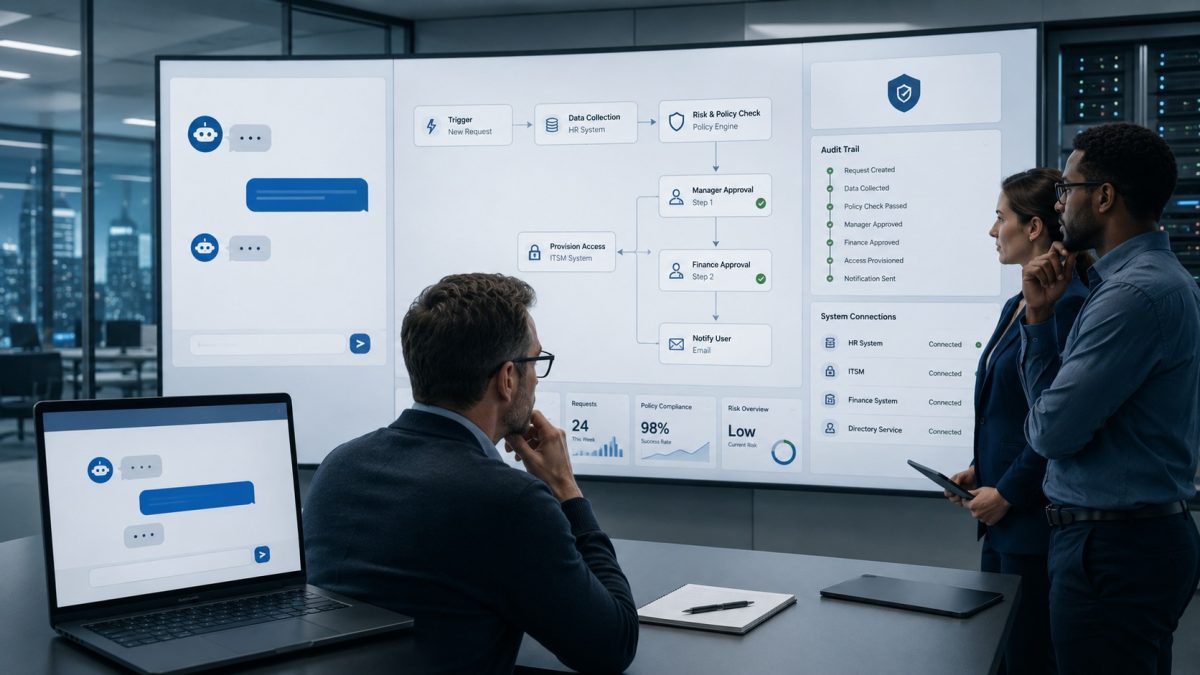
The defining characteristic of an AI agent is agency: the ability to pursue a goal through a sequence of steps, each of which may involve interacting with external systems, making decisions based on intermediate results, and adapting the approach based on what those results reveal. An AI agent given the goal of “process this employee’s leave request” doesn’t just answer a question about leave policy. It accesses the HR system to verify the employee’s eligibility, checks the team calendar for coverage, applies the relevant policy rules to calculate the approval conditions, routes the request through the appropriate approval workflow, and updates the employee record when the process is complete.
That sequence involves multiple system interactions, multiple decision points, and multiple outputs — none of which look like the input-output model of a chatbot conversation. And each step in that sequence represents a governance challenge that the chatbot framework was never designed to address.
Action scope vs. response scope: A chatbot’s governance surface is its response — what it says. An AI agent’s governance surface is its action set — what it does. An agent that can write to a database, trigger a workflow, send a notification, modify a record, or initiate a transaction has a fundamentally different risk profile than a system that produces text. The question is not just what the agent might say incorrectly, but what it might do incorrectly — and what the downstream consequences of those incorrect actions are in a production environment.
Autonomy and human oversight: Chatbots operate in a human-supervised loop by design. A person reads the response and decides what to do with it. The human remains in the decision chain. AI agents are designed to operate with reduced human supervision — that is the value proposition. The agent handles a sequence of steps that would otherwise require human attention at each stage. This is genuinely useful. It is also a governance challenge, because the human oversight that catches errors in the chatbot model is partially or fully removed from the agent model. An agent that makes an incorrect decision midway through a process may complete the entire sequence before anyone realizes the error — and undoing a completed sequence of system actions is significantly harder than ignoring an incorrect chatbot response.
Extended operation and audit trail requirements: A chatbot conversation is a discrete event with a defined beginning and end. An AI agent may operate over an extended period — minutes, hours, or in some architectures, continuously — pursuing a goal through a sequence of steps that spans multiple systems and produces multiple outputs. The audit trail for that operation is not a conversation log. It is a record of every action taken, every system accessed, every decision made, and the basis for each decision. Producing and maintaining that audit trail is a governance requirement that has no equivalent in chatbot oversight.
Cascading effects from compound decisions: Chatbot errors are contained. If the chatbot gives a wrong answer, the consequences are limited to the person who received the answer and acted on it. AI agent errors can cascade. If an agent makes an incorrect decision at step three of a twelve-step process, the remaining nine steps may execute based on that incorrect foundation. The error compounds through the sequence. By the time the final output is produced, the root cause may be deeply embedded in a chain of intermediate actions that is difficult to reconstruct.
The governance questions that chatbot frameworks don’t ask
If you apply a chatbot governance framework to an AI agent deployment, there are specific questions you will not ask — and the answers to those unasked questions are where the governance exposure lives.
What actions can the agent take, and who authorized them?
A chatbot governance review asks about data access. An agent governance review must ask about action authorization — the specific set of operations the agent is permitted to execute, the conditions under which each operation is permitted, and the documented authorization chain that established those permissions. This is not a data governance question. It is an access control question applied to actions rather than information, and it requires a different governance instrument than the data handling review.
What happens when the agent encounters an unexpected state?
Chatbots handle unexpected inputs through response guardrails — they decline to answer or escalate to a human when the input falls outside the defined scope. AI agents encounter unexpected states in the systems they interact with — data in an unexpected format, a condition the agent’s logic didn’t anticipate, a system that returns an error midway through a process. The agent’s behavior in those states is a governance question: does it halt and escalate? Does it attempt to proceed? Does it make a decision based on the unexpected state without human input? The answer has direct implications for compliance and operational integrity.
How are agent actions logged, and who can review those logs?
The audit trail for an AI agent is more complex than a conversation log. It needs to capture every system interaction, every decision point, every intermediate state, and the agent’s reasoning at each step — not just the final output. Designing and maintaining that audit trail requires deliberate architecture decisions, not just log retention policies. Most organizations evaluating AI agents have not worked through what a compliant audit trail for agent operations actually looks like in their environment.
What is the rollback procedure for agent actions?
If an AI agent executes a sequence of actions that produces an incorrect outcome, what is the organization’s procedure for identifying the error and reversing the effects? For some agent actions — sending a notification, updating a record — rollback is straightforward. For others — initiating a financial transaction, submitting a regulatory filing, modifying a production system — rollback may be difficult, expensive, or impossible. The governance framework needs to define rollback procedures before deployment, not after an error makes them urgent.
How does the agent interact with compliance-sensitive systems?
An AI agent that accesses systems containing PHI, PCI data, or other regulated information has the same compliance obligations as any other system with that access — plus the additional obligation of ensuring that the agent’s actions within those systems comply with the relevant frameworks. The agent’s decision logic, its data access patterns, and its action scope all need to be reviewed against the applicable compliance requirements. This is not the same review that covers the chatbot’s response content. It is a review of the agent’s operational behavior in a regulated data environment.
What enterprise AI agent governance actually requires
The organizations that are governing AI agent deployments effectively have moved beyond the chatbot framework to something that looks more like operational system governance — the same discipline applied to any production system that takes actions, modifies data, and operates with a degree of autonomy.
That governance framework has a few consistent elements.
Action authorization by design: The agent’s permitted action set is defined, documented, and enforced at the infrastructure level — not by the agent’s instructions but by the environment in which it operates. An agent authorized to read HR records and submit leave requests cannot, by design, modify payroll records or access systems outside its defined scope. The authorization is structural, not instructional. This is the equivalent of access controls for system permissions — the agent can only do what the environment permits, regardless of what its instructions say.
Human escalation thresholds: Not all agent decisions should proceed without human review. A governance-aware agent deployment defines the threshold conditions that trigger human escalation — the types of decisions, the magnitude of potential impact, or the degree of uncertainty that require a human to review and approve before the agent proceeds. Those thresholds are documented, enforced, and auditable. The agent doesn’t decide whether to escalate. The governance framework decides, and the agent follows.
Comprehensive audit trail by default: Every action the agent takes, every system it accesses, every decision point it encounters, and the basis for its decision at each point is logged automatically and retained in a format that supports compliance review and incident investigation. This is not optional overhead — it is the mechanism that makes agent operations explainable to auditors, regulators, and the organization’s own leadership when something requires review. It is also why governance-first platforms matter: when compliance is inherited from the platform rather than engineered into each individual agent deployment, the audit trail exists by design — not by effort. CloudApper’s approach of treating compliance certifications like HIPAA, SOC 2, FedRAMP, and GDPR as platform-level infrastructure rather than per-app requirements means every agent deployment starts with that foundation already in place.
Defined scope per deployment: Each AI agent deployment is scoped to a specific set of goals, actions, and systems — and that scope is documented, approved, and periodically reviewed. An agent deployed to handle leave requests has a defined scope that covers the systems and actions relevant to that function. Expanding the scope requires a documented change process, not a configuration update. This prevents scope creep — the gradual expansion of what an agent does that occurs without anyone making a deliberate decision to authorize the expansion.
Security review calibrated for agentic behavior: The security review for an AI agent deployment covers the agent’s action surface, not just its data access. This includes penetration testing of the agent’s interaction with production systems, review of the agent’s decision logic for behaviors that could be exploited or produce harmful outcomes, and assessment of the cascading risk from compound errors. Standard application security reviews cover the infrastructure. Agent security reviews need to cover the behavior.
Why this distinction is urgent now
Enterprise AI vendors are moving faster than enterprise governance frameworks. AI agents are being offered as extensions to ERP systems, HCM platforms, CRM tools, and productivity suites that enterprise organizations already run. Some of those offerings are being evaluated and deployed through the same process used for software feature updates — without the governance review that a new agentic capability actually requires.
The organizations that recognize this gap and build the appropriate governance framework before agent deployments proliferate are in a significantly better position than those that govern agents as enhanced chatbots and discover the difference through an audit finding, a compliance incident, or an operational error that a more rigorous governance process would have prevented.
The chatbot governance framework your organization developed was appropriate for chatbots. It is a starting point, not a complete answer, for AI agents. The additional governance elements that agents require are not exotic or experimental — they are extensions of the same operational discipline that applies to any production system taking autonomous actions in your enterprise environment. What makes this tractable for most enterprises is choosing a platform where those governance elements are already built in — where zero DevOps overhead per deployment, inherited compliance certifications, and governed blueprints replace the per-agent security reviews and audit work that ungoverned AI development requires. That is the infrastructure difference between AI agents that scale safely and AI agents that accumulate risk quietly until an audit or incident makes it visible.
The question is whether those extensions get built into the governance framework before the agents are deployed or after the consequences of deploying without them make the gap visible.
The Bottom Line
AI agents and chatbots are categorically different systems with categorically different governance requirements. An AI agent that takes actions, makes sequential decisions, and operates across multiple enterprise systems with reduced human oversight requires governance that addresses action authorization, audit trail completeness, human escalation thresholds, rollback procedures, and security review of agentic behavior — none of which are adequately addressed by the data handling and content guardrail framework designed for chatbots.
Enterprise IT leaders evaluating AI agent deployments need a governance framework designed for what agents actually do, not adapted from what chatbots do. The difference between those two frameworks is where the compliance exposure, operational risk, and audit vulnerability live.
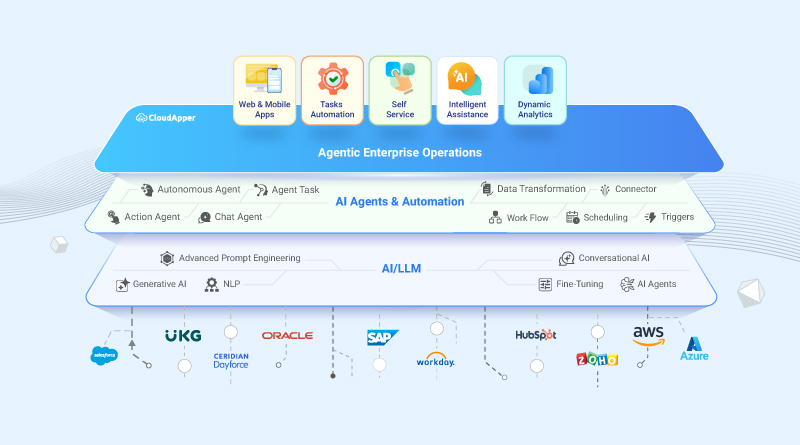
CloudApper builds enterprise AI agents on a governed platform that addresses the governance requirements of agentic AI by design — with structural action authorization, comprehensive audit trails, defined escalation thresholds, and compliance certifications including FedRAMP, HIPAA, SOC 2, and GDPR. Contact us to see how organizations in your industry are deploying AI agents within a governance framework built for what agents actually do.

What is CloudApper AI Platform?
CloudApper AI is an advanced platform that enables organizations to integrate AI into their existing enterprise systems effortlessly, without the need for technical expertise, costly development, or upgrading the underlying infrastructure. By transforming legacy systems into AI-capable solutions, CloudApper allows companies to harness the power of Generative AI quickly and efficiently. This approach has been successfully implemented with leading systems like UKG, Workday, Oracle, Paradox, Amazon AWS Bedrock and can be applied across various industries, helping businesses enhance productivity, automate processes, and gain deeper insights without the usual complexities. With CloudApper AI, you can start experiencing the transformative benefits of AI today. Learn More
- Useful Links:
- Agentic AI
- No-Code/Low-Code
- Custom Software
- HCM Personalization
- iPaaS
- FedRAMP