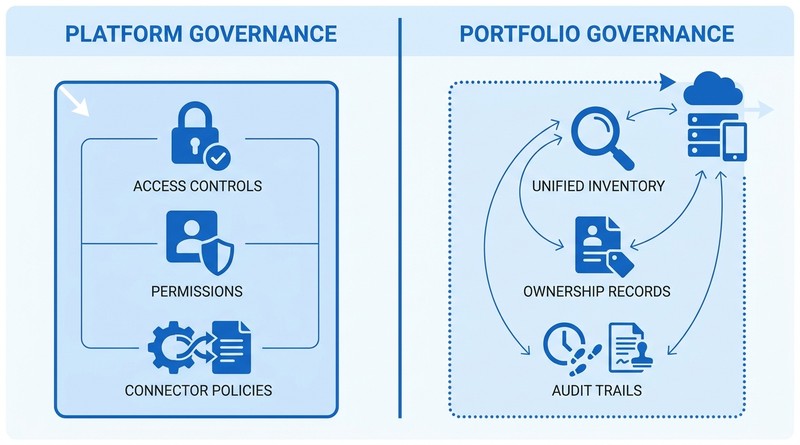
Enterprise IT teams that govern individual low-code platforms without a unified portfolio governance layer cannot answer the most basic audit question: produce a complete application register. Platform governance controls who can do what inside each tool. Portfolio governance covers what applications exist across all tools, who owns each, what data they touch, and what changed.

TL;DR
Enterprise IT teams that govern individual low-code platforms without a unified portfolio governance layer cannot answer the most basic audit question: produce a complete application register. Platform governance controls who can do what inside each tool; portfolio governance covers what applications exist across all tools, who owns each one, what data they access, and what changed. When business units deploy applications on multiple low-code platforms independently, IT inherits fragmented audit trails, inconsistent ownership records, and no common evidence infrastructure. The minimum application register entry requires platform, owner, data classification, change log with approvals, and recovery requirement for every application regardless of which tool generated it. Enterprises that build internal applications in a governed environment close this gap from day one rather than reconstructing evidence manually before each audit cycle.
Table of Contents
Your internal audit team wants a complete list of every low-code application in production: the data sources each one touches, the owner for each, and the change history for the last 12 months. You have three different platform consoles to check and no confidence the list is complete. That is not preparation for an audit. That is the audit finding.

This gap has nothing to do with whether your platforms have adequate permissions management or data loss prevention controls. Those controls exist inside each platform. The problem lives above all of them, in the absence of a unified governance layer across your entire application portfolio. That layer determines whether IT can answer audit questions from one place or scramble across four consoles hoping the evidence is there.
Platform Governance Is Not Portfolio Governance
When IT governs Power Apps, it sets environments, restricts connectors, and applies data loss prevention policies. When it governs AppSheet or Mendix, it configures access roles and deployment approvals. These controls are real and effective within each platform’s boundary.
Platform governance answers one question: who can do what inside this tool?
Portfolio governance answers a different one: what applications exist across all tools, what does each one do, who owns it, and what happens when something goes wrong?
This distinction is where governance-focused IT leaders bring CloudApper AI into the conversation. Not to adopt another low-code tool, but to build internal applications in a governed environment where the application register is part of every application from day one, not assembled manually from multiple platform consoles before each audit cycle.
When three business units deploy applications on three different platforms, IT manages three separate governance footprints. No unified inventory. No consistent ownership model. No common audit trail. If a compliance reviewer asks which applications handle regulated data, the answer requires logging into multiple consoles, correlating records that were never designed to be compared, and hoping nothing slipped through.
The enterprise shadow IT governance problem and the application inventory gap both point here: platform governance without portfolio governance is an incomplete answer to what auditors actually need.
What the Evidence Record Must Cover
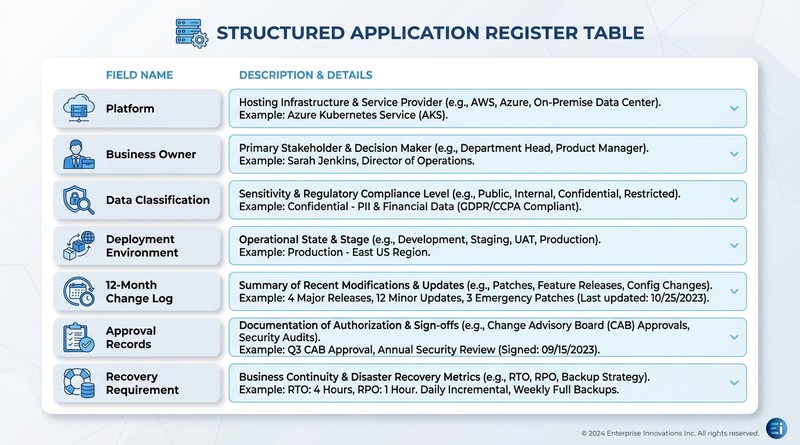
The compliance officer signing off on a SOC 2, HIPAA, or ISO 27001 attestation does not read platform documentation. They need one record per application: who owns it, what data it accesses and at what classification, what changed and when, and who approved it.
That record does not live inside any single low-code platform’s console. It lives in the application register. And if IT cannot produce one that spans every platform in the estate, the gap is the finding.
This is why the application decommissioning and lifecycle problem does not stay contained to old systems. Low-code applications built eighteen months ago on a departmental platform, with no documented owner and no change history, are already compliance exposure.
The minimum application register entry for any low-code application covers: the platform it runs on, the business owner, the data it accesses and that data’s classification, its deployment environment, a 12-month change log with approval records, and its recovery requirement. If the governance infrastructure cannot produce that record for every application regardless of which platform generated it, there is a portfolio governance gap that platform-level controls cannot close.
Governance That Travels With the Application
The realistic path forward is not mandating consolidation onto a single tool before the organization is ready. The platform engineering versus governance tension is well-documented in enterprise IT. What organizations need is governance that travels with every application from the moment it is built, regardless of which tool generated it.
A head of enterprise applications at a regional healthcare system faced this problem directly. She needed a governed environment where every internally built application carried its governance record from day one: ownership, data classification, change history, and audit trail, without her team manually maintaining that record across four different platform consoles. She described what she needed. CloudApper AI built the governed application environment. The compliance officer reviewing the subsequent SOC 2 attestation had one application register entry per application, already complete.
Governance evidence gaps surface at the board level, and they always look worse in hindsight than they would have cost to prevent early. When every department becomes a software vendor, the portfolio outruns the governance infrastructure. The audit question is coming. The enterprise that can answer it without three days of manual reconstruction is the one that made the architecture decision early.
If your enterprise is managing internal application development across multiple platforms and cannot produce a unified application register, CloudApper AI can build that governance layer into every application from day one. Start the conversation.

What is CloudApper AI Platform?
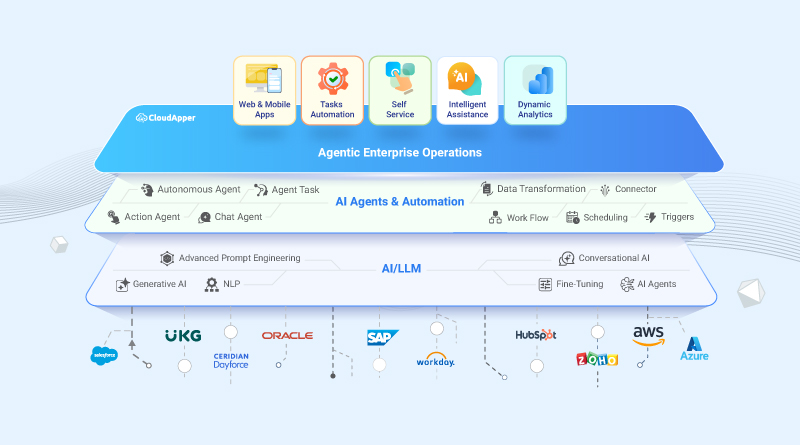
CloudApper AI is an advanced platform that enables organizations to integrate AI into their existing enterprise systems effortlessly, without the need for technical expertise, costly development, or upgrading the underlying infrastructure. By transforming legacy systems into AI-capable solutions, CloudApper allows companies to harness the power of Generative AI quickly and efficiently. This approach has been successfully implemented with leading systems like UKG, Workday, Oracle, Paradox, Amazon AWS Bedrock and can be applied across various industries, helping businesses enhance productivity, automate processes, and gain deeper insights without the usual complexities. With CloudApper AI, you can start experiencing the transformative benefits of AI today. Learn More
- Useful Links:
- Agentic AI
- No-Code/Low-Code
- Custom Software
- HCM Personalization
- iPaaS
- FedRAMP
CloudApper AI Solutions
- Works with







- and more.
Similar Posts

ISO 42001 Is Looking at the Code Your AI Coding…

Your Internally Built AI Applications Already Have an EU AI…