The EU AI Act's high-risk classification cannot be run retroactively. Internally built enterprise AI applications that affect employment, benefits, or clinical decisions likely qualify as high-risk — but most were deployed without the intended-purpose documentation the Act requires as build-time evidence. This article explains the provider obligation gap and what a governed build process looks like.

TL;DR
The EU AI Act requires high-risk AI applications to have intended-purpose documentation created at design time, not assembled after an audit request. Most internally built enterprise AI applications — routing engines, eligibility calculators, scheduling tools — were deployed without this documentation, leaving enterprises unable to produce defensible conformity evidence. The provider obligation is created when a business unit commissions the build, not when IT or Legal learns about it. Enterprises that are not establishing governed build processes now are extending this liability with every new deployment. CloudApper AI enables enterprise professionals to describe their application requirements in a governed environment where intended-purpose documentation is a structural output of the build itself.
Table of Contents
The compliance team sends a request to the application team eight months after deployment. They need “intended purpose” documentation for the AI-assisted eligibility routing tool that went live last spring. The application works. Users depend on it. The business unit that commissioned it has moved on to the next project. The documentation was never created because no one in the build process knew it was a classification prerequisite under the EU AI Act — not IT, not the business unit sponsor, not the vendor who supplied the underlying model. The ask arrives as a compliance project. What it actually reveals is a governance architecture that produces the liability before anyone has named it.

This is the problem most EU AI Act content does not address. Classification is not the hard part. Classification without documentation is.
The Classification Test That Cannot Be Run Retroactively
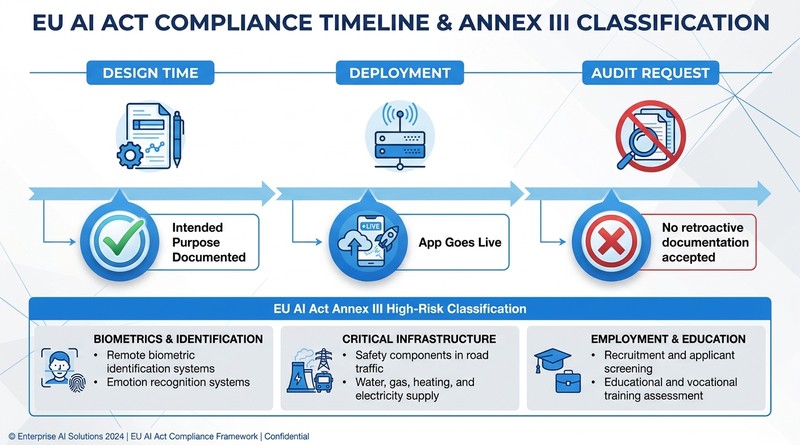
The EU AI Act’s Annex III lists the high-risk categories — employment and worker management, access to essential services, critical infrastructure safety, certain health and life sciences applications. An AI application that affects hiring decisions, workforce scheduling, benefit eligibility, credit access, or clinical workflow management is almost certain to qualify. The question most enterprise IT teams are asking is which of their internally built applications fall under that threshold.
That question is answerable only if the application’s intended purpose was documented at the time of design. Under the Act, “intended purpose” is the legal fulcrum. It determines whether a system is classified as high-risk, who bears provider obligations versus deployer obligations, and what evidence must exist for a conformity assessment. An application team that cannot produce contemporaneous records of what the system was designed to do, who it was designed to act on, and what decisions it was designed to influence cannot retroactively satisfy that standard. The documentation is not a report you write after the fact. It is evidence that must predate deployment to be defensible.
Most enterprises have dozens of internally built AI-assisted applications for which that evidence does not exist. As organizations examine what governance evidence they need to answer board-level AI questions, this gap is becoming visible in a way it wasn’t eighteen months ago.
Who Is Creating the Provider Obligation Without Knowing It
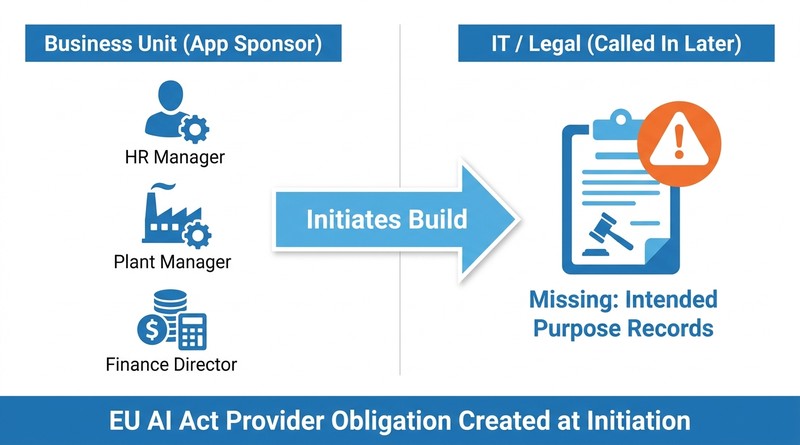
The Act distinguishes providers from deployers. A provider places an AI system on the market or puts it into service under its own name. A deployer uses an AI system under its authority for a professional purpose. For internally built applications, the enterprise is typically both — but the provider-equivalent obligations attach specifically to whoever develops or materially modifies the system. That means the HR leader who commissioned a workforce scheduling algorithm, the operations manager who funded a quality exception flagging module, and the finance director who greenlit an AI-assisted invoice routing tool are, functionally, initiating provider obligations that IT will be asked to document.
The missing stakeholder in most EU AI Act compliance programs is the business unit application owner. They initiate the build, fund the project, define the use case, and assume that compliance is someone else’s downstream task. The obligation, however, is created at initiation and documented at design. By the time IT or Legal is brought in, the classification-critical decisions have already been made and the people who made them have moved on.
This is structurally identical to the governance failure described in business-led application development and the shadow AI pattern that has expanded enterprise application estates without corresponding governance. The EU AI Act adds a legal consequence to a governance problem that was already expensive.
Why Retroactive Documentation Fails the Classification Test
Producing intended-purpose documentation after an audit request is not classification. It is reconstruction. The distinction matters for two reasons. First, the Act’s conformity assessment obligations for high-risk systems require technical documentation maintained and updated throughout the system lifecycle, not assembled upon request. Second, regulators examining the documentation will see its metadata. A document timestamped eight months after deployment, with language that mirrors the regulatory framework rather than the original design rationale, does not satisfy the evidence standard.
The same dynamics that drive retroactive evidence costs in SOX ITGC scope audits and NIST AI RMF evidence obligations apply here, with one material difference: the EU AI Act carries financial penalties that reach up to 3% of global annual turnover for failures in high-risk system obligations, with higher exposure for prohibited-practice violations. The exposure is not hypothetical; enforcement under the Act’s high-risk provisions begins in August 2026.
The teams that are producing documentation now, before that window closes, are working with application teams to reconstruct what can be reconstructed and to establish forward-looking governance for new builds. The teams that are not are accumulating the same kind of contingent liability that has driven legacy system compliance exception backlogs for a decade.
What a Build That Produces the Evidence Looks Like
The practical answer to the EU AI Act’s intended-purpose problem is not a compliance project. It is a governance architecture that produces the required documentation as a structural output of the application build itself.
A Head of Applications at a regional hospital network described a clinical workflow triage tool they needed to build — one that would qualify as high-risk under Annex III given its influence on care pathway assignments. She described the requirement, the intended user population, and the decision boundaries the system was and was not permitted to cross. CloudApper AI built the application with those parameters structured as governed, auditable specifications, not informal conversations. The intended-purpose record was a product of the build process. No reconstruction required.
That outcome is not available to teams building with unconstrained AI coding assistants or through informal low-code workflows. When an enterprise developer uses AI coding tools without a governed build environment, the intended-purpose definition exists only in Slack threads and project briefs that no one maintains. The EU AI Act does not recognize those as evidence.
The classification question most enterprises are asking about their existing AI applications is the wrong starting point. The governance question is whether the applications being built now are producing the documentation that future classification depends on. For most organizations, the honest answer to that question is no — and every new deployment without it extends the problem.
If your team is building internal AI applications that may qualify as high-risk under the EU AI Act, CloudApper AI can help you establish a governed build environment where intended-purpose documentation is a structural output, not a retroactive compliance project. Reach out to discuss what that looks like for your application portfolio.

What is CloudApper AI Platform?
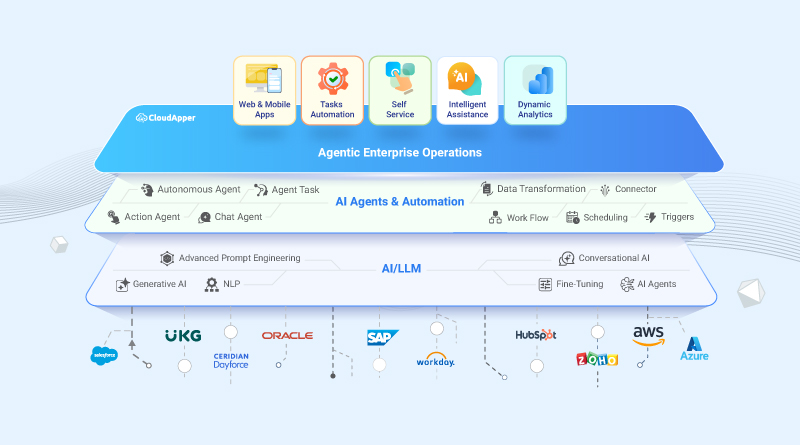
CloudApper AI is an advanced platform that enables organizations to integrate AI into their existing enterprise systems effortlessly, without the need for technical expertise, costly development, or upgrading the underlying infrastructure. By transforming legacy systems into AI-capable solutions, CloudApper allows companies to harness the power of Generative AI quickly and efficiently. This approach has been successfully implemented with leading systems like UKG, Workday, Oracle, Paradox, Amazon AWS Bedrock and can be applied across various industries, helping businesses enhance productivity, automate processes, and gain deeper insights without the usual complexities. With CloudApper AI, you can start experiencing the transformative benefits of AI today. Learn More
- Useful Links:
- Agentic AI
- No-Code/Low-Code
- Custom Software
- HCM Personalization
- iPaaS
- FedRAMP
CloudApper AI Solutions


- Works with









- and more.
Similar Posts

NIST AI RMF and Internally Built Enterprise Applications: The Evidence…

When an Internally Built Application Enters GxP Scope, Every Change…