Audit committees are now formally asking CIOs to prove AI governance with evidence, not just policy. Here is what boards are actually asking, what evidence the CIO must produce, and how a governed application development platform closes the gap between policy and proof.

TL;DR
Boards and audit committees are now formally requiring CIOs to produce governance evidence for all AI tools and AI-assisted applications in production, including those deployed by business units outside IT. The gap most enterprises face is not the absence of an AI policy; it is the absence of the auditable evidence trail that proves the policy is working: a complete inventory, compliance inheritance documentation, change records, and an incident log. Business-unit teams using AI coding assistants and low-code platforms are creating operational applications that carry compliance obligations but are invisible to any governance record the CIO maintains. CloudApper AI closes this gap by generating governance evidence automatically at the point of development, so the inventory, compliance documentation, and change records the board is asking for are a structural output of the development process rather than a pre-meeting reconstruction project. CIOs who build on a governed platform can answer board AI governance questions with documentation rather than assurances.
Table of Contents
- The Questions Now Arriving From Your Audit Committee
- Why “We Have an AI Policy” Does Not Answer Those Questions
- What Governance Evidence Actually Looks Like
- The AI-Development Layer Nobody Documented
- How a Governed Platform Generates Evidence Automatically
- How to Build Your Board AI Governance Report
- Frequently Asked Questions
Audit committees now ask CIOs for AI governance evidence, not AI strategy, and most CIOs do not have board reporting ready to answer. The questions are specific: an inventory of AI tools and outputs, including those deployed outside IT; the controls and evidence for each use case touching regulated data; whether AI-generated code was reviewed before deployment; and who is accountable if it causes a breach or material loss.

The NACD, Deloitte and major audit committee advisory bodies have published guidance in the past eighteen months directing boards to ask these questions. CloudApper AI is built to close the gap between having a policy and producing that evidence at the pace AI is actually used.
The Questions Now Arriving From Your Audit Committee
The shift in board and audit committee AI questions over the past year is directional. Earlier questions were strategic: Is management investing appropriately in AI? What is our AI roadmap? Those questions have not disappeared, but they have been joined by a different set that is more specific and more uncomfortable. The new questions are evidentiary. They presuppose that AI is already deployed and ask for proof that deployment is controlled.
Audit committee guidance from Deloitte explicitly frames AI oversight as an extension of existing financial reporting and cybersecurity oversight obligations — not a separate innovation governance track. That framing has consequences. When AI is treated as part of cybersecurity and financial reporting risk, the question is no longer “what is your AI strategy?” but “what would you show a regulator?” Board members are being advised to ask whether AI use cases affect financial reporting accuracy, whether data used in AI decision-making is properly classified and protected, whether third-party AI tools are covered by the same vendor risk management processes as other critical systems, and whether management has a process for identifying and responding to AI-related incidents. These are governance questions, and they require governance evidence — not strategy slides.
The quarterly cadence that is emerging for material AI risk reporting creates an additional accountability structure. A CIO reporting on AI governance quarterly to the audit committee cannot fill each report with the same policy summary. The committee will eventually ask to see the underlying artifacts: the inventory, the controls, the incident log, the evidence that what was reported last quarter is still true this quarter. The governance framework a CIO must operate under is therefore not a policy framework but an evidence-generation framework — one that produces the right artifacts continuously, not just before a board meeting.
Why “We Have an AI Policy” Does Not Answer Those Questions
Most enterprises responding to board AI questions today lead with their AI policy document. The policy covers acceptable use, data handling, vendor approval, and human review requirements. It was often written in response to the first wave of AI governance pressure, and it is usually a reasonable document. It is also not what the audit committee is asking for.
A policy is a statement of intent. What the board is now asking for is evidence of compliance — proof that the policy is being followed, that the AI tools in use were approved through the process the policy describes, that the data those tools touch is classified as the policy requires, and that when something went wrong, it was caught and documented in the way the policy mandates. The gap between “we have a policy” and “here is the evidence that the policy is working” is precisely the gap that most AI governance programs cannot currently close. As shadow AI development in enterprises has expanded, the distance between what the policy covers and what AI is actually being used for has widened significantly.
There is also a more uncomfortable dimension that Grok’s adversarial critique surfaces directly: the board is increasingly asking not just whether AI is governed, but who in the organization will sign their name to the attestation that no AI-driven decision or AI-generated application created material financial, regulatory, or reputational liability in the reporting period. That is an attestation question. And most CIOs cannot produce that attestation because the AI development and deployment activity happening in their enterprise — particularly the activity happening in business units — does not run through any system that generates the kind of auditable evidence an attestation requires. The incident that reveals the governance gap is usually not a planned discovery. It is the audit finding or the regulatory question that reveals, retroactively, that a significant AI-assisted workflow was running outside any documented governance structure.
What Governance Evidence Actually Looks Like
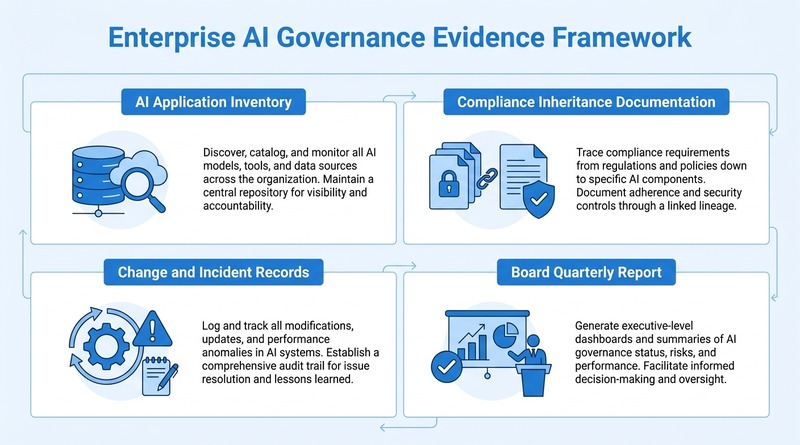
The evidence a CIO needs to answer board AI governance questions has four components, and each one corresponds to a specific category of board question.
The first is an AI and AI-assisted application inventory. This is more than a list of licensed AI tools. It includes internally built applications that incorporate AI-generated code, AI coding assistants used by the development team and business units, AI agents deployed for workflow automation, and AI features embedded in licensed enterprise software. The inventory must specify, for each entry, what regulated data the application or tool touches, what business function it supports, and whether it has been through a formal risk or compliance review. Most inventories CIOs maintain today cover licensed tools. They do not cover AI agents and internally developed AI-assisted applications, which are the fastest-growing and least-documented part of the enterprise AI estate.
The second component is compliance inheritance documentation. For each regulated use case — a healthcare application touching patient data, a financial application involved in reporting, a manufacturing system affecting safety — the board will want evidence that the applicable compliance controls are in place and that the AI elements of that application are covered by the same controls as the rest of the system. This is what “compliance by design” actually means in a board-reporting context: not that a policy says compliance is required, but that the platform or development process generates evidence of compliance at the point an application is deployed rather than through a retrospective audit. The distinction between a platform that tracks infrastructure and one that enforces governance determines whether compliance inheritance can be evidenced or only asserted.
The third is a change and incident record. The board needs to see not only that AI applications are governed at deployment but that changes to those applications are tracked and that incidents involving AI-generated or AI-assisted outputs have been identified, reviewed, and resolved according to the policy the CIO described. An AI-assisted application that is modified by a business unit without a change record, or that produces an incorrect output without a documented review and correction, represents a governance gap that the board will eventually find. The technical debt that accumulates in AI-assisted applications is the same as the evidence debt that accumulates in governance programs — invisible until the moment it is not.
The AI-Development Layer Nobody Documented
The hardest part of answering board AI governance questions is not the licensed tools. Most enterprises have visibility into those. The hard part is the AI development activity happening outside formal IT governance — and the pace of that activity is accelerating in exactly the enterprises whose boards are asking these questions.
Finance teams are using AI coding assistants to build reporting tools. Operations teams are automating workflows with AI-generated scripts. HR is deploying AI agents for onboarding and scheduling. Risk management is using AI-assisted analytics that began as a spreadsheet and became a production dependency. None of these originated through any formal IT intake. None of them have compliance reviews on file. None of them appear in the inventory a CIO would hand to the audit committee. But all of them are operationally real, and many of them touch regulated data. When the audit committee asks “what AI tools and applications are in use across the enterprise, including those deployed by business units?” this is the population they are asking about, and it is the population that is almost never captured in the answer.
This is the AI-development shadow layer that ungoverned AI coding tool use creates inside even well-managed enterprises. The business-unit VP who deployed it has no obligation to notify IT. The CIO who attests to the board that AI governance is in place has no mechanism to know it exists. The cyber insurance implications of this gap are significant: policies that require evidence of governance for AI-generated code in production do not distinguish between tools IT sanctioned and tools a finance analyst used independently. As AI-generated code creates new exposure in cyber insurance coverage, the documentation gap in business-unit AI development is not just a governance problem — it is a financial risk the CFO will eventually ask the CIO to explain.
How a Governed Platform Generates Evidence Automatically
The practical path to closing the board AI governance evidence gap is not a more comprehensive policy or a more rigorous annual audit cycle. Both of those approaches are retrospective — they describe what should have happened and then try to verify it after the fact. What the board is asking for requires something prospective: a development and deployment environment that generates governance evidence at the point of creation, not at the point of review.
CloudApper AI is built on this principle. When an internal application is built, extended, or modernized on CloudApper, the governance artifacts the board is asking for are produced as a natural output of the development process. The application is registered in the inventory at deployment, not discovered later. Compliance inheritance — which controls apply, which certifications the platform carries, which regulated data the application touches — is documented at the point data connections are configured. Change records are generated automatically when modifications are deployed, including modifications made by business-unit teams using the platform’s no-code and low-code capabilities. This means the inventory the CIO hands to the audit committee is not a reconstruction project before each board meeting. It is a live record of what is deployed, what controls are in place, and when things changed.
For the shadow-development problem — business units building applications outside formal IT intake — CloudApper AI provides the same governance infrastructure through the same platform. The no-code and low-code capabilities that make the platform accessible to business teams are the same capabilities that generate the governance record. A finance team building a reporting tool through CloudApper produces both the tool and the compliance documentation simultaneously. The CIO can attest to the board that AI-assisted applications built through the platform are governed because the platform architecture enforces that governance by design rather than by policy. That is the distinction between a policy that says governance is required and a platform that makes ungoverned development structurally unavailable.
How to Build Your Board AI Governance Report
- Build the AI and AI-assisted application inventory before the first board presentation. Start with licensed AI tools, then extend to internally built applications incorporating AI-generated code, AI coding assistant usage across the development team and business units, and AI agents deployed for workflow automation. For each entry, document what regulated data the application touches, what business function it supports, and whether it has completed a formal risk review. Flag every entry where these fields cannot be completed — each gap represents a board question you cannot yet answer.
- Classify each AI application by risk tier using criteria the audit committee can evaluate. A risk tier should reflect the sensitivity of data the application processes, the criticality of the business function it supports, the potential financial or regulatory exposure if it fails or produces incorrect output, and whether it operates in a regulated environment (HIPAA, SOC 2, PCI, FIPS). High-risk applications require the most detailed governance evidence; low-risk applications require documentation but can be addressed more efficiently. The tier classification is what allows the board to understand relative risk across the AI estate without requiring them to evaluate each application individually.
- Document compliance inheritance for each regulated AI application. For applications running on a governed platform, this means showing which platform certifications cover the application and which controls are inherited by design. For applications built outside a governed platform, this means producing evidence of individual compliance review — testing records, security assessments, data classification documentation. The difference in the evidence burden between governed and ungoverned applications is what makes the case for platform-based development when the board asks about efficiency.
- Establish a change-management record for AI applications and require it for business-unit deployments. Any AI application supporting a critical function should have a documented change record covering post-deployment modifications, including modifications made with AI coding assistance. Requiring business units to deploy AI-assisted applications through a governed platform is the most efficient way to generate this record without creating a manual documentation burden — the platform produces the record automatically.
- Create an AI incident log and confirm that reporting criteria are understood across the organization. Define what constitutes a reportable AI-related incident: an incorrect AI-assisted output that affected a business decision, an AI application that processed data outside its authorized scope, a change to an AI application that bypassed the defined review process. Confirm that the people managing AI-assisted workflows in business units know what to report and to whom. The board will eventually ask whether there have been incidents and what the response was.
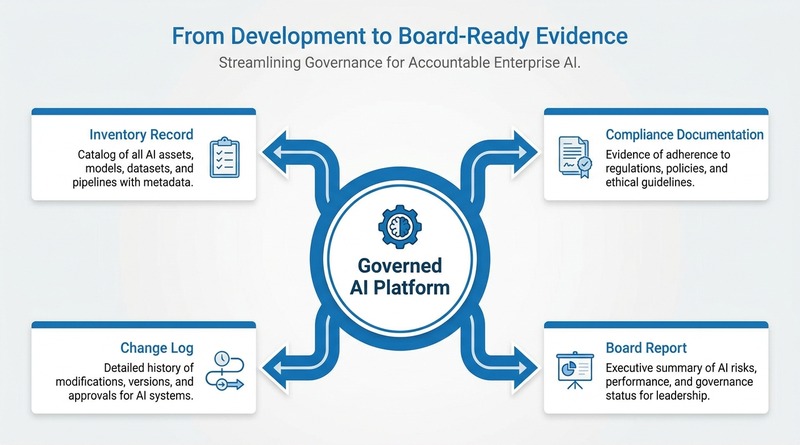
- Structure the board AI governance report around evidence categories, not policy descriptions. The report should show: the current AI inventory and any changes since the last report; the risk tier distribution of AI applications; compliance status for high-risk applications; a summary of changes to AI applications during the period, including any that triggered a formal review; any incidents and their resolution; and decisions the board is being asked to make or note. Each section should be evidenced, not asserted. A slide that says “AI governance is in place” is a policy claim. A slide that says “47 AI-assisted applications are in production, 12 are classified high-risk, all 12 have completed compliance documentation, and 3 changes were made to high-risk applications during the quarter, each with a documented review” is an evidence claim. The audit committee is asking for the second kind.
Frequently Asked Questions
What questions is the board asking the CIO about AI governance right now?
Audit committees are now formally asking CIOs to provide a complete inventory of all AI tools and AI-assisted applications in production, including those deployed by business units outside IT; evidence that compliance controls are in place for AI use cases touching regulated data; documentation of who is accountable if an AI-driven decision creates financial, regulatory, or reputational liability; and a process for identifying and responding to AI-related incidents. These questions reflect guidance from NACD, Deloitte, and major audit advisory bodies that treat AI oversight as an extension of existing financial reporting and cybersecurity governance obligations.
What evidence should the CIO bring to the board to prove AI is governed, compliant, and under control?
The evidence the board needs covers four areas: a complete AI and AI-assisted application inventory with risk tier classifications; compliance inheritance documentation for each regulated AI application, showing which controls are in place and how they were verified; a change and incident record demonstrating that modifications to AI applications go through a documented review process and that incidents are logged and resolved; and a quarterly reporting structure that shows changes in the AI estate and outstanding governance decisions. A policy document alone is not sufficient — the evidence must show that the policy is working, not just that it exists.
How should a CIO structure an AI governance report for the board or audit committee?
The report should be organized around evidence categories rather than policy descriptions. Each section should show a verifiable fact about the AI estate: how many AI applications are in production and how that number changed; how risk is distributed across the estate; what compliance documentation exists for high-risk applications; what changes were made to AI applications during the period and which required formal review; whether any incidents occurred and how they were resolved; and what decisions the board is being asked to note or approve. Audit committees are increasingly uncomfortable with AI governance reports that assert control without showing the underlying evidence.
How does AI-assisted development by business units create board-level governance exposure?
Business-unit teams using AI coding assistants, low-code platforms, and automation builders are creating operational applications that carry governance obligations — compliance with applicable regulations, data classification, change management, incident reporting — without going through any formal IT intake or governance review. These applications may not appear in the inventory the CIO presents to the board. If an audit committee asks for a complete inventory and an application is missing, the question is not only why the application was ungoverned — it is why the CIO’s governance program did not capture it. Requiring business units to build AI-assisted applications through a governed platform is the structural fix that closes the inventory gap prospectively.
What is the difference between an AI policy and AI governance evidence?
An AI policy describes what the organization requires of AI development and deployment: approval processes, data handling standards, human review obligations, incident reporting criteria. AI governance evidence demonstrates that those requirements are being followed: the inventory showing which applications were approved, the compliance documentation showing which controls are in place, the change records showing which modifications went through the required review, the incident log showing what was caught and resolved. The board is moving from asking about the policy to asking for the evidence. Most CIOs can produce the policy document readily; fewer can produce the evidence trail in the detail an audit committee is now requesting.
How can a governed development platform help the CIO answer AI governance questions from the board?
A governed development platform generates the evidence the board is asking for as a structural output of the development process, not as a retrospective documentation exercise. When AI-assisted applications are built on CloudApper AI, the inventory entry, compliance inheritance documentation, data classification, and change records are produced automatically at the point of deployment and modification. The CIO’s board report draws from a live governance record rather than requiring a pre-meeting reconstruction. For business-unit teams specifically, channeling AI-assisted development through the platform means that applications built outside formal IT intake still generate the governance evidence the board is asking for — because the platform architecture makes ungoverned deployment structurally unavailable.
The board questions arriving in CIO inboxes this quarter are specific, evidentiary, and will not be satisfied by a policy summary. CloudApper AI makes the governance evidence those questions require a natural output of how applications are built and managed — so CIOs can answer with documentation rather than assurances. If your team is preparing for a board AI governance review and finding that the evidence trail is thinner than the policy document, contact CloudApper to see how governed application development closes the gap between what boards are asking and what IT can actually show.

What is CloudApper AI Platform?
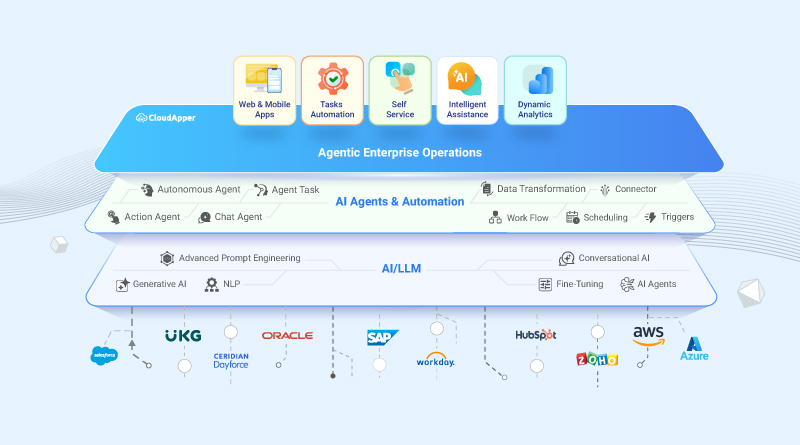
CloudApper AI is an advanced platform that enables organizations to integrate AI into their existing enterprise systems effortlessly, without the need for technical expertise, costly development, or upgrading the underlying infrastructure. By transforming legacy systems into AI-capable solutions, CloudApper allows companies to harness the power of Generative AI quickly and efficiently. This approach has been successfully implemented with leading systems like UKG, Workday, Oracle, Paradox, Amazon AWS Bedrock and can be applied across various industries, helping businesses enhance productivity, automate processes, and gain deeper insights without the usual complexities. With CloudApper AI, you can start experiencing the transformative benefits of AI today. Learn More
- Useful Links:
- Agentic AI
- No-Code/Low-Code
- Custom Software
- HCM Personalization
- iPaaS
- FedRAMP
CloudApper AI Solutions


- Works with







- and more.
Similar Posts

The Service Account Audit Nobody Runs: When AI-Built Apps Turn…

AI Agent Over-Permission: The Access Control Problem Nobody Scoped When…