Most enterprise AI workflow agents ship with permissions far broader than their function requires. The over-privileged agent is not a bug. It is the receipt for a governance trade-off made at deployment, and it accumulates compliance liability with every transaction it runs.

TL;DR
When enterprises deploy AI workflow agents without scoping a least-privilege access boundary, the resulting over-permission is not a software flaw but a governance gap that accumulates compliance liability with every transaction the agent runs. The broad permissions are typically inherited from a deployment-time OAuth scope chosen for speed rather than minimum required access. A single over-privileged agent touching HIPAA-covered data, financial records, or personally identifiable information can convert a productivity initiative into a reportable compliance event under current SEC disclosure guidance and EU AI Act obligations. The governed path is building AI workflows on a platform where access boundary design is part of the application architecture before deployment, not an afterthought discovered in audit sampling.
Table of Contents
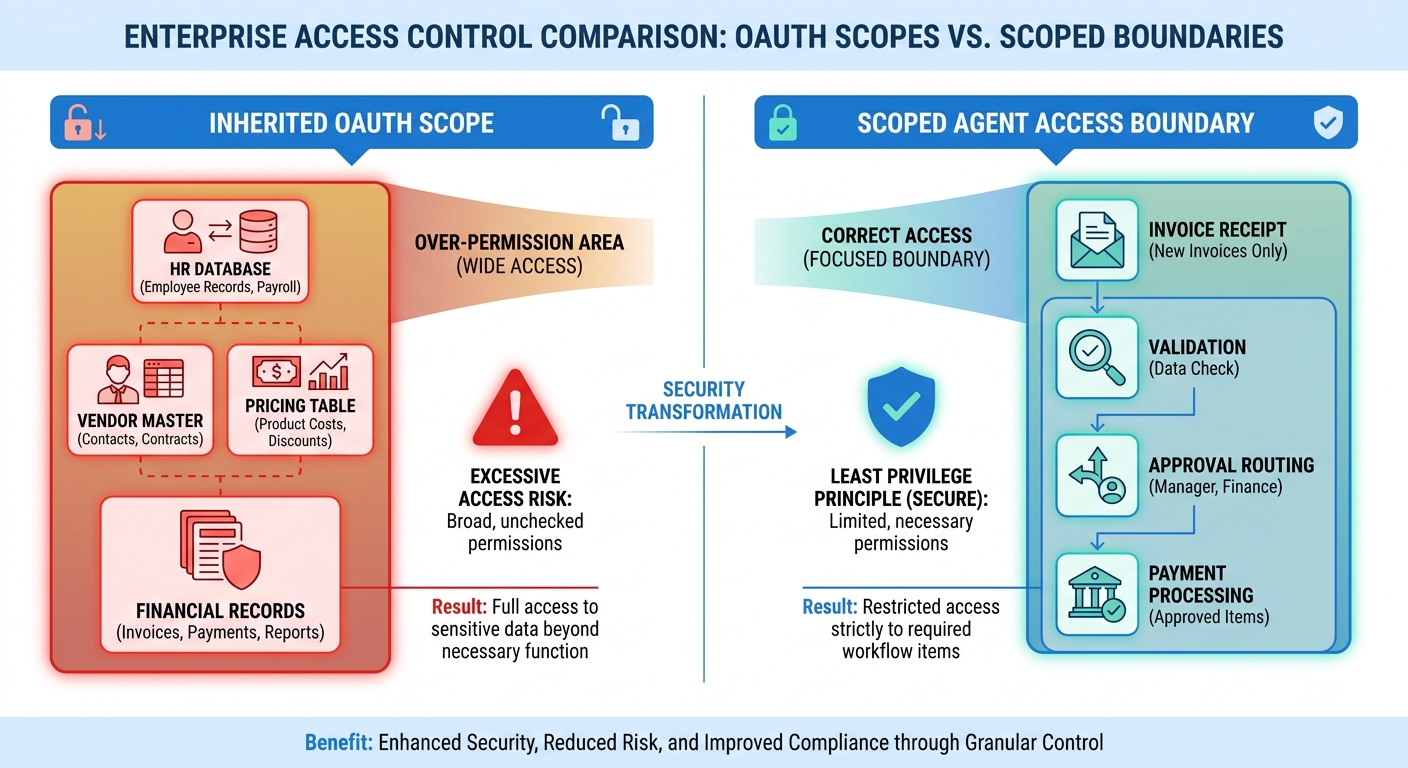
The permissions report was not part of the scheduled review. A compliance analyst pulled it during routine sampling on a procurement automation workflow that had been running for seven months. The AI agent managing invoice routing had read access to the HR records database, write access to the vendor master file, and modify rights to a customer pricing table the original workflow specification never mentioned. Nobody had specifically granted those permissions. Nobody had removed them either. They had inherited from the OAuth scope the deployment team applied at launch because provisioning a least-privilege service identity would have required a security review, and the sprint deadline did not have room for it.

The agent had touched thousands of transactions. All of them ran inside those permissions. That is the receipt.
The Authorization Boundary That Never Got Designed
There is a structural gap in how enterprises deploy AI workflow agents that sits outside the chatbot governance conversation most IT teams have already addressed. When an enterprise professional deploys an AI agent to automate a business process — routing invoices, processing onboarding records, managing vendor data — the agent requires system access. That access gets configured at deployment. In most cases, it gets configured by whoever is doing the deployment, not by someone whose job is to scope the minimum access the agent actually requires.
The result is an agent with permissions far broader than its function warrants. It is not a software flaw. It is a planning gap. That distinction matters because a planning gap means no alert fires, no audit log flags the configuration as anomalous, and no security tooling identifies it as a vulnerability. The agent runs correctly, for months, with access to data it has no business need to hold. As enterprises expand deployments into multi-agent architectures where one agent supervises and hands off work to others, each handoff carries whatever access profile the originating agent held. The blast radius grows without a single intentional decision to expand it.
The Speed Trade-off That Produced the Problem
Most AI workflow deployments are approved precisely because they were fast. A business unit identified an automation opportunity, an AI tool built the workflow in days, and the project reached production before a formal security review was scheduled. This is the same pattern behind enterprise shadow AI proliferation, and access over-provisioning is its most concrete consequence.
The over-privileged agent is not an oversight. It is evidence of a governance decision that was not made at the moment it needed to be made. The same speed-first trade-off that produces technical debt in AI-built applications produces access debt in AI agent deployments. Both accumulate silently. Both surface at the worst possible moment.
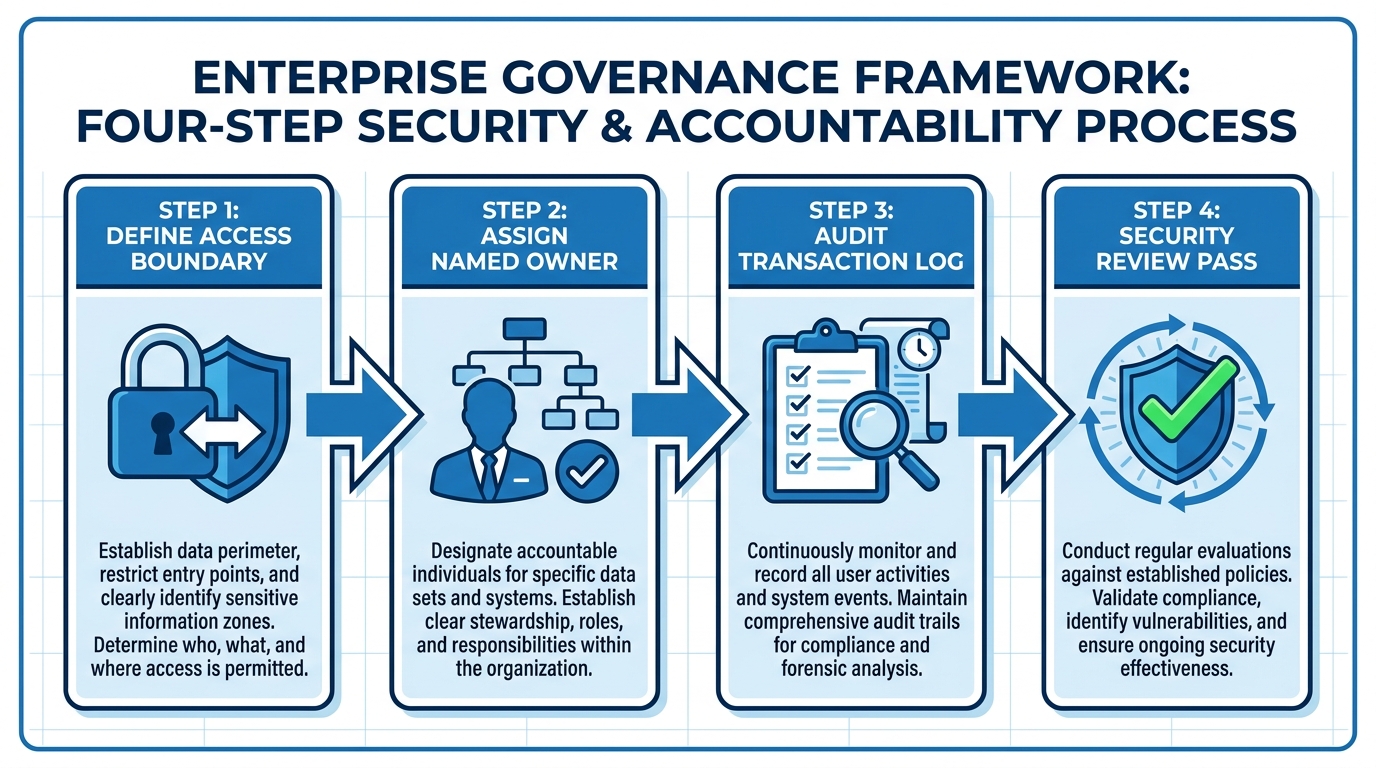
A director of enterprise applications at a manufacturing company described a procurement workflow she needed to automate, including which systems the agent should access, the specific transactions it should have write authority over, and the approval thresholds above which the agent should route to a human. She described it to CloudApper AI. The platform built the workflow with those access boundaries defined in the application architecture from day one: scoped identity, audited transactions, named owner in the governance record. The agent shipped on schedule and cleared its first security review without modification.
What the Liability Actually Looks Like
An over-privileged AI agent touching regulated data does not need to exfiltrate anything to create a compliance event. Under current SEC cyber disclosure guidance and EU AI Act obligations, an agent with unnecessary read/write access to systems containing HIPAA-covered data, financial records, or personally identifiable information may require disclosure depending on what the agent transacted and whether those transactions were audited at the permission level.
The board-level AI governance conversation has largely focused on what AI systems decide. The access question — what AI systems can touch, read, write, and modify without approval — is the one most governance frameworks have not yet operationalized. It is also the one that shows up in audit findings. Once an automated workflow agent falls within SOX ITGC scope, the access control question becomes part of the audit walkthrough. Auditors are not asking whether the agent behaved correctly. They are asking whether the access it held was authorized, documented, and reviewed. An inherited OAuth scope from a sprint deadline is not an authorization. It is an open liability with a timestamp.
The internal audit function is almost never in the room when AI workflow projects get approved. Application security review is already the deployment bottleneck that nobody admits to — adding agent access design to the pre-launch checklist is exactly the kind of friction that gets cut in the name of speed. But speed is what created the problem. The access boundary conversation belongs before deployment, not after the compliance sampling returns an unexpected permissions report.
If your organization has AI workflow agents in production and the access boundary has never been formally scoped, the clock on that liability is already running. CloudApper AI lets enterprise professionals define exactly what an agent needs to access, what it should never touch, and who owns the governance record — before the workflow ships. Reach the CloudApper team to start that conversation.

What is CloudApper AI Platform?
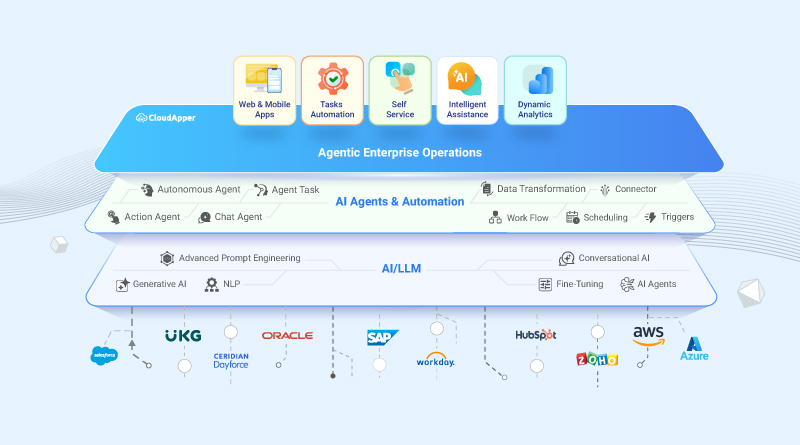
CloudApper AI is an advanced platform that enables organizations to integrate AI into their existing enterprise systems effortlessly, without the need for technical expertise, costly development, or upgrading the underlying infrastructure. By transforming legacy systems into AI-capable solutions, CloudApper allows companies to harness the power of Generative AI quickly and efficiently. This approach has been successfully implemented with leading systems like UKG, Workday, Oracle, Paradox, Amazon AWS Bedrock and can be applied across various industries, helping businesses enhance productivity, automate processes, and gain deeper insights without the usual complexities. With CloudApper AI, you can start experiencing the transformative benefits of AI today. Learn More
- Useful Links:
- Agentic AI
- No-Code/Low-Code
- Custom Software
- HCM Personalization
- iPaaS
- FedRAMP
CloudApper AI Solutions
- Works with








- and more.
Similar Posts

Power Apps Orphaned App: The IT Ownership Problem That Starts…

The Internal Application Your SOX Auditors Just Added to Scope:…