Legacy modernization proposals fail not because costs are too high — but because IT directors are asked to estimate systems they cannot fully document. Here's the structural reason modernization budgets keep stalling, and how staged discovery changes the funding conversation.

TL;DR
Legacy modernization proposals consistently fail at the funding stage not because the ask is too large, but because IT directors cannot produce defensible estimates for systems they cannot fully document. The structural problem is circular: reliable estimates require discovery, but discovery requires funding. An internal compliance or audit officer — rarely mentioned in modernization strategy — often kills proposals before they reach the CFO by demanding scope verification that undocumented systems cannot provide. The solution is to reframe the ask: fund discovery as its own bounded phase with fixed costs and auditable deliverables, then build the full-program estimate from that evidence. CloudApper AI Platform enables this staged approach, turning an unapprovable proposal into a credible, compliance-ready modernization plan.
Table of Contents
Legacy Modernization Keeps Getting Defunded. The Problem Isn’t Your Budget Ask.
“How much will it cost to modernize this system?”

If you’ve sat in that meeting, you know the problem already. The honest answer is: you don’t know. You can’t know — not until you’ve done the discovery that the funding is meant to pay for. And that’s the exact reason legacy modernization proposals keep dying before they’re approved.
This isn’t a budget problem. It’s a structural trap. The CFO isn’t wrong to push back on a number built on assumptions. The problem is that the assumptions are unavoidable at the estimate stage — and both sides of the table know it.
The Circular Dependency Nobody Names
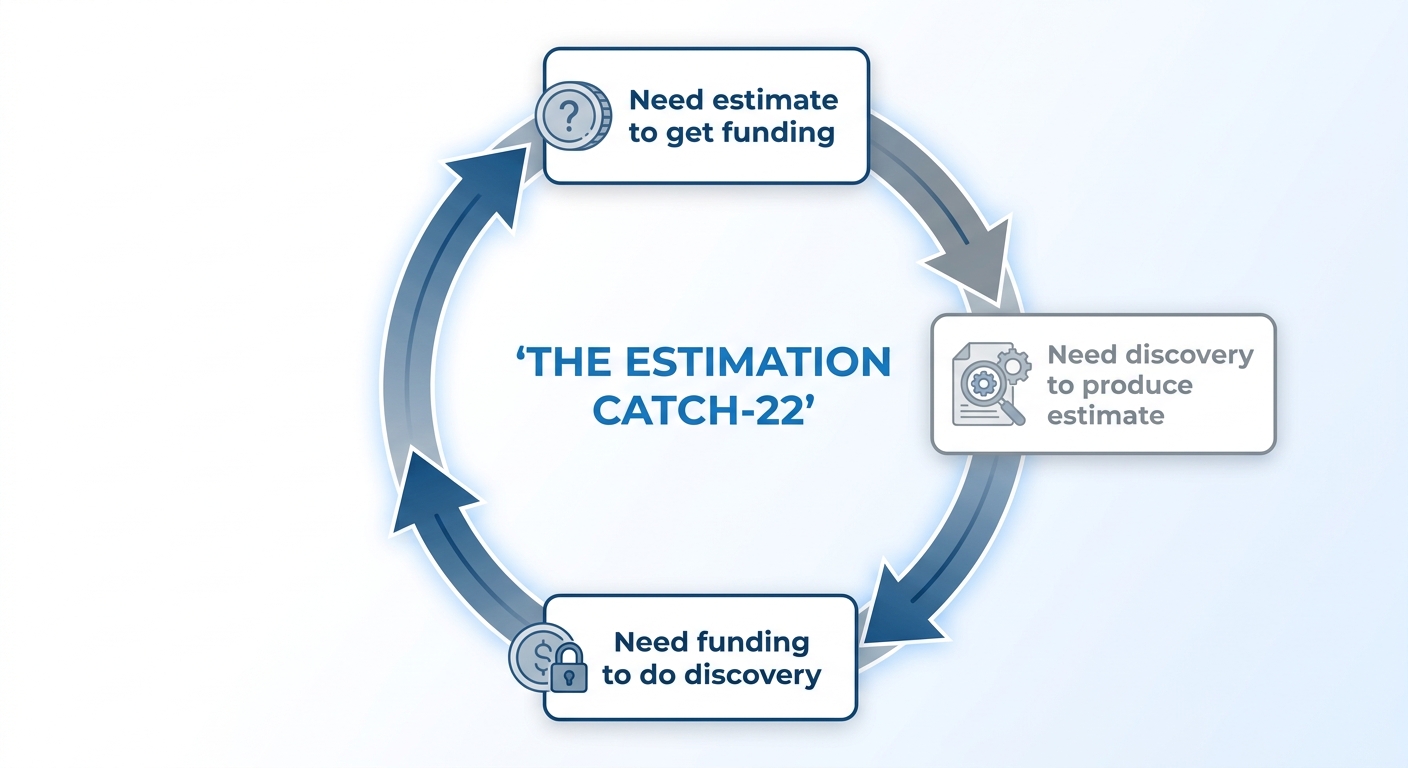
To produce a reliable estimate, you need a complete inventory of what the system does, what data it touches, what integrations depend on it, and what business rules exist only inside it. That inventory doesn’t exist. Building it is effectively the first phase of modernization. But you can’t fund that phase without a business case — and you can’t build the business case without the estimate. The loop is self-sealing.
When IT presents a $1.2 million project with a ±40% contingency, finance doesn’t read it as a prudent estimate. They read it as a project that hasn’t been scoped. And they’re not entirely wrong. The hidden integrations buried inside legacy systems are precisely why dependency inventories look simple on paper and collapse under scrutiny. Every undocumented connection is an unknown variable — and unknown variables translate directly to contingency percentage points.
The Documentation That Doesn’t Exist
Legacy applications weren’t built with replacement in mind. They were built to run, and they ran — accumulating fifteen or twenty years of patches, workarounds, and business rules that never made it into any spec document. The people who understood the actual system behavior have often retired or left. Institutional knowledge loss and estimation failure are the same problem.
When those variables are invisible, the only rational response is to pad the estimate. And padded estimates invite the rejection that kills the proposal. The real cost comparison between maintaining and modernizing almost always favors modernization — but only when both sides of the ledger are visible. When the modernization cost is a wide band and the maintenance cost is a familiar line item, the familiar number wins.
The Stakeholder Nobody Puts on the Org Chart
The compliance or internal audit officer kills more modernization proposals than any CFO — and they rarely appear in articles about IT funding strategy. Their concern isn’t cost. It’s scope verification. Before they’ll approve a new system touching regulated data, they need documented proof of what the system touches, which processes it runs, and which compliance boundaries it crosses.
Legacy compliance deferrals carry familiar risk with documented workarounds. An undocumented modernization scope is unfamiliar risk with none. A modernization proposal that doesn’t address compliance transition often doesn’t make it past the risk review stage — before it ever reaches the CFO’s desk.
Breaking the Loop
The way out isn’t a better estimate. It’s reframing what you’re asking the organization to fund.
Organizations using CloudApper AI Platform for legacy modernization treat discovery as a funded, bounded phase with its own deliverables, cost ceiling, and exit criteria. CloudApper’s governed architecture captures system behavior and business logic during discovery — producing the scope documentation that makes phase-two estimation credible. That structure gives compliance officers scope verification at each stage, gives finance a bounded commitment rather than a wide band, and gives IT directors a fundable proposal that doesn’t depend on documentation that doesn’t exist. Moving fast without creating new governance risk is exactly what staged, documented modernization produces.
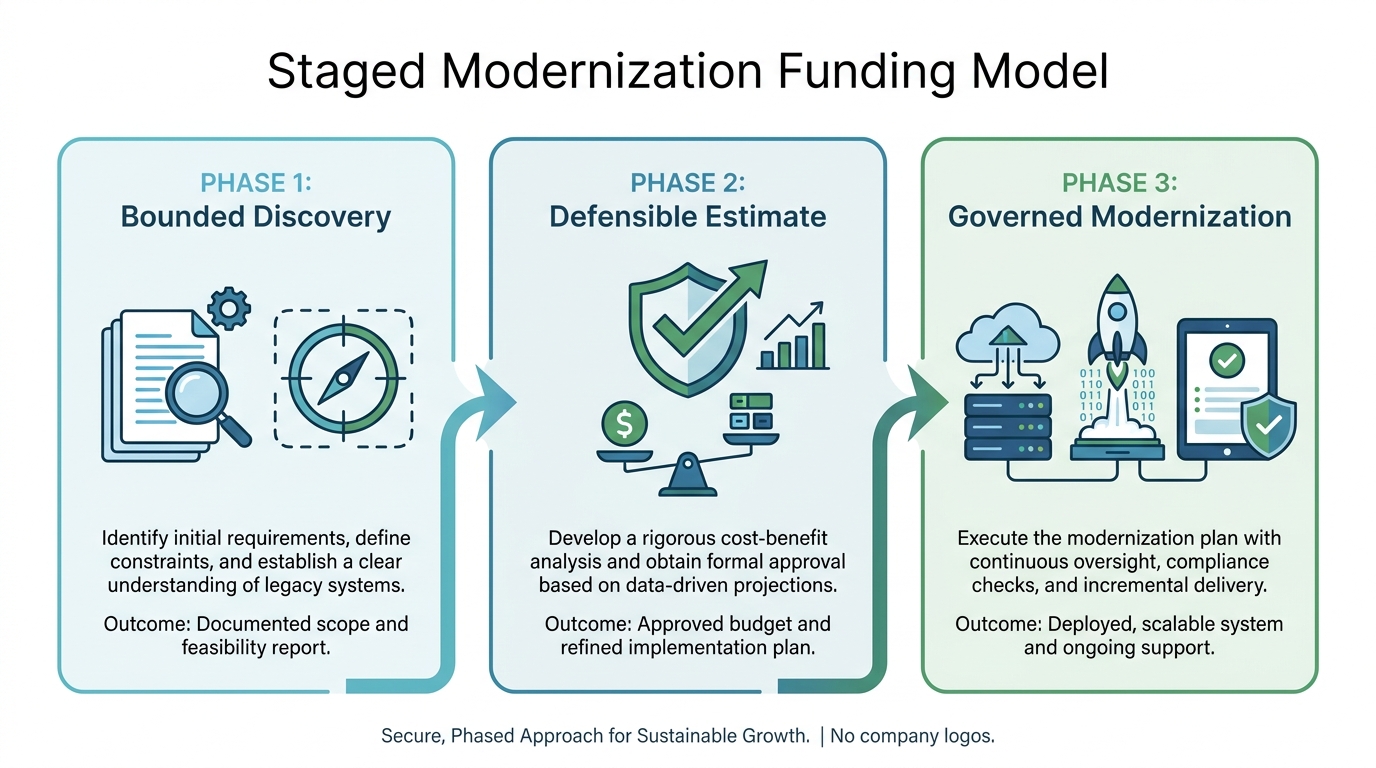
The ask changes from “approve $1.2 million with 40% contingency” to “approve a bounded discovery engagement at a fixed ceiling, which will produce a defensible estimate for the full program.” The second ask is fundable. The first usually isn’t.
When modernization programs fail, it’s rarely the technology. It’s that the scope was never genuinely understood before major funds were committed. Discovery isn’t overhead — it’s the mechanism that turns an unapprovable proposal into one that gets signed.
If your legacy modernization business case keeps stalling at the estimate stage, CloudApper can help you structure a bounded discovery engagement that produces the scope documentation and compliance evidence your finance and audit stakeholders need. Talk to a CloudApper modernization specialist.

What is CloudApper AI Platform?
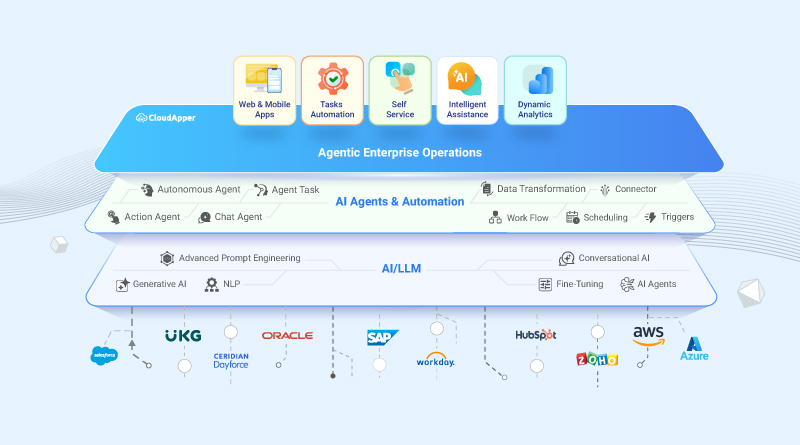
CloudApper AI is an advanced platform that enables organizations to integrate AI into their existing enterprise systems effortlessly, without the need for technical expertise, costly development, or upgrading the underlying infrastructure. By transforming legacy systems into AI-capable solutions, CloudApper allows companies to harness the power of Generative AI quickly and efficiently. This approach has been successfully implemented with leading systems like UKG, Workday, Oracle, Paradox, Amazon AWS Bedrock and can be applied across various industries, helping businesses enhance productivity, automate processes, and gain deeper insights without the usual complexities. With CloudApper AI, you can start experiencing the transformative benefits of AI today. Learn More
- Useful Links:
- Agentic AI
- No-Code/Low-Code
- Custom Software
- HCM Personalization
- iPaaS
- FedRAMP
CloudApper AI Solutions


- Works with







- and more.
Similar Posts

Power Apps Orphaned App: The IT Ownership Problem That Starts…

The Internal Application Your SOX Auditors Just Added to Scope:…