When both the legacy system and its replacement run simultaneously, enterprises face a compliance window that most audit frameworks were not designed to cover. This article examines the parallel-run governance gap.

TL;DR
Legacy modernization projects create a compliance risk window during the parallel-run period — when both the old and new systems operate simultaneously, often for 6 to 18 months or longer. Compliance frameworks like SOC 2, HIPAA, and ISO 27001 assess a defined system boundary at a point in time; they were not designed to address a period where two systems share authority over the same data class, with split access controls and divided audit logs. The result is a gap in continuous control evidence that cannot be closed retroactively. CloudApper's governed modernization platform maintains continuous audit evidence across both systems throughout the transition, eliminating the gap before the auditor asks the question.
Table of Contents
The biggest compliance risk in a legacy modernization transition sits in the parallel-run period, when both systems are live and no governance document says which one is the authoritative record. Ask the project manager, the legacy administrator and the compliance officer which system owns a data class, and an auditor gets three different answers that are all defensible.

Most modernization projects create this window and almost none plan for it. CloudApper AI is designed to close it by keeping a single compliance posture across the legacy state and the replacement while the two run side by side.
When Both Systems Are Authoritative, Neither Is
The parallel-run period is not an edge case. It is the standard operating state for most enterprise modernization programs at their most critical phase. Organizations run both systems simultaneously for anywhere from six months to two years — long enough to validate the new platform, migrate data in tranches, and retire legacy dependencies one at a time. The technical rationale is sound. The compliance exposure is almost never formally designed.
Compliance frameworks — HIPAA, SOC 2, PCI DSS, ISO 27001 — are written to assess a defined system boundary at a point in time. They ask: what are your controls, who has access, where does data flow, and what is your evidence? None of those questions have a clean answer when the same data class is written to two systems, the access controls are configured differently in each, and the audit log is split between two platforms with no unified view. The data governance debt that surfaces at migration is compounded during the transition window, because the organization is now responsible for demonstrating control over both sides simultaneously.
The specific failure mode is not a breach — it is an audit finding that the organization cannot demonstrate continuous control during the transition period. That finding does not appear on the project budget. It appears in the remediation cycle that follows the next annual audit, by which point the modernization project has been declared complete and the budget has closed.

What the Compliance Program Was Not Built to Cover
Most compliance programs are steady-state instruments. They certify a configuration, validate a control set, and produce evidence against a defined architecture. When that architecture is in motion — when the system the last audit certified is being replaced by a system the next audit will certify — there is a governance gap in between that neither audit covers formally.
The gap has a specific shape. The old system's controls were designed for the old system's architecture. Moving a legacy application to a new environment does not transfer its compliance posture — the same is true in reverse: retiring a legacy system does not automatically transfer its established audit history to the replacement. The new system's controls need to accumulate their own evidence record. During the parallel-run period, neither system has a complete record: the legacy system's record ends partway through, and the new system's record starts partway through. An auditor who asks for 12 months of continuous control evidence during a modernization transition will find a gap in every organization that ran both systems without a designed governance bridge.
The integration dependencies that connect a legacy system to downstream processes extend the parallel-run window further than most project plans assume, because those dependencies cannot be cut over cleanly until every system that touches the legacy platform has been migrated. Each additional integration dependency adds weeks to the window. Each additional week is an additional period of split compliance evidence.

The Governance Decision That Has to Precede Go-Live
The transition window has a governance solution, and it is not technical — it is a documented decision made before the parallel-run period starts, not after the audit finding arrives. That decision names the authoritative system for each data class at each phase of the transition, defines which system's access controls govern which users during each phase, specifies how audit logs from both systems are reconciled into a single evidence record, and identifies who owns the compliance posture of the transition state — not the legacy system owner and not the new system owner, but a designated accountable party for the window itself.
This decision is almost never made at modernization project kickoff because compliance is almost never represented at that meeting. The same pattern that produces ERP customization debt — governance decisions deferred because they are politically difficult to make — produces transition compliance debt: the organization cannot produce continuous control evidence because it never formally allocated control during the transition.
CloudApper's governed modernization platform maintains a unified compliance record throughout the transition — both systems logging to the same governance layer, access controls managed from a single policy engine, and audit evidence that does not have a gap between the legacy system's last certified state and the new system's first. For organizations that are currently in or planning a parallel-run period, the question is not whether the compliance window exists — it does, by definition — but whether it has been formally governed or left for the next audit cycle to discover.
For enterprises managing compliance exposure during a legacy modernization transition, CloudApper provides a governed platform that maintains continuous audit evidence across both systems throughout the parallel-run period. To discuss your modernization timeline, visit CloudApper's contact page.

What is CloudApper AI Platform?
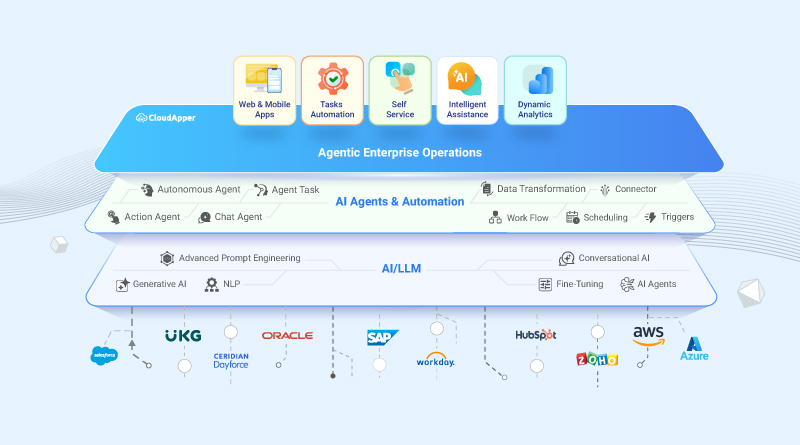
CloudApper AI is an advanced platform that enables organizations to integrate AI into their existing enterprise systems effortlessly, without the need for technical expertise, costly development, or upgrading the underlying infrastructure. By transforming legacy systems into AI-capable solutions, CloudApper allows companies to harness the power of Generative AI quickly and efficiently. This approach has been successfully implemented with leading systems like UKG, Workday, Oracle, Paradox, Amazon AWS Bedrock and can be applied across various industries, helping businesses enhance productivity, automate processes, and gain deeper insights without the usual complexities. With CloudApper AI, you can start experiencing the transformative benefits of AI today. Learn More
- Useful Links:
- Agentic AI
- No-Code/Low-Code
- Custom Software
- HCM Personalization
- iPaaS
- FedRAMP
CloudApper AI Solutions
- Works with







- and more.
Similar Posts
Your SAST Tool Scanned It. Your DAST Tool Tested It.…

CMMC Level 2 and Internally Built Applications: The Evidence Gap…