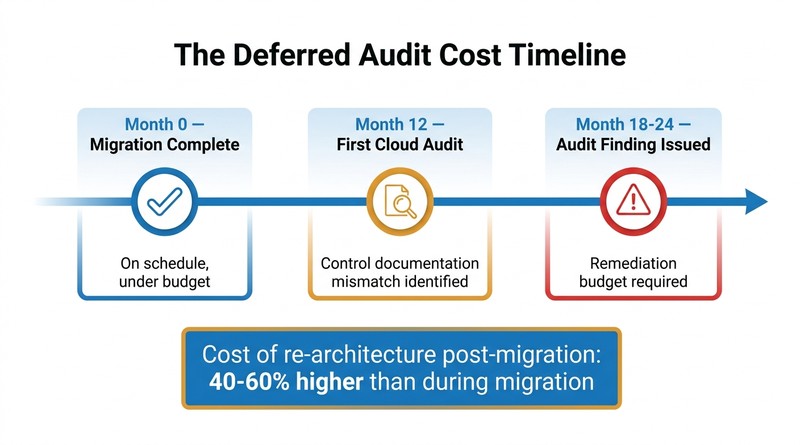
Lift-and-shift cloud migration moves legacy applications to cloud infrastructure without changing their architecture or compliance posture. The governance gap it creates does not surface at go-live — it arrives eighteen to twenty-four months later as an audit finding and a remediation budget the original business case never included.

TL;DR
Lift-and-shift cloud migration moves an application to cloud infrastructure without redesigning its access controls, compliance posture, or governance model — and the cost of that deferred work does not appear at project close. It arrives eighteen to twenty-four months later as an internal audit finding, a remediation budget, and a second migration the original business case never included. The governance problem is not technical; it is organizational — migration projects are funded and measured on delivery, not on the compliance posture of the environment they leave behind. Re-architecting an application after a lift-and-shift is materially more expensive than doing that work during the migration. CloudApper AI addresses this by defining governance posture as a platform property, not a documentation layer produced after deployment.
Table of Contents
- What Lift-and-Shift Actually Does
- The Governance Problem That Rode Along
- The Budget Cycle That Gets the Bill
- What the Audit Finding Says About Architectural Debt
- What Modernization Actually Requires
- How to Evaluate Whether a Migration Is Modernization
- Frequently Asked Questions
A lift and shift cloud migration moves the application but leaves its governance posture behind, and the bill usually arrives eighteen to twenty-four months later as an audit finding. The access control model was never re-evaluated for the cloud, data egress paths no longer match the compliance boundary documentation, and the recorded control owner is a vendor offboarded at migration.
The project still counts as a success because it was measured on schedule, budget and uptime. CloudApper AI, a governed platform for building, extending and modernizing enterprise applications, was designed around that pattern: the costly failures are the ones that pass every assigned metric and fail the one nobody owned.
What Lift-and-Shift Actually Does
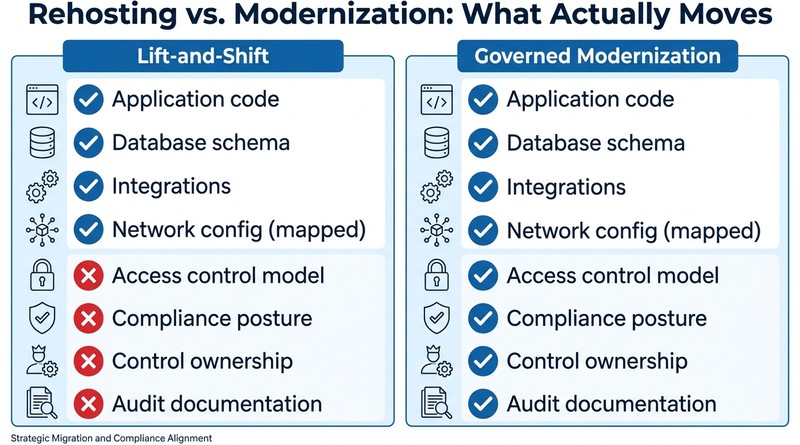
A lift-and-shift migration — formally called rehosting — takes an existing application and moves it from one infrastructure environment to another without changing the application’s architecture, code, or operating model. The database schema moves. The application logic moves. The integrations, access patterns, and data flows move. The only thing that changes is where the servers are.
This is not inherently wrong. For workloads with no strategic differentiation, no compliance sensitivity, and no anticipated change requirement, rehosting is a reasonable way to reduce infrastructure management overhead. But enterprise applications are rarely any of those things. The applications that justify a migration project are, by definition, the ones that carry business-critical data, serve regulated workflows, or underpin systems that auditors examine.

When those applications are lifted and shifted, the migration project closes successfully. The application is running in the new environment. The performance is acceptable. The initial cost comparison to on-premises hosting looks favorable. The project is marked complete.
What the project does not document — because no one was asked to — is that the application’s control environment was designed for a specific infrastructure footprint that no longer exists. The access controls assume a network boundary that is now a virtual construct. The logging configuration sends events to a SIEM that may or may not have been reconfigured for the new environment. The data classification policy references an on-premises storage tier that no longer holds the data it describes.
Research aggregated by the Software Engineering Institute reports that between 44 and 57 percent of cloud migration initiatives fail to meet their stated objectives. One analysis of large enterprise rehosting programs estimated that approximately half of massive lift-and-shift migrations fail to achieve their intended outcomes. Around 18 percent of organizations had to roll back at least some workloads after migration. These numbers are not primarily technical failures. They are outcome failures — the application moved, but the expected business value did not materialize.
The Governance Problem That Rode Along
The governance problem with lift-and-shift is not that it is technically wrong. It is that the migration business case is almost never evaluated by the people whose job it is to assess the compliance implications of changing where regulated data lives and who can reach it.
Internal audit and risk committees are the stakeholders who ultimately sign off on whether a migrated application changes the organization’s control environment. In most lift-and-shift programs, they are not consulted until after go-live. At that point, the finding is usually a variant of the same observation: the controls were not re-evaluated because re-evaluation was not in the project scope, and the project scope was written by people who were not compliance specialists.
This dynamic is structural, not accidental. Migration projects are funded and measured on delivery. The business unit that owns the application wants it moved without disruption to their workflows. Central IT is measured on uptime and schedule. The compliance function has never been asked to define what an acceptable risk posture looks like for a rewritten system — so it was not asked to define one for a rehosted system either. Each group acted rationally within its own incentive structure. The result is a migrated application with no assigned compliance owner and a control environment that was documented for a different infrastructure context.
This is what Grok’s framing captures precisely: the lift-and-shift fallacy is not technical. It is organizational. The organization believed it could relocate the governance problem along with the application — that moving to a cloud provider’s infrastructure would, in some sense, transfer the compliance burden. It does not. Modernization is not an excuse to skip governance, and rehosting is not modernization — so the governance work was simply deferred.
The Budget Cycle That Gets the Bill
The financial case for lift-and-shift typically looks compelling in the first eighteen months. Infrastructure costs are visible and comparable. The migration project is complete. The application is running. Stakeholders who approved the budget see a closed line item.
The second budget cycle is where the accounting changes. Lift-and-shift programs that rehost without re-architecting tend to consume 60 to 80 percent of the modernization budget while leaving the application in the same audit scope it occupied before migration. The next budget cycle must then fund one of two things: a second migration that does the re-architecture work the first migration deferred, or an audit remediation program that addresses the control gaps the internal audit team documented.
This is the number that belongs in the migration business case but almost never appears there: the expected remediation cost two cycles out. It is not a theoretical cost. Cloud infrastructure costs that were expected to drop often grow as egress fees, reserved instance mismatches, and operational overhead accumulate on an application architecture that was designed for on-premises fixed capacity. The architectural debt does not disappear in the new environment. It becomes visible in the cloud bill.
A CIO who wants this framing to survive a steering committee needs one additional element: the delta. The cost of doing re-architecture work after a lift-and-shift is materially higher than doing it during the migration. The infrastructure team is no longer engaged. The documentation from the migration project is complete but frozen. The application has accumulated eighteen months of cloud-specific configuration changes that were not governed by any change management process designed for the new environment. Starting the re-architecture work from this state is more expensive than starting it at migration time, and every quarter of deferral adds to the gap.
What the Audit Finding Says About Architectural Debt
Architectural debt, unlike technical debt, is not primarily a code problem. It is a design problem that expresses itself in the compliance record. When a lifted-and-shifted application enters an audit cycle, the auditor is examining a system whose documented controls were written for a different environment. The access control narrative in the SOC 2 or HIPAA documentation refers to network segmentation, logging targets, and backup procedures that described the on-premises deployment. Some of those descriptions are no longer accurate.
Auditors do not fail organizations for running applications in the cloud. They raise findings when the control documentation does not match the operating environment, when access permissions cannot be demonstrated to be appropriate for the data classification of the information the application handles, and when change management records do not exist for configuration changes made in the new environment. All three of these conditions are common outcomes of a migration project that moved the application without migrating the governance posture.
What auditors ask about application environments has not changed because the environment moved to cloud. What has changed is that the gap between the documented control posture and the actual operating environment is now wider — because the migration project introduced changes that were not subject to the compliance review process that would have caught them.
This is also where shadow AI enters the picture. A legacy application that was lifted to cloud infrastructure is now sitting in an environment where developers can deploy AI-generated supplementary tools, automation scripts, and integration connectors without going through the formal change process. The original application was not designed with this threat model in mind. Its access boundaries assume a deployment environment that has changed, and the AI-generated tooling that accumulates around it after migration is almost never subject to the same compliance review as the original application. Shadow AI development around a rehosted application is the version of this problem that will occupy internal audit in the next cycle.
What Modernization Actually Requires
Genuine legacy modernization is not defined by where an application runs. It is defined by whether the application’s operating model — its access controls, compliance posture, integration architecture, and change management process — was redesigned for the target environment rather than transplanted from the source environment.
The practical distinction matters at several specific points. A modernized application has access controls that were designed for the cloud identity model, not mapped from an on-premises Active Directory structure that was never intended to be exposed to cloud-native services. Its data egress paths were defined explicitly, not inherited from a network configuration that happened to work in the original environment. Its logging and monitoring configuration was designed for the new SIEM and alerting stack, not configured to emit events in a format that happens to be accepted by the new environment.
These are not sophisticated technical requirements. They are basic hygiene decisions that a migration project skips when the definition of success is uptime and schedule rather than governance posture. Security review that happens at the end of a project rather than embedded in its architecture produces exactly this outcome: a technically functional application with a governance posture that was designed for a different environment.
The organizational requirement for modernization is also different from the organizational requirement for migration. A migration project needs infrastructure specialists, a project manager, and a business unit sponsor. A modernization program needs all of those and the compliance function at the table during design, not during the post-go-live audit review. The institutional knowledge of what the original system was designed to do and why specific design decisions were made is required for that redesign — and it is exactly the knowledge that is most likely to be lost during or after a migration project that treats the application as a black box to be moved rather than a system to be understood.
CloudApper AI approaches this through governed blueprints: application architecture and compliance posture are defined as platform properties, not as documentation produced after the fact. When an application is built or modernized on CloudApper, the access control model, data classification, and compliance configuration are part of the application definition — not a separate governance document that may or may not match what the application actually does. This is what makes CloudApper’s approach to legacy modernization structurally different from rehosting: the governance posture moves with the application because it is part of the application.
How to Evaluate Whether a Migration Is Modernization
Before a migration project closes, there is a set of questions that the internal audit or risk function — not the migration project team — should be able to answer from project documentation. If the documentation does not support these answers, the migration is a rehosting project, not a modernization program, and the remediation cost belongs in the next budget cycle’s line items.
- Was the application’s access control model re-evaluated for the target environment? A yes answer requires documentation that the access permissions were reviewed against the data classification of the information the application handles and redesigned for the cloud identity model in use. A yes answer is not “the access permissions were migrated and verified as functional.”
- Were the compliance control descriptions updated before go-live? SOC 2, HIPAA, or relevant compliance documentation should reflect the new operating environment, not the previous one. If the control narrative describes on-premises infrastructure after a cloud migration, the compliance documentation is inaccurate and the next audit cycle will document that gap.
- Who is the documented control owner in the new environment? If the CMDB still lists a vendor, a team, or a person who is no longer responsible for the application’s operating environment, the control ownership is undocumented. Undocumented control ownership is an audit finding.
- Was the change management process for the new environment established before the first post-migration change? The first configuration change made to the application after migration establishes the change management pattern. If that change was made without a process, the pattern is ungoverned.
- Was the internal audit or risk function consulted during design, not after go-live? If the answer is no, the compliance posture was assessed after the fact by people who did not participate in the design decisions. Their findings will reflect design decisions they did not make, not implementation errors they can correct.
- Does the application’s logging and monitoring configuration produce output that the current SIEM can ingest and alert on? A migrated application that logs to a target that is no longer monitored has no effective security posture for the events those logs would have caught.
Frequently Asked Questions
- Is lift-and-shift cloud migration the same as legacy application modernization?
- No. Lift-and-shift rehosting moves an application to cloud infrastructure without changing its architecture, access controls, or compliance posture. Modernization requires redesigning those elements for the target environment. An application that was moved without being redesigned is running in a new location with the same architectural and governance constraints it had before the migration.
- What compliance risks does a lift-and-shift migration create?
- The primary compliance risk is a mismatch between the application’s documented control posture and its actual operating environment. Access control documentation written for on-premises infrastructure may not accurately describe cloud-native access patterns. Logging configurations may not match the current SIEM. Control ownership may not reflect the teams actually responsible for the migrated environment. These mismatches are audit findings that appear in the cycle after migration, not at go-live.
- Why do lift-and-shift migrations often fail to deliver expected cost savings?
- An application migrated without re-architecting uses cloud infrastructure the same way it used on-premises infrastructure — as fixed-capacity compute rather than as elastic, managed services. Egress costs, reserved instance mismatches, and the operational overhead of maintaining an application that was not designed for cloud-native operation accumulate. Research aggregated by the Software Engineering Institute reports that between 44 and 57 percent of cloud migration initiatives fail to meet their stated objectives.
- Who should be involved in evaluating a cloud migration for compliance purposes?
- The internal audit or risk function should be consulted during migration design, not after go-live. In most lift-and-shift programs, compliance stakeholders are engaged after the migration is complete, at which point the design decisions that created control gaps have already been made. Governance posture decisions made during design are less expensive to correct than audit findings addressed during remediation.
- What is architectural debt in the context of cloud migration?
- Architectural debt in a migrated application is the accumulated gap between the application’s design assumptions and its actual operating environment. An application designed for on-premises fixed infrastructure carries architectural debt when moved to cloud without redesign: its access control model, network boundary assumptions, logging targets, and data egress paths were all designed for an environment that no longer exists. That debt expresses itself as audit findings, remediation cost, and constraints on AI and digital initiatives that require the application to behave in ways its architecture was never designed to support.
- How does CloudApper AI support genuine legacy modernization as opposed to rehosting?
- CloudApper AI defines governance posture — access controls, data classification, compliance configuration, and audit logging — as properties of the application platform rather than as documentation produced after deployment. When an application is built or modernized on CloudApper, the control environment moves with the application because it is part of the application definition, not a separate governance layer that must be manually reconstructed after each infrastructure change.
For organizations evaluating their cloud migration programs against current compliance requirements, CloudApper AI provides a governed platform for building, extending, and modernizing enterprise applications — with security and compliance designed into the application rather than documented around it. To discuss your modernization requirements, visit CloudApper’s contact page.

What is CloudApper AI Platform?
CloudApper AI is an advanced platform that enables organizations to integrate AI into their existing enterprise systems effortlessly, without the need for technical expertise, costly development, or upgrading the underlying infrastructure. By transforming legacy systems into AI-capable solutions, CloudApper allows companies to harness the power of Generative AI quickly and efficiently. This approach has been successfully implemented with leading systems like UKG, Workday, Oracle, Paradox, Amazon AWS Bedrock and can be applied across various industries, helping businesses enhance productivity, automate processes, and gain deeper insights without the usual complexities. With CloudApper AI, you can start experiencing the transformative benefits of AI today. Learn More
- Useful Links:
- Agentic AI
- No-Code/Low-Code
- Custom Software
- HCM Personalization
- iPaaS
- FedRAMP
CloudApper AI Solutions

- Works with








- and more.
Similar Posts

Vendor-Built Internal Applications: The Governance Gap Enterprise IT Inherited From…

What Your AI Development Platform Vendor’s Security Review Should Actually…