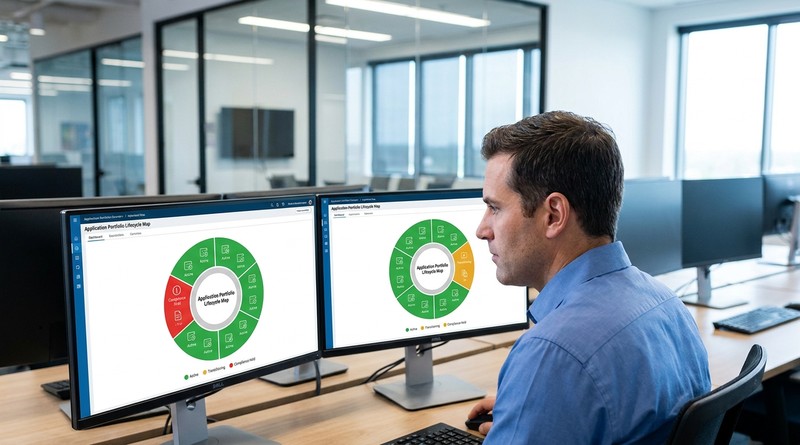
Your internal app estate generates cloud infrastructure costs with no clear owner, no cost center tag, and no FinOps record — because the applications were deployed outside IT intake. Here is why the attribution problem is structural and how a governed development platform closes the gap.

TL;DR
Every enterprise internal app estate generates cloud infrastructure costs that appear in the monthly bill with no cost center, no documented owner, and no inventory entry — because the applications were built and deployed outside formal IT intake. FinOps programs are designed for workloads with known owners; they cannot retroactively tag an application that was never registered as a managed asset. The structural cause is an incentive misalignment: business units are funded to deliver applications and measured on delivery speed, not on the ongoing cloud cost those applications generate indefinitely. CloudApper AI addresses this at the architecture level by making cost attribution metadata — owner, cost center, registry entry — a structural output of the deployment process rather than a retrospective FinOps exercise. CIOs who require all internally developed applications to deploy through a governed platform close both the governance gap and the FinOps visibility gap simultaneously.
Table of Contents
Cloud cost governance breaks down around internal application development that skipped formal intake, because spend from those apps cannot be assigned to a cost center. An app built quickly by a business unit, deployed without an IT ticket and running on infrastructure outside your FinOps tagging schema becomes a line item nobody can explain.

The team that built it assumes cloud spend is IT’s problem, and with AI coding tools speeding up business-unit development, one unexplained line is becoming a pattern. CloudApper AI, a governed platform for building enterprise applications, is relevant where that intake step keeps getting skipped.
The Ownership Problem That FinOps Cannot Tag
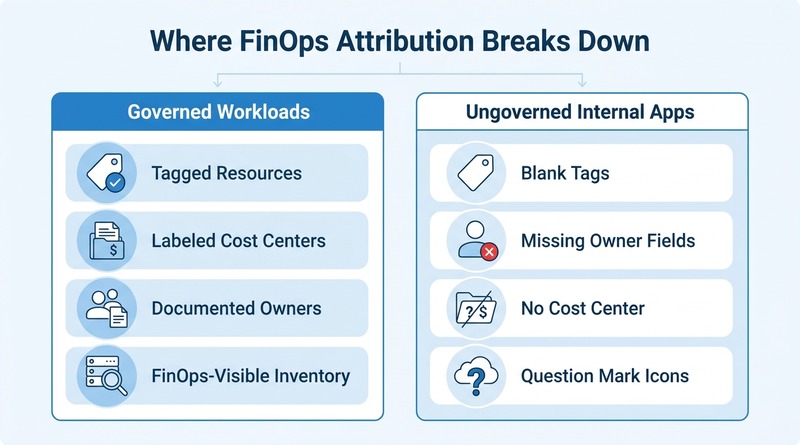
FinOps programs assume workloads have owners: a known application, a defined cost center, a team accountable for the compute it consumes. That model works for provisioned infrastructure and licensed SaaS. It breaks down when the workload is an internal application deployed outside IT intake — a department-level automation, an AI-assisted workflow tool, a reporting app a business analyst scaffolded with a coding assistant and pushed to production without a formal ticket.
These applications appear in the cloud console. What they lack is the governance metadata that makes them attributable: no tagged cost center, no documented owner, no inventory entry. Industry estimates place cloud waste at 30 to 35 percent of total spend, with more than half attributed to workloads that were never brought under governance. As shadow IT has re-emerged — this time driven by AI tools enabling business teams to build and deploy their own applications — the gap has expanded from unmanaged SaaS into unmanaged internally developed applications, each carrying its own cloud footprint and no clear operational owner.
Why the Cloud Bill Is Evidence of a Structural Problem
Business units receive approval and budget to build an application. Once it is deployed, the infrastructure cost belongs to no one’s P&L line. The business sponsor moves to the next project. IT is measured on delivery dates and uptime, not the ongoing operational cost of applications already shipped. The cloud bill is where those costs surface — as undifferentiated OpEx the CFO cannot forecast accurately and the CIO cannot explain to an audit committee.
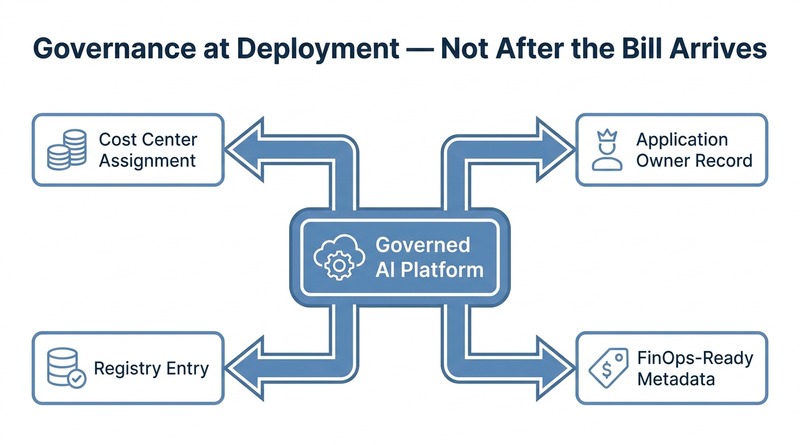
This is a total cost of internal app development problem that FinOps programs encounter but were not designed to solve. FinOps can tag what exists in the cost allocation model. It cannot retroactively register an application that was never submitted for intake. The governance gap in internal developer platforms is exactly where cost attribution breaks: if every internally built application goes through a governed platform, the cost center, owner, and inventory entry are assigned at deployment. If the platform is ungoverned, FinOps inherits the cleanup — when decommissioning is politically complicated and attribution requires manual forensics.
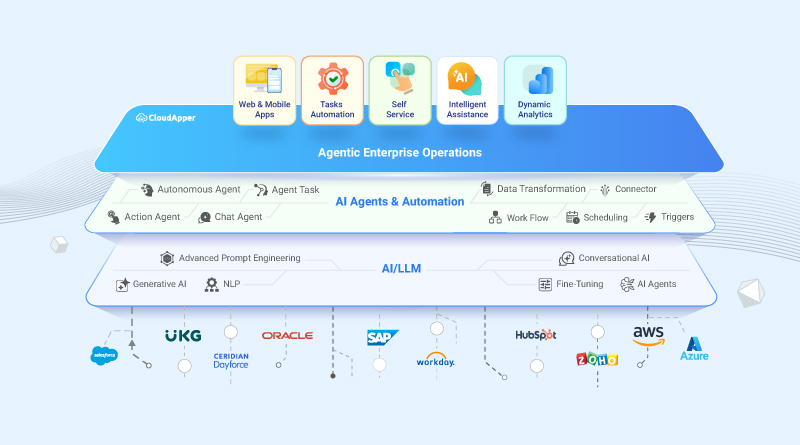
CloudApper AI addresses this at the architecture level. When internal applications are built on CloudApper’s governed platform, cost attribution metadata — cost center, owner, registry entry — is a structural output of deployment rather than a retrospective exercise. Applications built with AI-assisted development on a governed foundation carry their governance record from day one, which means the FinOps program has something to work with before the bill arrives rather than after the anomaly appears.
What It Takes to Actually Own the App Estate
Every time a business unit deploys an application outside formal intake — using AI coding tools, low-code builders, or departmental scripting — it is not only creating a security and compliance exposure. It is creating a cloud cost liability that compounds until someone with organizational authority decides to address it. The technical debt of ungoverned AI-assisted development accumulates on the cloud bill the same way it accumulates in the codebase. A workflow automation built six months ago as a quick fix is now calling external APIs, writing to storage, and generating compute costs that appear nowhere in the current IT portfolio review.
A platform that governs internal app development without imposing DevOps overhead ensures every deployed application carries the cost attribution record that makes it manageable. The cloud bill stops being a forensics exercise and becomes a ledger with owners. That is the difference between a FinOps program measuring last quarter’s damage and one that has the governance metadata to manage the estate going forward.
If you are working through the cost governance gap in your internal app estate, CloudApper AI provides the platform architecture to make cost attribution structural rather than manual. The same governed development environment that handles compliance inheritance also generates the ownership record your FinOps program needs. Reach out to see how it works in practice.

What is CloudApper AI Platform?
CloudApper AI is an advanced platform that enables organizations to integrate AI into their existing enterprise systems effortlessly, without the need for technical expertise, costly development, or upgrading the underlying infrastructure. By transforming legacy systems into AI-capable solutions, CloudApper allows companies to harness the power of Generative AI quickly and efficiently. This approach has been successfully implemented with leading systems like UKG, Workday, Oracle, Paradox, Amazon AWS Bedrock and can be applied across various industries, helping businesses enhance productivity, automate processes, and gain deeper insights without the usual complexities. With CloudApper AI, you can start experiencing the transformative benefits of AI today. Learn More
- Useful Links:
- Agentic AI
- No-Code/Low-Code
- Custom Software
- HCM Personalization
- iPaaS
- FedRAMP
CloudApper AI Solutions


- Works with







- and more.
Similar Posts

What Your AI Development Platform Vendor’s Security Review Should Actually…

SR 11-7 Wasn’t Written for This: AI-Assisted Internal App Development…