Most internal developer platforms optimize for developer velocity, not governance. This piece examines why platform engineering fails regulated enterprises without enforced policy controls, and what CIOs must demand from any governed internal developer platform.

TL;DR
Most internal developer platforms are built to optimize developer velocity, not to enforce governance. When platform teams optimize for self-service speed instead of policy controls, they risk creating a new form of shadow IT with better tooling. This article argues that platform engineering succeeds as a governance strategy only when it makes non-negotiable policy cheaper to follow than to bypass, and explains what the controls, audit requirements, and compliance inheritance model of a genuine governance platform look like for CIOs in regulated industries.
Table of Contents
- The Platform That Looks Like Governance but Isn’t
- The Missing Voice in Every Platform Engineering Conversation
- Where Self-Service Becomes Liability
- What a Governance Platform Actually Requires
Platform engineering is not an enterprise governance strategy by itself: an internal developer platform without enforced policy controls can expand your audit surface, dilute access controls and recreate ungoverned sprawl. Ticket-free provisioning, deployment and third-party integration win adoption fast, which is why the compliance officer’s meeting request tends to follow the thank-yous.
In regulated industries, how CIOs respond decides whether the platform becomes a defensible governance asset or a compliance liability. CloudApper AI approaches this from the governance side, with controls enforced in the development layer instead of documented as expectations.

The Platform That Looks Like Governance but Isn’t
Platform engineering has a marketing problem. The vendor pitch, the conference talk, and the analyst framing all converge on the same story: build a paved road for developers, give them a golden path to production, and governance follows naturally because everyone is using the same toolchain.
That is not wrong. But it is incomplete in ways that matter enormously to enterprises operating under HIPAA, SOC 2, FIPS 140-2, or PCI DSS — and the gap between the pitch and the reality is where compliance findings live.
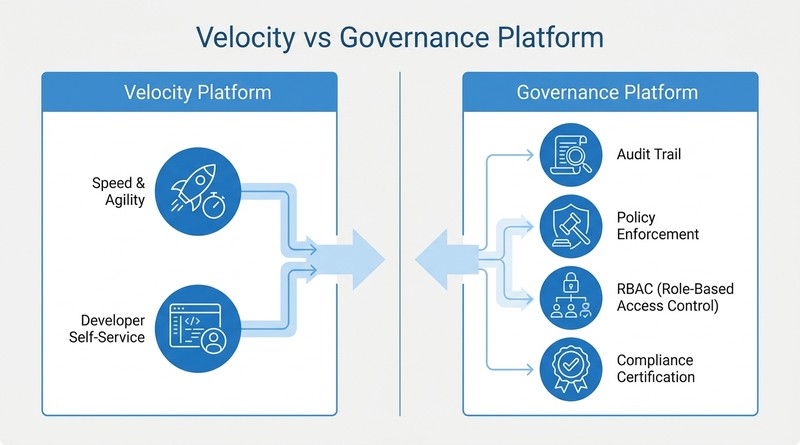
The version of platform engineering that gets funded and celebrated in most enterprises is built around a developer-experience metric: how quickly can a developer go from idea to deployed application? Fewer tickets is better. More self-service is better. These are not bad goals. But they are not governance goals.
Governance asks different questions: Can you prove who had access to what, and when? Can you demonstrate that your deployment pipeline enforced security scanning before code reached production? Can you produce an audit trail for every configuration change? Can you show your auditor that no developer could grant themselves elevated permissions without a logged approval workflow?
Most internal developer platforms that optimize for velocity cannot answer those questions cleanly. They reduce friction — but they also reduce the friction that was doing compliance work. This pattern is well-established: the same enterprises that once struggled with shadow IT spreading outside centralized IT control are now encountering a second wave, this time wearing a developer portal as a uniform.
The Missing Voice in Every Platform Engineering Conversation
Ask a platform engineering team who their customer is, and they will describe a developer. Sometimes they will describe the CTO. Almost never will they describe the compliance officer, the internal auditor, or the risk management function.
That asymmetry explains a great deal.
The compliance function operates on an entirely different incentive structure than a development platform team. A platform team is measured on adoption, developer satisfaction, and deployment frequency. A compliance function is measured on audit findings, remediation timelines, and regulatory exposure. Those incentives do not naturally align — and when they collide, which they will at the first post-implementation audit, the platform team is usually surprised and the compliance function is not.
What compliance and internal audit actually need from an internal developer platform is specific. A defined boundary of what developers can do without human approval — and what they cannot. An unbroken audit log of every deployment, every access request, every configuration change, stored in a way that cannot be altered by the same team being audited. Role-based access control tied to employment status, updated automatically when someone changes teams or exits the organization. Evidence that secrets, credentials, and API keys are managed through a governed vault — not committed to a repository or stored in an environment variable someone set manually eighteen months ago.
These requirements do not emerge organically from a developer-happiness metric. They have to be built in from the start, which is why SOC 2 auditors consistently find that internal app development teams cannot answer the questions they should have anticipated. The audit does not introduce a new standard. It exposes what was never built into the platform to begin with.
CloudApper is designed around this reality. The platform’s security-by-design architecture means governance controls are not added to applications after they are built — they are embedded in the framework the applications run on. HIPAA, SOC 2, GDPR, CCPA, FIPS 140-2, and OWASP ZAP certifications apply at the platform layer, which means every application built on CloudApper starts from a certified foundation rather than beginning with a blank governance slate every team has to fill in independently.
Where Self-Service Becomes Liability
The word “self-service” appears in nearly every platform engineering case study, and for good reason — removing manual approval bottlenecks from development workflows genuinely accelerates delivery. But self-service is only safe when it operates within enforced constraints, not just documented ones.
The distinction matters precisely. A documented constraint says: developers should not deploy to production without a security review. An enforced constraint says: the pipeline will not allow a deployment to reach production without a security scan that meets a defined threshold, and that gate cannot be bypassed by the developer triggering the deployment.
In regulated environments, the difference between “should” and “cannot” is the difference between a policy and a control. Auditors care about controls. The security risks created when developers operate without enforced governance gates are well-documented, and they compound when the platform itself is designed to minimize friction rather than enforce compliance.
The risk compounds further when AI-assisted development enters the picture. When developers use AI coding tools inside an ungoverned platform, the code they produce is moving faster than any review processes designed to catch vulnerabilities. The combination of self-service infrastructure and AI-generated code — both optimizing for velocity without enforced governance gates — creates an audit exposure that is larger than either creates alone. Adding governance to AI coding tools after the fact is significantly harder than selecting a platform that enforces those controls by design from the beginning.
Enterprise security teams running retrospective audits on AI-assisted projects routinely find the same categories of exposure: credentials in commit history, access control logic handled inconsistently across services, API integrations that were never reviewed for data classification compliance. The platform made building easier. It did not make building badly harder.
What a Governance Platform Actually Requires
The controls that separate a governance platform from a productivity platform are not exotic. They are specific, and they are achievable, but they require that governance be a design requirement from the first architecture decision — not a feature request submitted after go-live.
Policy-as-code is the foundation. Governance rules defined as machine-readable policies that the platform enforces automatically at deployment time, creating an evidence record as a byproduct of the deployment process. Without that automated evidence trail, compliance teams are manually reconstructing what happened from logs that were never designed to answer audit questions.
Immutable audit logs are non-negotiable in any regulated environment. Every action in the platform — who deployed what, who changed a configuration, who approved an access request — written to a tamper-resistant log that neither the developer nor the platform team can modify after the fact. The moment an audit log can be altered by the people being audited, it ceases to satisfy the control requirement.
Role-based access control must be tied to identity, not convention. Access provisioned through an identity provider, updated in real time when roles change, and scoped to the minimum permissions required for a given function. Not “we have RBAC configured” — but RBAC that proves no developer could access a production database they were not explicitly granted access to, with a log entry for every query that ran against it.
Secret management closes a gap that developer-experience platforms routinely leave open. Credentials, API keys, and certificates managed through a governed vault, with rotation policies enforced and access logged. Environment variables stored outside the vault are a finding waiting to happen, and they appear in audit reports with reliable frequency.
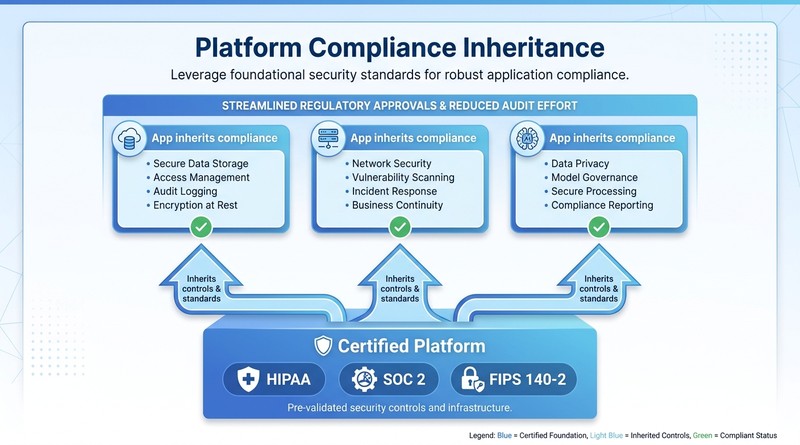
Compliance inheritance is the efficiency argument for governed platforms that is almost never made in developer experience conversations. When a platform is certified at the infrastructure level — HIPAA, SOC 2, FIPS 140-2 — applications built on that platform can inherit those certifications rather than each team seeking independent validation. The compliance work is done once, at the platform level, and inherited by everything built on it. That is a significant reduction in compliance overhead at scale. When evaluating whether to build, buy, or adopt a governed platform for internal app development, compliance inheritance is one of the least-discussed but most consequential variables in the decision.
Platform Engineering Done Right in Regulated Environments
The enterprises getting this right are not the ones that built the most sophisticated developer portals. They are the ones that defined what “built right” means before they built anything — starting with the compliance requirements and working backward to platform architecture, rather than starting with developer experience and attempting to layer governance on top.
That means beginning with a control inventory: what does your compliance framework actually require of your development environment? HIPAA requires documented access controls and audit trails. SOC 2 requires evidence of consistent security practices across the development lifecycle. FIPS 140-2 requires validated cryptographic modules. Those are not optional configurations. They are the requirements the platform must satisfy before the first development team onboards.
It also means including the compliance function in the platform design process — not as a reviewer after the architecture is set but as a stakeholder with input on decisions that affect audit surface area. Their involvement will add time to the initial design phase. It will also prevent the retrofit conversation that happens eighteen months later when an auditor asks a question the platform cannot answer.
For enterprises modernizing legacy systems alongside building new platform capabilities, the governed platform approach addresses a risk that is frequently underestimated: when applications are rebuilt on an ungoverned platform, the institutional knowledge embedded in the legacy system gets translated rather than formally captured. The technical debt that accumulates from ungoverned development does not disappear when a legacy system is replaced — it transfers, in a new form, to whatever was used to build the replacement.
CloudApper applies this directly in modernization engagements. Legacy applications are rebuilt not by rewriting code from memory but through AI-assisted requirements extraction, with the resulting applications deployed within CloudApper’s governed platform framework. The compliance controls are in place from the first line of logic, and the zero-DevOps model means the platform handles patching, updates, and runtime compliance without the internal team carrying ongoing infrastructure overhead.
The Decision CIOs Are Actually Making
The framing in most internal developer platform conversations is: should we build a platform? The better question is: what kind of platform are we building, for what purpose, and who owns the governance outcome?
A platform designed to make developers faster will make developers faster. It will also generate evidence of activity without necessarily generating evidence of control. An auditor can see that a thousand deployments happened. They want to see that every one of those deployments passed a defined security gate, was executed by a credentialed engineer within their authorized scope, and generated a log that persists independently of the team that created it.
Platform engineering succeeds as a governance strategy only when it makes non-negotiable policy cheaper to follow than to bypass. Most implementations are still optimizing for the opposite — removing friction from deployment workflows without identifying which friction was performing compliance work. The result is a platform that is genuinely faster and genuinely less auditable, which is not a tradeoff most CIOs would agree to explicitly but often accept implicitly by not specifying governance requirements before selecting platform tooling.
For CIOs in regulated industries, the platform decision is ultimately a risk architecture decision. Building or selecting a platform that does not treat governance as a first-class design requirement means inheriting the audit findings that follow. Selecting a platform that embeds those controls — and certifies compliance at the platform layer so applications inherit it — means those controls apply to everything built on it, without the compliance team having to validate each application separately.
That is not a developer experience decision. It is a governance decision, and the governance outcome belongs with the people responsible for it.
If your organization is evaluating internal developer platforms and needs to reconcile development velocity with compliance requirements, CloudApper’s governed enterprise application platform is designed to resolve that tradeoff by architecture rather than policy. Contact the CloudApper team to explore what governed platform engineering looks like in practice for your industry and compliance environment.

What is CloudApper AI Platform?
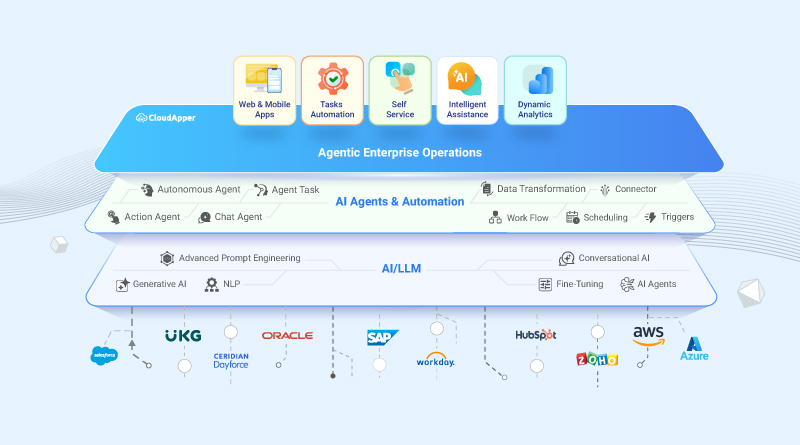
CloudApper AI is an advanced platform that enables organizations to integrate AI into their existing enterprise systems effortlessly, without the need for technical expertise, costly development, or upgrading the underlying infrastructure. By transforming legacy systems into AI-capable solutions, CloudApper allows companies to harness the power of Generative AI quickly and efficiently. This approach has been successfully implemented with leading systems like UKG, Workday, Oracle, Paradox, Amazon AWS Bedrock and can be applied across various industries, helping businesses enhance productivity, automate processes, and gain deeper insights without the usual complexities. With CloudApper AI, you can start experiencing the transformative benefits of AI today. Learn More
- Useful Links:
- Agentic AI
- No-Code/Low-Code
- Custom Software
- HCM Personalization
- iPaaS
- FedRAMP
CloudApper AI Solutions


- Works with








- and more.
Similar Posts

The Service Account Audit Nobody Runs: When AI-Built Apps Turn…

AI Agent Over-Permission: The Access Control Problem Nobody Scoped When…