Most enterprises have a documented disaster recovery plan for their legacy applications. Very few have ever tested one. That gap is not an IT execution failure — it is a governance decision with a cost that compounds every year until an outage or audit forces the reckoning.

TL;DR
Most enterprise legacy applications have a documented disaster recovery plan that has never been tested. The gap between a written plan and demonstrable recovery capability is not an IT oversight — it is a governance choice organizations make by repeatedly deferring the test that would surface how much depends on one person's memory. Testing requires acknowledging that exposure, which creates an obligation to address it. Organizations carrying untested legacy DR plans should scope which applications carry enough operational and compliance risk to warrant a genuinely testable recovery posture, and which are candidates for structured modernization before an incident makes the decision for them. CloudApper's requirements extraction approach captures application dependencies at the level of specificity needed to convert theoretical plans into testable ones.
Table of Contents
Every year, the business continuity attestation arrives. Every year, someone in IT checks the box: “DR plans documented and current.” And every year, for a subset of legacy applications running quietly in the background, the plan being attested has never been exercised — not once, not in a tabletop, not in any partial form. The form gets signed. The plan gets renewed. The test never gets scheduled.

That is not negligence. It is a governance position. And like most governance positions, it carries a cost that compounds quietly until it doesn’t.
CloudApper works with enterprise IT teams across healthcare, manufacturing, and financial services navigating exactly this exposure — legacy applications with a documented recovery plan and a zero-test history, often with no clear owner for what actually happens when recovery is needed.
The Plan Documents. The Recovery Doesn’t Follow.
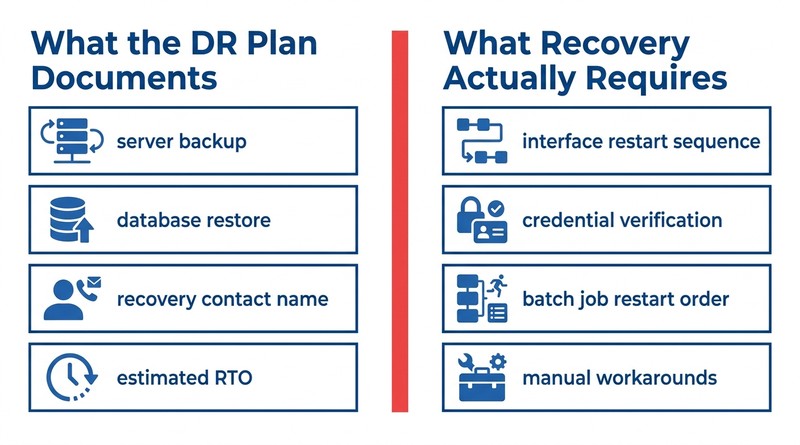
A disaster recovery document and demonstrable recovery capability are different things. Most organizations have the first for their legacy applications. Very few have verified the second.
The gap matters because a legacy application DR plan written by the person who built the system describes the recovery environment as it existed when that person last touched it. It names credentials that may have rotated, references environments that may have been decommissioned, and assumes an operational sequence nobody else has ever walked through. What it does not document — because the author assumed it was obvious — are the interfaces that need to restart in a specific order, the batch jobs requiring manual intervention, and the licensing server sitting on a physical box in a different building.
Organizations that discover this during a real outage are not discovering an IT failure. They are discovering the accumulated consequence of a governance decision made across years of attestation cycles. The pattern shows up consistently in legacy system compliance exception logs that have grown behind language like “acceptable risk” and “reviewed and monitored.”
Why the Test Never Gets Scheduled
The deeper question is not why the test was never run — it is why scheduling it was always deferred. Running the test requires publicly acknowledging how dependent the application is on one person’s memory. The test surfaces the exposure. And surfacing the exposure creates an obligation to address it. The organization has chosen to carry the risk rather than confront what the test would reveal — and the business continuity officer and internal audit function who sign the risk acceptance form are the ones who will have to justify that choice when it surfaces in an audit finding or an actual incident.
When the institutional knowledge tied to that legacy application retires or leaves, what remains is a plan describing a system only one person understood. Dependency scans of legacy applications routinely surface two to five times the integrations the architecture diagram shows — connections written informally over years that no runbook captures.
The Path to a Plan That Can Actually Be Tested
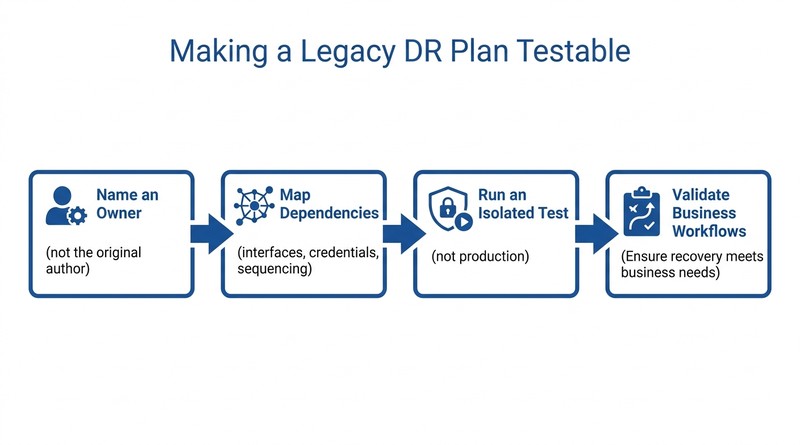
Making a legacy application DR plan testable is a scoping exercise before it is a testing exercise. It requires naming an owner who is not the original author. It requires documenting dependencies at the interface and credential level. It requires an isolated environment where recovery can be exercised without touching production. And it requires a business validation step — not confirming the application starts, but confirming the workflows the business depends on execute correctly after recovery.
Regulatory frameworks like DORA are now formalizing exactly this standard, requiring tested recovery capability for critical internal applications — not just documented plans. For organizations carrying multiple untested legacy DR plans, the rationalization question becomes: which applications carry enough operational and compliance risk to warrant a genuinely testable recovery posture, and which are candidates for structured modernization that extracts the governance debt before an incident does it for you.
CloudApper’s approach to legacy modernization begins with requirements extraction at exactly this level of specificity — capturing not just what the application does, but what it depends on and how it recovers. That extraction work is what converts a theoretical plan into a testable one.
If your organization has legacy applications with DR plans that have never been exercised, CloudApper can help you scope the dependency extraction and governed modernization path that converts those plans into demonstrated recovery capability. Talk to the team about where to start.

What is CloudApper AI Platform?
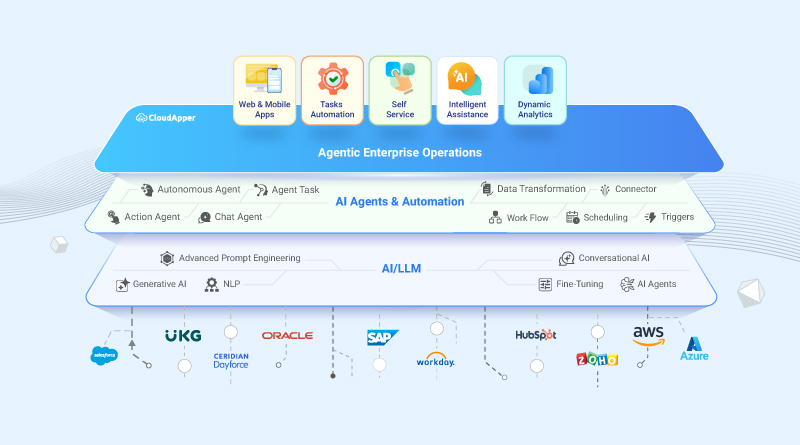
CloudApper AI is an advanced platform that enables organizations to integrate AI into their existing enterprise systems effortlessly, without the need for technical expertise, costly development, or upgrading the underlying infrastructure. By transforming legacy systems into AI-capable solutions, CloudApper allows companies to harness the power of Generative AI quickly and efficiently. This approach has been successfully implemented with leading systems like UKG, Workday, Oracle, Paradox, Amazon AWS Bedrock and can be applied across various industries, helping businesses enhance productivity, automate processes, and gain deeper insights without the usual complexities. With CloudApper AI, you can start experiencing the transformative benefits of AI today. Learn More
- Useful Links:
- Agentic AI
- No-Code/Low-Code
- Custom Software
- HCM Personalization
- iPaaS
- FedRAMP
CloudApper AI Solutions


- Works with







- and more.
Similar Posts

The Change Freeze on Your Legacy System Is Not a…

Microsoft Access Modernization: Why the Technical Migration Is the Easy…