Cyber insurance policies exclude losses tied to unreviewed AI-generated code more often than IT leaders realize. Learn what underwriters now ask, why claims get delayed or denied, and how governed development platforms like CloudApper close the gap before a breach becomes a dispute.

TL;DR
Cyber insurance policies are conditional contracts, and most already contain exclusions for failure to maintain security controls, known vulnerabilities, and unpatched systems. AI-generated code, when built outside a governance process, tends to trigger exactly these exclusions because it produces undocumented logic and no clear audit trail. Insurers are now adding direct questions about AI coding tool use to underwriting applications. Organizations that run internal AI-assisted development through a governed platform, with a documented review process and consistent audit trail, are positioned to satisfy both auditors and underwriters. CloudApper builds that governance in as the default rather than requiring it be retrofitted after a breach.
Table of Contents
- How Cyber Insurance Underwriting Actually Works
- The Policy Language That Creates the Gap
- What a Denied or Delayed Claim Actually Looks Like
- Why AI-Generated Code Specifically Creates This Exposure
- What Underwriters Are Now Asking For
- Building a Development Posture Insurers Can Actually Underwrite
- What to Do Before the Next Renewal
Many cyber insurance policies condition coverage on reasonable security measures, and AI-generated code that nobody on the team can explain is becoming a reason insurers contest claims. Underwriters have started asking about it at renewal, yet most enterprise IT leaders have not connected AI-generated code to their cyber insurance exposure.

The failure case is specific: a breach traced to an internal app built with an AI coding assistant, a vulnerability in a code path nobody reviewed, and a claim delayed for months while the insurer questions whether security obligations were met. CloudApper has worked with enterprise IT and compliance teams who found this gap only when a broker asked how an application was built, secured and maintained.
How Cyber Insurance Underwriting Actually Works
Cyber insurance policies are not blanket protection. They are conditional contracts built around representations the policyholder makes during underwriting. When a company applies for coverage, it answers a detailed security questionnaire covering patch management, access controls, incident response, and increasingly, software development practices. The insurer prices the policy and writes exclusions based on those answers.
The policy pays out when a breach happens despite the security posture described in the application. It does not necessarily pay out when a breach happens because the actual security posture diverged from what was represented. That divergence is where AI-generated code becomes a problem insurers are only now starting to price correctly.
Most underwriting questionnaires ask about code review processes, vulnerability scanning cadence, and who has access to production systems. Very few, until recently, asked whether developers use AI coding assistants and what governance sits around that use. As the security risks of ungoverned AI coding assistants have become better documented, that’s changing fast. Insurers are adding explicit questions about AI-assisted development to renewal applications, and some are adding exclusionary language tied to the answers.

The Policy Language That Creates the Gap
Three clauses appear across most enterprise cyber policies, and each one interacts badly with unreviewed AI-generated code.
Failure to maintain minimum required practices. Nearly every policy conditions coverage on maintaining the security controls described at underwriting. If a company represented that all production code goes through peer review and static analysis, and a breach originates in an AI-generated module that skipped that process because nobody flagged it as needing review, the insurer has grounds to argue the condition wasn’t met.
Known vulnerability exclusions. Many policies exclude losses stemming from vulnerabilities the insured knew about or should have known about and failed to remediate. AI code generation carries a documented 40 to 45 percent vulnerability rate in unreviewed output. Once that statistic becomes part of the industry’s underwriting baseline, “should have known” gets easier for an insurer to argue, particularly if the company had no process to check.
Failure to patch or maintain systems. Cyber policies routinely exclude claims tied to systems running outdated or unpatched software the insured had the ability to update. AI-generated applications built outside a formal engineering pipeline often become exactly this kind of orphaned system. Nobody owns the update cycle because nobody who understands the code is still responsible for it.
None of these clauses were written with AI coding tools in mind, but they don’t need new language to apply. The existing exclusions already cover the failure mode. What’s changed is how frequently that failure mode now occurs, because the volume of code entering production without traditional review has grown so quickly.
What a Denied or Delayed Claim Actually Looks Like
Insurers rarely deny a claim outright on day one. The more common pattern is a reservation of rights letter, where the insurer agrees to investigate while explicitly preserving its right to deny coverage based on findings. For a breach involving AI-generated code, that investigation typically asks for:
The development history of the affected application, including who wrote or generated the code and what review it received before deployment. Access logs showing whether the vulnerability existed at launch or was introduced later. Documentation of the company’s AI development governance policy, if one exists. Evidence that the vulnerability class involved was a known and disclosed risk in the industry at the time of deployment.
Companies that built the application through an ungoverned AI coding workflow often cannot answer the first two questions with any confidence. There’s no clean audit trail because the code was never treated as requiring one. This is the same governance gap explored in what one enterprise IT team learned after a security incident forced them to reconstruct a development history that never existed in usable form.
The insurer doesn’t need to prove bad faith. It only needs to show the gap between what was represented at underwriting and what actually happened. That’s usually enough to turn a six-week claim into a six-month dispute, and in some cases enough to reduce the payout or deny it.
Why AI-Generated Code Specifically Creates This Exposure
The vulnerability isn’t that AI writes worse code than a human developer in every case. It’s that AI-generated code, when unreviewed, produces exactly the conditions cyber policies are written to exclude: undocumented logic, inconsistent data access patterns, and code nobody can fully explain after the fact. Black-box AI-generated code creates injection vulnerabilities precisely because the logic inside it was never audited the way a human-written module typically is before shipping.
Insurance underwriters think in terms of controllable versus uncontrollable risk. A known vulnerability class in a reviewed codebase, patched on a documented schedule, is controllable risk, and it’s the kind of risk cyber insurance is built to cover. An unknown vulnerability in code nobody reviewed, running in production with no clear ownership, looks more like a condition the insured failed to manage. Insurers price that differently, and increasingly, they exclude it differently too.
This is also why the frequency of internal app development matters more than most IT leaders assume. A single AI-generated app might represent tolerable, containable risk. Dozens of them, built across departments without centralized governance, start to look like the kind of systemic control failure insurers write policies specifically to exclude.
What Underwriters Are Now Asking For
Cyber insurance applications are catching up to this risk faster than most internal IT teams expect. Newer applications increasingly ask whether the organization uses AI coding tools, whether a governance policy exists for that use, and whether generated code goes through the same security review as human-written code before deployment.
Answering these questions honestly matters more than answering them favorably. A company that admits it uses AI coding assistants with a documented review and governance process is underwritten as a manageable risk. A company that either omits the practice or answers vaguely creates the exact ambiguity that gets exploited during a claims dispute later. This is the same dynamic covered in what a SOC 2 auditor will ask about internal AI-assisted development: the questions are coming whether or not the organization has prepared for them, from auditors and now from insurance underwriters alike.

Building a Development Posture Insurers Can Actually Underwrite
The fix isn’t avoiding AI coding tools. It’s closing the gap between how fast those tools let a business build software and how much control the organization retains over what gets deployed. CloudApper approaches this by removing unmanaged source code from the equation entirely. Instead of generating raw code that a security team has to retroactively review, CloudApper produces governed application definitions that run inside a certified, audited runtime. Every application built this way inherits the same security controls, the same data governance layer, and the same audit trail, which means the documentation an insurer asks for during a claims investigation already exists rather than needing to be reconstructed after a breach.
This matters for underwriting in a very specific way. When a company can show an insurer that every internally built application runs through a single governed platform with FedRAMP Ready, HIPAA, SOC 2, and FIPS 140-2 controls baked in, the “reasonable security measures” representation on the policy application becomes something the company can actually demonstrate, not just assert. For organizations evaluating platforms specifically to close this gap, evaluating secure enterprise app development vendors against compliance requirements is a useful place to start, since the criteria that satisfy an auditor tend to satisfy an underwriter as well.
What to Do Before the Next Renewal
Start by pulling the current cyber policy and reading the exclusions tied to security representations, known vulnerabilities, and patch management. Compare that language against how internal applications actually get built today, not how they were built two years ago. If departments outside centralized IT are generating apps with AI tools, that gap is worth closing before the next renewal application asks about it directly.
Second, get a straight answer on whether the organization can produce a development and review history for every AI-assisted application currently in production. If the honest answer is no for some subset of them, that’s the exposure a broker or underwriter will eventually find.
Third, treat the governance question as a procurement decision, not just a policy one. A platform that generates auditable, governed applications from the start removes the argument before an insurer ever has to make it.
Cyber insurance was built to cover the breach a company couldn’t have reasonably prevented, not the one it built the conditions for and never reviewed. As AI coding tools reshape how fast enterprises ship internal software, the organizations that treat governance as part of the build process, not an afterthought, are the ones whose policies will still pay out when it matters. CloudApper exists to make that governance the default rather than a retrofit.
If your organization is building internal applications with AI tools and can’t yet produce a clean answer to what an insurer or auditor would ask, CloudApper can help close that gap before it becomes a claim. Get in touch with our team to talk through your current development environment.

What is CloudApper AI Platform?
CloudApper AI is an advanced platform that enables organizations to integrate AI into their existing enterprise systems effortlessly, without the need for technical expertise, costly development, or upgrading the underlying infrastructure. By transforming legacy systems into AI-capable solutions, CloudApper allows companies to harness the power of Generative AI quickly and efficiently. This approach has been successfully implemented with leading systems like UKG, Workday, Oracle, Paradox, Amazon AWS Bedrock and can be applied across various industries, helping businesses enhance productivity, automate processes, and gain deeper insights without the usual complexities. With CloudApper AI, you can start experiencing the transformative benefits of AI today. Learn More
- Useful Links:
- Agentic AI
- No-Code/Low-Code
- Custom Software
- HCM Personalization
- iPaaS
- FedRAMP
CloudApper AI Solutions


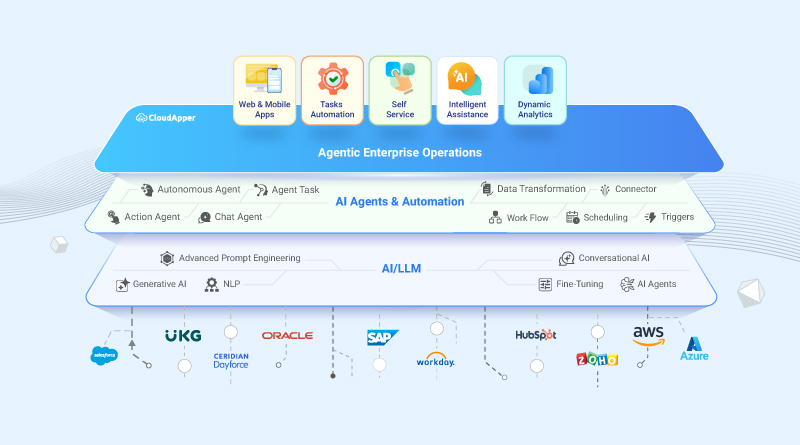
- Works with







- and more.
Similar Posts

CMMC Level 2 and Internally Built Applications: The Evidence Gap…

Vendor-Built Internal Applications: The Governance Gap Enterprise IT Inherited From…