Custom workflow applications in enterprise environments create separation-of-duties violations that ERP SoD tools cannot detect. These runtime conflicts survive standard access reviews, and the SOC 2 CC6.3 finding arrives months later. Governed development changes what auditors find.

TL;DR
Custom workflow applications create separation-of-duties violations that ERP SoD tools cannot detect because the conflicts are not static role assignments -- they materialize at runtime through delegation logic and approval routing encoded in custom code. These violations survive standard user access reviews because access reviews evaluate standing permissions, not workflow state at transaction time. SOC 2 CC6.3 findings from this gap require architectural remediation, not access corrections. Governed development processes that capture approval chain design as a reviewable artifact before production deployment surface the conflict pattern at build time, changing what the audit walkthrough finds.
Table of Contents
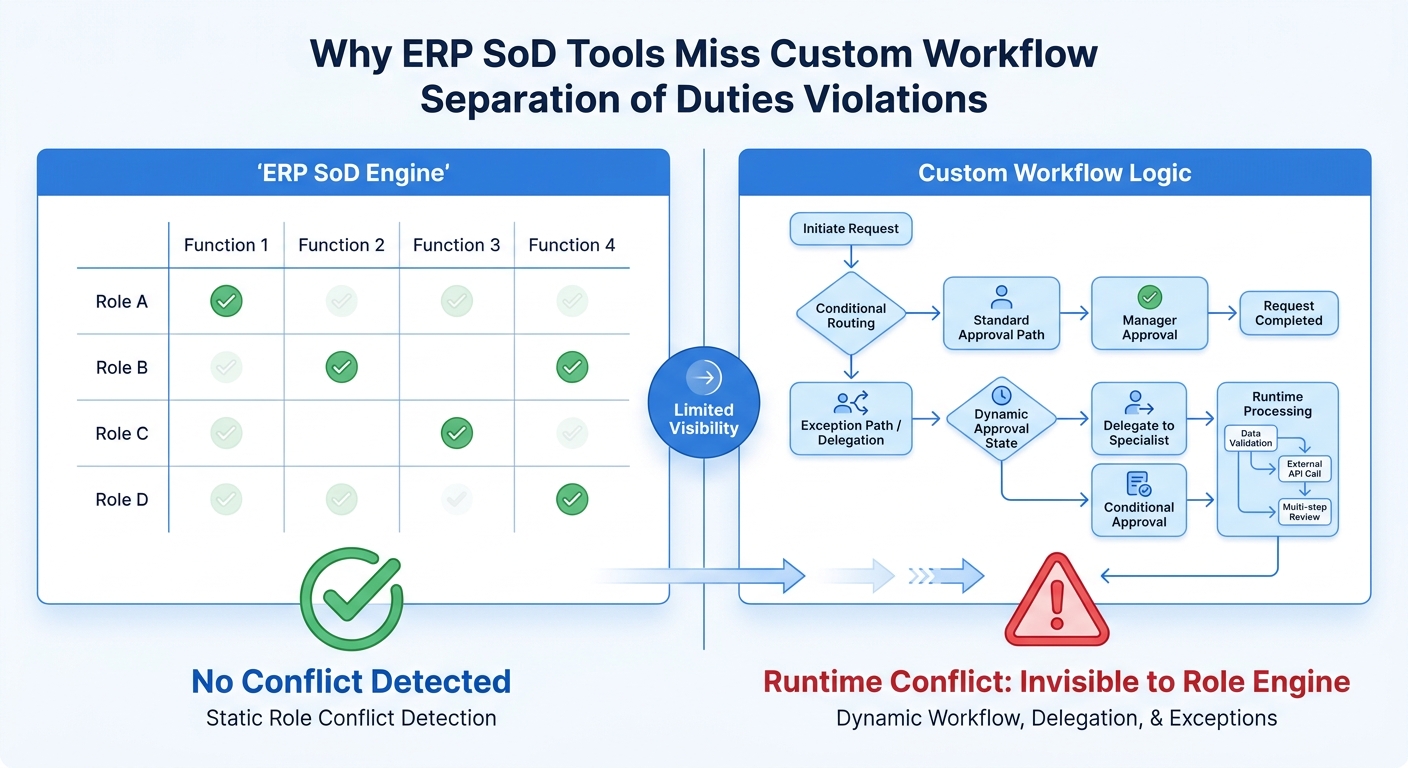
An exception-handling workflow fires inside a manufacturing operations system. A purchasing supervisor carries delegated create-access on purchase orders, temporarily granted four weeks ago when their direct report called in sick and never revoked. The order moves through the custom approval workflow. The ERP SoD engine shows clean: the user’s standing roles carry no static conflict, and the approval itself happened inside a custom application the tool does not evaluate. The last access review passed without a finding. The separation-of-duties violation exists only in this transaction, at this moment, under conditions that no role engine was ever designed to surface.

The SOC 2 CC6.3 finding arrives six months later during a manual walkthrough of the order approval cycle.
This is not a misconfigured access control tool. It is a category of violation that static role engines cannot detect by design: a conflict that materializes at runtime through approval chain logic, delegation handling, and data-state conditions that exist only inside custom workflow code. Organizations building workflow applications through governed platforms like CloudApper AI capture the approval chain design as a structured build artifact before the application reaches production, making the conflict pattern visible at development time rather than audit time.
Why the ERP Tool Shows Green
Traditional SoD analysis works by comparing role assignments against a conflict ruleset. If a user holds two incompatible roles simultaneously, the tool flags the conflict. That model assumes the violation is structural, is static, and lives inside the system the tool evaluates. For ERP modules, that assumption holds. For internally built workflow applications, it fails on all three conditions.
Custom applications encode business logic in ways ERP SoD engines cannot parse: approval states stored in a database, delegation rules embedded in middleware, exception paths that temporarily elevate permissions, and conditional routing that places a user in different positions depending on the record value being processed. None of this appears in an entitlement export. None of it surfaces in a role matrix review. The tool shows clean because the conflict has no static representation. It materializes only when specific conditions align during a live transaction.
This is the gap SOC 2 auditors increasingly find when they walk through approval cycles for internally built procurement, exception-handling, and finance workflow applications. The issue is not that the tool missed a role assignment. It is that the tool was asked to evaluate something it was not built to see.
The Process Owner Who Built the Exception In
The business process owner who requested the workflow designed the approval chain to cover routine operations. The delegation logic, the exception paths, and the emergency override rules were each reasonable responses to real operational scenarios. The control implication of allowing one user to occupy two approval positions under a specific data condition was not part of the requirements conversation. It rarely is, because the person defining workflow requirements is not the person accountable for the SOC 2 control environment.
When auditors add internally built applications to SOC 2 or SOX scope, they evaluate the approval chain design as a control, not just the role assignments attached to it. This is the distinction that separates a workflow that passes from one that generates a finding: the routing logic is treated as a control artifact requiring review before go-live, not documentation attached after the fact.
When an IT leader or operations team describes a workflow requirement and CloudApper AI builds the application from that description, the approval chain structure and delegation logic become part of a reviewable build record from the start. A Director of IT can require that the routing logic be evaluated for SoD conflicts before the application is promoted to production, because the logic exists as a documented artifact, not embedded invisibly in custom code that only surfaces during a manual walkthrough.
What the Finding Actually Requires
A CC6.3 finding tied to custom workflow SoD does not resolve with a user access review. The remediation requires architectural changes to the approval logic, compensating controls with documented evidence, or both. The access review did not fail because it was executed poorly. It failed because it was designed to review standing role assignments for a violation that exists only in workflow state at runtime.
Organizations that apply access control governance to applications they build internally, not just to the IAM infrastructure surrounding them, reach the audit cycle with a different conversation. The auditor walks through the approval chain design and finds evidence that someone evaluated the routing logic for SoD conflicts before the application handled its first production transaction. That documentation exists because access control requirements were applied at the development stage, not traced back after a finding.
The access control tool gap is real, but it is a symptom. The root issue is that internally built workflow applications are frequently scoped, designed, and deployed without a structured review of their approval chains as access control artifacts. ERP SoD tools cannot close that gap. What closes it is a development and governance process where the workflow logic itself is treated as something that requires review before it handles transactions in a production environment. The review obligation belongs at the application design stage, not at the audit walkthrough that reveals the conflict was there all along.
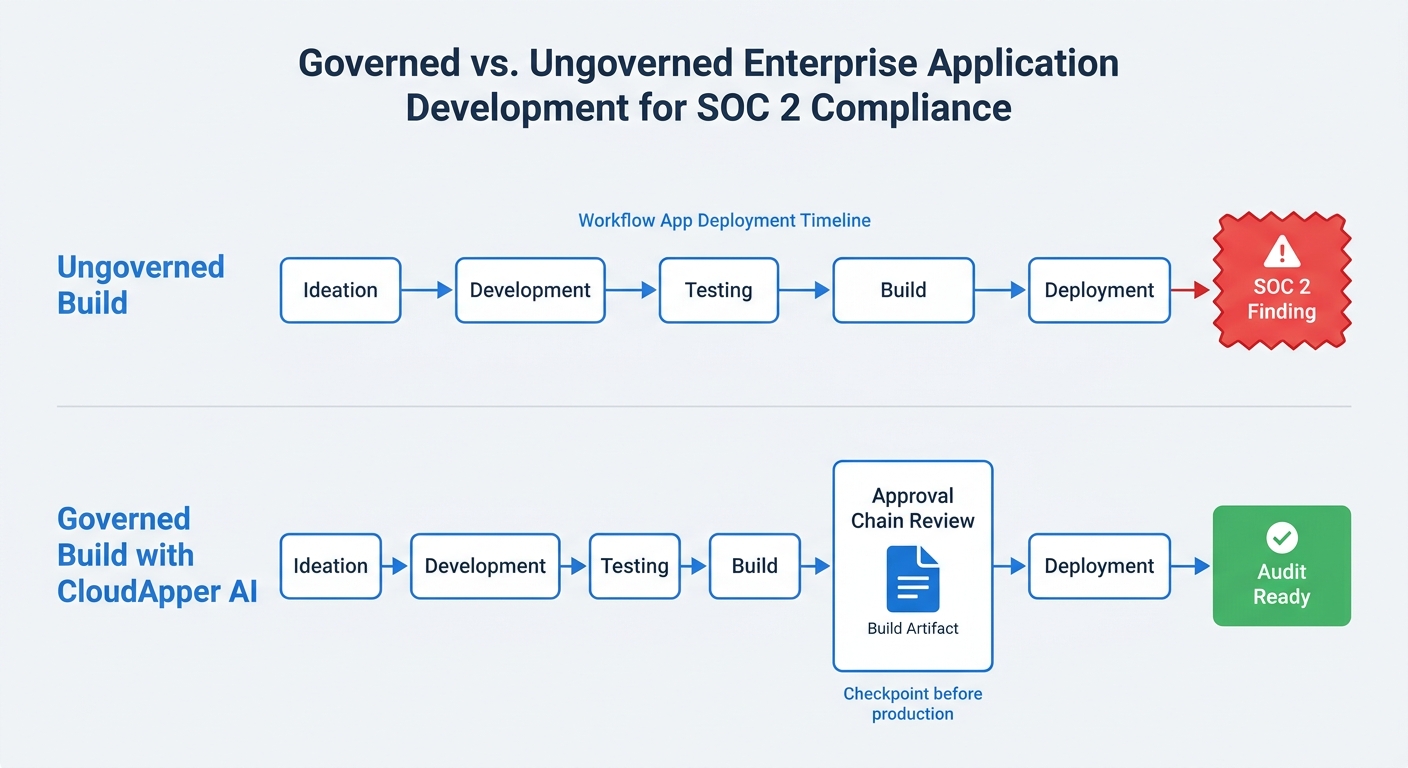
IT and compliance teams using CloudApper AI to build internally governed workflow applications have the approval chain structure and delegation logic captured as reviewable artifacts from the first design conversation. If your organization is managing custom workflow applications that handle approval-sensitive transactions without that design-stage review record, it is worth understanding how governed application development changes what the SOC 2 walkthrough finds. Start the conversation with CloudApper.

What is CloudApper AI Platform?
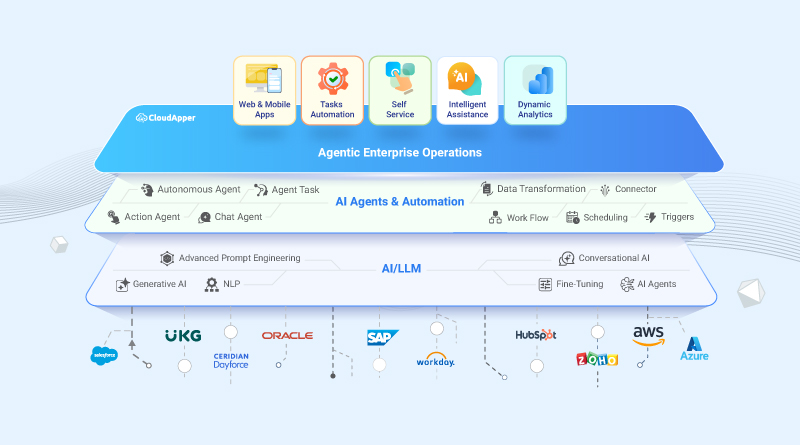
CloudApper AI is an advanced platform that enables organizations to integrate AI into their existing enterprise systems effortlessly, without the need for technical expertise, costly development, or upgrading the underlying infrastructure. By transforming legacy systems into AI-capable solutions, CloudApper allows companies to harness the power of Generative AI quickly and efficiently. This approach has been successfully implemented with leading systems like UKG, Workday, Oracle, Paradox, Amazon AWS Bedrock and can be applied across various industries, helping businesses enhance productivity, automate processes, and gain deeper insights without the usual complexities. With CloudApper AI, you can start experiencing the transformative benefits of AI today. Learn More
- Useful Links:
- Agentic AI
- No-Code/Low-Code
- Custom Software
- HCM Personalization
- iPaaS
- FedRAMP
CloudApper AI Solutions


- Works with









- and more.
Similar Posts
Why Pen Test Findings Keep Tracing Back to Apps IT…

Your Low-Code Platforms Have Governance. Your Application Portfolio Does Not.