Maintaining blog consistency is hard for small marketing teams with limited time and resources. This article explains why blogs go silent and how AI tools like CloudApper AI Amplifier Agent help teams publish consistently without hiring more writers.


TL;DR
- Blog consistency breaks down when small teams rely on manual processes.
- Too many responsibilities and idea fatigue cause blogs to go silent.
- Consistent blogging requires a repeatable and predictable workflow.
- AI helps by supporting ideation, drafting, repurposing, and publishing.
- Teams can maintain blog consistency without hiring more writers.
Table of Contents
You start every month with good intentions. A content calendar, a few solid ideas, and a plan to publish regularly. Then real work kicks in. A campaign needs changes. Sales asks for help. A launch gets delayed. Before you realize it, the blog post you planned for last week is still sitting in draft, and the one before that never even got started. The blog does not fail loudly. It just slowly goes quiet.
If you are the one responsible for keeping the blog alive with a small team and limited time, this struggle probably feels very familiar. Blog consistency breaks not because teams lack ideas or skill, but because the process depends too much on manual effort and perfect timing. This is exactly why many teams turn to tools like CloudApper AI Amplifier Agent. Not to replace writers, but to remove the friction that keeps blogs stuck in draft mode and help maintain blog consistency without hiring more people or stretching the team thin.
Why Blog Consistency Is So Hard for Small Teams
Blog consistency sounds simple when you talk about it in a meeting. Pick a schedule. Write posts. Publish them on time. The reality is very different when you are working with a small team and limited resources. Consistent blogging breaks down not because teams lack intent, but because daily work rarely leaves space for long-term content discipline.
Too Many Responsibilities Competing for Attention
When you work on a small or lean marketing team, blogging is almost never your only responsibility. You manage campaigns, support sales, update landing pages, prepare emails, respond to internal requests, and jump into last-minute projects. Blogging often feels important, but it rarely feels urgent.
Urgent tasks always win. A campaign launch, a sales request, or a leadership review will push blog work aside. You tell yourself you will get back to it tomorrow. Tomorrow turns into next week. Before long, weeks pass without a new post.
This pattern repeats because blogging does not usually break anything immediately when it stops. There is no alert or outage. The cost shows up slowly in declining traffic, lower engagement, and missed opportunities. By the time you notice, restarting feels harder than stopping ever did.
No Time for Ongoing Ideation
Another major reason blog consistency is hard to maintain is idea fatigue. You may begin with a strong list of topics, often created during a planning session or quarterly review. That list feels long at first, but it shrinks quickly once publishing begins.
When ideas run out, writing slows down. You sit down to work on a blog post and spend most of your time trying to decide what to write about. This mental friction drains energy and delays execution. Even experienced writers struggle when ideation becomes a constant task instead of a prepared one.
Without a steady idea pipeline, blogging becomes reactive. You write only when inspiration strikes or when pressure builds. This makes consistent blogging almost impossible to sustain.
Publishing Always Comes Last
Even when a draft exists, publishing often gets delayed. Preparing images, formatting content, adding links, reviewing copy, and scheduling posts all take time. Each step may involve another person or approval.
When deadlines slip, blogs are often the first thing to be postponed. Publishing gets pushed to the end of the day or the end of the week. If something unexpected comes up, the blog waits again.
These small delays create visible gaps. Readers notice when blogs go quiet. Search engines notice too. Over time, irregular publishing weakens blog consistency and reduces the long-term value of your content.
What Actually Causes Blogs to Go Silent
Silent blogs usually do not fail because of one big mistake. They fail because of small, repeated breakdowns in the process that add up over time.
Lack of a Repeatable Process
Many teams rely on informal blogging habits. Someone writes when they have time. Someone else publishes when reminded. This approach may work briefly, but it does not hold up under pressure.
Without a repeatable process, blog consistency depends on individual effort and memory. If that person gets busy, goes on leave, or leaves the company, blogging stops entirely. There is no system to carry the work forward.
Repeatable processes remove this risk. They ensure blogging continues even when people are stretched thin.
Manual Workflows Slow Everything Down
Manual workflows add friction at every stage of content creation. Topic research, drafting, editing, formatting, publishing, and promotion all require hands-on effort. Each step waits for the previous one to finish.
When tasks depend on availability, delays stack up. One missed handoff can stall a post for days. Planning ahead becomes difficult because nothing moves predictably.
Manual workflows also discourage batching and scheduling. You end up working post by post instead of building momentum. This reactive approach hurts consistent blogging.
Dependence on One Writer
Many small teams rely heavily on one strong writer. That person becomes the voice, the planner, and the executor of the blog. When they are unavailable, blogging slows or stops.
This dependency creates risk and pressure. Blog consistency should not rely on one person’s availability or energy level. Sustainable blogging spreads responsibility across systems, not individuals.
How AI Helps Small Marketing Teams Maintain Blog Consistency
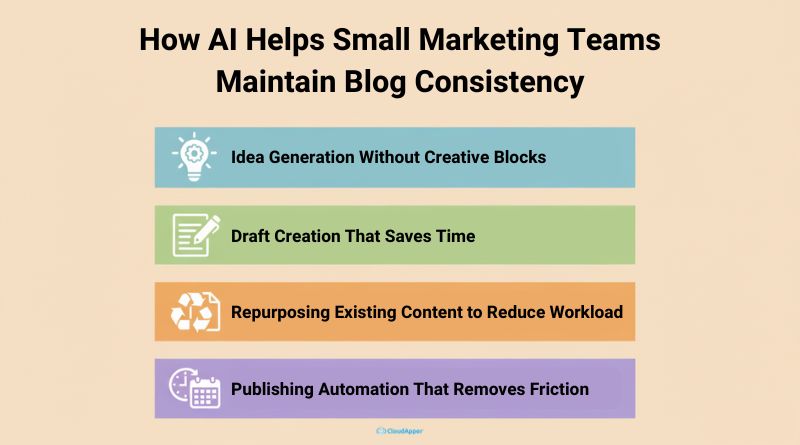
For small marketing teams, blog consistency usually breaks because there are too many manual steps and not enough time. AI tools like CloudApper AI Amplifier Agent help by reducing friction across the entire content workflow, so publishing no longer depends on perfect timing, creative energy, or one person’s availability, and your content calendar remains full year-round. Instead of trying to do more work, you use support where it matters most.
Idea Generation Without Creative Blocks
One of the biggest obstacles to blog consistency is running out of ideas. CloudApper AI Amplifier Agent helps by analyzing current trends, past content, and audience interests to suggest relevant topics. This gives you a steady stream of ideas that align with what your audience is already searching for.
When ideas are always available, you no longer waste time deciding what to write. Writing becomes a planned task rather than a creative gamble. This alone removes a major source of delay for small teams.
Draft Creation That Saves Time
The AI Amplifier Agent also helps with drafting content. Instead of starting from a blank page, you begin with a structured draft that already follows a logical flow. You can then focus on refining the message, adding examples, and aligning the content with your voice.
For small teams, this time savings is critical. Draft support makes it realistic to publish regularly even when writing time is limited.
Repurposing Existing Content to Reduce Workload
Maintaining blog consistency does not always require new content. CloudApper AI Amplifier Agent helps extend the value of existing posts by refreshing, summarizing, or adapting them into new formats.
Older blogs can be updated with the current context. Long articles can be broken into shorter posts. This reduces pressure to constantly create from scratch while keeping your blog active and relevant.
Publishing Automation That Removes Friction
Publishing is often where blogs get stuck. Formatting, scheduling, and uploading take time and are easy to postpone. AI-supported automation removes these steps from your to-do list.
When posts are scheduled and published automatically, you are more likely to stick to a consistent cadence. Blog consistency improves because fewer steps depend on manual follow-through.
Conclusion: Make Blog Consistency Sustainable
Blog consistency is not about working harder. It is about working more predictably. Small teams struggle with consistent blogging because processes depend too much on manual effort and individual availability.
When you add structure, automation, and support through tools like CloudApper AI Amplifier Agent, blog consistency becomes manageable. You reduce bottlenecks, protect your team’s time, and keep your blog active without hiring more writers.
If keeping your blog publication consistent feels harder than writing the content itself, the process likely needs support, not more effort.

Scale Revenue Without Hiring More People
Meet the AI Team Behind Your Revenue Growth
CloudApper’s AI Revenue Operations Team helps you scale without the cost and complexity of hiring.
Learn more | Download BrochureFrequently Asked Questions about Blog Consistency
-
Why is blog consistency so difficult for small marketing teams?
Blog consistency is difficult because small teams juggle many priorities, rely on manual workflows, and often lack a repeatable content process. -
What causes blogs to go silent over time?
Blogs usually go silent due to inconsistent planning, manual publishing steps, idea fatigue, and dependence on one writer. -
How can AI help maintain blog consistency?
AI helps maintain blog consistency by supporting idea generation, drafting, repurposing existing content, and automating publishing tasks. -
Does using AI replace writers or reduce content quality?
No. AI supports writers by removing repetitive tasks and saving time, allowing teams to focus on refining content and maintaining quality. -
How often should small teams publish blog content?
Small teams should publish on a schedule they can realistically maintain, whether weekly, biweekly, or monthly, to build consistent momentum.
What is CloudApper AI Platform?
CloudApper AI is an advanced platform that enables organizations to integrate AI into their existing enterprise systems effortlessly, without the need for technical expertise, costly development, or upgrading the underlying infrastructure. By transforming legacy systems into AI-capable solutions, CloudApper allows companies to harness the power of Generative AI quickly and efficiently. This approach has been successfully implemented with leading systems like UKG, Workday, Oracle, Paradox, Amazon AWS Bedrock and can be applied across various industries, helping businesses enhance productivity, automate processes, and gain deeper insights without the usual complexities. With CloudApper AI, you can start experiencing the transformative benefits of AI today. Learn More
AI RevOps Agent
Scale Revenue Without Hiring More People
Download Brochure


Amplifier Agent
Keeps Your Brand Visible With Articles & Social Media Content That Connects.
Learn More
Outreach Agent
Launches Email & SMS Campaigns That Reach Out on Time and Actually Convert.
Learn More


- Works with
















Similar Posts

The Next Generation of Email Automation Tools: Why the AI…
Speed Up SaaS Queries with Real-Time FAQ Tools for Busy…

 AI RevOps
 Find Ideal Prospects
 Create Engaging Content
 Launch Outreach Campaigns
 Capture Website Leads
 Provide Customer Support