Hiring delivery drivers in the competitive logistics industry is challenging with high turnover and fast-moving talent. These 10 targeted delivery driver interview questions assess efficiency, safety, customer service, and tech skills. CloudApper AI Recruiter automates screening via conversational AI, cutting time-to-hire by 90% while ensuring unbiased, high-quality hires.

Table of Contents
The last-mile delivery sector is experiencing explosive growth and equally explosive hiring challenges. With e-commerce sales projected to reach $7.4 trillion globally, companies like Amazon, UPS, FedEx, and countless delivery service providers are competing for the same pool of delivery drivers in an increasingly tight labor market. According to recent industry reports, delivery driver turnover rates hover between 30-40% annually, with some companies experiencing even higher attrition during peak seasons.
The hiring pain points are severe and multifaceted. Recruiters report that 65-75% of delivery driver candidates drop off before completing the application process—often because traditional hiring workflows are too slow and cumbersome. The average cost to hire a single delivery driver ranges from $1,500 to $4,000 when you factor in advertising, screening time, background checks, and onboarding. Meanwhile, competitive pressure means you need to move fast: the best candidates accept offers within 3-5 days of starting their job search, yet most companies take 2-3 weeks just to complete initial screening.

Add to this the complexity of modern delivery operations. Today’s delivery drivers aren’t just steering vehicles—they’re navigating sophisticated routing software, managing digital proof-of-delivery systems, handling customer service interactions, and operating under strict safety and compliance protocols. Finding candidates who combine driving competence, tech proficiency, customer service skills, and reliability is harder than ever.
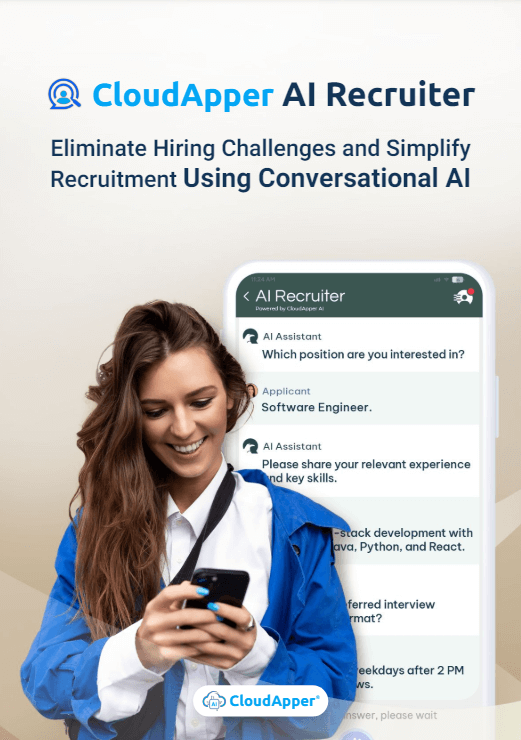
CloudApper AI Recruiter solves these challenges with conversational AI technology that engages candidates instantly via SMS or web chat, conducts intelligent screening 24/7, and can complete what used to take a week in less than 24 hours—all while eliminating bias and ensuring consistent evaluation. Our clients report screening 90% faster and significantly higher candidate conversion rates.
In this guide, we’ll give you the exact interview questions to identify top-performing delivery drivers, plus show you how CloudApper AI Recruiter handles the heavy lifting so your team can focus on hiring great people instead of chasing applications.
Why These Questions Matter for Delivery Driver Roles
The delivery driver role has transformed dramatically in the past five years. What was once primarily about driving from point A to point B now requires technological fluency, advanced time management, problem-solving under pressure, and exceptional customer interaction skills. Modern delivery drivers use handheld scanners, mobile apps for route optimization, GPS navigation systems, and digital communication platforms—sometimes managing 150-300 packages and 100+ stops in a single shift.
Old-school questions like “Do you have a valid driver’s license?” and “Can you lift 50 pounds?” barely scratch the surface of what predicts success in this role. We need to assess adaptability to technology that changes frequently, customer service capabilities in high-stress situations, decision-making when faced with delivery obstacles, and cultural alignment with your company’s safety and service standards.
The questions below are specifically designed to reveal the qualities that separate adequate delivery drivers from exceptional ones: self-management, problem-solving agility, tech-savviness, customer focus, and the reliability that keeps your operations running smoothly during peak seasons when volume explodes.
Top 10 Essential Delivery Driver (Amazon/UPS/FedEx style) Interview Questions (Plus How AI Recruiter Can Automate The Entire Hiring Process)
1. Walk me through your typical approach when you start your delivery shift. How do you organize your day for maximum efficiency?
Why ask this? This reveals organizational skills, planning abilities, and whether they understand route optimization—critical factors that separate productive drivers from those who struggle to meet delivery targets.
Sample Strong Answer: “I arrive 15 minutes early to give myself prep time before clocking in. First thing, I do a quick vehicle inspection—tires, lights, fluid levels, and cargo area cleanliness—because vehicle issues mid-route kill productivity. Then I review my manifest and load my packages strategically, organizing by delivery sequence with my first stops most accessible and heavy items on the bottom. I spend a few minutes studying my route on the app, looking for areas where I can optimize the suggested sequence based on my knowledge of traffic patterns or access issues. I make sure my phone is charged, I have water and snacks, and I mentally prepare for the day. During my route, I stay about 3-5 stops ahead mentally, so I’m always thinking about parking challenges or access issues before I arrive. This preparation means I’m not wasting time rearranging packages or figuring out my next move on the fly—I hit the ground running and maintain momentum throughout my shift.”
2. Describe a time when you encountered a delivery obstacle—like a locked gate, wrong address, or customer not home. How did you handle it?
Why ask this? Delivery obstacles happen constantly. This behavioral question assesses problem-solving, resourcefulness, and customer service instincts under pressure.
Sample Strong Answer: “I had a situation where I arrived at a business delivery at 4:45 PM and discovered the office had closed early with no notice. The package required a signature and was marked high-priority. Rather than just leaving an attempted delivery notice, I first checked if there was an after-hours contact number posted. There wasn’t, so I called the customer using the contact info in my delivery app, explained the situation, and asked if they could either return or authorize delivery to an alternative location. They were actually still in the area and met me at a nearby coffee shop five minutes later. They were incredibly grateful I took the extra step rather than making them wait another day. I documented everything in my app notes and completed the delivery successfully. My philosophy is that ‘attempted delivery’ should be a last resort—there’s usually a creative solution if you’re willing to take a few extra minutes to find it. Obviously, I balance this against my overall route schedule, but solving problems on the spot saves everyone time and frustration.”
3. Tell me about your experience with delivery apps, GPS navigation, and scanning technology. How comfortable are you learning new systems?
Why ask this? Technology fluency is non-negotiable in modern delivery operations. Drivers who struggle with apps create bottlenecks and errors.
Sample Strong Answer: “I’m very comfortable with technology and actually prefer it because it makes the job more efficient. In my previous delivery role, I used a proprietary routing app daily—scanning packages, capturing signatures, taking delivery photos, and communicating status updates all through my handheld device. I also use Google Maps or Waze as backups when I need real-time traffic updates or when the company app has GPS issues. I’ve learned that every company has slightly different systems, but the core functions are usually similar—scan, navigate, confirm, document. When I started my last job, they’d just rolled out a new app and I volunteered to be part of the training group because I wanted to master it quickly. I’m the type who watches tutorial videos and practices during downtime until I’m fast and efficient with new technology. I understand that in this industry, technology changes frequently and that’s fine with me—I adapt quickly and I’m always looking for features that help me work smarter.”
4. How do you handle customer interactions, especially when someone is upset about a late delivery or package condition?
Why ask this? Drivers are the face of your brand. Their customer service skills directly impact satisfaction, reviews, and repeat business.
Sample Strong Answer: “I approach every customer interaction as an opportunity to represent my company positively, even in difficult situations. If a customer is upset, I first listen without getting defensive—often people just want to be heard and acknowledged. I apologize for their experience regardless of whether it was technically my fault, then I focus on solutions. For example, I once delivered a package that had been damaged in transit before I even received it. The customer was understandably frustrated. I apologized, took photos of the damage, explained how to file a claim through our customer service, and offered to take the damaged package with me to return if they wanted. I also made sure to note the issue in my delivery app so there was documentation. The customer calmed down significantly once they saw I was taking it seriously and trying to help. In general, I’m always friendly and professional—I greet customers with a smile, handle packages carefully, and take the extra second to place deliveries neatly rather than just tossing them. Small details matter in customer perception, and I know my actions reflect on the entire company.”
5. Describe your approach to vehicle safety and awareness, especially in residential neighborhoods and high-traffic areas.
Why ask this? Safety is paramount. One accident can cost tens of thousands of dollars and damage your company’s reputation. This question reveals safety consciousness.
Sample Strong Answer: “Safety is my absolute top priority because my job isn’t worth risking anyone’s safety—including my own. In residential neighborhoods, I drive slowly and constantly scan for kids, pets, and pedestrians who might emerge from between cars or driveways. I’m extra cautious during after-school hours when children are outside playing. I never block driveways or fire hydrants, and I use my hazard lights when I need to stop briefly. In high-traffic areas, I look for safe, legal parking even if it means walking an extra 50 feet—it’s not worth causing a traffic hazard or risking a ticket. I always practice defensive driving: maintaining safe following distances, checking my mirrors constantly, and never rushing. I’ve been in situations where I was behind schedule and felt pressure to hurry, but I’ve learned that a few minutes of delay is infinitely better than an accident. My previous employer actually recognized me at a safety meeting for completing an entire peak season without any incidents or vehicle damage. That’s the standard I hold myself to—zero preventable incidents.”
6. Peak season can mean 12-hour days, 250+ packages, and working weekends. How do you maintain performance and attitude when the workload intensifies?
Why ask this? Peak season makes or breaks delivery operations. This question identifies candidates who can handle pressure and sustained physical/mental demands.
Sample Strong Answer: “I actually thrive during peak season because I enjoy the challenge and the fast pace keeps the day interesting. My approach is to focus on sustainability—I know these demanding periods might last 6-8 weeks, so I can’t burn out in the first week. I make sure I’m getting adequate sleep, eating properly, and staying hydrated throughout my shift. Physically, I use proper lifting techniques religiously and pace myself to avoid injury. Mentally, I break the day into chunks—I don’t think about 250 packages, I think about completing the next 10 stops, then the next 10. I also maintain a positive attitude because I know my coworkers are dealing with the same pressure and negativity just makes everything harder. During my last peak season, we had several drivers call out, which increased everyone’s load. Instead of complaining, I focused on what I could control—my own efficiency and attitude. I actually received a performance bonus that season for maintaining high delivery rates and zero customer complaints despite the chaos. I understand that peak season is when companies need their most reliable people, and I take pride in being someone management can count on during those critical weeks.”
7. Tell me about a time you had to make a judgment call about whether a delivery location was safe or accessible. What did you decide and why?
Why ask this? Drivers need sound judgment about risk assessment. This reveals decision-making abilities and whether they’ll protect themselves and company assets.
Sample Strong Answer: “I had a rural delivery where the GPS directed me down an unpaved road that got progressively worse—deep ruts, standing water, and no clear end in sight. I was driving a standard delivery van, not an off-road vehicle. I stopped and assessed the situation: the package wasn’t time-critical, I was risking getting stuck which would delay my entire route, and I could potentially damage the vehicle. I decided to turn around and call the customer to explain the access issue and offer an alternative—either they could meet me at the main road, or I could attempt delivery the next day after checking with my supervisor about access protocols. The customer was actually grateful I called rather than getting stuck on their property, and they met me at the main road 10 minutes later. I documented the access issue in our system so future drivers would know about the condition. My philosophy is that delivery completion is important, but not at the expense of safety or creating bigger problems. When I’m uncertain about a situation, I communicate with my supervisor rather than just winging it—I’d rather ask for guidance than create an expensive problem by making a bad judgment call.”
8. How do you manage your time when unexpected delays occur—traffic, vehicle issues, or taking longer at stops than planned?
Why ask this? Time management under pressure is essential. This reveals adaptability, stress management, and communication instincts.
Sample Strong Answer: “Delays are inevitable in this job, so I’ve learned to stay calm and adjust dynamically. When I hit unexpected traffic, I immediately check my routing app to see if there’s a better alternative route, and I communicate with my dispatcher to give them a heads-up that I might run behind schedule. I also mentally reprioritize my remaining deliveries—are there any time-sensitive or business deliveries that need to happen before closing time? I’ll sometimes reorganize my sequence to ensure those critical deliveries happen on time even if it means less-critical residential deliveries happen slightly later. If I’m running significantly behind due to circumstances beyond my control, I don’t try to compensate by driving unsafely or skipping my required breaks—that’s when accidents happen. I communicate clearly about my status and let my supervisor make the call about whether routes need to be adjusted. I’ve found that being proactive with communication prevents problems from escalating. Most days I finish on schedule, but when delays happen, I stay focused on working efficiently through my adjusted plan rather than stressing about circumstances I can’t control.”
9. What’s your understanding of DOT regulations, hours of service requirements, and other compliance issues that affect delivery drivers?
Why ask this? Even non-CDL delivery drivers face regulations. This question assesses professionalism and awareness of legal requirements.
Sample Strong Answer: “I understand that even though most local delivery driving doesn’t require a CDL, there are still important regulations that apply. I need to maintain a valid driver’s license with a clean record, follow all traffic laws, and immediately report any tickets or incidents to my employer. I know that companies monitor driving records regularly and that DUIs or serious violations can end my employment. For package delivery specifically, I’m aware of hazmat labeling requirements—certain packages require special handling and I can’t just throw everything in my truck without checking labels. I also understand basic workers’ comp and safety regulations—I’m required to use proper lifting techniques, wear required PPE like safety shoes, and report any injuries immediately no matter how minor. In my previous role, we had monthly safety meetings where we reviewed compliance topics, and I took those seriously because I know regulations exist to protect both drivers and companies. If hired, I’d make sure I’m fully trained on your specific policies and any additional regulations that apply to your operations. I take compliance seriously because cutting corners just creates risk for everyone.”
10. Why do you want to work as a delivery driver for our company specifically, and what are your long-term career goals?
Why ask this? This reveals motivation, retention potential, and whether they’ve researched your company or just need any job.
Sample Strong Answer: “I’m specifically interested in your company for several reasons. First, I’ve researched your reputation and you’re known for treating drivers well—competitive pay, benefits, and reasonable expectations. I’ve talked to drivers who work here and they consistently mention supportive management, which is huge in this industry. Second, I like that you invest in your fleet with modern vehicles and technology rather than running old equipment that breaks down constantly. Third, I’m looking for stability and growth opportunity. I know you promote from within—I’ve seen drivers move into dispatch, operations coordination, and even management roles. Short-term, I want to establish myself as one of your most reliable, high-performing drivers. I want to consistently hit my delivery targets, maintain a perfect safety record, and be someone supervisors know they can count on during peak season or when challenges arise. Long-term, I’m interested in potentially moving into a lead driver or training role where I could help onboard new drivers or improve operational efficiency. I’m not just looking for a job—I’m looking for a company where I can build a career, and everything I’ve learned about your organization suggests that’s possible here.”
How CloudApper AI Recruiter Makes Hiring Delivery Drivers Effortless
Here’s the brutal reality of delivery driver recruiting: you need to process hundreds of applications quickly, engage candidates before competitors do, screen for reliability and skills consistently, and move fast enough to capture candidates who might have 3-4 other offers in play—all while your recruiting team is already overwhelmed with existing operational demands.
CloudApper AI Recruiter solves this impossible equation by automating the entire initial screening process through conversational AI that works 24/7. Here’s exactly how it transforms delivery driver hiring:
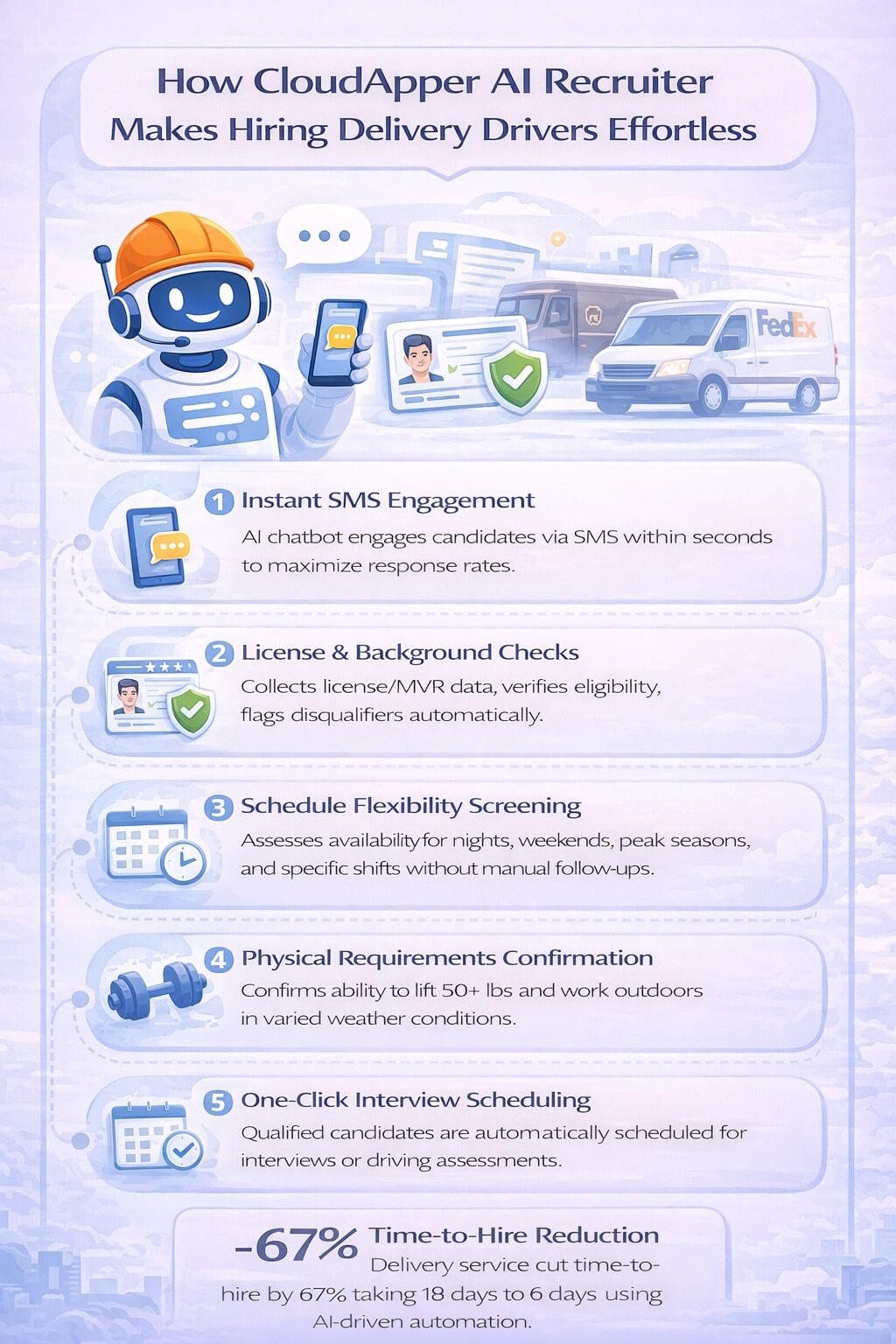
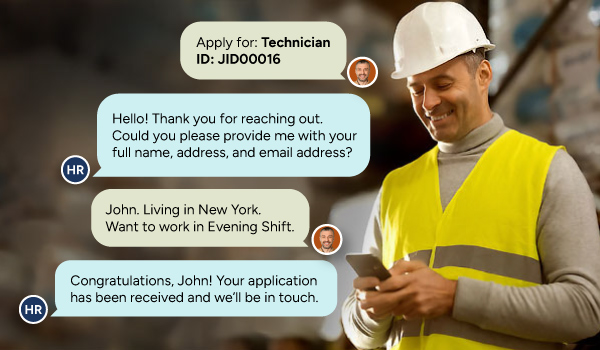
The moment a candidate applies or responds to your recruiting outreach, CloudApper’s AI chatbot engages them immediately via SMS or web chat—no waiting for business hours, no application sitting unreviewed for days. The AI conducts a natural, conversational interview asking these exact screening questions (or your customized versions), adapting follow-up questions based on responses just like an experienced recruiter would.
Key features specifically designed for delivery driver recruitment:
- Instant SMS Engagement: Reach candidates on their phones within seconds of application—critical when competing for hourly workers who often apply to multiple positions simultaneously and accept the first offer that responds
- Automated License & Background Verification: The AI collects driver’s license numbers, verifies validity, obtains consent for MVR and background checks, and flags any immediate disqualifiers based on your criteria—all before human involvement
- Schedule Flexibility Assessment: The system automatically asks about availability for peak seasons, weekend work, and shift preferences, immediately identifying candidates whose schedules don’t align with your needs
- Physical Requirements Confirmation: Built-in questions about ability to lift 50+ pounds, work outdoors in varying weather, and stand/walk for extended periods ensure candidates understand job demands before proceeding
- Technology Comfort Screening: Custom questions assess smartphone proficiency, app usage comfort, and willingness to learn new systems—helping you identify tech-resistant candidates who’ll struggle with modern delivery tools
- One-Click Interview Scheduling: Qualified candidates are automatically routed to calendar scheduling for in-person interviews or driving assessments, eliminating endless phone tag and coordination emails
Real-world impact: A regional delivery service provider with operations across six states implemented CloudApper AI Recruiter during their peak season ramp-up. They reduced time-to-hire from 18 days to just 6 days while improving candidate quality scores by 35% based on 90-day retention metrics. Their recruiting team went from spending 80% of their time on initial phone screens to focusing exclusively on final interviews with pre-qualified candidates.
Most impressively, they discovered that 58% of their successful hires were engaging with the AI screener outside traditional business hours—evenings, weekends, and late nights when their human recruiters weren’t available. These were candidates they would have completely lost under their old system, either to competitors who responded faster or to drop-off from the delayed response time.
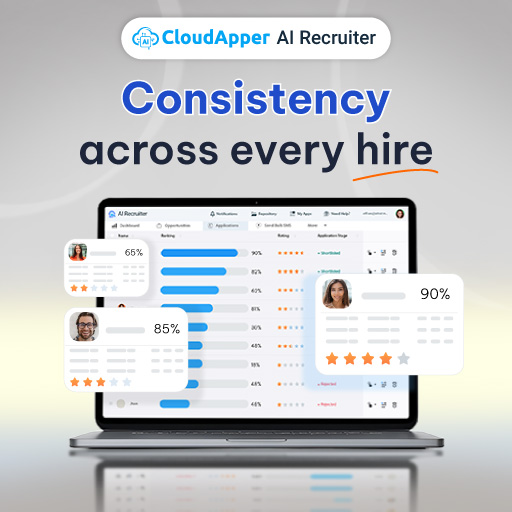
The AI system also eliminated unconscious bias from initial screening. Every candidate received identical questions asked in the same way with the same evaluation criteria, ensuring hiring decisions were based purely on qualifications, experience, and fit—not factors unrelated to job performance. This not only improved compliance but actually resulted in more diverse hiring outcomes.
For delivery companies operating in today’s hypercompetitive labor market, CloudAapper AI Recruiter isn’t just a nice-to-have efficiency tool—it’s the difference between staffing your fleet adequately or watching packages pile up because you can’t hire fast enough.
Frequently Asked Questions
1. Why are behavioral interview questions important for hiring delivery drivers?
Behavioral questions reveal how candidates have handled real situations like obstacles, customer issues, or peak workloads—key predictors of on-the-job performance in fast-paced logistics environments like Amazon or UPS.

2. How can I assess a delivery driver’s tech skills during an interview?
Ask about experience with delivery apps, GPS, scanning tools, and learning new systems. Strong candidates demonstrate quick adaptation, as modern roles rely heavily on technology for routing, proof-of-delivery, and updates.
3. What questions help evaluate a candidate’s safety awareness?
Questions on vehicle inspections, defensive driving in neighborhoods, judgment calls for unsafe locations, and knowledge of DOT regulations identify drivers who prioritize safety and minimize risks.

4. How do I gauge a delivery driver’s ability to handle customer interactions?
Probe scenarios involving upset customers, late deliveries, or damaged packages. Look for responses emphasizing empathy, professionalism, problem-solving, and brand representation.
5. Why ask about peak season performance in delivery driver interviews?
Peak periods involve long hours and high volumes (e.g., 250+ packages). This question assesses resilience, time management, and attitude under pressure—critical for reducing turnover in seasonal roles.

6. How does CloudApper AI Recruiter automate the delivery driver hiring process? It uses conversational AI for 24/7 SMS/web chat engagement, intelligent screening of qualifications (e.g., license, physical ability, tech comfort), automated verifications, and one-click interview scheduling—completing processes in under 24 hours.
7. What are the main benefits of using AI for recruiting delivery drivers?
AI reduces time-to-hire by 90%, lowers costs (from $1,500–$4,000 per hire), eliminates bias, boosts conversion rates, improves retention by 35%, and captures off-hours applicants for faster, higher-quality hiring.
8. Can CloudApper AI handle high-volume applications for logistics roles?
Yes, it screens thousands of applicants instantly, asks tailored follow-up questions (e.g., on route optimization or safety), and ensures consistent evaluation—ideal for competitive markets with 30-40% turnover.
9. How does AI recruiter ensure unbiased hiring for delivery drivers?
By focusing on skills, experience, and qualifications through standardized conversational screening, removing human bias in initial reviews and promoting diverse, merit-based selections.
10. Is CloudApper AI suitable for small logistics companies or only large ones like FedEx?
It’s scalable for any size—small fleets benefit from cost savings and quick setup, while larger operations handle volume efficiently without added HR burden.
11. How quickly can CloudApper AI reduce time-to-hire for delivery drivers?
Clients report reducing time-to-hire from weeks to days (e.g., 18 to 6 days), allowing you to secure top talent before competitors in a market where candidates accept offers in 3-5 days.
12. Does CloudApper integrate with existing ATS or job boards for driver recruitment?
Yes, it seamlessly integrates with popular platforms, automating outreach and screening while syncing data for effortless workflow in transportation hiring.
Ready to Transform Your Delivery Driver Hiring?
The war for delivery driver talent is only intensifying, but your hiring challenges don’t have to. Stop losing qualified candidates to competitors who engage faster. Stop burning your recruiting team’s time on unqualified applicants. Stop watching your cost-per-hire climb while turnover remains stubbornly high.
CloudApper AI Recruiter gives you the speed, consistency, and intelligence to win the talent war while dramatically reducing recruiting costs and improving driver quality. Our clients are filling delivery driver positions 70% faster with candidates who stay longer and perform better.
Book a personalized demo today and we’ll show you exactly how delivery companies like yours are automating screening, engaging candidates instantly, and building stronger driver teams. We’ll customize the platform with your specific questions, requirements, and workflow—and you’ll see firsthand how AI recruiting changes everything.
What delivery driver interview questions have worked best for your hiring? Share your insights in the comments below—we’d love to hear what’s working in today’s market!
You might also like to read:
10 Crucial Interview Questions for Dispatch Coordinator in Transportation & Logistics Industry with AI Recruiter Automation

What is CloudApper AI Platform?
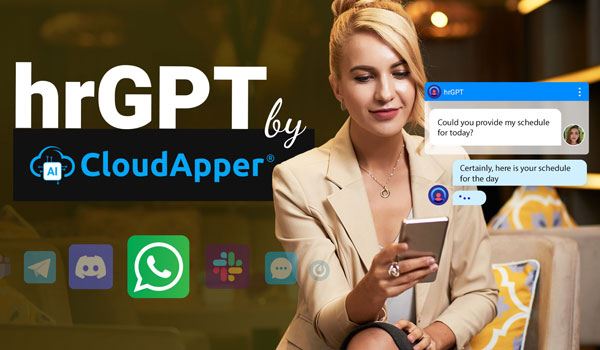
CloudApper AI is an advanced platform that enables organizations to integrate AI into their existing enterprise systems effortlessly, without the need for technical expertise, costly development, or upgrading the underlying infrastructure. By transforming legacy systems into AI-capable solutions, CloudApper allows companies to harness the power of Generative AI quickly and efficiently. This approach has been successfully implemented with leading systems like UKG, Workday, Oracle, Paradox, Amazon AWS Bedrock and can be applied across various industries, helping businesses enhance productivity, automate processes, and gain deeper insights without the usual complexities. With CloudApper AI, you can start experiencing the transformative benefits of AI today. Learn More
CloudApper AI Solutions for HR
- Works with


- and more.








Similar Posts
How cNPS Reflects Your Recruitment and Employer Brand
The Recruitment-to-HRIS Gap: Why Your “System of Record” Should Start…