Discover how to gain real-time recruiting metrics without relying on BI requests. Learn to automate workflows for essential metrics like time to hire, vacancy rates, and recruiter workload, ensuring faster access to meaningful data for better decision-making.

Ask most talent acquisition leaders how long it takes to fill a role and you will get an answer. Ask them how long it took last week, by location, and the answer changes: someone has to request a report.
That gap is the whole problem. The metrics exist. Your ATS captured every application, every stage change, every offer. But getting those facts into a form a recruiter can act on usually means submitting a request to a BI or analytics team, waiting days, and receiving a snapshot of a situation that has already moved on.
Recruiting decisions do not wait for reporting cycles. A requisition aging past 40 days needs attention today, not in next month’s dashboard review.
What Are Real-Time Recruiting Metrics?
Real-time recruiting metrics are hiring measurements that update as the work happens, visible to recruiters and hiring managers without a report request. Instead of extracting data after the fact and formatting it for review, the workflow surfaces time to hire, open requisitions, vacancy aging, and applicant volume continuously, so the numbers reflect the pipeline as it stands right now.
The distinction matters because delayed metrics change what they are for. A number you see weeks later can only explain what happened. A number you see today can change what happens next.
Why Recruiting Metrics Get Trapped in the System
Your ATS is a system of record. It is built to store what happened accurately, which it does well. It was never designed to answer “which of my 40 open roles is drifting, and who owns them.”
So the data gets extracted. Someone builds a query, exports to a spreadsheet, formats it for a monthly review, and by the time it circulates the pipeline has changed. Meanwhile the recruiter who needed to know that a requisition had gone quiet for nine days found out at the review, not on day nine.

Three things follow from this, and every TA team recognises them:
Reporting becomes retrospective, so metrics get used to explain results rather than to change them. Requests queue behind other business priorities, so the people closest to the work wait longest for information about it. And because pulling numbers is effortful, teams track fewer metrics than they should, usually just the one or two that leadership asks about.
The Five Recruiting Metrics Worth Tracking in Real Time
What is a good time to hire?
SHRM’s latest benchmarking puts the median time to fill a nonexecutive role at 39 calendar days, down from 44 the previous year, with executive roles steady at 45 days. Global research from AMS and The Josh Bersin Company puts average time to hire at 44 days, ranging from roughly 14 days for easy-to-fill roles to 67 days or more in sectors like energy and defense. SHRM also found that organisations with effective recruitment practices fill roles about five days faster than their peers.
Track this as a live average across open requisitions, not as a backward-looking figure for closed ones. A closed-req average tells you about hires you already made. A live average tells you which ones are drifting now.
How should you track open roles by business area?
Total headcount of open roles hides the problem. Twelve openings spread evenly across a company is a staffing plan; twelve concentrated in one department is an operational emergency for that department’s manager.
Break open requisitions down by business unit, location, and job family, and watch the distribution rather than the total. Concentration is the signal.
What is vacancy aging and why does it matter?
Vacancy aging measures how long each open requisition has been open, right now, rather than averaging across all of them. It is the metric most likely to change a decision today, because it identifies the specific roles that have stalled while the average still looks acceptable.
Set a threshold tied to your own time-to-hire benchmark, flag anything past it, and review the flags weekly. If your median is 39 days, a requisition at 55 days is not a statistic, it is a conversation with a hiring manager.
How many applicants per role should you expect?
There is no universal benchmark here, and treating a high number as good is a common mistake. Applicants per role tells you whether a posting is attracting interest, and reading it alongside your completion rate tells you whether the application itself is the obstacle. Research reported by SHRM found that 92% of candidates who begin an online application never finish it, so raw applicant counts routinely overstate real pipeline.
Track applicants per role next to completion rate and source. A role with high traffic and low completion has a form problem, not a marketing problem.
What is a healthy requisition load per recruiter?
Requisitions per recruiter is the metric that predicts whether the other four will hold up under pressure. When load climbs past what a recruiter can service, time to hire stretches, candidates go unanswered, and vacancy aging drifts across the board.
Public benchmarks for this vary widely by hiring type, so derive your own: track requisitions per recruiter alongside your time-to-hire average for two quarters, and find the load level where your own time to hire starts rising. That threshold is your real capacity number, and it is more useful than any external figure.
Why Capturing Metrics at the Point of Action Beats Reporting on Them Later
The fix is not a better dashboard on top of the same pipeline. It is moving measurement into the moment the work happens.
When a candidate applies, screens, schedules, or accepts, that event is the metric. If the workflow records it in a structured way as it occurs, the numbers assemble themselves and no one needs to reconstruct them later. Recruiters see current state in the system they already work in, and the reporting request disappears because there is nothing left to request.
This also changes which metrics are affordable to track. When measurement is a by-product of the workflow rather than a separate project, tracking five metrics costs the same as tracking one.
How to Make Recruiting Metrics Actionable Rather Than Informational
A metric earns its place only if someone changes behaviour because of it. Three tests:
Does it have an owner? “Time to hire is up” is information. “These four requisitions are past 50 days and belong to these two recruiters” is a task.
Does it have a threshold? Numbers without thresholds get discussed. Numbers with thresholds get acted on. Pick the trigger point before you start tracking.
Does the person who can act on it see it without asking? If acting on a metric requires requesting it first, most people will not.
Where These Metrics Live in a UKG Environment
For teams running UKG Pro Recruiting, UKG Ready, or Dayforce, the underlying data is already captured. The friction is in surfacing it: standard reporting tends to answer the questions the report was built for, and anything else becomes a request to whoever owns reporting configuration.
That is why the practical route to real-time recruiting metrics for UKG customers is usually a workflow layer that reads and writes inside the existing system rather than a separate analytics stack. The data stays where it belongs. What changes is who can see it and when.
How CloudApper AI Recruiter Surfaces Metrics as Work Happens
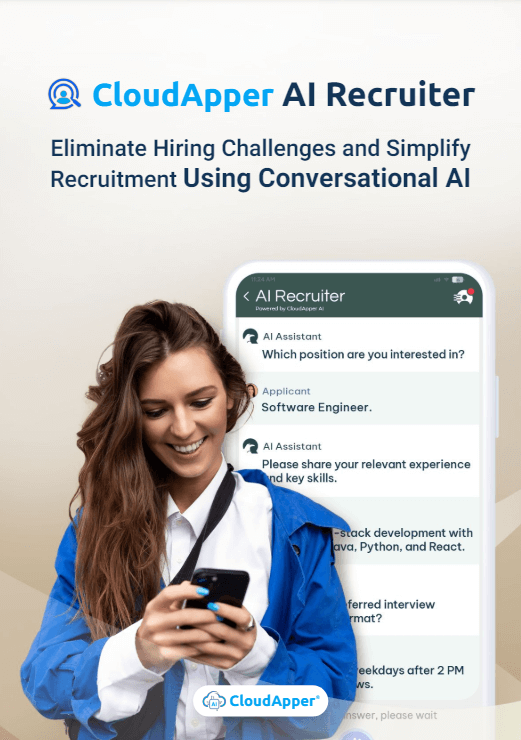
CloudApper AI Recruiter runs as a process layer on top of the ATS you already use, including UKG Pro Recruiting and Dayforce. Because it handles screening, candidate communication, and interview scheduling inside that workflow, the events that constitute your metrics pass through it as they occur.
The practical result is that recruiters see current pipeline state, requisition aging, and stage movement without filing a report request, and the numbers reflect this morning rather than last month. Organisations using it have compressed application-to-interview time from 12 days to 72 hours, which is the kind of change that only becomes visible, and therefore manageable, when the measurement is live.
What Gets Measured Should Be Available
There is an unspoken assumption in most recruiting operations that measurement is a reporting function, something that happens after the work, owned by someone else. That assumption is what puts a queue between a recruiter and a fact about their own pipeline.
CloudApper is the process layer that closes the gaps enterprise software cannot. Your ATS holds the recruiting record. It was never built to tell the recruiter, mid-week, which of their requisitions has gone quiet. Teams that close that gap stop reviewing hiring performance and start managing it, in weeks rather than quarters.
Frequently Asked Questions
What are real-time recruiting metrics?
Real-time recruiting metrics update as hiring work happens and stay visible to recruiters without a report request. Rather than extracting and formatting data after the fact, the workflow surfaces time to hire, open requisitions, vacancy aging, and applicant volume continuously, so the numbers reflect the current pipeline.
What is a good time to hire?
SHRM’s latest benchmarking puts the median time to fill a nonexecutive role at 39 calendar days and an executive role at 45. AMS and The Josh Bersin Company put the global average time to hire at 44 days, ranging from about 14 days for easy-to-fill roles to 67 days or more in energy and defense.
What is vacancy aging?
Vacancy aging measures how long each individual requisition has been open right now, instead of averaging across all of them. It surfaces the specific roles that have stalled while the overall average still looks healthy, which makes it the most action-oriented of the common recruiting metrics.
Why can’t we just use our ATS reports?
ATS platforms store the hiring record accurately, but their standard reports answer the questions those reports were built for. Anything outside that usually becomes a request to whoever owns reporting configuration, which puts a delay between the recruiter and information about their own pipeline.
How many applicants per role is normal?
No universal benchmark applies, and a high count can mislead. Because 92% of candidates who start an online application never finish it, raw applicant counts overstate real pipeline. Read applicants per role alongside completion rate and source to see whether the application itself is the obstacle.
Do you need a BI tool to track recruiting metrics?
No. A BI tool reports on data after it lands. Capturing structured events as work happens, inside the ATS workflow, assembles the same metrics without a separate analytics stack or a reporting queue.
Which recruiting metric should we track first?
Start with vacancy aging. It identifies specific stalled requisitions rather than describing an average, it has an obvious owner for each flag, and it usually predicts movement in time to hire before the average shifts.

What is CloudApper AI Platform?
CloudApper AI is an advanced platform that enables organizations to integrate AI into their existing enterprise systems effortlessly, without the need for technical expertise, costly development, or upgrading the underlying infrastructure. By transforming legacy systems into AI-capable solutions, CloudApper allows companies to harness the power of Generative AI quickly and efficiently. This approach has been successfully implemented with leading systems like UKG, Workday, Oracle, Paradox, Amazon AWS Bedrock and can be applied across various industries, helping businesses enhance productivity, automate processes, and gain deeper insights without the usual complexities. With CloudApper AI, you can start experiencing the transformative benefits of AI today. Learn More
- Useful Links:
- Agentic AI
- No-Code/Low-Code
- Custom Software
- HCM Personalization
- iPaaS
- FedRAMP
CloudApper AI Solutions for HR



- Works with








- and more.
Similar Posts

How to Stop Losing Shortlisted Candidates During a Hiring Surge…

Recording Candidate Video Interviews in Illinois: Consent, Retention, and Deletion…