Interview scheduling should not slow hiring or frustrate candidates. This article explains why scheduling breaks down, what automation really means, and how CloudApper AI Recruiter helps teams schedule interviews faster without hurting candidate experience.


TL;DR
- Interview scheduling becomes a bottleneck because manual coordination depends on fast responses, stable calendars, and constant follow-up.
- Automating interview scheduling removes email back-and-forth while keeping recruiters in control of hiring decisions.
- CloudApper AI Recruiter schedules interviews only after candidates pass pre-screening, then sends confirmations and reminders automatically.
- Faster scheduling keeps candidates engaged, reduces no-shows, and lowers candidate drop-off.
- When scheduling feels clear and predictable, candidate experience improves instead of suffering.
Table of Contents
If you work in recruiting, you know that interview scheduling sometimes takes more time than it should. You find good candidates, but calendars get in the way. Emails go back and forth. Time zones cause confusion. Candidates wait days for a response, and sometimes disappear before the interview even happens.
That is why many teams started using solutions like CloudApper AI Recruiter. Not because scheduling is the hardest part of hiring, but because it quietly slows everything else down. The real concern is not whether to automate interview scheduling. It is whether automation will hurt the candidate experience. That concern is fair, and it depends entirely on how you approach it.
Why Interview Scheduling Becomes a Bottleneck
Interview scheduling turns into a bottleneck because it depends on too many variables that recruiters cannot control.
-
Too many people need to align at the same time
Every interview requires coordination between the candidate, one or more interviewers, and the recruiter. Each person has their own priorities, meetings, and time zones. When even one person is slow to respond or unavailable, the entire scheduling process pauses. This makes progress feel fragile and unpredictable. -
Back-and-forth emails waste time
Manual scheduling often means long email threads just to agree on a single time. One message asks for availability. Another suggests alternatives. A third corrects a misunderstanding. Each step adds waiting time, and candidates lose momentum while nothing visibly moves forward. -
Availability changes quickly
Calendars shift constantly. Meetings get added. Priorities change. A time slot that worked yesterday may disappear today. Manual scheduling cannot adjust fast enough, so recruiters end up restarting the process instead of moving ahead. -
Recruiters juggle scheduling alongside many other tasks
Scheduling rarely gets full focus. Recruiters balance sourcing, screening, follow-ups, and stakeholder updates at the same time. When scheduling competes for attention, mistakes happen. Details get missed, responses go out late, and the process slows down even more. -
Small delays compound into larger problems
A one-day delay may not feel serious at first. But one delay often leads to another. By the time an interview is finally booked, several days or even a full week may have passed. At that point, candidate interest drops, priorities shift, and the risk of losing strong talent increases.
These issues feel normal because they happen so often. Over time, they quietly slow hiring and frustrate candidates.
What Manual Interview Scheduling Costs You
Manual interview scheduling creates real costs that build quietly over time. These costs rarely show up in reports, but you feel them every day.
Recruiter Time Gets Drained by Coordination Work
Recruiters spend a surprising amount of time just trying to line up calendars. They send availability requests, wait for replies, follow up, and repeat the process when plans change. This work adds no real hiring value, but it consumes hours each week.
That time comes at a cost. Instead of engaging candidates, preparing interviewers, or reviewing strong applications, recruiters stay stuck managing logistics. Over time, this leads to burnout and slower hiring progress.
Candidate Experience Suffers from Delays and Confusion
Candidates experience the process very differently from recruiters do. They do not see internal workloads or calendar conflicts. They only see long gaps between messages, unclear next steps, and last-minute changes.
When scheduling feels slow or disorganized, candidates assume the company is the same way. Even if they like the role, the experience leaves doubt. That doubt affects how excited they feel about moving forward.
Strong Candidates Quietly Drop Out
Strong candidates rarely complain about scheduling delays. They simply move on. While one company takes days to confirm an interview, another confirms within hours.
When scheduling drags on, candidates accept other offers or lose interest. You may never know why they disappeared. All you see is a role that stays open longer than expected.
Hiring Feels Heavier Than It Should
Each of these costs may seem manageable on its own. Together, they slow hiring and increase frustration across the team.
Recruiters feel stretched. Candidates feel ignored. Hiring managers feel impatient. The process starts to feel harder than it needs to be, even when talent is available.
What Automating Interview Scheduling Actually Means
Automating interview scheduling does not remove people from hiring. It removes the slow and repetitive coordination work that gets in the way.
-
Availability is matched automatically instead of negotiated manually
The system checks candidate availability against interviewer calendars and finds times that actually work. Recruiters no longer need to send multiple emails just to discover that schedules do not align. -
Interview confirmations happen instantly
Once a time is selected, calendars update automatically, and confirmations go out right away. Everyone knows when the interview is scheduled without waiting for follow-ups. -
Reminders reduce missed interviews
Automated reminders go out before the interview, so candidates and interviewers are less likely to forget or show up late. This keeps the process moving without extra effort from recruiters. -
Calendar updates stay accurate without manual edits
Changes are reflected across calendars automatically. Recruiters do not need to chase updates or worry about double bookings. -
Recruiters keep full control over hiring decisions
Automation does not decide who gets interviewed. Recruiters still review candidates and choose who moves forward. The system only handles the logistics. -
Candidates still interact with real people
Automation supports communication, but it does not replace conversations. Candidates still speak with recruiters and interviewers. The experience feels organized, not automated.
If your recruiters spend more time coordinating calendars than talking to candidates, this is the bottleneck to fix first.
How CloudApper AI Recruiter Automates Interview Scheduling Without Hurting Candidate Experience
Automation improves candidate experience only when it supports communication instead of replacing it. This is where CloudApper AI Recruiter fits naturally into the process.
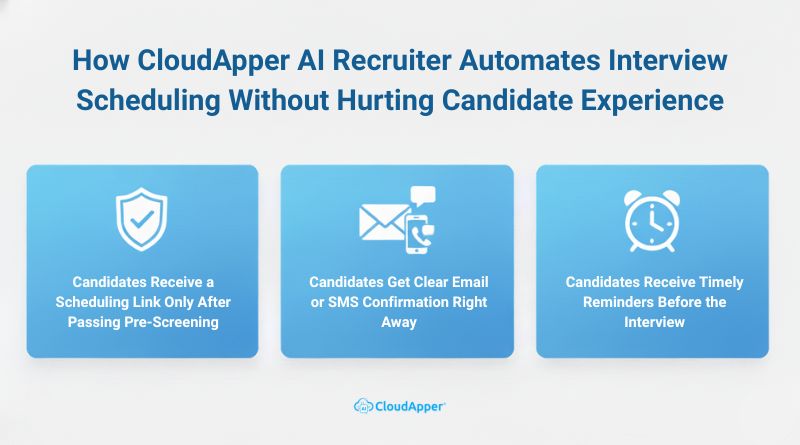
Candidates Receive a Scheduling Link Only After Passing Pre-Screening
Candidates should never be asked to schedule an interview before they know they qualify. With CloudApper AI Recruiter, only candidates who pass the pre-screening questionnaires move forward to scheduling.
Once they qualify, they receive a calendar link that shows real availability from the interview team. Candidates choose a time that works for them without guessing, waiting, or emailing back and forth. This keeps the process fair and transparent while giving candidates control over their schedule.
Candidates Get Clear Email or SMS Confirmation Right Away
After a candidate selects a time slot, confirmation happens immediately. CloudApper AI Recruiter sends an email or SMS that clearly confirms the interview date, time, and format.
There is no uncertainty about whether the interview is booked. Candidates know exactly what to expect, and interviewers see the same information reflected on their calendars. This instant confirmation reduces confusion and builds confidence in the process.
Candidates Receive Timely Reminders Before the Interview
Missed interviews often happen because candidates forget or lose track of details. Automated reminders help prevent that without adding pressure.
CloudApper AI Recruiter sends reminders before the interview so candidates have time to prepare and show up on time. These reminders feel helpful, not intrusive. They reinforce professionalism and show respect for the candidate’s time.
By guiding candidates through scheduling, confirmation, and reminders, automation removes friction while keeping the experience human and predictable.
A Real Hiring Team Example
I worked with a growing tech team that hired year-round. Their recruiters handled strong inbound interest, but scheduling interviews had become overwhelming.
Candidates waited days for interview times. Recruiters followed up manually. Missed interviews became common.

After introducing automated interview scheduling through CloudApper AI Recruiter, the process stabilized. Candidates received interview options quickly. Calendars stayed aligned. Reminders reduced no-shows.
Recruiters regained time and control. Candidates stayed engaged. Scheduling stopped being a source of stress.
When Interview Scheduling Automation Makes Sense
Automation makes sense when scheduling starts affecting hiring outcomes.
If recruiters spend a noticeable part of their week scheduling interviews, automation helps immediately. If candidates wait more than a day or two for interview options, automation closes that gap.
It also becomes necessary as hiring volume increases. Manual scheduling works at low volume but breaks quickly as roles and interviews scale.
Automation is especially valuable for panel interviews and multi-step processes. The more people involved, the more coordination matters.
Most importantly, automation makes sense when candidate experience matters to you. Faster scheduling shows respect for their time and keeps momentum strong.
Final Thoughts
Interview scheduling should not be the reason you lose good candidates or burn out recruiters. You can automate interview scheduling without hurting candidate experience when you focus on clarity, speed, and respect.
When scheduling works smoothly, recruiters move faster, and candidates stay engaged.
Reduce Time-to-Hire by 97% with AI for Talent Acquisition
Recruit skilled, culturally fit, and diverse candidates with CloudApper’s state-of-the-art AI resume screening, automated interview scheduling, and offer letter generation.
Learn more | Download BrochureFrequently Asked Questions
-
What does it mean to automate interview scheduling?
Automating interview scheduling means using software to match candidate availability with interviewer calendars, send confirmations, and deliver reminders automatically, without recruiters needing to coordinate everything manually. -
Will automating interview scheduling hurt candidate experience?
No, when done correctly. Automation improves candidate experience by reducing wait times, providing clear next steps, and confirming interviews quickly, as long as communication stays clear and respectful. -
How does CloudApper AI Recruiter automate interview scheduling?
CloudApper AI Recruiter sends scheduling links only after candidates pass pre-screening, confirms interviews by email or SMS, and sends reminders so candidates stay informed and prepared. -
When should recruiting teams automate interview scheduling?
Teams should automate scheduling when recruiters spend too much time coordinating calendars, candidates wait days for interview times, or hiring volume increases beyond what manual scheduling can handle. -
How does automated scheduling reduce candidate drop-off?
Automated scheduling reduces drop-off by shortening delays, keeping candidates engaged, sending reminders to prevent missed interviews, and making the process feel organized and predictable.
What is CloudApper AI Platform?
CloudApper AI is an advanced platform that enables organizations to integrate AI into their existing enterprise systems effortlessly, without the need for technical expertise, costly development, or upgrading the underlying infrastructure. By transforming legacy systems into AI-capable solutions, CloudApper allows companies to harness the power of Generative AI quickly and efficiently. This approach has been successfully implemented with leading systems like UKG, Workday, Oracle, Paradox, Amazon AWS Bedrock and can be applied across various industries, helping businesses enhance productivity, automate processes, and gain deeper insights without the usual complexities. With CloudApper AI, you can start experiencing the transformative benefits of AI today. Learn More
CloudApper AI Solutions for HR

- Works with


- and more.








Similar Posts
How cNPS Reflects Your Recruitment and Employer Brand
The Recruitment-to-HRIS Gap: Why Your “System of Record” Should Start…