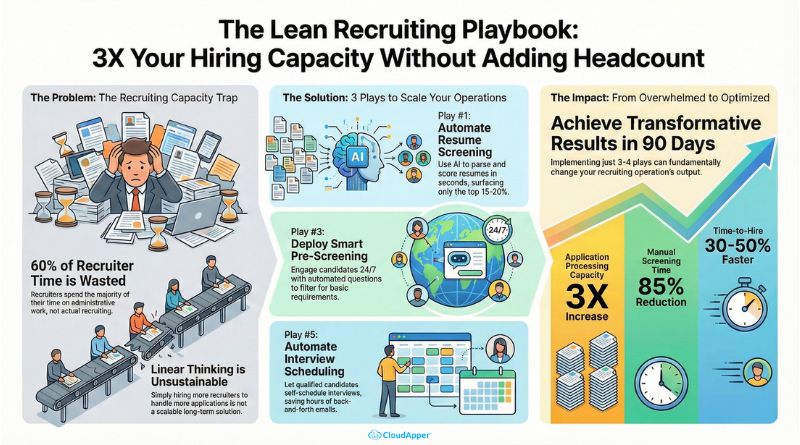
This lean recruiting playbook outlines seven proven plays to help your team handle 300 percent more hiring volume without adding headcount. Learn how to automate screening, streamline workflows, and scale faster using smarter recruiting systems.


TL;DR
- You can scale recruiting operations by 200–300% without adding headcount by optimizing systems, not hiring more recruiters.
- Automating resume screening and pre-screening delivers the fastest and biggest time savings.
- Standardized workflows eliminate inconsistencies and accelerate time-to-hire across teams.
- Interview scheduling automation alone can save 10–15 recruiter hours per week.
- Talent pipelines shift recruiting from reactive to proactive, cutting time-to-fill by up to 60%.
- Most teams see meaningful results within 30 days and full transformation within 90 days.
Table of Contents
Your recruiting team is buried. Last quarter you processed 2,000 applications. This quarter? 6,000. Your team size? Exactly the same. Sound familiar?
I’ve worked with dozens of recruiting teams across industries facing this exact challenge. The applications keep coming, but your budget stays flat. You can’t hire more recruiters. You can’t ignore qualified candidates. Something has to change.
Here’s what I’ve learned: 67% of companies now prioritize using AI in their recruiting operations. [1] The traditional solution, hiring more recruiters, isn’t sustainable. You need systems that multiply capacity, not just more hands doing the same manual work.
This playbook gives you 7 battle-tested plays to scale recruiting operations. Each play includes the challenge it solves, the solution, how to implement it, and the impact you can expect. Tools like CloudApper AI Recruiter were built specifically to help teams implement these plays, integrating directly with your existing ATS or HCM system to automate screening, scoring, and scheduling.
By implementing just 3 or 4 of these plays, teams typically see a 30-50% reduction in time-to-hire and can manage 200-300% more applications with their existing team. Give yourself 90 days, and you’ll transform how your recruiting operation works.
Why You Need This Playbook to Scale Recruiting Operations
Lean recruiting means maximizing your output while cutting out waste. Most recruiting teams operate with linear thinking. More applications mean more people are needed. That’s unsustainable. You need exponential thinking instead. Better systems equal more capacity.
This requires an operations mindset. Stop thinking of recruiting as an art that can’t be systematized. Start treating it like a production system that can be optimized. I’ve audited hundreds of recruiting teams. Most operate at 40-60% efficiency because of manual processes. Your recruiters spend 60% of their time on admin work and only 40% on actual recruiting.
Companies with optimized recruiting operations achieve 3X application processing capacity, 85% reduction in manual screening time, 30-50% faster time-to-hire, and 60% less administrative work for recruiters. These aren’t aspirational numbers. These are real results from teams that implemented this playbook.
The 7-Play Playbook to Scale Recruiting Operations
Each play follows the same structure: The Challenge, The Solution, How to Implement, and Expected Impact. You don’t need to implement all 7 at once. Start with the plays that address your biggest bottlenecks.
Play #1: Automate High-Volume Resume Screening
The Challenge
Manual resume review takes 5-10 minutes per application. At 1,000 applications, that’s 83+ hours of recruiter time. Qualified candidates slip through because they’re buried in volume. Each recruiter evaluates differently, creating inconsistent results.
The Solution
AI resume screening systems parse and score resumes in seconds, surfacing only the top 15-20% for human review. You get a consistent, objective evaluation that integrates directly with your existing ATS.
How to Implement
Week 1: Audit your current screening process. What criteria do recruiters use? Where are the inconsistencies?
Week 2: Define qualification requirements. Separate must-haves from nice-to-haves. Assign scoring weights.
Week 3: Integrate AI screening with your ATS or HCM system. CloudApper AI Recruiter makes this straightforward with built-in integrations for all major ATS & HCM platforms, e.g., UKG, Workday, Greenhouse, Bullhorn, Lever, Oracle, Infor, etc.
Week 4: Train the system using historical data and test it in recruiting one role. Adjust scoring criteria based on results.
Week 5: Go live for all your recruitment campaigns. Monitor results and gather recruiter feedback.
Expected Impact
80-90% reduction in screening time. Handle 5-10X more applications. Consistent, objective candidate evaluation. Remove unconscious bias from initial screening.
Play #2: Standardize Your Recruiting Workflows
The Challenge
Every recruiter operates differently. One takes 2 days to schedule an interview, another takes 2 weeks. Candidates get inconsistent experiences. What works for your top performer doesn’t transfer to the rest of the team.
The Solution
Document proven workflows. Create repeatable processes that everyone follows. You’re scaling what your best people already do naturally.
Learn more about standardizing recruiting workflows from our recent blog.
How to Implement
Identify key workflows: candidate intake, screening criteria, interview scheduling, communication cadence, and offer approval. Shadow your top recruiters and document their approach. Create simple step-by-step guides. Train your team through walk-through sessions. Iterate monthly based on feedback.
Expected Impact
30-40% faster process execution. Predictable time-to-hire. New recruiters are productive in days, not months. Every candidate gets consistent, high-quality experience.
Play #3: Deploy Smart Candidate Pre-Screening
The Challenge
Resumes don’t tell the full story. You spend hours on phone screens only to discover candidates don’t meet basic requirements. Their salary expectations are too high, they won’t relocate, or they lack the required certifications.
The Solution
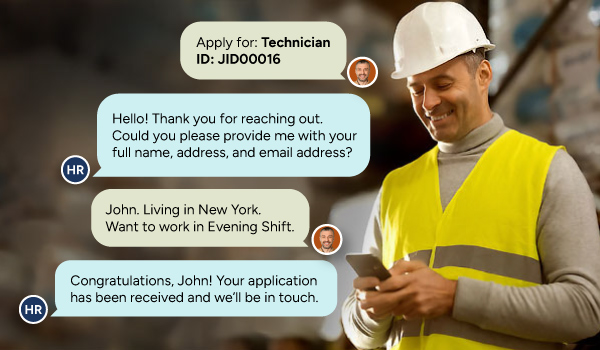
Use CloudApper AI Recruiter’s Automate pre-screening with role-specific questions before any human contact. Conversational AI engages candidates 24/7 via chat or SMS, scoring responses automatically. Only qualified candidates reach recruiters.
How to Implement
Define knock-out questions per role: salary expectations, certifications, relocation willingness, work authorization. Create 5-8 questions per role type, mixing multiple choice and scenario-based questions. Deploy conversational AI that candidates access via SMS or chat. Set scoring thresholds and auto-advance qualified candidates. Sync results with your ATS.
Expected Impact
70-80% of screened candidates meet basic requirements. 60% reduction in phone screen time. 24/7 candidate qualification. Instant engagement instead of waiting days for a recruiter call.
Want to see how automated pre-screening and resume scoring would work with your ATS?
Play #4: Build an Employee Referral Engine
The Challenge
Referrals are your best candidates, but traditional programs generate few submissions. Lengthy forms and complex processes make it hard for employees to participate.
The Solution
Make referring completely frictionless. CloudApper AI Recruiter allows you to use SMS and QR code sharing that takes 30 seconds. Set up automatic syncing with your ATS. Make it mobile-first.
How to Implement
Add text-to-apply functionality and QR codes for each job. Let employees text job links from their phones or share QR codes in their networks. Set up automatic syncing so referred candidates populate in your ATS automatically. Close the loop with automatic status updates to referrers.
The Math
100 employees times 2 referrals per year equals 200 high-quality applicants with zero sourcing cost.
Expected Impact
200-400% more referral applications. Referred candidates are hired 55% faster [2]. Lower cost-per-hire. Better cultural fit. Every employee becomes a recruiter.
Play #5: Automate Interview Scheduling
The Challenge
Back-and-forth email chains to find available times. Each interview takes 20-30 minutes to schedule. Multiply that by hundreds of candidates. Pure administrative waste.
The Solution
Self-scheduling tools let candidates pick from available slots with zero recruiter involvement. Calendar integration ensures availability stays current. Automated reminders reduce no-shows.
How to Implement
Choose your scheduling solution (Calendly, Microsoft Bookings, or built-in ATS features). Set availability rules and interview slots per role. Integrate with Google Calendar or Outlook for real-time availability. Create automated triggers so top-scoring candidates automatically receive scheduling links. Enable reminder automation for confirmations and 24-hour reminders.
Expected Impact
10-15 hours saved per recruiter per week. Interviews are scheduled in minutes, not days. 40% reduction in no-shows. Candidates love controlling their schedule. Works the same for 10 or 1,000 candidates.
Play #6: Create Talent Pipeline Programs
The Challenge
You’re always reacting. A requisition opens, and you scramble to find candidates, starting from zero every time. Long time-to-fill hurts your business.
The Solution
Build proactive talent pipelines for common roles. Keep pre-qualified candidates ready. Switch from reactive scrambling to continuous sourcing.
How to Implement
Identify roles you hire repeatedly (sales, engineering, nursing, customer service). Build continuous sourcing campaigns with saved job board searches and LinkedIn outreach. Nurture passive candidates with quarterly touchpoints. Re-engage silver medalists from past searches. Tag everything in your ATS with “Pipeline – Sales” or “Pipeline – Engineering” segments.
The Shift
From “We need a sales rep, start sourcing today” to “We need a sales rep, let’s review our 30 pre-screened pipeline candidates.”
Expected Impact
50-60% reduction in time-to-fill. Strategic instead of reactive posture. Pre-warmed, engaged candidates. Less spending on external agencies. Win talent battles with faster offers.
Play #7: Optimize Your Technology Stack
The Challenge
Disconnected tools create information silos. Manual data entry wastes time. You can’t get a holistic view of recruiting metrics. Technology should enable you, not burden you.
The Solution
Build an integrated stack where data flows seamlessly. As I’ve said before in this playbook, CloudApper AI Recruiter integrates seamlessly with all major ATS and HCM Systems. Create a single source of truth. Eliminate duplicate entries. Get real-time visibility.
How to Implement
Audit current tools and identify integration gaps. Map where manual data entry happens. Build your essential stack: ATS/HCM foundation, AI screening layer, pre-screening tools, scheduling automation, email/SMS engagement, and analytics dashboards. Test to ensure data syncs correctly.
Integration Example
Your ATS or HCM plus CloudApper AI Recruiter creates seamless flow. Job postings automatically pull from your system. AI screens and scores candidates. Pre-screening happens via conversational AI. Interview scheduling runs on autopilot. All data syncs back to your ATS automatically.
Expected Impact
8-12 hours reclaimed per recruiter per week. Eliminate manual entry errors. Real-time visibility across your funnel. Infrastructure supports 3X growth without breaking.
If your tech stack is holding you back, this is the point where you should automate your recruiting process
Your 90-Day Implementation Plan to Scale Recruiting Operations
You don’t need to implement all 7 plays at once. This phased approach lets you scale incrementally. Most teams see improvements within 30 days.
Phase 1: Days 1-30 (Assess & Quick Wins)
Calculate baseline metrics: applications per recruiter per week, time-to-hire, time spent on admin versus strategic work. Identify your number one bottleneck. Survey your team asking, “What takes most of your time?”
Implement ONE play addressing your biggest pain point. If screening is the bottleneck, deploy Play #1. If scheduling is killing you, deploy Play #5. Train your team and set up tracking.
Expected Outcome: One play implemented, 20-30% improvement in the target area, team bought in, clear data showing impact.
Phase 2: Days 31-60 (Build Foundation)
Implement Play #2 if you haven’t already. Document workflows from your first quick win. Train your entire team to consistent standards. Implement Play #7 to optimize your tech stack. Fix the top 2-3 integration gaps. Set up automated reporting for visibility into key metrics.
Expected Outcome: Consistent processes, integrated systems, 40-50% improvement in initial bottleneck, data infrastructure in place.
Phase 3: Days 61-90 (Scale & Optimize)
Implement 2 additional plays based on remaining bottlenecks. Common combinations: Play #3 plus Play #4, or Play #6 plus Play #4. Review all metrics versus baseline. Calculate your ROI. Gather team feedback. Document new procedures. Plan the next 90-day cycle.
Expected Outcome: 3-4 plays implemented, 150-250% increase in capacity, 30-50% reduction in time-to-hire, 10-15 hours reclaimed per recruiter weekly, foundation to continue scaling.
How to Measure Your Playbook Success
Track these key metrics:
Application Processing Capacity: Measure applications per recruiter per week. Baseline is typically 20-40, target 60-120 after implementation.
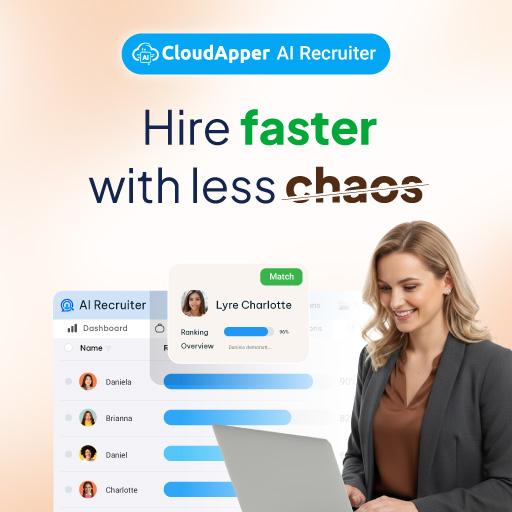
Time-to-Hire: Track days from req approval to offer acceptance. Target 30-50% reduction from your baseline of 30-50 days.
Recruiter Time Allocation: Measure admin versus strategic work hours. Move from 60% admin to 30% admin.
Quality of Hire: Track 90-day retention and hiring manager satisfaction. Maintain or improve as volume increases.
Cost per Hire: Should decrease as efficiency increases. Factor technology costs versus time savings.
Recruiter Satisfaction: Track team satisfaction and retention through monthly pulse surveys.
Start Running Your Lean Recruiting Playbook Today
You don’t need more recruiters. You need better systems. Each play delivers 20-30% improvement. Combine 3-4 plays for a 3X capacity increase.
Your first step: Answer “What’s taking up most of my recruiting team’s time?” If screening is the bottleneck, start with Play #1. If scheduling is the problem, start with Play #5. If consistency is the issue, start with Play #2.
Organizations that systematically optimize recruiting operations handle 3X more volume without growing headcount. This isn’t about working harder. It’s about working smarter with proven plays.
Start with one play. Measure results. Build momentum. Within 90 days, you’ll transform your recruiting operations.
How CloudApper AI Recruiter Enables Your Playbook To Scale Recruiting Operations
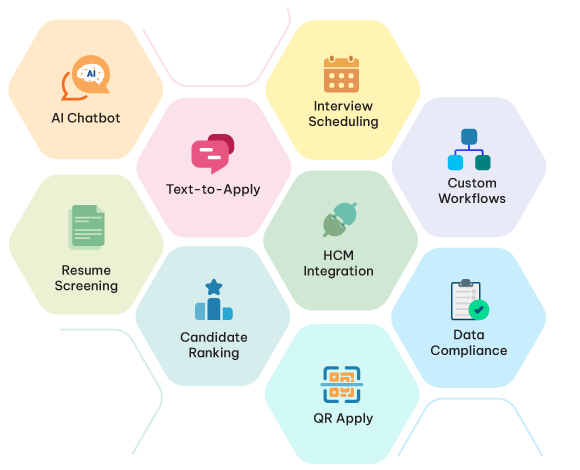
CloudApper AI Recruiter was built specifically to help recruiting teams implement this playbook across any major ATS or HCM system. You get AI-powered resume screening integrating directly with your existing platform, conversational pre-screening via SMS and chat engaging candidates 24/7, automated interview scheduling syncing with calendars, and seamless integration with your recruiting environment with no duplicate data entry.
Teams using CloudApper typically see an 85% reduction in manual screening time, a 60% decrease in administrative workload, a 50% faster time-to-hire, and a 3X increase in application processing capacity. The platform turns this playbook from theory into automated reality for teams who need to scale recruiting operations without adding headcount.
Ready to see how your team could handle 3X hiring volume with the same headcount?
References:
- https://www.secondtalent.com/resources/ai-in-recruitment-statistics/
- https://clickup.com/p/small-business/how-to-start-employee-referral-system-business
Reduce Time-to-Hire by 97% with AI for Talent Acquisition
Recruit skilled, culturally fit, and diverse candidates with CloudApper’s state-of-the-art AI resume screening, automated interview scheduling, and offer letter generation.
Learn more | Download BrochureQuestions I Get Asked The Most About Scaling Recruiting Operations
-
How long does it take to scale recruiting operations?
Most teams see improvements within 30 days of implementing their first play. Full transformation typically takes 90 days. Start with quick wins that build momentum.
-
Do I need to implement all 7 plays?
No. Most teams implement 3–4 plays addressing their specific bottlenecks. The playbook is modular. Pick what works for your situation.
-
What's the ROI of recruiting automation?
If recruiters spend 60% of time on manual work, automation reclaims 10–15 hours per recruiter per week. At $70,000 average salary, that's $20,000 to $30,000 in reclaimed time value per recruiter annually, not counting faster time-to-hire benefits.
-
Will automation reduce hire quality?
No. Properly implemented automation improves quality through consistent evaluation and reduced bias. Use AI for screening and admin tasks while keeping humans involved in final decisions.
-
What if we have a small team of 2–3 recruiters?
The playbook works for all team sizes. Smaller teams often see the biggest impact from immediate capacity relief. Start with Plays #1 and #5 for fastest ROI.
-
Can we implement this with our current ATS?
Yes. These strategies work with any modern ATS or HCM system. Play #7 focuses on integrating tools with your existing platform. CloudApper AI Recruiter integrates with major ATS and HCM systems.
-
How do we get our team to adopt new processes?
Start with pain point solutions. When recruiters see immediate time savings like reclaiming 10 hours per week, adoption follows naturally. Involve recruiters in selecting which plays to implement first.
-
What's the biggest mistake teams make?
Trying to implement everything at once. Start with one play. Prove the value. Then add more. Incremental implementation with clear measurement beats big-bang approaches every time.

What is CloudApper AI Platform?
CloudApper AI is an advanced platform that enables organizations to integrate AI into their existing enterprise systems effortlessly, without the need for technical expertise, costly development, or upgrading the underlying infrastructure. By transforming legacy systems into AI-capable solutions, CloudApper allows companies to harness the power of Generative AI quickly and efficiently. This approach has been successfully implemented with leading systems like UKG, Workday, Oracle, Paradox, Amazon AWS Bedrock and can be applied across various industries, helping businesses enhance productivity, automate processes, and gain deeper insights without the usual complexities. With CloudApper AI, you can start experiencing the transformative benefits of AI today. Learn More
CloudApper AI Solutions for HR

- Works with


- and more.







Similar Posts
How cNPS Reflects Your Recruitment and Employer Brand
The Recruitment-to-HRIS Gap: Why Your “System of Record” Should Start…