Need to shorten time-to-screen for high-volume hiring? Learn how to automate first-touch, screen and rank resumes in seconds, and schedule interviews 24/7—so candidates stay engaged and managers get faster shortlists with CloudApper AI Recruiter.

Table of Contents
High-volume hiring looks simple on paper—until 300 applications hit the same role overnight, managers want a short list “today,” and candidates disappear the moment your process slows down. If you want to shorten time-to-screen, you need more than faster resume review. You need a screening system that responds instantly, stays consistent, and keeps candidates moving while your team focuses on judgment calls—not admin work.
That’s exactly where CloudApper AI Recruiter fits. It’s a multi-agent recruitment solution that screens, scores, ranks, and schedules candidates quickly, while also automating candidate communication 24/7. Instead of adding another tool that creates extra steps, it works alongside your existing ATS/HRIS so your process gets faster without a messy overhaul.
Why “Time-To-Screen” Is The Metric That Quietly Breaks High-Volume Hiring
In high-volume roles—hourly retail, warehouse, hospitality, call centers, seasonal staffing, healthcare support—your biggest constraint isn’t sourcing. It’s processing. When the top of your funnel is wide, every hour of delay compounds into:
- Candidates accepting other offers because they heard nothing back
- Recruiters drowning in repetitive steps (review, message, schedule, reschedule)
- Hiring managers losing trust in the pipeline because “no one is qualified” (when the real problem is “no one was screened yet”)
- Inconsistent decisions because humans get fatigued and start skimming
Time-to-screen is the “first response time” of recruiting. Candidates interpret it as a signal: Does this company move fast? Do they respect my time? Is this role real?
And in high-volume hiring, speed isn’t just convenience—it’s control. When screening starts late, the whole process turns reactive: recruiters chase candidates, managers chase recruiters, and quality drops because everyone is trying to catch up.
What Time-To-Screen Actually Means (And How To Measure It Cleanly)
Time-to-screen is the elapsed time between application received and candidate screened (or “screen decision made,” depending on your process). To make it useful, define it in two layers:
- Time-to-first-touch: How long until a candidate gets a meaningful response (message, screening questions, or next-step instruction).
- Time-to-screen-decision: How long until the candidate is classified (advance, hold, reject) based on job criteria.
In high-volume roles, time-to-first-touch is often the fastest lever to reduce drop-off. Meanwhile, time-to-screen-decision is the lever that helps managers get short lists sooner.
If you’re trying to shorten time-to-screen, measure both. They reveal different bottlenecks—and they require different fixes.
The Real Bottlenecks (It’s Not Just Resume Volume)
Most teams assume the delay comes from “too many resumes.” That’s part of it, but the bigger culprits are usually:
- Back-and-forth scheduling: The hidden time sink that multiplies with every candidate.
- Manual pre-screen questions: Recruiters repeating the same checks (availability, work authorization, shift fit, location).
- Inconsistent evaluation: Different screeners interpret resumes differently, causing rework and second-guessing.
- Candidate follow-up gaps: A “quick reminder” turns into 30 minutes when done one-by-one.
- AI-era noise: Resumes and answers that look polished but don’t reflect real capability—forcing more time spent verifying.
So the goal isn’t “read resumes faster.” The goal is: automate the repeatable parts while improving the proof behind screening decisions.

How To Shorten Time-To-Screen For High-Volume Roles
The fastest, most sustainable path is to redesign screening as a workflow, not a task. Below is a practical playbook that recruiters and HR leaders can apply without turning their process upside down.
Start By Designing Your Screening Rules Like A Scoring System (Not A Vibe Check)
High-volume roles require consistency. Before you automate anything, define what “qualified” means in a way your team can repeat.
Think in categories:
- Must-haves (certifications, legal requirements, shift availability, location)
- Role fit indicators (relevant experience, stability, willingness to do the work)
- Risk flags (inconsistencies, unrealistic claims, missing essentials)
CloudApper AI Recruiter supports candidate scoring and ranking so you can turn these categories into structured evaluation. That matters because speed without structure just creates faster inconsistency.
Automate First-Touch So Candidates Don’t Wait On Humans
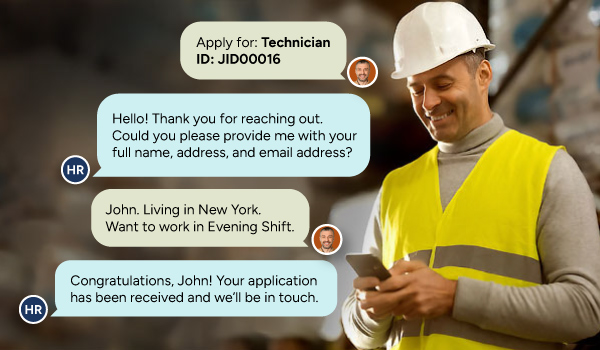
In high-volume hiring, your first-touch shouldn’t depend on someone being online. When candidates apply, they should immediately receive a next step—like screening questions, role details, or scheduling options—so interest doesn’t cool off.
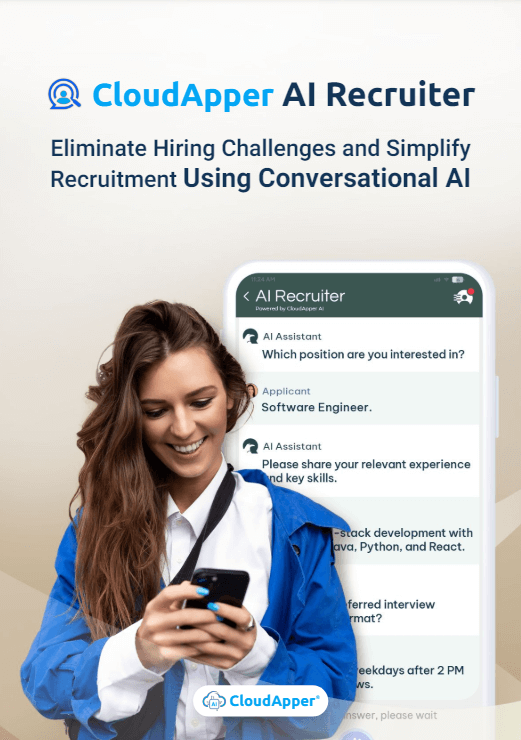
CloudApper AI Recruiter’s Communication Agent handles candidate outreach and updates, keeping engagement running 24/7. That means your process can keep moving even when your team is busy, after hours, or handling other requisitions.
This is one of the most direct ways to shorten time-to-screen because it removes the “inbox delay” that kills momentum.
Use Deep Resume Understanding—Then Verify With Scenario-Based Questions
High-volume screening breaks when teams rely on keyword matching. Keywords can be gamed, especially now. Instead, you want contextual analysis that actually understands what the resume is saying.
CloudApper AI Recruiter’s Screening Agent analyzes resumes against job requirements and identifies top candidates. But the real speed gain comes when resume analysis is paired with verification.
This is where scenario-based, personalized questions matter. Instead of generic “tell me about yourself” prompts, candidates get questions that require proof—real examples, role-specific decisions, and situational judgment. That reduces time wasted on candidates who look great on paper but can’t back it up.
Shorten Time-To-Screen With A Multi-Agent Workflow
If screening is your bottleneck, treating it like one person’s job is the problem. A better model is a “team” of specialized agents that each handle a specific stage—at machine speed and with consistent rules.
CloudApper AI Recruiter includes specialized agents such as:
- Screening Agent to analyze resumes and surface top fit
- Assessment Agent to evaluate candidate capabilities through structured assessments and scoring
- Communication Agent to manage outreach and keep candidates engaged
- Scheduling Agent to coordinate interviews and reduce scheduling back-and-forth
- Analytics (via dashboards) to help recruiters and leaders see what’s happening across the funnel
This setup helps you shorten time-to-screen because work doesn’t pile up behind one step. Screening, assessment, messaging, and scheduling can move in parallel rather than sequentially.
Add Scheduling Automation Early (Not At The End)
In high-volume roles, scheduling is often where momentum dies. Candidates drop when they’re asked to “pick times” but nothing happens quickly—or when the process involves too many emails.
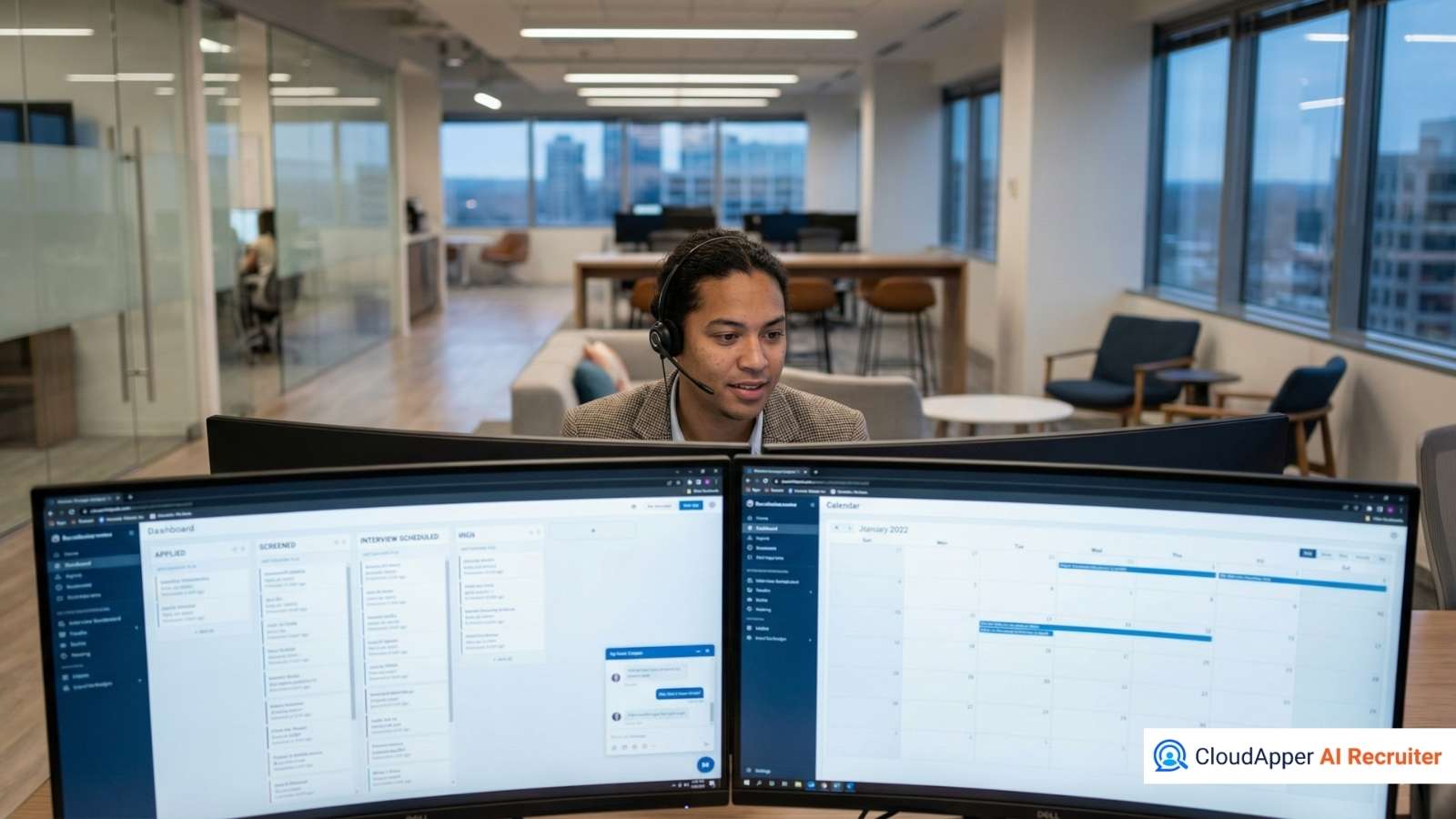
CloudApper AI Recruiter’s Scheduling Agent handles interview scheduling and calendar coordination. Practically, that means:
- Less recruiter time spent coordinating
- Fewer delays between “qualified” and “interview booked”
- A smoother candidate experience that feels modern and responsive
And when scheduling speeds up, managers see candidates sooner—which reduces the pressure to “rush decisions” later.
Use One Controlled List Of Screening Questions Per Role (Then Personalize The Edge Cases)
A common mistake is creating an enormous set of screening questions to “cover everything.” That slows candidates down and increases abandonment.
A better approach:
- Keep a small, consistent base (3–6 essentials)
- Personalize only when something needs validation
CloudApper AI Recruiter can personalize questions based on the candidate’s resume and your role requirements, which helps you stay fast without going shallow.
Run A Weekly “Screening Hygiene” Check To Prevent Future Backlog
Once you speed up screening, the next risk is: the process quietly drifts back into old habits. Protect your gains with a simple operating rhythm.
Here’s a single bullet-based checklist you can use (and keep it short on purpose):
- Confirm your must-haves are still accurate for the role
- Review top rejection reasons and tighten the knockout logic
- Check candidate response time after application
- Check how many candidates stall after first-touch
- Inspect your top-ranked candidates and validate scoring quality
- Identify where scheduling delays happen (if any)
- Adjust scenario-based questions for better proof of skills
That ongoing tuning is how you keep improvements durable—especially when hiring ramps up seasonally.
Where CloudApper AI Recruiter Creates The Biggest “Time-To-Screen” Wins
Most teams see the biggest improvements in three areas:
- Faster, consistent shortlists
Instead of wading through volume, recruiters get screened, scored, and ranked candidates quickly—so time is spent on decisions, not sorting. - Less candidate drop-off through instant engagement
When candidates don’t wait, they stay in your funnel. Automated reminders and follow-ups keep the process moving. - Stronger screening integrity in the AI era
By using contextual resume analysis and scenario-based questions, the system pushes for proof. During assessments, scenario-driven evaluation focuses on how candidates think, not just what they claim—making it harder to fake competence with generic answers or real-time tools.
This matters because a fast screen that produces weak hires isn’t a win. Speed has to come with confidence.
Implementation Approach That Won’t Overwhelm Your Team
If you’re leading TA or HR and you want results quickly, focus on a simple rollout:
- Start with one high-volume role (the role that creates the most screening stress)
- Define scoring and must-haves clearly
- Turn on automated first-touch + screening questions
- Add scheduling automation once the short list quality is stable
- Review dashboards weekly and refine
You don’t need to rebuild your stack. CloudApper AI Recruiter is designed to integrate with existing systems without interrupting your workflows, so your team can modernize screening while keeping your process familiar.

Quick Answers Recruiters Ask About Speeding Up Screening
How fast should we aim to respond to applicants in high-volume roles?
Aim for immediate first-touch whenever possible. Even when final decisions take time, instant screening steps keep candidates engaged and reduce drop-off.
Will automation increase bias or reduce fairness?
Not if it’s structured. Consistency improves when every candidate is evaluated against the same job criteria, with the same scoring logic, and with de-identified evaluation options when needed.
Can we still keep a human in the process?
Yes—and you should. The best setup is automation for repeatable tasks, with humans focused on judgment calls, final interviews, and hiring decisions.
The Bottom Line
If your recruiters are stuck “catching up” every morning, the problem isn’t effort—it’s system design. High-volume hiring needs a process that responds instantly, evaluates consistently, and verifies skills without adding workload. When you shorten time-to-screen, you don’t just move faster—you protect candidate experience, reduce drop-off, and give hiring managers a pipeline they can trust.
Explore CloudApper AI Recruiter

What is CloudApper AI Platform?
CloudApper AI is an advanced platform that enables organizations to integrate AI into their existing enterprise systems effortlessly, without the need for technical expertise, costly development, or upgrading the underlying infrastructure. By transforming legacy systems into AI-capable solutions, CloudApper allows companies to harness the power of Generative AI quickly and efficiently. This approach has been successfully implemented with leading systems like UKG, Workday, Oracle, Paradox, Amazon AWS Bedrock and can be applied across various industries, helping businesses enhance productivity, automate processes, and gain deeper insights without the usual complexities. With CloudApper AI, you can start experiencing the transformative benefits of AI today. Learn More
CloudApper AI Solutions for HR

- Works with


- and more.








Similar Posts
How cNPS Reflects Your Recruitment and Employer Brand
The Recruitment-to-HRIS Gap: Why Your “System of Record” Should Start…