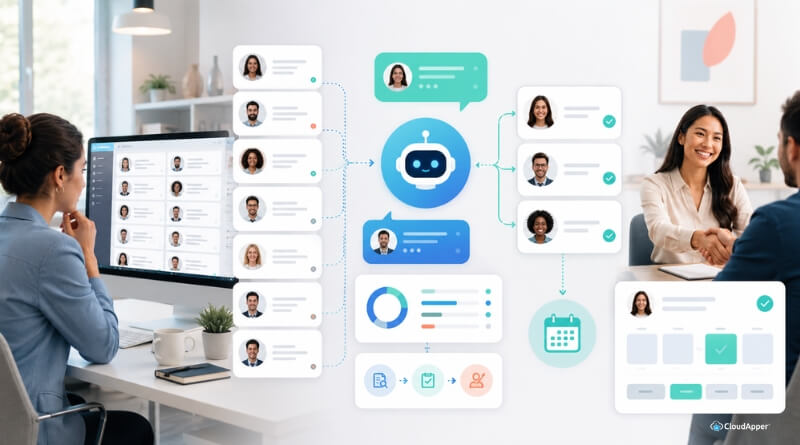
A screening score and what actually happens in the interview rarely talk to each other. This article looks at why that screening score feedback loop stays broken by default, and how AI Recruiter lets recruiters recalibrate criteria from real interview outcomes.

TL;DR
A candidate's screening score and what an interviewer actually learns about them almost never connect back to the screening model. That means a systematic ranking problem can run unnoticed for months. CloudApper AI Recruiter lets recruiters adjust screening criteria, knockout questions, and scoring weights directly from interview patterns, closing the screening score feedback loop instead of leaving the original setup untouched.
Table of Contents
- Why screening scores and interview outcomes drift apart
- What gets lost when interview feedback never reaches the screening model
- Recalibrating screening criteria from what recruiters see in interviews
- Turning interview outcomes into scoring and knockout-question adjustments
A candidate gets a screening score, moves to an interview, and whatever the interviewer actually learns about them, good or bad, mostly stays in their head or gets jotted in a private note. It never makes its way back into what generated that score in the first place. So if your screening is quietly over-ranking or under-ranking a certain type of candidate, nothing catches it, because the screening score feedback loop between what a score predicted and what the interview actually showed never closes. Closing that loop is exactly what CloudApper AI Recruiter is built to do.
Why screening scores and interview outcomes drift apart
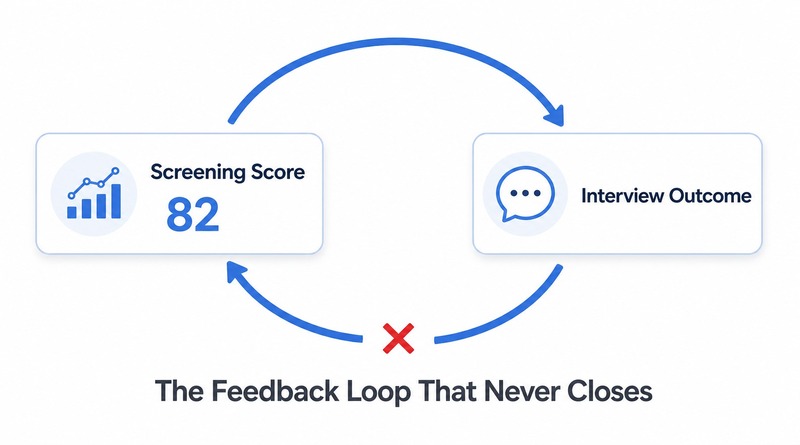
A screening model runs once, early, before anyone talks to the candidate. The interview happens later, with a different person in the room, working from a different set of impressions. Nothing structural connects the two. The recruiter who ran the screening rarely sits in on the interview, and the interviewer rarely sees the score breakdown, so there’s no natural point where anyone checks one against the other.

This isn’t about interviewers disagreeing with each other or needing to calibrate their judgment in a live session. It’s simpler and easier to miss than that. The score never gets checked against what actually happened at all, and a screening rubric built for skills-based hiring is only as good as the last time someone confirmed it still matches reality.
What gets lost when interview feedback never reaches the screening model
When that check never happens, a screening question or scoring weight that isn’t actually predictive of interview success keeps running unchanged, month after month. At your hiring volume, that means the same accuracy problem repeats itself across hundreds of requisitions, quietly under-ranking or over-ranking a type of candidate, with nothing in the process built to surface the pattern.
That’s a different failure than a ranking algorithm’s mechanics being wrong on paper. The ranking can be working exactly as configured and still lose candidate ranking accuracy over time, because nobody built a way for what actually happens in interviews to talk back to it.
Recalibrating screening criteria from what recruiters see in interviews
CloudApper AI Recruiter closes that loop by letting recruiters go back into the screening setup and adjust criteria based on what they’re actually seeing downstream. If interviewers keep flagging that a scored-high candidate is missing something the rubric never weighted, or that a scored-low candidate interviews well every time, that pattern becomes something a recruiter can act on directly instead of a comment that fades in a Slack thread.
That’s different from balancing AI and human judgment as a general philosophy. It’s a specific, ongoing configuration change that keeps the screening score feedback loop closed instead of relying on recruiters quietly overriding a score they no longer trust while the underlying rubric stays frozen.
Turning interview outcomes into scoring and knockout-question adjustments
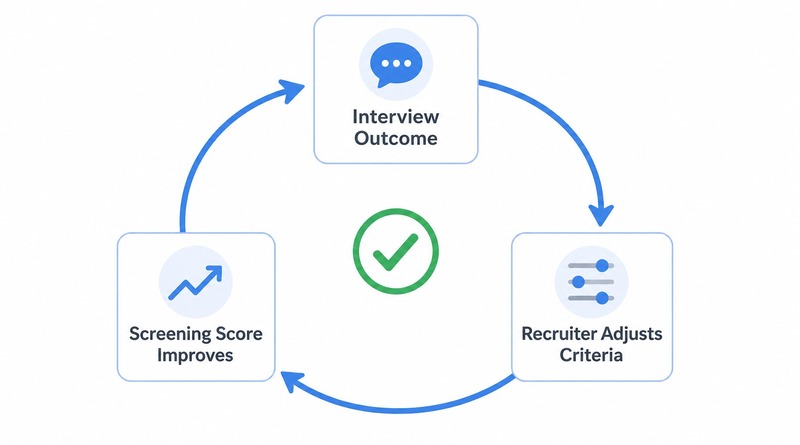
Every knockout question, scoring weight, and threshold in the AI Recruitment Platform is something a recruiter configures directly, requisition by requisition, not a fixed setting only IT can touch. If a knockout question is disqualifying candidates who go on to interview well anyway, a recruiter opens that requisition’s screening setup and loosens or removes it. If a scoring weight is undervaluing a skill that keeps showing up as the actual differentiator in interviews, that weight gets increased the same way, no ticket, no vendor change request. None of it requires rebuilding the setup from scratch, and a different requisition can be configured completely differently the moment its hiring pattern calls for it.
Recruiters aren’t guessing at this from memory either. Recruiting analytics and funnel data surface where a requisition’s advance-to-hire pattern looks off, which is usually the first sign that a criterion needs adjusting.
Making screening accuracy something you can actually see improve
None of this is about getting the screening setup perfect on day one. It’s about building a system where interview outcomes actually inform what the score rewards, so your screening score feedback loop stays closed instead of freezing at whatever the original setup happened to get right. Watching this play out over time, through recruiting metrics you don’t have to wait on a BI team for, is what candidate ranking accuracy improving on purpose actually looks like, not a one-time tuning exercise, but criteria that keep adjusting to what’s actually predictive. That’s the ongoing job CloudApper AI Recruiter is built to support.
Want to see how this would work against your own screening setup? Contact us and we’ll walk through it with you.
Frequently Asked Questions
Why Doesn’t a Screening Score Automatically Reflect Interview Outcomes?
Because nothing structural connects the two steps. The screening model runs before the interview happens, a different person usually conducts the interview, and there’s no built-in checkpoint where anyone compares the score against what actually got learned about the candidate.
Does Adjusting Screening Criteria Require Technical Setup?
No. Recruiters can update scoring weights and knockout questions directly in the screening configuration for a requisition, without needing a developer or a rebuild of the rubric from scratch.
Is This Just About Trusting Recruiter Instinct Over the Score?
Not exactly. It’s about feeding what recruiters and interviewers are actually observing back into the criteria that produced the score in the first place, so the score itself gets more accurate instead of being quietly overridden case by case.

What is CloudApper AI Platform?
CloudApper AI is an advanced platform that enables organizations to integrate AI into their existing enterprise systems effortlessly, without the need for technical expertise, costly development, or upgrading the underlying infrastructure. By transforming legacy systems into AI-capable solutions, CloudApper allows companies to harness the power of Generative AI quickly and efficiently. This approach has been successfully implemented with leading systems like UKG, Workday, Oracle, Paradox, Amazon AWS Bedrock and can be applied across various industries, helping businesses enhance productivity, automate processes, and gain deeper insights without the usual complexities. With CloudApper AI, you can start experiencing the transformative benefits of AI today. Learn More
- Useful Links:
- Agentic AI
- No-Code/Low-Code
- Custom Software
- HCM Personalization
- iPaaS
- FedRAMP
CloudApper AI Solutions for HR

- Works with







- and more.
Similar Posts

How to Stop Screening Rules From Auto-Rejecting Candidates With Employment…

The Hidden Cost of Duplicate Candidate Records Across Your Hiring…