Duplicate candidate records happen when one person applies through several channels and your ATS treats each submission as a new candidate. This quietly inflates your hiring metrics and buries strong applicants under lower scores. CloudApper AI Recruiter merges them automatically.

Table of Contents
- TL;DR
- Where These Duplicate Candidate Records Actually Come From
- What Duplicate Candidate Records Cost You
- How CloudApper AI Recruiter Helps
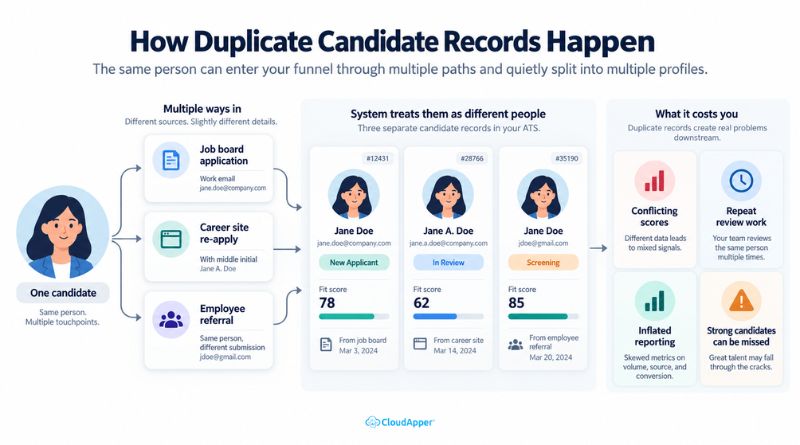
A candidate applies through a job board, then applies again on your career site a week later because they weren’t sure the first one went through, and then a current employee refers them for good measure. Now you’ve got three records for the same person, three different scores, and nothing telling you they’re actually the same candidate. This is probably the most common scenario you’ve faced during the last couple of years. These duplicate candidate records rarely show up as one big, obvious failure. They just sit there quietly, chipping away at how accurate your hiring process really is, one application at a time. It’s part of why CloudApper AI Recruiter was built to catch this kind of mess before it spreads through your pipeline.
TL;DR
- Duplicate candidate records form when one person applies through multiple channels, and the ATS treats each version as a separate candidate.
- Each duplicate gets its own screening score, so a strong candidate can get buried under a weaker duplicate.
- Duplicates inflate application counts, time-to-hire, and source-of-hire numbers, skewing recruiting reports.
- CloudApper AI Recruiter matches new applications against existing candidate records and merges duplicates automatically.
- It works on top of your current ATS or HCM platform, including iCIMS, Lever, Greenhouse, Dayforce, and Workday, with no data migration required.
Where These Duplicate Candidate Records Actually Come From
Most ATS platforms only recognize two applications as coming from the same person if the name, email, and phone number match exactly. But candidates rarely fill out every form the same way twice. Maybe they used a work email the first time and a personal one the second. Maybe they added a middle initial once and dropped it the next. That’s all it takes for your system to treat one person as two, or three, separate candidates. Add in job board reposts, transfers between openings, and referral submissions, and duplicate candidate records pile up faster than most recruiters ever notice.

What Duplicate Candidate Records Cost You
Once duplicate candidate records exist, each is screened and scored on its own, with no knowledge of the others. A strong candidate might score well on one application and poorly on another, simply because the two resumes weren’t formatted quite the same. The recruiter who opens the lower-scoring version has no way of knowing that a better one is sitting elsewhere in the system. You end up reviewing the same person two or three times, burning hours you don’t have during high-volume hiring. Your reporting takes a hit, too. Application counts, time-to-hire, and source-of-hire numbers all get inflated when a single candidate counts as three, making it a lot harder to tell what’s actually working in your funnel. For roles pulling in hundreds of applicants a week, that adds up fast and quietly skews the decisions you’re making off that data.
How CloudApper AI Recruiter Helps
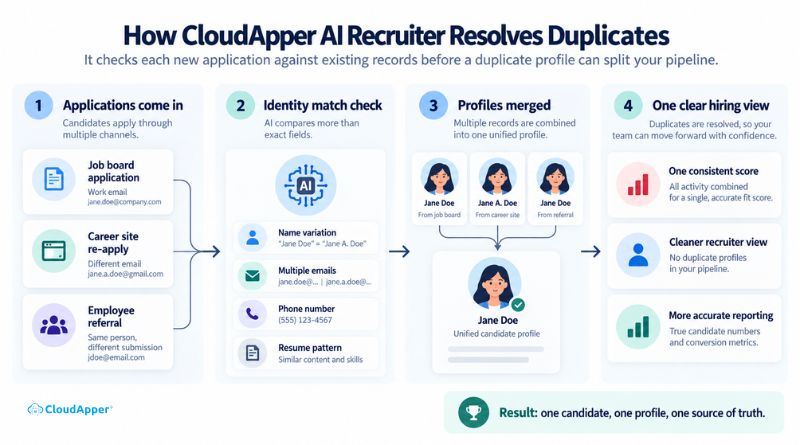
CloudApper AI Recruiter sits on top of whatever ATS or HCM platform you already use, whether that’s iCIMS, Lever, Greenhouse, Dayforce, or Workday. You don’t have to migrate anything or rebuild your candidate database to fix this. CloudApper AI Recruiter can be customized to work in the background and catch duplicate candidate records as they come in, before they can split into separate profiles competing for a recruiter’s attention.
How It Works Day to Day
Every new application gets checked against your existing candidate records first, not just on exact name and email matches, but on the broader pattern of who this person is. When it finds a match, the new submission is folded into that person’s existing profile instead of creating a new one. A candidate who applies through three different channels still ends up with one consistent score, not three conflicting ones. Recruiters see a single clean profile per person, and your reporting reflects how many people actually applied, not how many times someone clicked submit.
The Bottom Line
Duplicate candidate records are easy to miss because nothing about them looks broken on the surface. Your ATS still runs fine. Your recruiters are still screening candidates every day. It’s usually only when you dig into the numbers, or find out a strong candidate nearly got passed over because their duplicate scored low, that the real cost becomes obvious. Fixing this isn’t about ripping out systems you already trust. It’s about making sure the data feeding into them is accurate before it ever lands on a recruiter’s desk.
Contact us today to get a personalized demo of CloudApper AI Recruiter.

What is CloudApper AI Platform?
CloudApper AI is an advanced platform that enables organizations to integrate AI into their existing enterprise systems effortlessly, without the need for technical expertise, costly development, or upgrading the underlying infrastructure. By transforming legacy systems into AI-capable solutions, CloudApper allows companies to harness the power of Generative AI quickly and efficiently. This approach has been successfully implemented with leading systems like UKG, Workday, Oracle, Paradox, Amazon AWS Bedrock and can be applied across various industries, helping businesses enhance productivity, automate processes, and gain deeper insights without the usual complexities. With CloudApper AI, you can start experiencing the transformative benefits of AI today. Learn More
- Useful Links:
- Agentic AI
- No-Code/Low-Code
- Custom Software
- HCM Personalization
- iPaaS
- FedRAMP
CloudApper AI Solutions for HR

- Works with








- and more.
Similar Posts

Hiring During ATS Migration: How to Keep Your First Round…

Hiring Freeze? How to Keep Qualified Candidates Engaged Until the…