Workday handles multi-state payroll tax jurisdiction assignment and reciprocity well, but mobile and field workforces expose gaps in local tax tracking and SUI allocation that native configuration alone can't close. Here's where those limits show up and how to close them.
TL;DR
Workday manages payroll tax jurisdiction assignment, statutory tax tables, and standard state reciprocity well, but it wasn't built to track daily work-location changes for mobile, field-based, or multi-site hourly workforces. This creates real exposure around local tax jurisdictions, reciprocity edge cases, and state unemployment insurance allocation, since Workday's Work Location field is static rather than dynamic. Payroll and HRIS teams should first audit tax election overrides and reciprocity configuration inside the tenant, since much of this is fixable with existing tools. For organizations whose workforce genuinely crosses state lines as part of the job, CloudApper iPaaS closes the remaining gap by feeding real-time location data into Workday so tax jurisdiction stays accurate without replacing Workday's payroll engine.
Table of Contents
- What Workday Handles Natively
- Where the Friction Shows Up
- What to Configure Within Workday First
- Where Native Tools Run Out
Payroll tax follows where an employee actually works, not where the HR record says they live, and that mismatch causes the multi-state payroll tax compliance problems in Workday that are hardest to catch. The cases are familiar: a warehouse worker splitting the week between Ohio and Kentucky, a New Jersey technician working in New York, a remote employee who moved from Texas to California mid-year without updating tax elections. Most surface only when a jurisdiction sends a notice.

Workday’s payroll tax engine is strong at what it was built to do. CloudApper sits alongside Workday to close the specific gaps that appear when tax depends on real-time worker location rather than a static address.
What Workday Handles Natively
Workday Payroll (and, for organizations running third-party payroll, Workday’s payroll integration layer) manages jurisdiction assignment through the worker’s Tax Elections, Work Location, and Home Address data. When you hire someone in a new state, Workday can automatically register the applicable state and local tax jurisdictions based on the position’s Location object, and it maintains statutory tax tables that are updated as rates and brackets change.
Workday also handles the standard case of state reciprocity reasonably well. If a worker lives in Pennsylvania and works in New Jersey — two states with a reciprocal agreement — Workday’s tax election configuration can route withholding to the state of residence instead of double-withholding, provided the reciprocity agreement and the worker’s election are both configured correctly in the tenant.
For single-state or low-complexity multi-state employers, this native configuration is often sufficient. The friction shows up as organizations scale across more jurisdictions, add hybrid or field-based roles, or acquire entities that bring their own state footprint into the tenant.

Where the Friction Shows Up
The first failure mode is the gap between Work Location and actual work location. Workday’s tax jurisdiction logic is built around the assigned position’s Location object — a fixed record. It was not designed to track where an hourly or field employee physically worked on a given day. A construction crew that moves between job sites in different states, a home health aide covering counties across a state line, or a retail employee picking up a shift at a sister location in another state all generate tax obligations that Workday’s static Location field doesn’t capture without manual intervention.
The second is reciprocity and non-reciprocity edge cases. Not every state pair has a reciprocal agreement, and the ones that exist come with conditions — some require an annually filed exemption certificate, some apply only to wage income and not to bonuses or equity compensation, and a few states, as multi-entity organizations often discover, don’t recognize reciprocity at all regardless of where the neighboring state stands. Workday can hold the configuration, but someone has to know which rule applies to which worker, and that knowledge tends to live in a payroll specialist’s head rather than in the tenant.
The third is local tax jurisdictions below the state level — city earnings taxes in Ohio and Pennsylvania, occupational privilege taxes in parts of Colorado, and school district taxes in several states. These are numerous, change more often than state-level rates, and are easy to miss when a worker moves between two cities in the same state.
The fourth is state unemployment insurance (SUI) allocation for employees who split time across states in a given quarter. SUI is typically owed to the state where the employee primarily performs services, determined by a four-factor test (localization of services, base of operations, direction and control, and residence) that Workday does not evaluate automatically. Getting this wrong doesn’t just create a tax discrepancy — it can affect unemployment claims and experience rating in the wrong state.
What to Configure Within Workday First
Before treating any of this as an integration gap, there’s real work to do inside the tenant. Confirm that Work Location objects are correctly assigned at the position level, not just the worker level, since Workday’s tax jurisdiction logic follows the position’s location record. Audit tax election overrides for any workers already flagged as multi-state, since manual overrides drift out of sync when a worker’s schedule changes and nobody remembers to update the record.
Review which reciprocity agreements are configured as active in the tenant and confirm they match current state law — states periodically renegotiate or terminate these agreements, and a tenant configured five years ago may be running on stale assumptions. Workday’s standard payroll tax reports, when run quarterly rather than only at year-end, will surface most jurisdiction mismatches before they compound into a W-2 correction problem. This maintenance work resolves a meaningful share of multi-state tax issues without touching anything outside the tenant.
Where Native Tools Run Out
The limit shows up specifically for organizations whose workforce moves across state lines as part of the job, rather than organizations with employees who simply live in one state and work from a home office in another. Workday was not built to ingest daily or weekly location data from a mobile or multi-site workforce and translate that into per-pay-period tax jurisdiction splits. It expects a worker’s tax jurisdiction to be relatively stable, updated through an HR transaction when it changes — not recalculated dynamically based on where someone clocked in that day.
This is also where SUI allocation becomes a real operational burden rather than a configuration exercise, because the four-factor test requires data — where hours were actually worked, in what proportion, over what period — that Workday’s payroll module doesn’t natively track at the granularity needed to defend an allocation decision if a state challenges it.
Where CloudApper iPaaS Fits
CloudApper iPaaS addresses this specific gap: capturing real-time work location data from time clock or kiosk check-ins — the same data organizations often already collect through a frontline self-service kiosk — and feeding it into Workday as structured jurisdiction data rather than a static field.
For a construction or field-service organization, this means each worker’s actual daily work location, captured at clock-in, gets mapped to the correct state and local tax jurisdiction and synced to Workday before payroll processes, instead of relying on a static Location assignment that hasn’t been updated since the worker’s last transfer. For SUI allocation specifically, iPaaS can aggregate the hours-by-state data needed to support the four-factor test and produce a defensible allocation record, rather than leaving that reconstruction work to a payroll analyst during an audit.
This isn’t a payroll tax engine that competes with Workday’s — Workday remains the system of record for tax calculation and remittance. iPaaS closes the upstream data gap: making sure Workday has accurate, current jurisdiction data to calculate against, especially for workers whose location changes more often than an HR transaction typically captures. Organizations that have already gone through connecting Workday to a third-party payroll system are usually the ones that find this gap first, since the jurisdiction mismatch surfaces the moment payroll data crosses into a system with less tolerance for stale location fields.

Frequently Asked Questions
Q: Does Workday automatically calculate multi-state payroll taxes?
Workday calculates payroll tax based on the tax jurisdictions assigned to a worker’s Tax Elections and Work Location records. It applies statutory rates and reciprocity rules correctly once those records are accurate, but it does not automatically detect that a worker’s actual work state has changed unless an HR transaction updates the record.
Q: How does Workday handle state reciprocity agreements?
Workday supports reciprocity through tax election configuration, allowing withholding to route to the state of residence when a valid agreement exists between the work state and home state. The agreement and any required exemption certificate must be configured correctly in the tenant, and not every state pair has reciprocity.
Q: What is the four-factor test for state unemployment insurance, and does Workday apply it?
The four-factor test — localization of services, base of operations, direction and control, and place of residence — determines which state is owed SUI for an employee working across multiple states. Workday does not automatically evaluate this test; it requires manual analysis or an external process to determine the correct state.
Q: How often should multi-state tax configuration be audited in Workday?
Quarterly reviews of payroll tax reports catch jurisdiction mismatches before they accumulate into year-end W-2 correction problems. Annual-only reviews tend to surface issues after several pay periods have already processed incorrectly.
Q: Can Workday track daily work location for mobile or field employees?
Native Workday does not track daily work location changes at the granularity needed for tax jurisdiction purposes. It relies on the position’s assigned Work Location, which is a relatively static field updated through HR transactions rather than daily activity.
Q: What happens if an employee’s tax jurisdiction is wrong in Workday for several pay periods?
Incorrect withholding accumulates until caught, typically requiring W-2 corrections (W-2c), amended state filings, and potentially penalties for underpayment to the correct jurisdiction and refund processing from the incorrect one. Catching the mismatch through quarterly reporting significantly reduces the scope of correction needed.
Q: Is multi-state tax compliance different for union versus non-union workforces in Workday?
Union agreements can add jurisdiction-specific pay code and premium rules on top of standard multi-state tax withholding, but the underlying tax jurisdiction determination process in Workday works the same way regardless of union status.
If your organization is running into jurisdiction mismatches that Workday’s native configuration isn’t catching, get in touch with CloudApper to walk through how iPaaS can close the location-data gap feeding your Workday payroll tax calculations.

What is CloudApper AI Platform?
CloudApper AI is an advanced platform that enables organizations to integrate AI into their existing enterprise systems effortlessly, without the need for technical expertise, costly development, or upgrading the underlying infrastructure. By transforming legacy systems into AI-capable solutions, CloudApper allows companies to harness the power of Generative AI quickly and efficiently. This approach has been successfully implemented with leading systems like UKG, Workday, Oracle, Paradox, Amazon AWS Bedrock and can be applied across various industries, helping businesses enhance productivity, automate processes, and gain deeper insights without the usual complexities. With CloudApper AI, you can start experiencing the transformative benefits of AI today. Learn More
- Useful Links:
- Agentic AI
- No-Code/Low-Code
- Custom Software
- HCM Personalization
- iPaaS
- FedRAMP
Brochure
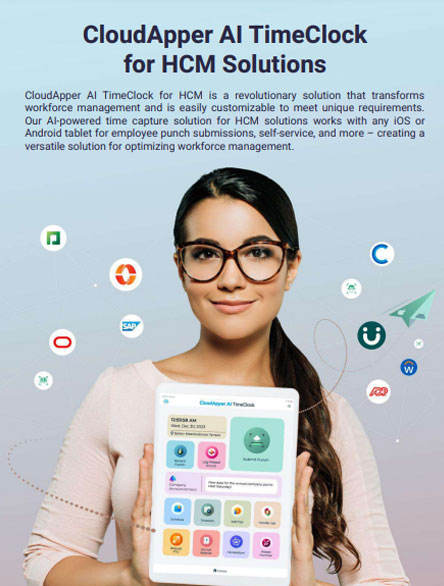
CloudApper AI TimeClock
For accurate & touchless time capture experience.
Download Brochure
CloudApper AI Solutions for Workday


- Works with








- and more.
Similar Posts

Workday Payroll Without Workday Time Tracking: How to Get Hourly…

Moving Acquired Employees into Workday: Service Dates, Year-to-Date Wages, and…