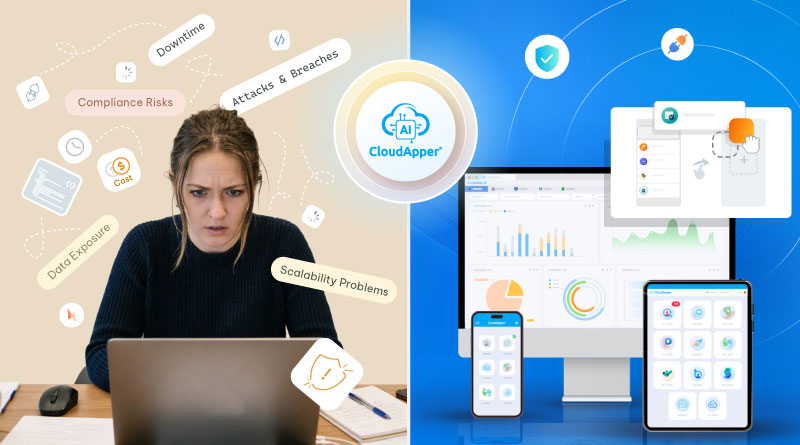
Hiring against a 40-project backlog has never worked, and AI coding assistants only move the cost - roughly 45% of AI-generated code ships with vulnerabilities your team then owns. Here is how enterprises scale software development without hiring, by changing what an application costs to deliver, secure, and maintain.

TL;DR
You cannot scale software development without hiring by pushing the existing team harder, and AI coding assistants only move the cost - Veracode found roughly 45% of AI-generated code introduces security vulnerabilities your team then owns. The alternative is changing what a single application costs to deliver: applications that run on a governed, certified platform runtime, with no new source code to secure, audit, or maintain.
Table of Contents
- Why the IT Backlog Keeps Growing Faster Than the Team
- Why the Usual Answers Don’t Scale
- How to Scale Software Development Without Hiring: The Model That Actually Works
- What Happens to the Engineering Team
Every IT leader has run the same math. The backlog is 40 projects deep. The team can deliver six a year. So the request goes up the chain: we need to hire. Then the hiring math comes back — nine months to fill a senior role, three months to onboard, a real chance they leave inside two years — and the backlog grows faster than the team ever will. Which is why more enterprises are asking a different question: how do you scale software development without hiring at all?
The answer is not working the existing team harder, and it is not pointing an AI coding assistant at the queue. It is changing what a single application costs to deliver, secure, and maintain.
Why the IT Backlog Keeps Growing Faster Than the Team
Two things changed at once.
The first is demand. Every function in the enterprise now needs software of its own — a portal for one business unit, a workflow the ERP never supported, a compliance process the system of record only half covers. These are not vanity projects. They are the difference between a department that operates efficiently and one that runs on spreadsheets and goodwill.

The second is that the legacy estate underneath keeps getting more expensive to hold still. U.S. organizations are carrying an estimated $1.52 trillion in accumulated technical debt from outdated software, according to CISQ’s Cost of Poor Software Quality report. And in some sectors, keeping legacy systems running consumes up to 80% of the entire IT budget — leaving almost nothing for the work that would actually move the business forward.
So teams are asked to build more while a growing share of their capacity is spent standing still. Hiring does not fix that ratio. It raises the cost of it.
Why the Usual Answers Don’t Scale
Three approaches dominate, and each one moves the cost rather than removing it.
| Approach | What it adds | What it costs you later |
|---|---|---|
| Hiring engineers | Linear capacity, in 9–12 months | Payroll, onboarding, turnover risk — while demand compounds |
| Outsourcing overflow | Delivery on a fixed project | A codebase nobody on the payroll wrote, maintained forever |
| AI coding assistants | Very fast first drafts | New source code per app: its own vulnerabilities, audits, pipeline, maintenance |
| Governed AI platform | Applications, not source code | Nothing to secure, audit, or maintain per app |
Hiring your way out. Even successful hiring adds capacity linearly while demand compounds. And the internal developer shortage is structural — for organizations still running older systems, finding people who can maintain what they already have is often harder than finding people to build something new.
Outsourcing the overflow. Contractors deliver code and leave. What stays behind is a codebase nobody on the payroll wrote, with its own conventions, its own dependencies, and its own maintenance bill arriving quarterly forever.
Pointing raw AI coding tools at the problem. This is the newest answer and the most seductive, because the demos are genuinely impressive. Something that looks finished appears in an afternoon.
The trouble starts after the demo. Veracode’s 2025 GenAI Code Security Report found that roughly 45% of AI-generated code introduced security vulnerabilities across the development tasks it tested. Every application generated this way arrives with its own logic, its own data access rules, and its own security gaps — then needs its own review, its own audit, its own deployment pipeline, and its own maintenance forever. Ship twelve of them and you have not scaled delivery. You have created twelve new liabilities your team now owns.
Fast to create. Expensive to trust. That is the trade most enterprises using AI this way have quietly accepted.
How to Scale Software Development Without Hiring: The Model That Actually Works
The organizations getting this right made a different decision. Instead of generating more code faster, they stopped treating source code as the output at all.
That is the architectural shift behind the CloudApper AI platform: AI describes what the application needs to do, and the platform runs it on a hardened, certified runtime that is already governed, already integrated, already compliant. There is nothing new to review, secure, audit, or maintain — because there is no new codebase.
What that changes in practice:
- Security by design, not security review. Applications inherit a hardened runtime instead of introducing fresh vulnerabilities. Zero, rather than the 40–45% the industry is seeing.
- Compliance is inherited. FedRAMP, HIPAA, and GDPR posture belongs to the platform, so the number of separate audits per app is zero.
- One data layer, not one database per project. Every application reads and writes through the same governed data fabric — no silos accumulating quietly in the corners of the estate.
- Zero DevOps burden. No infrastructure to provision per app, no per-deploy operations cost, no endless update cycles. The platform updates; the applications come along.
- No lock-in. Applications move across any cloud, run on-premise, and work on any device — so today’s infrastructure decision does not become tomorrow’s migration project.
This is the part that makes the headcount question disappear rather than merely soften. When the marginal cost of an application drops toward zero — no audit, no pipeline, no maintenance tail — capacity stops being a function of how many people the team has and starts being a function of how clearly it can describe what the business needs. More than 500 enterprises now ship on this model.
What Happens to the Engineering Team
There is a version of this story that sounds like engineers being replaced. That is not what organizations report after making the shift.
What actually happens is that the work engineers were hired to do finally becomes the work they spend their time on. The maintenance tax comes off the top. The queue of “can you build us a small thing” requests stops landing on a team with no room for it. Architecture, integration strategy, and the genuinely hard problems get the attention they always deserved.
And the business units stop waiting. The gap between someone identifying a problem and someone solving it collapses from quarters to weeks — which changes not just IT’s throughput but the organization’s willingness to try things at all. Teams that expect to wait nine months stop asking. Teams that expect an answer in weeks start bringing their best ideas forward.
The people downstream feel it too, even if they never hear the platform’s name. Patients whose provider responds faster. Students whose district runs without friction. Citizens whose agency answers the first time. Every hour reclaimed from maintaining software is an hour spent on the mission the software was bought to serve.
The Choice in Front of Enterprise IT
The next few years will separate two kinds of organizations.
The first will keep treating capacity as a headcount line item — hiring against a backlog that grows faster than any hiring plan, spending the majority of the budget maintaining what already exists, and accumulating risk with every AI-generated shortcut taken under deadline pressure.
The second will change what a unit of delivery costs. They will scale output without scaling payroll, and without trading governance for speed. Not because they found better engineers, but because they stopped asking their engineers to hand-build and hand-maintain everything the business asks for.
CloudApper is the AI platform that closes the gaps enterprise software leaves behind — across HR, ERP, CRM, and any system of record, on any cloud, in weeks not quarters. Because the organizations that move fastest are not the ones with the biggest budgets or the best vendors. They are the ones that stopped waiting for permission to close the gap.
Talk to an expert about what your team could deliver next quarter without adding a single role.
Frequently Asked Questions
Can you really scale software development without hiring developers?
Yes — but only by changing what delivery costs, not by working the existing team harder. When applications run on a governed platform runtime instead of arriving as new source code, the security review, audit, deployment, and maintenance work that normally scales with every project largely disappears. Capacity stops being a function of headcount.
How is this different from using AI coding assistants?
AI coding assistants produce source code that your team then owns — including its vulnerabilities, its data access patterns, and its maintenance burden. Veracode’s 2025 research found roughly 45% of AI-generated code introduced security vulnerabilities. CloudApper’s architecture produces applications that run on a hardened, certified runtime instead, so there is no new codebase to secure, audit, or maintain.
How much faster is delivery on a governed AI platform?
The meaningful change is not the build step — it is everything after it. Because applications inherit security, compliance, integration, and infrastructure from the platform, the review and deployment work that usually stretches a project across quarters is removed. Enterprises typically describe delivery timelines in weeks rather than quarters.
Does this work for regulated industries?
Compliance posture is inherited from the platform rather than rebuilt per application, which is what makes the model workable in regulated environments. The platform is built for FedRAMP, HIPAA, and GDPR requirements, so individual applications do not each require their own compliance review.
What happens to our existing legacy systems?
They do not have to be thrown away. The platform is designed to modernize what already exists — preserving the data, the business logic, and the institutional knowledge inside those systems while replacing the parts that cannot scale, integrate, or be maintained.
What is CloudApper AI Platform?
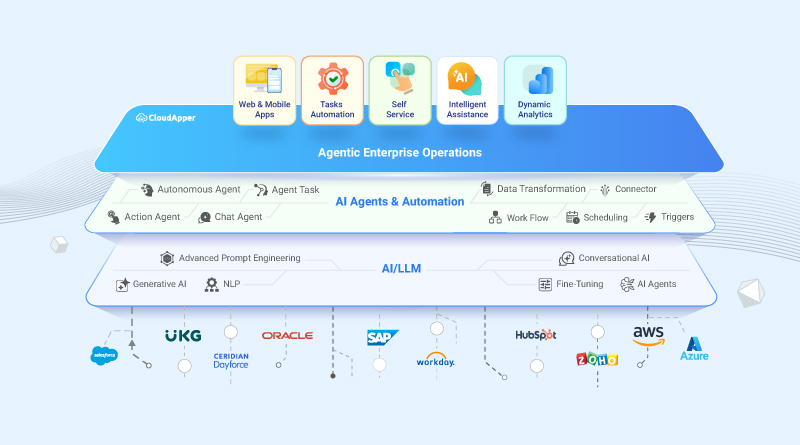
CloudApper AI is an advanced platform that enables organizations to integrate AI into their existing enterprise systems effortlessly, without the need for technical expertise, costly development, or upgrading the underlying infrastructure. By transforming legacy systems into AI-capable solutions, CloudApper allows companies to harness the power of Generative AI quickly and efficiently. This approach has been successfully implemented with leading systems like UKG, Workday, Oracle, Paradox, Amazon AWS Bedrock and can be applied across various industries, helping businesses enhance productivity, automate processes, and gain deeper insights without the usual complexities. With CloudApper AI, you can start experiencing the transformative benefits of AI today. Learn More
- Useful Links:
- Agentic AI
- No-Code/Low-Code
- Custom Software
- HCM Personalization
- iPaaS
- FedRAMP
Brochure
CloudApper hrPad
Empower Frontline Employees with an AI-Powered Tablet/iPad Solution
Download Brochure
CloudApper AI Solutions

- Works with







- and more.
Similar Posts
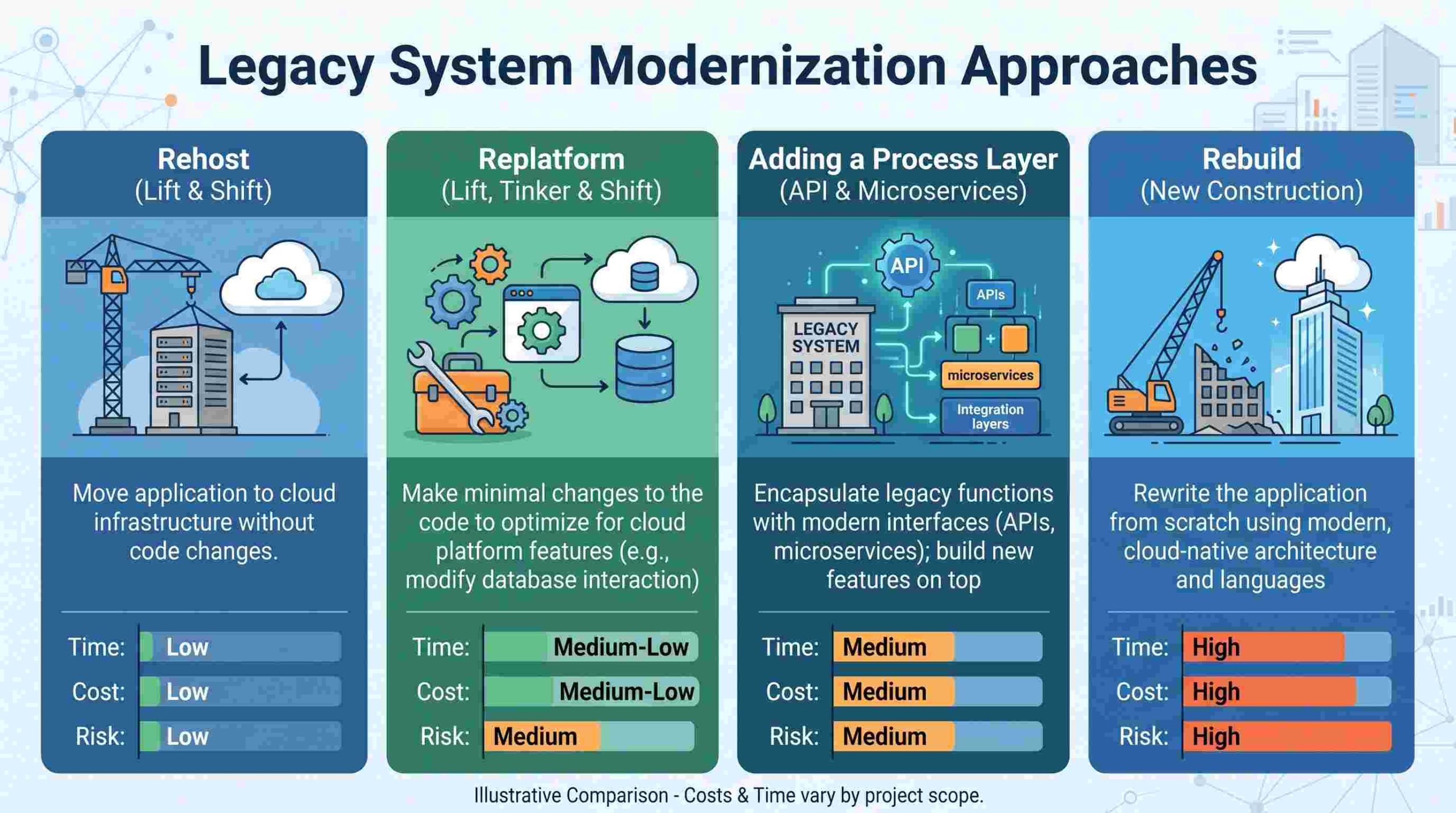
Legacy System Modernization Without a Full Rebuild
![Is Your Workforce Management Ready for AI? [Free 90-Second Assessment]](https://www.cloudapper.ai/wp-content/uploads/2026/07/Is-Your-Workforce-Management-Ready-for-AI.jpg)
Is Your Workforce Management Ready for AI? [Free 90-Second Assessment]