Hiring bias silently costs enterprises top talent and millions in lost productivity. This guide shows how to reduce hiring bias using AI-driven screening, structured interviews, and objective scoring—so candidates are evaluated on skills, not background, at every stage of hiring.

TL;DR
- Reduce hiring bias by fixing every stage: job descriptions, screening, interviews, scoring, AI governance, and funnel tracking.
- Use bias-free job descriptions that focus on skills and outcomes, not coded language or “preference” requirements.
- Implement blind resume screening so early decisions are made on qualifications, not names, schools, or demographics.
- Run structured interviews with standardized questions and rubrics to prevent first-impression and “chemistry” bias.
- Measure results with funnel analytics to spot drop-off patterns and continuously improve fairness over time.
Table of Contents
- Why Bias in Hiring Costs You More Than You Think
- The Complete Framework to Reduce Hiring Bias
- Common Mistakes When Trying to Reduce Hiring Bias
- How CloudApper AI Recruiter Eliminates Both Human and AI Bias from the Hiring Process
- Real Results from Companies That Reduced Hiring Bias
- How to Get Started This Week
- The Bottom Line on Reducing Hiring Bias
- Reference:
You’re reviewing applications for a senior engineering role. Two candidates have nearly identical qualifications. One went to your alma mater. The other didn’t. Without even realizing it, you just lingered three seconds longer on the first resume. That’s bias at work, and it happens thousands of times across your organization every single day.
Some companies are facing lawsuits. Others are watching their diversity initiatives fail despite millions invested. The truth is, traditional hiring processes are packed with bias, even when your team has the best intentions. The solution to this problem is using AI in your recruiting process. It helps you to reduce hiring bias by standardizing each applicant’s resume and scoring them based on their actual skills.
I’ve helped dozens of enterprise teams tackle this problem using AI-powered tools like CloudApper AI Recruiter. The platform screens and scores candidates based purely on skills and fit, removing the human tendency to favor familiar names or backgrounds. But here’s what I’ve learned after working with so many organizations: You need a complete strategy that addresses bias at every stage of hiring. This guide shows you exactly how to reduce hiring bias in your recruitment process, step by step, based on what actually works in the real world.
Why Bias in Hiring Costs You More Than You Think
Let’s talk numbers. When bias creeps into your hiring process, you’re not just risking compliance issues. You’re actively hurting your bottom line.
The Real Cost of Biased Hiring:

Bad hires cost you 30% of first-year earnings on average.[1] For a $100K role, that’s $30,000 down the drain. Multiply that across dozens of positions, and you’re looking at millions in wasted budget.
Your talent pool shrinks dramatically when bias filters out qualified candidates. While your competitors are tapping into diverse talent markets, you’re fishing in the same small pond. The result? Slower time to hire, unfilled positions, and teams that can’t innovate because everyone thinks the same way.
What Actually Causes Hiring Bias:
You probably think bias means someone actively discriminating. That’s rarely the case. Most bias is unconscious. Your brain makes split-second judgments based on patterns it learned over decades. When a recruiter sees a name, a school, or a resume format, their brain instantly categorizes that candidate. It happens before they even read the qualifications.
Here’s where it gets tricky. You hired AI tools to eliminate bias, right? Plot twist: many AI systems actually amplify it. They learn from your historical hiring data. If you’ve been unconsciously favoring certain groups for years, your AI learns to do the same thing. It’s recruitment bias at machine speed.
The interview process adds another layer. Unstructured interviews are basically bias factories. One interviewer asks about problem-solving. Another talks about sports. A third focuses on culture fit, which often means “do I want to grab a beer with this person?” You end up with inconsistent evaluations and decisions based on likability rather than capability.
The Complete Framework to Reduce Hiring Bias
Reducing bias isn’t a one-time fix. It’s a systematic approach that touches every part of your recruiting process. Here’s how to do it right.
Quick Summary:
| Strategy | What It Does | Impact |
| Bias-Free Job Descriptions | Removes coded language and unnecessary requirements | Attracts a more diverse and qualified applicant pool |
| Blind Resume Screening | Hides names, schools, and other identifiers | Ensures candidates are evaluated on skills, not background |
| Structured Interviews | Uses the same role-based questions for every candidate | Reduces subjective judgment and improves hiring consistency |
| Objective Candidate Scoring | Scores candidates against weighted job criteria | Shifts decisions from gut feeling to measurable fit |
| Fairness-Aware AI Screening | Evaluates skills without learning historical bias | Prevents AI from reinforcing past hiring patterns |
| Bias Tracking & Analytics | Monitors candidate movement through each hiring stage | Identifies where bias appears and enables continuous improvement |
Start with Your Job Descriptions
Your bias problem begins before anyone even applies. Job descriptions are loaded with coded language that discourages qualified candidates from applying.
Words like “aggressive,” “rockstar,” or “ninja” skew male. “Nurturing” or “collaborative” can skew female. Even seemingly neutral terms carry weight. “Digital native” discriminates by age. “Culture fit” often means “looks like us.”
What to do instead:
Write job descriptions that focus purely on required skills and outcomes. Replace “5+ years of experience” with specific competencies. Instead of “bachelor’s degree required,” list the actual knowledge needed for the role. Many excellent candidates learned through non-traditional paths.
Use gender-neutral language throughout. Tools can help, but the real fix is questioning every requirement. Does this role truly need a degree? Do they really need to be in the office five days a week? You’ll be surprised how many “requirements” are actually preferences in disguise.
Implement Blind Resume Screening
This is one of the key bias elimination strategies. Names reveal a lot. Gender. Ethnicity. Sometimes age. Studies show identical resumes get different response rates based solely on the name at the top. Marcus gets called for interviews. Jamal doesn’t. Even though they have the exact same qualifications.
Traditional ATS systems still show you everything. Name, photo, college, graduation year. Each detail triggers unconscious associations. Your brain can’t help it. That’s not a moral failing. It’s how human cognition works.
The solution is AI-powered blind screening:
CloudApper AI Recruiter helps reduce hiring bias with standardized resumes by automatically removing identifying information during initial screening. The AI evaluates candidates based purely on skills, experience, and job fit. No names. No photos. No alma mater. Just qualifications that matter for the role.
The system scores each candidate against your job requirements. You get a ranked list of top candidates without any demographic information. Only after candidates pass objective screening do you see full profiles. By then, you’re evaluating people who have already proved they can do the job.
This isn’t about hiding information. It’s about reviewing it in the right order. Skills first. Everything else later.
Use Structured Interviews with Standardized Questions
Here’s what typically happens in interviews. Interviewer A asks about technical skills. Interviewer B focuses on soft skills. Interviewer C just chats about hobbies and sees if there’s chemistry. Then they compare notes and wonder why their assessments are all over the place.
Unstructured interviews are terrible predictors of job success. They’re basically extended first impressions. And first impressions are bias-central.
Switch to structured interviews:
Every candidate for the same role gets asked the same questions in the same order. You’re not being a robot. You’re being fair. The questions should directly relate to job requirements. Ask for specific examples. “Tell me about a time you had to handle conflicting priorities” is better than “How do you handle stress?”
Create a scoring rubric before you start interviewing. Define what a great answer looks like versus an okay answer versus a poor answer. When all interviewers use the same criteria, you can actually compare candidates meaningfully.
CloudApper AI Recruiter helps you build these structured interview frameworks. The platform lets you create custom assessment questions for each role. Whenever a candidate applies for the role, it asks those custom assessment questions and pre-screening knockout questions, so when it’s time for a live interview, you only need to assess the candidate’s soft skills or cultural fit.
Score Candidates with Objective Criteria
Let’s be honest. “Culture fit” is often code for “reminds me of myself.” When you use subjective criteria, bias sneaks in through every crack.
Replace vague assessments with measurable metrics. Instead of “good communicator,” define what that means for this specific role. Can they explain complex technical concepts to non-technical stakeholders? Can they write clear documentation? Can they present to executives?
Build a candidate scorecard:
List every skill and qualification the role requires. Assign each one a weight based on importance. During evaluation, score candidates on each criterion using a consistent scale. Maybe 1-5, where 3 is meets requirements, 4 exceeds them, and 5 is exceptional.
This approach forces you to evaluate candidates on actual job requirements rather than gut feelings. You might discover that your “gut feeling” was actually responding to someone’s confident handshake or prestigious school, not their ability to do the work. This will reduce hiring bias significantly
CloudApper AI Recruiter’s bias-free candidate scoring system does this automatically. The AI evaluates every candidate against your predefined criteria. Each person gets scored on the same dimensions using the same standards. No exceptions. No special cases. Just a fair evaluation.
Remove Bias from Your AI Tools
You bought AI recruiting tools to reduce bias. But did you actually verify they’re not making it worse?
Many AI systems learn from historical hiring data. If your company has historically hired more men for technical roles, the AI learns that men are “better fits” for those positions. It’s not malicious. It’s mathematical. The algorithm optimizes for patterns in past data.
How to ensure your AI isn’t biased:
Audit what data your AI uses for training. If it learned from biased historical decisions, it will replicate that bias. CloudApper AI Recruiter is built on research-backed frameworks specifically designed to minimize algorithmic bias from your recruitment process. The system doesn’t just optimize for past patterns. It evaluates candidates against job requirements using fairness-aware algorithms.
Track and Measure Your Bias Reduction Efforts
You can’t improve what you don’t measure. Most companies say they care about reducing bias, but they don’t actually track whether their efforts work.
Set up bias metrics:
Track demographic data at every stage of your funnel. What percentage of applicants are women? What percentage make it to phone screens? To the final interviews? To offers? If you see drop-off at any stage that doesn’t match your applicant pool, you’ve found where bias is entering your process.
Look at the offer acceptance rates. Are certain groups declining your offers more often? That might indicate bias in how you’re presenting opportunities, negotiating compensation, or conveying company culture during the process.
CloudApper AI Recruiter provides recruiter dashboards with comprehensive analytics. You can see exactly where in your process candidates are succeeding or dropping off. The system tracks metrics by role, department, and location. You get the visibility you need to spot problems and fix them quickly.
See how this bias-reduction framework works inside a real recruiting workflow—without replacing your existing ATS.
Common Mistakes When Trying to Reduce Hiring Bias
Even with good intentions, companies mess this up. Here are the biggest mistakes I see.
Mistake 1: Focusing Only on Unconscious Bias Training
Awareness training alone doesn’t work. Study after study shows that telling people they’re biased doesn’t change their behavior. You need structural changes that make biased decisions harder to make, not just awareness that bias exists.
Mistake 2: Implementing Quotas Instead of Process Changes
Quotas might hit diversity targets, but they don’t fix your broken hiring process. Plus, they create resentment and undermine the credibility of diverse hires. Fix the process so the best candidates naturally bubble up, regardless of background.
Mistake 3: Assuming AI is Automatically Unbiased
AI is trained on data. If your data reflects historical bias, your AI will too. Choose platforms specifically designed with fairness in mind, like CloudApper AI Recruiter.
Mistake 4: Ignoring the Candidate Experience
Your job posting might be bias-free, but what about your careers page? Your interview process? Your follow-up communication? Bias reduction has to extend through the entire candidate journey.
Mistake 5: Treating This as a One-Time Project
Bias doesn’t disappear because you ran a training session or bought a tool. It’s ongoing work. You need continuous monitoring, regular audits, and constant improvement.
How CloudApper AI Recruiter Eliminates Both Human and AI Bias from the Hiring Process
Most AI recruiting tools weren’t built with bias reduction as a core feature. They were built for speed and efficiency. Bias reduction was bolted on later, if at all. CloudApper AI Recruiter is different. The platform was designed from the ground up using research-backed frameworks specifically to minimize both human and algorithmic bias.
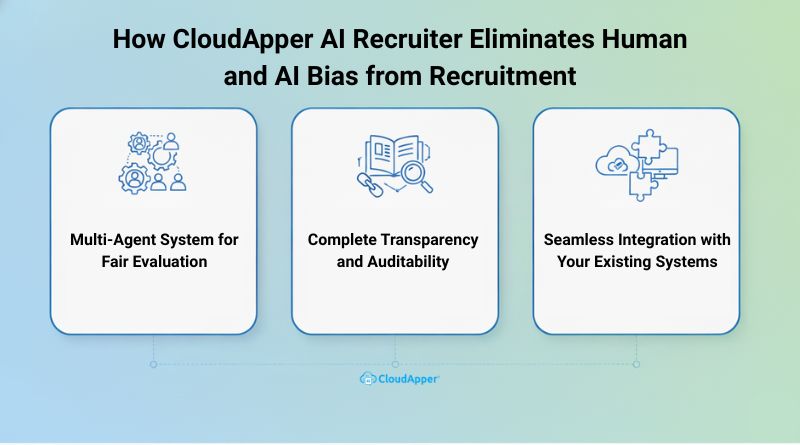
Multi-Agent System for Fair Evaluation
The system uses specialized AI agents that handle different parts of recruiting. The Screening Agent analyzes resumes based purely on skills and job requirements. No demographic information is used in scoring. The Assessment Agent evaluates candidates using standardized questions and criteria you define. Every candidate for a role gets assessed the same way. The Communication Agent handles candidate outreach and updates, ensuring every applicant gets timely responses. The Scheduling Agent coordinates interviews without the back-and-forth that often disadvantages certain candidates.
Complete Transparency and Auditability
All of this runs on fairness-aware algorithms. The AI is regularly audited for disparate impact. The system provides complete transparency; you can see exactly why a candidate was scored a certain way. No black boxes. No mysterious algorithms making unexplained decisions. Your recruiter dashboards show bias metrics automatically. You can track diversity at every stage, compare time-to-hire across groups, and monitor which job sources bring in diverse candidates. All the data you need to continuously improve is right there.
Seamless Integration with Your Existing Systems
The platform integrates with your existing ATS and HRIS, whether that’s UKG, Workday, Bullhorn, Greenhouse, Oracle, or any other major system. You don’t need to replace your tech stack. CloudApper AI Recruiter works alongside it, adding AI-powered bias reduction without disrupting your current workflows. Setup takes days, not months, and your team can start seeing results immediately.
Real Results from Companies That Reduced Hiring Bias
Let’s look at what actually happens when you implement these strategies.
A large healthcare network was drowning in a high volume of applications for nursing and administrative roles. Their recruiting team spent 70% of their time screening resumes, which meant unconscious bias had plenty of opportunities to creep in. They implemented CloudApper AI Recruiter to automatically screen employment history by standardizing all resumes for unbiased evaluation. The AI surfaced top candidates based purely on skills and qualifications, not resume formatting or school prestige. Within a few months, their recruiters went from spending most of their day on screening to focusing on compliance checks and onboarding.
This isn’t an exception. This is what happens when you systematically address & remove bias from the recruitment process instead of just talking about it.
Want to see what unbiased screening and skill-based evaluation would surface in your own candidate pipeline?
How to Get Started This Week
You don’t need to overhaul everything at once. Here’s how to start reducing hiring bias in your organization with CloudApper AI Recruiter.
Step 1: Talk to Our Solution Experts
Schedule a conversation with our team about your specific challenges. We’ll discuss how your recruitment process currently works, what’s causing bottlenecks, and where bias is most likely entering your hiring decisions. Bring your tech stack details too. Whether you’re using UKG, Workday, Bullhorn, Greenhouse, Lever, or any other ATS and HRIS, we’ll map out how CloudApper integrates without disrupting your existing workflows. This isn’t a sales pitch. It’s a real discovery session where we understand your requirements, your volume, your roles, and your pain points.
Step 2: We Build Your Custom Solution
Our solution experts develop your AI recruiting solution using the CloudApper CloudApper AI platform. This happens fast, usually within just a few days. We configure the screening criteria based on your job requirements, set up blind resume evaluation, create structured interview frameworks, and establish objective scoring rubrics. The system gets customized to match how you actually hire, not some generic template. You’ll see exactly how candidates will be evaluated, what data flows where, and how your recruiters will interact with the AI recommendations.
Step 3: Run a Pilot Test
Pick one role that you hire for frequently. Maybe it’s a position where you’ve struggled with bias issues or where you get overwhelmed with applications. Run your next hiring cycle through CloudApper AI Recruiter. See how the AI screens and ranks candidates. Check if the top recommendations actually match what you’re looking for. Gather feedback from your recruiters and hiring managers. This test run lets you identify any adjustments needed before you roll it out company-wide. Most companies discover that AI catches qualified candidates they would have overlooked and flags concerns they would have missed.
Step 4: Go Live Across Your Organization
Once you’re confident the system works for your needs, expand it to all your open roles. Your recruiters get access to unbiased candidate rankings, structured evaluation frameworks, and comprehensive analytics showing exactly where candidates succeed or drop off in your process. You’ll immediately see faster screening, more consistent evaluations, and better quality shortlists. The best part? Your hiring team spends less time on manual resume review and more time on what actually matters: connecting with top talent and making great hires.
The Bottom Line on Reducing Hiring Bias
Hiring bias isn’t a diversity initiative. It’s a business problem that costs you money, talent, and competitive advantage. Every biased decision means you’re not hiring the best person for the job. You’re hiring the person who triggers the fewest unconscious associations.
The good news? Bias is solvable. Not with slogans or one-time training sessions, but with systematic process changes backed by the right technology.
CloudApper AI Recruiter gives you the complete platform to eliminate bias from hiring. The system screens, scores, and ranks candidates based on skills and fit, nothing else. You get better hires faster while building a more diverse, capable team.
Start reducing bias this week. Your next great hire is probably in a resume pile you’re about to overlook because of unconscious bias. Don’t let that happen.
Start reducing hiring bias this week with an AI recruiting solution built to work with your existing systems and processes.
Reference:

What is CloudApper AI Platform?
CloudApper AI is an advanced platform that enables organizations to integrate AI into their existing enterprise systems effortlessly, without the need for technical expertise, costly development, or upgrading the underlying infrastructure. By transforming legacy systems into AI-capable solutions, CloudApper allows companies to harness the power of Generative AI quickly and efficiently. This approach has been successfully implemented with leading systems like UKG, Workday, Oracle, Paradox, Amazon AWS Bedrock and can be applied across various industries, helping businesses enhance productivity, automate processes, and gain deeper insights without the usual complexities. With CloudApper AI, you can start experiencing the transformative benefits of AI today. Learn More
- Useful Links:
- Agentic AI
- No-Code/Low-Code
- Custom Software
- HCM Personalization
- iPaaS
- FedRAMP
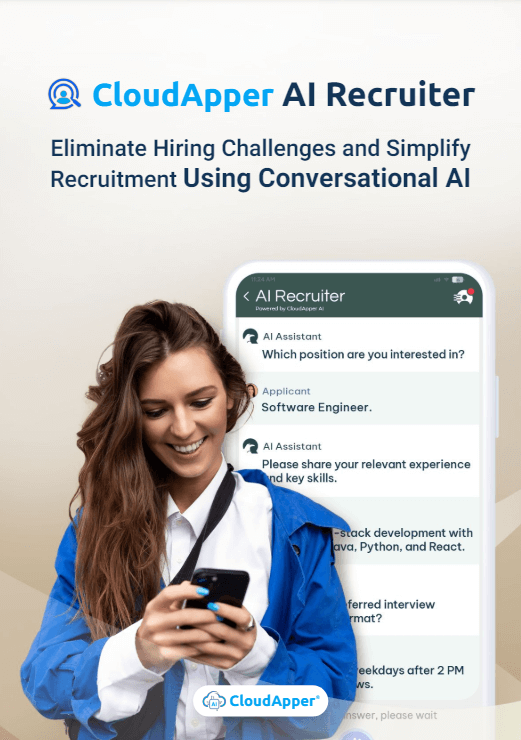
CloudApper AI Solutions for HR

- Works with







- and more.
Similar Posts
Recording Candidate Video Interviews in Illinois: Consent, Retention, and Deletion…

Replace 30-Minute Phone Screens With 10-Minute Video Reviews: The Recruiter…